



1. Background
2. Objectives
3. Methods
3.1. Materials
3.2. Expression and Purification of Protein
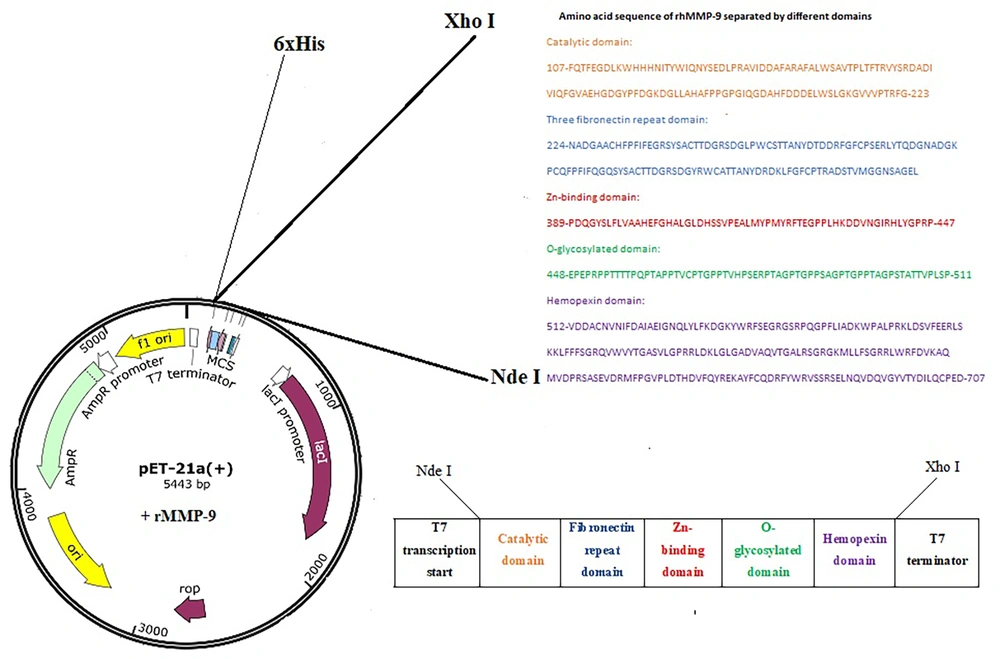
Plasmid system encoding full-length recombinant human matrix metalloproteinase 9 (rhMMP-9) and amino acid sequence of rhMMP-9 divided by domains
3.3. Protease Activity Assay
3.4. Protein Concentration Measurement
3.5. Surface Plasmon Resonance Measurements
3.6. Molecular Docking
4. Results
4.1. Expression and Purification of Recombinant Human Matrix Metalloproteinase 9 from Escherichia coli
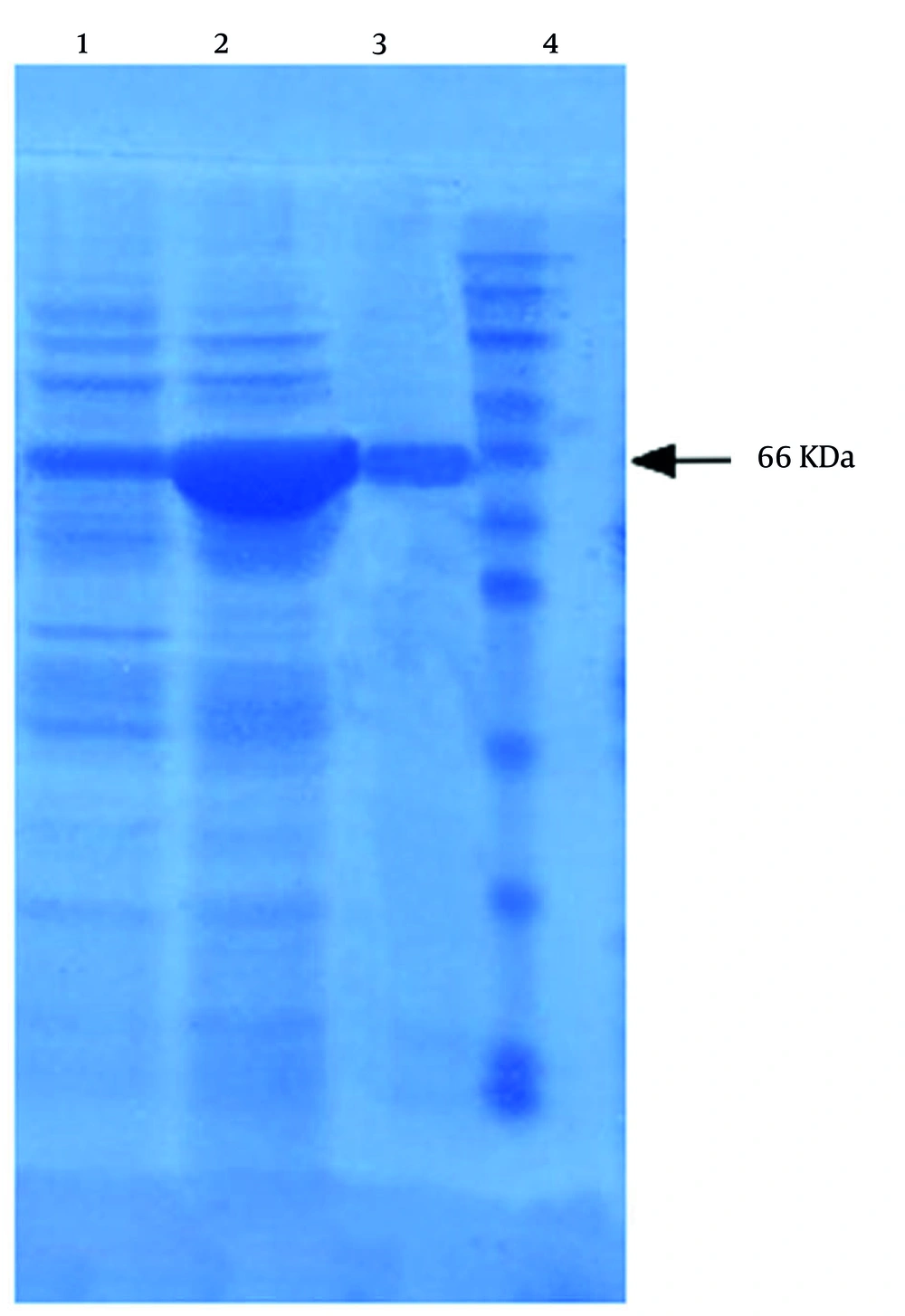
SDS-PAGE analysis of recombinant matrix metalloproteinase 9 (rMMP-9) expression product: Lane 1, before isopropyl-β-D-thiogalactopyranoside (IPTG) induction (2.3 mg/mL); lane 2, after IPTG induction (8.45 mg/mL); lane 3, pure protein [matrix metalloproteinase 9 (MMP-9); lane 4, molecular marker
4.2. Inhibition of Recombinant Human Matrix Metalloproteinase 9 Activity by Ellagic Acid and Its Derivatives
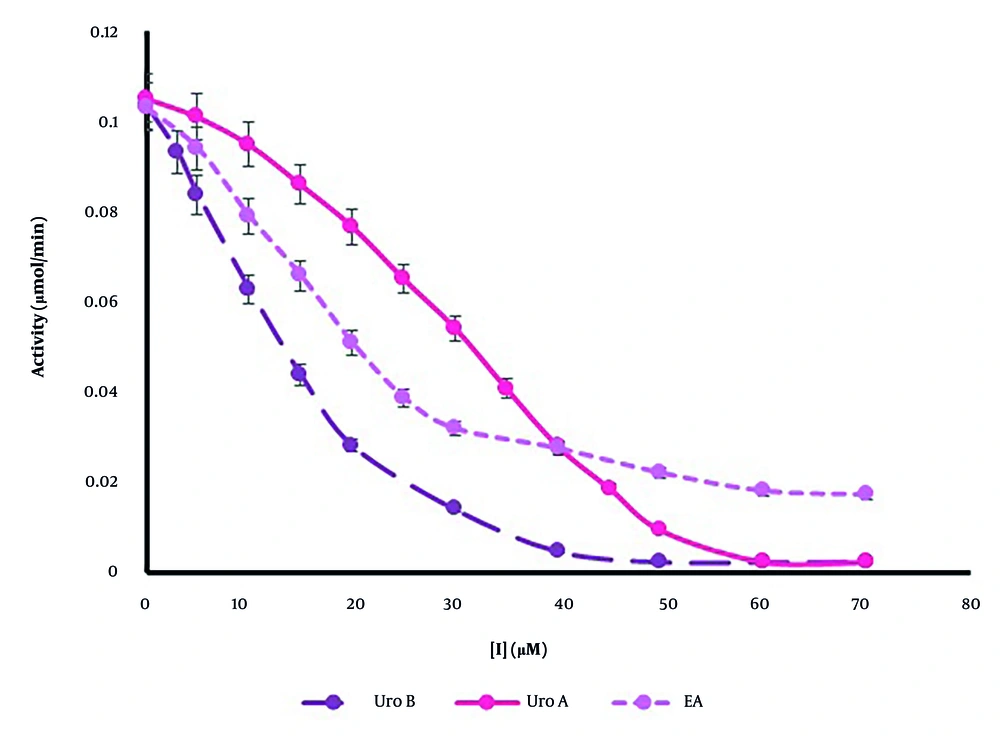
Dose-response curves of recombinant human matrix metalloproteinase 9 (rhMMP-9) activity inhibition at the presence of various concentrations of ellagic acid (EA), urolithin A (Uro A); and urolithin B (Uro B). Data were stated as mean ± SD (n = 6).
4.3. Mixed Inhibition Mechanism of rhMMP-9 Activity by Ellagitannins
![Michaelis-Menten curve [A for urolithin A (Uro A); C for urolithin B (Uro B); E for ellagic acid (EA)] and Lineweaver-Burk plot (B for Uro A; D for Uro B; F for EA) for recombinant human matrix metalloproteinase 9 (rhMMP-9) in the presence of various concentrations of ellagitannins. Values were expressed as mean ± SD (n = 5).](https://brieflands.com/journals/ijpr/articles/148332/figures/ijpr-148332-i004-F4-preview.webp "Michaelis-Menten curve [A for urolithin A (Uro A); C for urolithin B (Uro B); E for ellagic acid (EA)] and Lineweaver-Burk plot (B for Uro A; D for Uro B; F for EA) for recombinant human matrix metalloproteinase 9 (rhMMP-9) in the presence of various concentrations of ellagitannins. Values were expressed as mean ± SD (n = 5).")
Michaelis-Menten curve [A for urolithin A (Uro A); C for urolithin B (Uro B); E for ellagic acid (EA)] and Lineweaver-Burk plot (B for Uro A; D for Uro B; F for EA) for recombinant human matrix metalloproteinase 9 (rhMMP-9) in the presence of various concentrations of ellagitannins. Values were expressed as mean ± SD (n = 5).
| System Parameters and Factors | Uro A (µM) | Uro B (µM) | EA (µM) | ||||||
|---|---|---|---|---|---|---|---|---|---|
| 0 | 5 | 15 | 0 | 5 | 15 | 0 | 15 | 30 | |
| Vmax(µmol/min) | 0.175 ± 0.009 | 0.120 ± 0.006 | 0.04 ± 0.002 | 0.175 ± 0.009 | 0.079 ± 0.004 | 0.033 ± 0.002 | 0.175 ± 0.009 | 0.093 ± 0.005 | 0.078 ± 0.004 |
| Km (%) | 0.036 ± 0.002 | 0.085 ± 0.004 | 0.1 ± 0.005 | 0.036 ± 0.002 | 0.030 ± 0.002 | 0.020 ± 0.001 | 0.036 ± 0.002 | 0.03 ± 0.002 | 0.03 ± 0.002 |
| Ki | 12 | 22.5 | 24.85 | ||||||
| αKi (KI) | 3.03 | 3.02 | 27.57 | ||||||
| α | 0.25 | 0.13 | 1.11 | ||||||
Abbreviations: Uro A, urolithin A; Uro B, urolithin B; EA, ellagic acid.
a Each concentration was repeated 5 times and all data are represented as mean ± SD.
![Secondary plots of 1/Vʹ<sub>max</sub> against [Io] [A for urolithin A (Uro A), B for urolithin B (Uro B), C for ellagic acid (EA)] and secondary plots of the slope of the primary plot against [Io] (D for Uro A, E for Uro B, F for EA). Data were stated as mean ± SD (n = 5).](https://brieflands.com/journals/ijpr/articles/148332/figures/ijpr-148332-i005-F5-preview.webp "Secondary plots of 1/Vʹ<sub>max</sub> against [Io] [A for urolithin A (Uro A), B for urolithin B (Uro B), C for ellagic acid (EA)] and secondary plots of the slope of the primary plot against [Io] (D for Uro A, E for Uro B, F for EA). Data were stated as mean ± SD (n = 5).")
Secondary plots of 1/Vʹmax against [Io] [A for urolithin A (Uro A), B for urolithin B (Uro B), C for ellagic acid (EA)] and secondary plots of the slope of the primary plot against [Io] (D for Uro A, E for Uro B, F for EA). Data were stated as mean ± SD (n = 5).
4.4. Increased Affinity of Urolithin B to rhMMP-9 Based on SPR Results

Sensograms of A, urolithin A (UA); B, urolithin B (UB) and C, ellagic acid (EA) binding to recombinant human matrix metalloproteinase 9 (rhMMP-9) at different concentrations at 37°C (5, 10, 20, 30, 40 µM)
| Natural Molecules | KD (M) | Catalytic Domain | Fibronectin Domain | ||
|---|---|---|---|---|---|
| Binding Energy (kcal/mol) | Interaction Amino Acids | Binding Energy (kcal/mol) | Interaction Amino Acids | ||
| Uro A | 6.7 × 10⁻⁵ | -8.41 | Leu 397, Val 398, His 401, Glu 402, Pro 415, Tyr 423, Arg 424 | -7.44 | Leu 212, Lys 214, Gly 215, Val 217, Ala 229, His 231, Cys 230, Phe 232, Thr 258 |
| Uro B | 4.3 × 10⁻⁵ | -8.54 | Leu 397, Val 398, His 401, Pro 415, Tyr 423, Arg 424 | -6.72 | Leu 212, Lys 214, Gly 215, Val 217, Ala 229, His 231 |
| EA | 11.3 × 10⁻⁵ | -6.19 | Met 422, Arg 424, Thr 426, Pro 429 | -7.35 | Glu 130, Val 217, Val 218, Pro 219, Pro 272, Tyr 277, Thr 331, Ala 333 |
Abbreviations: Uro A, urolithin A; Uro B, urolithin B; EA, ellagic acid.
4.5. Molecular Docking Analysis
![Molecular docking (35) poses [A, for urolithin A (Uro A); C, for urolithin B (Uro B); E, for ellagic acid (EA)]; and 3D interaction (B for Uro A; D for Uro B; F for EA) of ellagitannins with fibronectin domain of matrix metalloproteinase 9 (MMP-9)](https://brieflands.com/journals/ijpr/articles/148332/figures/ijpr-148332-i007-F7-preview.webp "Molecular docking (35) poses [A, for urolithin A (Uro A); C, for urolithin B (Uro B); E, for ellagic acid (EA)]; and 3D interaction (B for Uro A; D for Uro B; F for EA) of ellagitannins with fibronectin domain of matrix metalloproteinase 9 (MMP-9)")
Molecular docking (35) poses [A, for urolithin A (Uro A); C, for urolithin B (Uro B); E, for ellagic acid (EA)]; and 3D interaction (B for Uro A; D for Uro B; F for EA) of ellagitannins with fibronectin domain of matrix metalloproteinase 9 (MMP-9)
![Molecular docking poses [A for urolithin A (Uro A); C for urolithin B (Uro B); E for ellagic acid (EA)] and 3D interaction (B for Uro A; D for Uro B; F for EA) of ellagitannins with catalytic domain of matrix metalloproteinase 9 (MMP-9)](https://brieflands.com/journals/ijpr/articles/148332/figures/ijpr-148332-i008-F8-preview.webp "Molecular docking poses [A for urolithin A (Uro A); C for urolithin B (Uro B); E for ellagic acid (EA)] and 3D interaction (B for Uro A; D for Uro B; F for EA) of ellagitannins with catalytic domain of matrix metalloproteinase 9 (MMP-9)")
Molecular docking poses [A for urolithin A (Uro A); C for urolithin B (Uro B); E for ellagic acid (EA)] and 3D interaction (B for Uro A; D for Uro B; F for EA) of ellagitannins with catalytic domain of matrix metalloproteinase 9 (MMP-9)