1. Background
2. Objectives
3. Methods
3.1. Time-Kill Kinetics
3.2. Thermal Stability Assay
3.3. Reactive Oxygen Species Generation in Acinetobacter baumannii
3.4. Ability of M-PEX12 Against Acinetobacter baumannii Biofilms Effects on Biofilm Formation
3.5. Scanning Electron Microscope Observations
3.6. Determination of Peptides Toxicity on HEK293 Cell Line by MTT Assay
3.7. Real-time PCR
3.7.1. RNA Extraction and Complementary DNA Synthesis and In Vitro Virulence Gene Expression
3.7.2. Reverse Transcriptase and Quantitative-PCR Assays
| Primer Names | Sequences (5'- 3') | Amplicon Size (bp) | Gene ID | Ref. |
|---|---|---|---|---|
| omp A | 182 | KF195966.1 | (18) | |
| Forward | ATTTACCAGGATGGGCCGTG | |||
| Reverse | GCGCCACAACCAAGCAATTA | |||
| omp 33-36 | 194 | AJ831523.2 | (19) | |
| Forward | GTTTTCTTGACCGAATGCACC | |||
| Reverse | GTTTTCTTGACCGAATGCACC | |||
| csu E | 103 | A0AAP1W7J4 | (20) | |
| Forward | TTGTGGGAATCGGGGTGTTCTTTG | |||
| Reverse | GAGAGTGAACCAAGCGAGTCTGC | |||
| bfmR | 200 | 66398311 | (21) | |
| Forward | CTGGTAGGTAATGCAGTTCG | |||
| Reverse | GAGAGACCCAAACCATAACC | |||
| DNA gyras A | 122 | CT025946.2 | (22) | |
| Forward | AAGGCCGTCCAATCGTGAA | |||
| Reverse | AACCGTACCAGAAGCTGTC |
3.8. Animal Study Design
3.8.1. Animals
3.8.2. Establishment of the Peritonitis Infection Model and Determination of Effective Dose
3.8.3. In Vivo Efficacy of M-PEX12 Against Acinetobacter baumannii Peritonitis Mouse Model
3.9. Statistical Analysis
4. Results
4.1. Time-Kill Kinetics
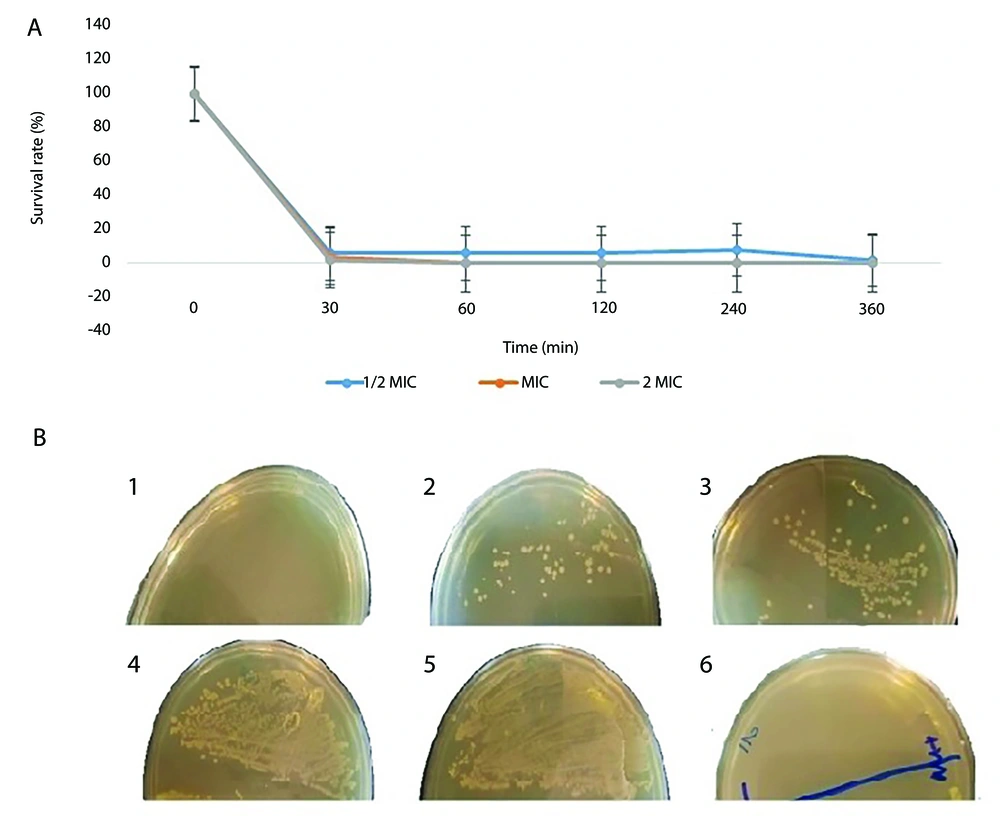
A, The survival percentage of Acinetobacter baumannii bacteria after treatment with the M-PEX12 peptide was measured at different time points. Significant differences in survival rates were observed between groups at the following time points: Thirthy minutes (P < 0.001), 60 minutes (P < 0.001), 120 minutes (P = 0.005), 240 minutes (P < 0.001), and 360 minutes (P = 0.001); B, the growth of A. baumannii bacteria was assessed at different temperatures (1, 2, 3, 4, 5) from left to right, corresponding to temperatures of 4, 20, 40, 60, and 80 degrees Celsius. 6, A negative control was also included.
4.2. Thermal Stability Assay
4.3. Reactive Oxygen Species Generation in Acinetobacter baumannii Upon Exposure to M-PEX12
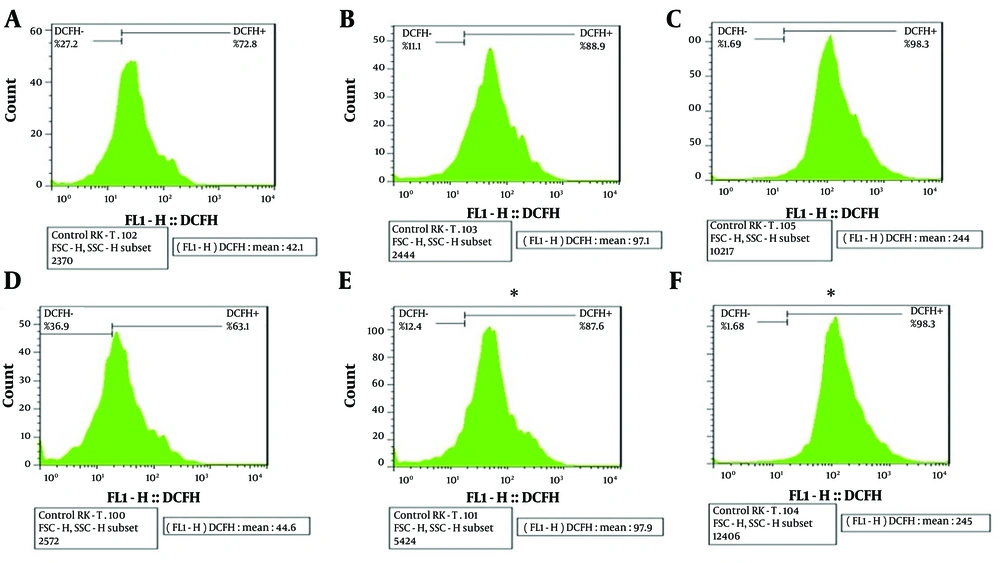
The expression level of DCFH dye is indicated on the right side of the graph in the upper section, and beneath each graph, a numerical value reported as mean fluorescence intensity (MFI) represents the intensity of color in each sample for compArison across multiple graphs. In the above graph, A, B, and C, respectively represents the negative control, minimum inhibitory concentration (MIC) peptide concentration, and 2xMIC peptide concentration at 2 hours of bacterial and peptide treatment; similarly, D, E and F, respectively represents the negative control, MIC peptide concentration and 2x MIC peptide concentration at 4 hours of treatment (* P < 0.05).
4.4. Inhibitory Effect of M-PEX12 on Acinetobacter baumannii Biofilm Formation
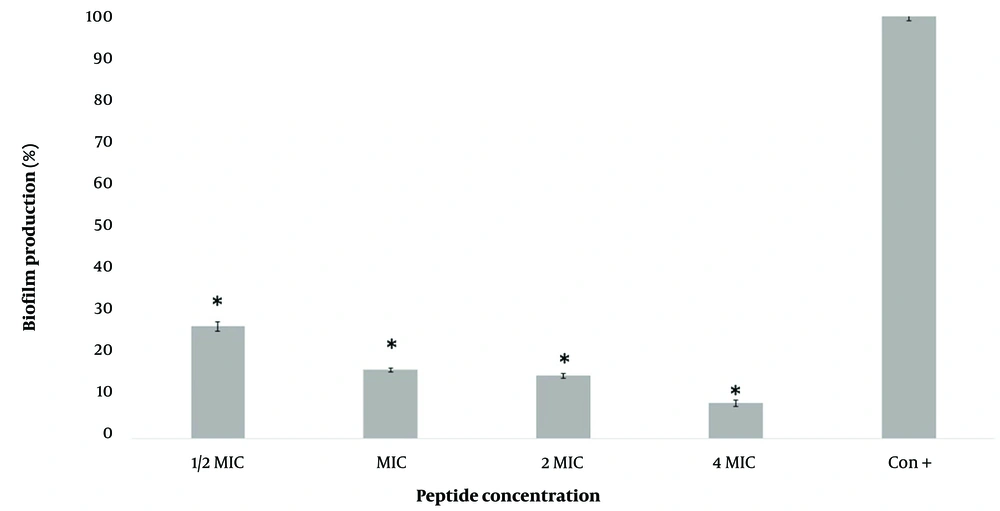
Biofilm formation by Acinetobacter baumannii bacteria at different concentrations of M-PEX12 (* P < 0.05)
4.5. Scanning Electron Microscope Observations
4.5.1. Effects of M-PEX12
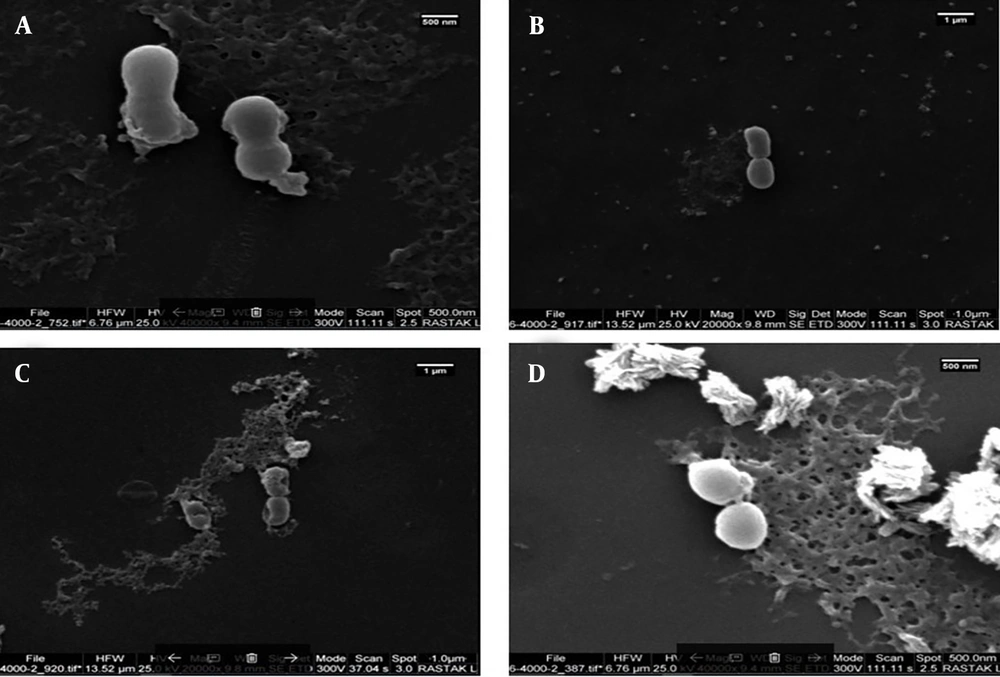
Scanning electron microscopy (SEM) images before and after peptide treatment. A and B, Show Acinetobacter baumannii bacteria before peptide treatment at different magnifications and time points; C, shows A. baumannii after a 2-hour treatment with the peptide at a concentration of 2x minimum inhibitory concentration (MIC); D, shows A. baumannii after a 4-hour treatment with the peptide at a concentration of 4x MIC (25)
4.6. Determination of Peptides Toxicity on HEK293 Cell Line by MTT Assay
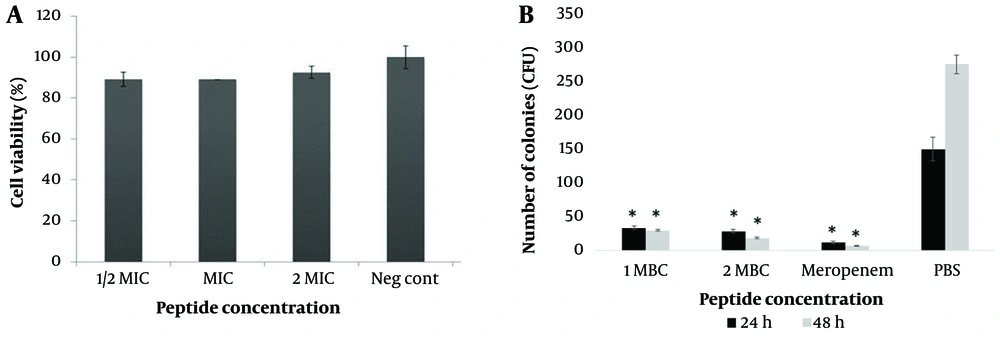
A, In the investigation on the cytotoxic effect of the M-PEX12 peptide on the HEK293 cell line (P > 0.05); B. investigation of the antimicrobial activity of the novel chimeric peptide M-PEX12 in a mouse model of sepsis caused by Acinetobacter baumannii at 24 and 48 hours post-infection (* P < 0.05).