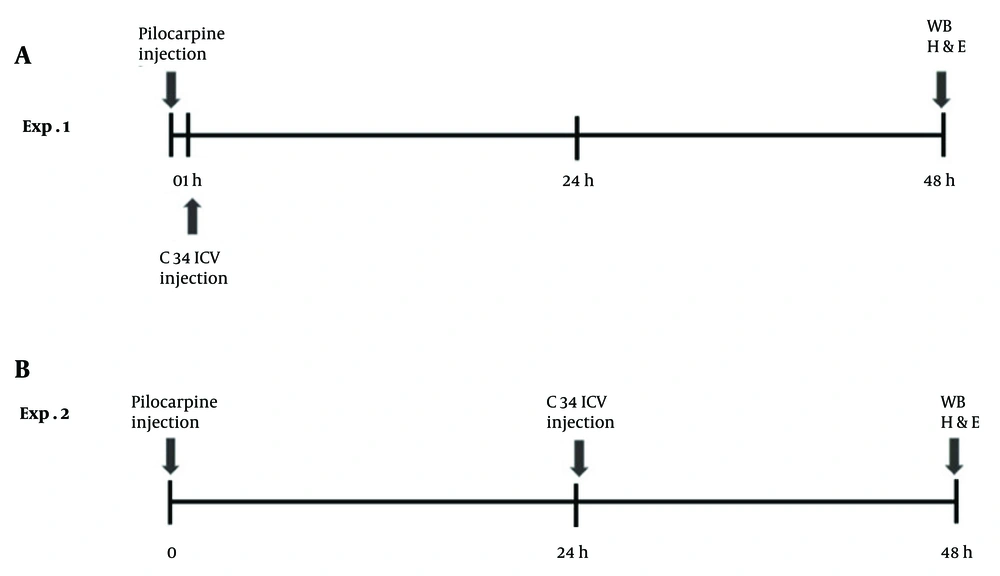
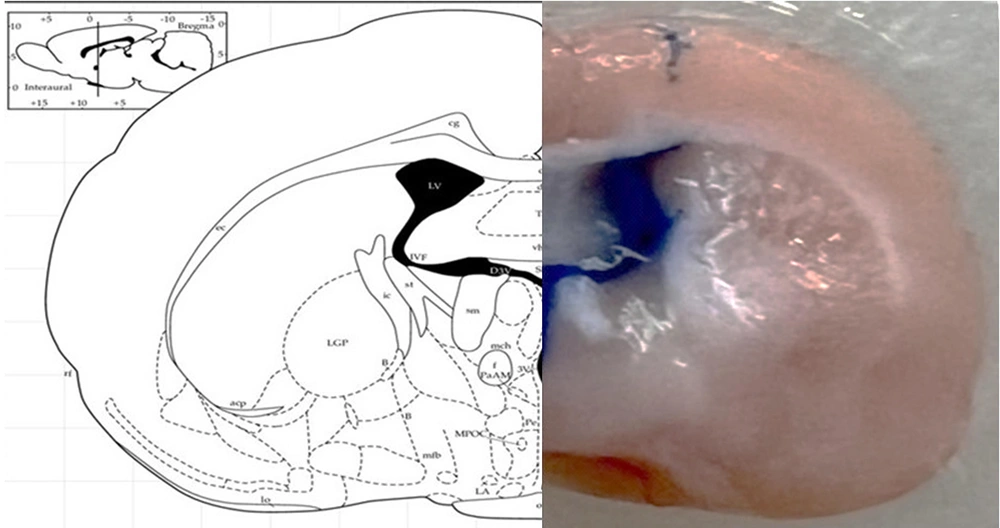
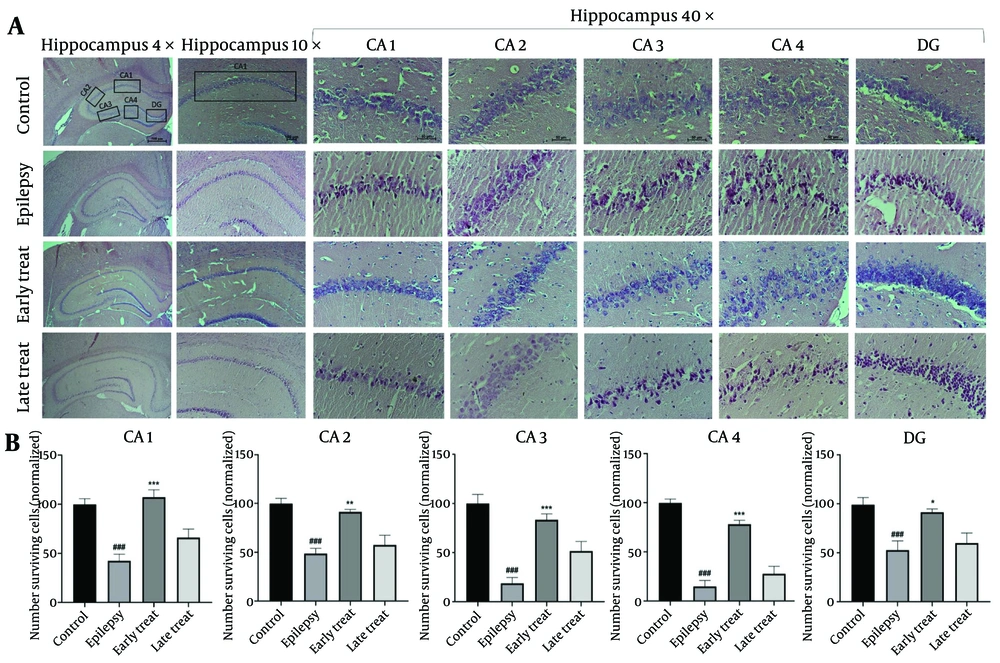
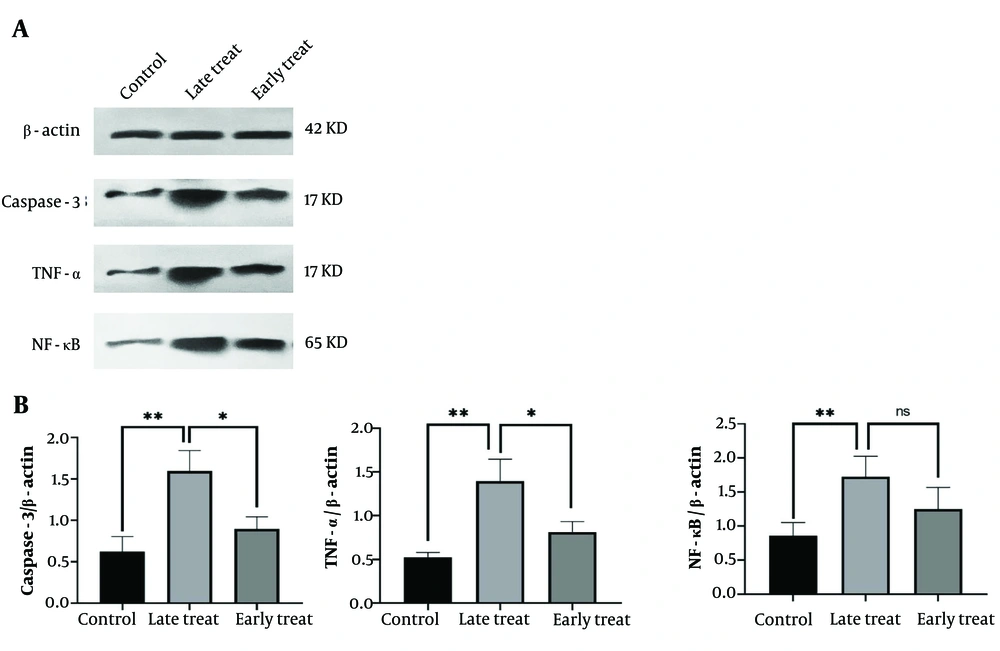
In our study, we investigated the neuroprotective effect of inhibiting TLR4 with C34 on hippocampal neuronal death and inflammatory factors during the acute period following SE. We compared early treatment with C34, administered one hour after pilocarpine injection, to late treatment, given 24 hours after the injection. We demonstrated that early treatment with C34 reduced the mortality rate and neuronal death induced by pilocarpine in the hippocampus. Additionally, it decreased the expression of caspase-3 and the neuroinflammatory factors TNF-α and NF-κB compared to the late treatment. These findings underscore the significance of early intervention in reducing neuronal death and decreasing inflammation in an epilepsy model.
In the current study, the epilepsy model was induced using pilocarpine intraperitoneal injection. Although this model is associated with high mortality rates, it remains one of the oldest and most well-studied animal models of SE (
14). Epileptogenesis is thought to occur in three distinct stages: (1) The initial insult or acute period, (2) the latent period, and (3) the chronic epilepsy phase (
15). In this study, during the acute period after SE, cell damage was observed in all areas of the hippocampus in rats that received pilocarpine. A recent study using Fluoro-Jade C staining showed that neurodegeneration in the hippocampal region, particularly prominent in the dentate gyrus, was evident 24 hours after SE and remained at the same level seven days later (
16). This finding implies the critical importance of the first 24 hours following SE.
In a study by Fujikawa, neuronal damage resulting from SE induced by pilocarpine in rats was found to be progressive and varied across different brain regions. Initial signs of neuronal damage induced by pilocarpine appeared as minor damage in hippocampal regions after just 20 minutes of SE. This damage continued to evolve even after the seizures ceased, with the most severe damage observed 24 hours after SE, and cell breakdown observed after 72 hours (
17). In addition to the progressive neuronal damage observed following pilocarpine-induced SE, another study demonstrated that severe and repetitive seizures during SE cause significant brain damage, particularly in vulnerable regions such as the hippocampus. This cumulative damage not only indicates the critical need for early intervention but also highlights its potential role in the subsequent development of chronic epilepsy (
18). Therefore, the significantly reduced neuronal damage we observed in the hippocampus with early treatment (1 hour after SE) compared to late treatment (24 hours after SE) may be attributed to intervention before the progression of SE-induced damage.
Among the mechanisms underlying this progressive neural damage, neuroinflammation plays a crucial role. Early inflammatory processes in the brain have been reported to be associated with epilepsy (
19). There is considerable evidence suggesting that neuroinflammation significantly contributes to seizure-induced neuronal death through various mechanisms, one of which involves the toll-like receptor (TLR) pathway (
20,
21). We used C34 to inhibit TLR4 in the brain. C34, a 2-acetamidopyranoside with the formula C17H27NO9, has been shown through in silico docking studies to specifically inhibit TLR4 by directly binding to it. The inhibition of TLR4 signaling by C34 has been confirmed in both in vivo and in vitro studies (
22). However, to the best of our knowledge, no study has investigated the intracerebral effects of C34 in an epilepsy model.
Toll-like receptor 4, when activated, stimulates nuclear factor kappa-B (NF-κB), which in turn activates inflammatory pathways (
23). Our findings show that administering C34 one hour after the pilocarpine injection significantly reduced the expression of NF-κB and TNF-α in the hippocampus, compared to the treatment given 24 hours later. However, C34 administered 24 hours after pilocarpine injection could not decrease NF-κB or TNF-α expression as effectively as earlier treatment, indicating the critical role of neuronal inflammation in the pathophysiology of epilepsy, particularly during the very early stages following the initial insult.
Regarding the role of TLR4 and NF-κB in epilepsy, previous studies have demonstrated that the overexpression of HMGB1, which signals through TLR4 and activates NF-κB, exacerbates epileptogenesis (
24). Similarly, Zhou et al. reported elevated levels of NF-κB expression in SE rats. They intracerebrally injected exogenous miR-322-5p, which binds to the 3′-UTR of TRAF6, a key component of the TLR4/NF-κB signaling pathway, and observed that the brain tissues of these SE rats exhibited reduced levels of inflammation and apoptosis in the hippocampal CA1 area (
25). This is consistent with our results, where caspase-3, a crucial mediator of apoptosis, was decreased when TLR4 was inhibited by C34 one hour after the SE model compared to 24 hours after the SE model.
In a separate study, Wu et al. demonstrated that the expression of NF-κB in the hippocampus increased in a SE model of rats. Furthermore, administering a TLR4 inhibitor (TAK-242) intraperitoneally one hour after pilocarpine injection inhibited the activation of the inflammatory signaling pathway in microglia. They suggested that downregulating the TLR4/NF-κB inflammatory pathway may have antiepileptic effects in epilepsy (
26). It has been shown that microinjection of exogenous damage-associated molecular patterns (DAMP) such as HMGB1 into the hippocampus in mice enhances the seizures induced by kainate through the stimulation of TLR4 (
27). However, intravenous treatment with neutralizing anti-HMGB1 mAb inhibits inflammation in the very acute phase of SE induced by pilocarpine and reduces the apoptosis of pyramidal cells (
28).
It has been demonstrated that TLR4 mediates microglial activation and induces NF-κB activation, playing a critical role in the activation of the M1 microglial phenotype. Inhibiting the pilocarpine-induced TLR4/NF-κB pathway in the hippocampi of epileptic rats promotes the polarization of microglia to the M2 phenotype, suggesting this pathway as a potential strategy for alleviating epileptogenesis (
29). It can be assumed that C34 may have a therapeutic effect in the SE model of epilepsy by inhibiting the TLR4/NF-κB inflammatory pathway.
In the context of early treatment strategies, Rosciszewski et al. reported that blocking HMGB-1 with glycyrrhizin immediately after pilocarpine-induced SE in rats led to a reduction in neuronal degeneration, reactive astrogliosis, and microgliosis over the long term (
30). Their results align with ours, as we demonstrated that inhibiting TLR4 one hour after pilocarpine-induced SE significantly reduced neurodegeneration in the hippocampus. In this study, we also observed that inhibiting TLR4 with the compound C34, when administered 24 hours after pilocarpine-induced SE, does not effectively prevent neurodegeneration in the hippocampus. This finding suggests that neuroinflammation occurring in the early minutes post-insult may activate molecular pathways that initiate and propagate fundamental and progressive changes in the brain. The early activation of these inflammatory pathways underscores the importance of timely therapeutic intervention to mitigate long-term neurodegenerative consequences and improve clinical outcomes in epilepsy.
In this line, Suleymanova et al. demonstrated a neuroprotective effect by antagonizing CB1 receptors, significantly reducing the number of neurodegenerating neurons four hours post-SE during the acute phase. However, it is noteworthy that this neuroprotective effect did not persist into the latent period (
16). Our study highlighted the critical importance of precise timing within the early minutes of the acute phase, demonstrating that even slight variations at specific time points during this phase can significantly influence levels of neurodegeneration. Specifically, inhibiting TLR4 during the critical first minutes after SE resulted in a significant decrease in the number of neurodegenerating neurons across all areas of the hippocampus, compared to inhibiting TLR4 24 hours after SE in the acute period.
One of the limitations of this study is the absence of a standalone epilepsy (pilocarpine-only) group in the western blot analysis, which would have allowed for a more direct comparison of cytokine expression levels across all experimental conditions. While this group was included in the histological analysis, where it clearly demonstrated that the rate of neuronal death in different regions of the hippocampus was quite similar to that observed in the late C34 treatment group, its inclusion in the western blot analysis would have provided additional insights into the molecular changes among groups. Although our previous study demonstrated that pro-inflammatory cytokine levels were elevated in the rat hippocampus 24 hours after pilocarpine administration (
31), including a pilocarpine-only group in the western blot analysis would have allowed for a more accurate comparison of cytokine expression between the early and late C34 treatment groups and untreated epileptic animals. This would have helped to further elucidate the extent to which C34 modulates inflammatory pathways at different treatment time points. However, due to experimental constraints, this analysis was not conducted. We acknowledge this as a limitation, emphasizing the need for future studies to incorporate a dedicated epilepsy control group in molecular analyses for a more comprehensive understanding of treatment effects.
5.1. Conclusions
Our results indicate the critical role of neuronal inflammation in the pathophysiology of epilepsy, emphasizing how inflammatory processes within neurons are pivotal during the very early stages following the initial insult. This early intervention window is crucial for mitigating the inflammatory cascade that contributes to the progression and severity of epileptic episodes. By addressing neuronal inflammation promptly, we can gain a better understanding of its impact on the development of epilepsy and potentially improve therapeutic strategies to manage and prevent epileptic conditions more effectively.