
1. Background
Atrial septal defect (ASD) is one of the most prevalent congenital heart defects, affecting a significant portion of the population (1, 2). Historically, median sternotomy has been the gold standard for ASD repair, providing optimal access and effective outcomes despite requiring a substantial incision (3-5). In recent years, there has been a notable shift towards less invasive surgical techniques, such as thoracotomy, which aim to improve cosmetic outcomes and reduce recovery time and surgical trauma (6, 7). The development of transcatheter device closure has further transformed ASD management, offering a less invasive alternative that is increasingly utilized in many cardiac centers. However, this approach has limitations and may not be suitable for all cases, necessitating continued reliance on surgical repair (8, 9).
Growing attention to cosmetic outcomes, particularly for female patients, has driven a shift towards exploring alternative incision methods. Despite advancements in minimally invasive techniques, there remains a need to evaluate their efficacy relative to traditional methods. Specifically, right anterior mini-thoracotomy (RAMT) has emerged as a promising approach that might offer benefits over classic midline sternotomy in terms of both aesthetic and recovery outcomes.
2. Objectives
The present study aims to evaluate and compare the surgical complications associated with RAMT and classic midline sternotomy for ASD repair. By analyzing these techniques, we aim to compare their effectiveness, aesthetic benefits, and recovery profiles to inform better surgical strategies and enhance patient satisfaction.
3. Methods
We retrospectively collected and analyzed the medical records of 70 patients who underwent surgical repair of ASD with a single surgeon at Imam Ali Hospital of Kermanshah University of Medical Sciences, Iran, which is a specialized cardiac center, and Faruk Medical City Hospital in Sulaymaniyah, Kurdistan region, Iraq, between July 2020 and December 2023. The patients were divided into two groups: Fifty patients in the median sternotomy group and 20 patients in the right atrial mini-thoracotomy group. Inclusion criteria included all patients with ASD with or without tricuspid valve insufficiency. Exclusion criteria included patients with mitral valve insufficiency, ventricular septal defect, and pulmonary pressure lower than 6 mmHg. The choice of surgical approach was made based on the surgeon’s recommendation and patient consultation.
All patients underwent routine clinical examinations, including electrocardiography, chest X-ray, blood, and biochemical tests. The ASD diagnosis was confirmed by echocardiography or prior catheterization. Postoperative drainage amount was measured daily according to the volume of drainage fluid collected in the chest tubes by the nursing staff until the removal of the tubes. The precise length of the incision was measured using a standard surgical ruler by the surgeon in the operating room and recorded accordingly. Surgery duration was calculated from the initiation of anesthesia to the complete closure of the incision and was documented in the patient’s medical records. The duration of intensive care unit (ICU) stay was recorded based on the exact admission and discharge times. Criteria for ICU discharge included stable vital signs, no need for ventilatory support, and normal hemodynamic function.
3.1. Surgical Approach
The surgical procedures were performed using two different approaches:
1. Classic midline sternotomy: The standard surgical approach involved a median sternotomy. A midline skin incision was made, starting 1 - 2 cm below the sternal angle and extending to 1 - 2 cm below the xiphoid process. The sternum was completely divided along the midline to provide full access to the thoracic cavity. This approach allowed direct exposure to the heart and major vessels.
2. Right anterior mini-thoracotomy: The minimally invasive method was performed with the patient in the left lateral decubitus position. A small skin incision, approximately 5 - 10 cm in length, was made below the breast fold. The fourth or fifth intercostal space was carefully opened without removing the rib. In some cases, the cartilage of the fourth or fifth rib was partially resected to improve visualization and access. This approach aimed to reduce surgical trauma while providing adequate exposure for the procedure.
The anesthesia protocol was identical for both surgical techniques, ensuring consistent perioperative management.
3.2. Statistical Analysis
Continuous variables were presented as mean ± standard deviation (SD), while categorical variables were expressed as absolute values and percentages. Analysis of variance (ANOVA) was used for continuous variables, and the chi-square (χ2) test or Fisher’s exact test was used for categorical variables. Statistical analyses were performed using SPSS software version 23.0 (IBM Corp, Armonk, NY, USA), with a significance level of P < 0.05.
4. Results
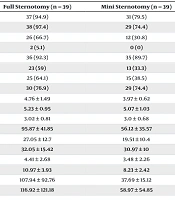
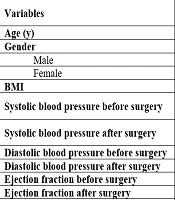
A total of 70 people were included in the study, of which 44 were women (63%) and 26 were men (37.1%). The average age of these individuals was 37.46 ± 14.50 years. The mean Body Mass Index (BMI) was 26 ± 0.52 in the median thoracotomy group and 26 ± 0.42 in the LAMT group. Regarding the duration of the surgery, a statistically significant difference existed between the two groups (P < 0.001) (Table 1). The amount of drainage after surgery in the sternotomy group was 758.9 ± 474 mL, and in the thoracotomy group, it was 542.5 ± 418.8 mL (P = 0.011). The difference in incision length between the two groups was statistically significant (P = 0.001). Mean incision lengths for sternotomy and thoracotomy were 20 ± 0 cm and 9.5 ± 0 cm, respectively. The average length of stay in the ICU was 3.92 ± 3.78 days in the sternotomy group and 2.65 ± 1.82 days in the thoracotomy group (P = 0.006). The results showed that among the variables of the study, significant differences were observed in the amount of drainage after surgery, the length of the incision in centimeters, the length of surgery, and the stay in the ICU between the two surgical methods (P ≤ 0.05).
Table 1
. Comparison of Baseline, Perioperative and Postoperative Data Among Two Groups of Patients a
| Variables | Classic Midline Sternotomy (n = 50) | RAMT (n = 20) | P-Value |
|---|---|---|---|
| Age (y) | 40.28 ± 15.46 | 30.40 ± 8.61 | 0.001 |
| Gender | 0.96 | ||
| Male | 18 (36) | 8 (40) | |
| Female | 32 (64) | 12 (60) | |
| BMI | 26 ± 0.52 | 26 ± 0.42 | 0.88 |
| Systolic blood pressure | |||
| Before surgery | 125.22 ± 20.85 | 118.45 ± 7.53 | 0.37 |
| After surgery | 117.54 ± 18.55 | 115.10 ± 13.72 | 0.83 |
| Diastolic blood pressure | |||
| Before surgery | 74.26 ± 11.04 | 73.10 ± 7.61 | 0.81 |
| After surgery | 67.68 ± 11.19 | 67.10 ± 7.17 | 0.7 |
| Ejection fraction | |||
| Before surgery | 50.14 ± 5.74 | 51.25 ± 3.58 | 0.356 |
| After surgery | 49.48 ± 4.81 | 49.25 ± 3.35 | 0.726 |
| Smoker | 0.6 | ||
| Yes | 10 (20) | 3 (15) | |
| No | 39 (78) | 17 (85) | |
| Operation time (min) | 302.2 ± 80.1 | 269.2 ± 65.3 | < 0.001 |
| Aortic cross clamp time | 27.5 ± 16.84 | 26.2 ± 20.9 | 0.524 |
| Extubation time | 9.5 ± 5.23 | 7.5 ± 2.56 | 0.15 |
| Packed red blood cells transfusions in operation room (mL) | 1.86 ± 0.86 | 2.1 ± 0.55 | 0.15 |
| Fresh frozen plasma transfusions in operation room (mL) | 2.78 ± 2.76 | 1.95 ± 2.16 | 0.28 |
| Platelets transfusions in operation room (mL) | 0.66 ± 1.61 | 0.65 ± 1.63 | 0.93 |
| Red blood cell transfusions in operation room (mL) | 0.34 ± 1.72 | 0.5 ± 1.82 | 0.95 |
| Ventilation time | 1.48 ± 1.23 | 1.05 ± 0.22 | 0.062 |
| Extubation time | 9.50 ± 5.23 | 7.55 ± 2.56 | 0.156 |
| Drainage | 758.9 ± 474 | 542.5 ± 418.8 | 0.011 |
| ICU stay (d) | 3.92 ± 3.78 | 2.65 ± 1.82 | 0.006 |
| Hospital stay (d) | 6.78 ± 3.33 | 5.90 ± 2.31 | 0.41 |
| Length of the incision (cm) | 20 ± 0 | 9.5 ± 0 | < 0.001 |
| Mortality | 0 (0) | 0 (0) |
Abbreviations: RAMT, right anterior mini-thoracotomy; BMI, Body Mass Index; ICU, intensive care unit.
a Values are expressed as No. (%) or mean ± SD.
5. Discussion
Median sternotomy has long been the standard approach for repairing congenital heart defects; however, its associated complications have prompted a transition to thoracotomy. Evidence from surgical experience suggests that less invasive cardiac and thoracic procedures are associated with diminished postoperative discomfort and pain, expedited return to work and daily activities, enhanced healing and aesthetic outcomes, reduced length of hospital stay, and, consequently, lower costs for patients. The primary benefit of less invasive surgical techniques lies in their ability to circumvent a complete sternotomy. This approach minimizes tissue damage and reduces contamination at the surgical site, consequently lowering the incidence of postoperative infections, including mediastinal infections, as well as postoperative pain (10).
The use of RAMT offers several advantages for patients. This technique involves a smaller incision, leading to reduced surgical trauma and minimal adhesions behind the sternum, which facilitates future mediastinal surgeries. Additionally, RAMT preserves the stability and integrity of the thoracic cage, resulting in lower pain levels, enhanced postoperative recovery, and a quicker return to daily activities. Studies have also indicated that this approach requires fewer resources and leads to shorter hospital stays, ultimately reducing costs (11).
Conversely, some drawbacks associated with RAMT include reported cases of breast and pectoral muscle maldevelopment, occurring in 7.4% of patients (12), and the potential for phrenic nerve injury (13). However, another study found no significant breast deformities or phrenic nerve injuries during long-term follow-up (14). The results showed that RAMT was a safe method with comparable or even superior results in some aspects, such as postoperative drainage, surgical incision length, and ICU stay. These results are consistent with the study by Poyrazoglu et al. (15), which recommended the RAMT approach as a safe incision compared to sternotomy, with less drainage, reduced transfusion rate, and shorter ICU stay.
The limitations of our study include its retrospective design and the fact that all surgeries were performed by a single surgeon but in two centers, which may result in variations in other cardiac centers. Additionally, further analysis of long-term follow-up data is necessary.
5.1. Conclusions
Right anterior mini-thoracotomy technique for ASD closure is considered both safe and reliable which patients typically experience earlier recovery, shorter stays in the ICU and excellent cosmetic result.