4.2. Molecular Dynamics Simulations
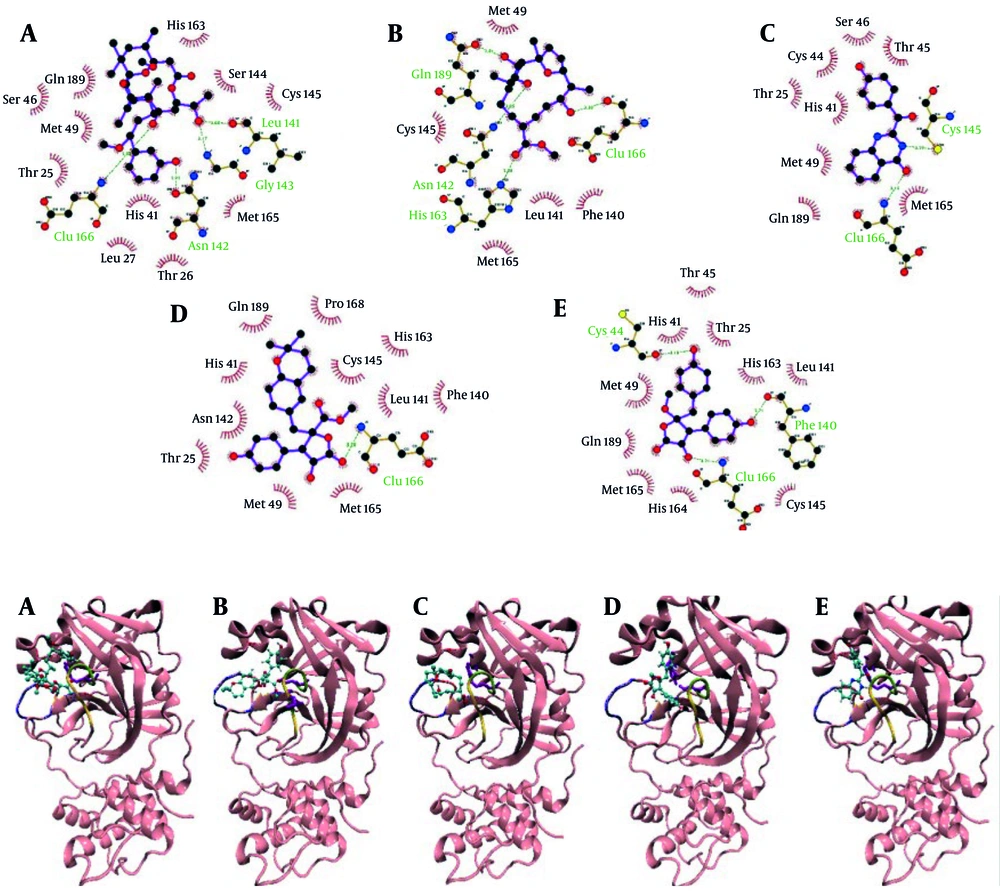
Molecular dynamics simulations were performed using 100 ns all-atom trajectories to study the conformational stability and interaction patterns of selected marine-derived compounds with the SARS-CoV-2 main protease (3CLpro). Analyses included assessments of changes in binding mode and persistence (Appendix 3 in Supplementary File), interaction dynamics, and structural changes over time. For 3-Methoxydebromoaplysiatoxin, hydrogen bonds were reduced to two with Thr26 and Met49 in domain I, and the compound retained interaction only with Cys145, indicating a slight shift from its original binding pose. Aspernolide A preserved interactions with domain II residues (Met165, Val142, Arg188, Gln189) and maintained two hydrogen bonds with His41 and Glu166, although the total number of interactions declined. Ehrenbergol C lost several original contacts and retained only hydrophobic interactions with Glu166, Gln189, and Thr190 in domain II, suggesting weakened binding. Isobutyrolactone II established a strong hydrogen bond with Glu47 and retained interactions with domain I residues and the catalytic dyad His41 and Cys145, supporting its stable binding. Penipanoid C also showed reduced residue interactions post-simulation but preserved contacts with catalytic residues His41 and Cys145, formed a stable hydrogen bond with Glu166, and retained van der Waals interactions with Met49, Met165, and Gln189, indicating potential to inhibit enzymatic function. Collectively, these findings demonstrate that while marine-derived ligands undergo subtle conformational adjustments during MD simulations, they retain stable binding interactions with the active site of the protease. The persistent structural integrity of the complexes, coupled with sustained ligand-enzyme contact at the catalytic site, suggests a plausible mechanistic basis for their protease inhibitory activity.
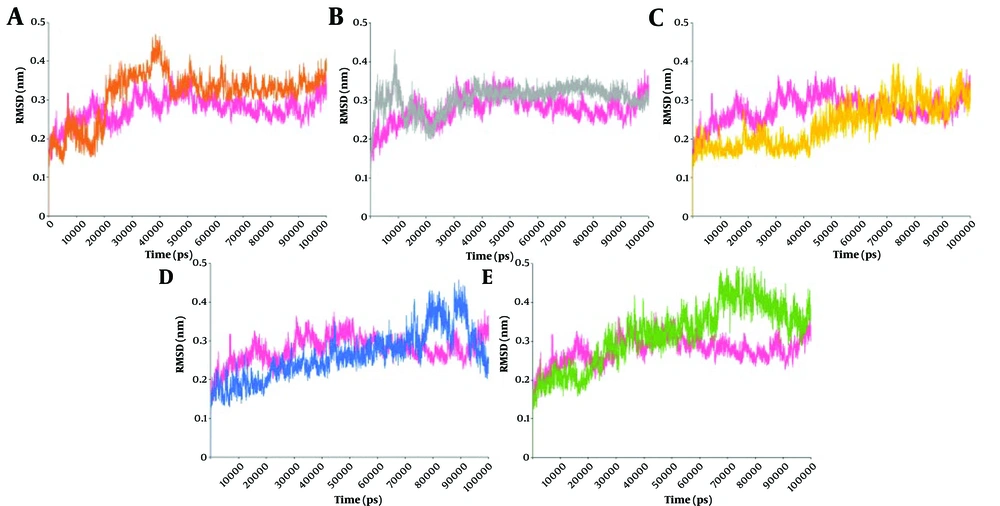
Root mean square deviation (RMSD) analysis over 100 ns for protein backbone atoms revealed that the unbound protease initially increased in RMSD during the first 20 ns and then stabilized (
Figure 2). The 3-Methoxydebromoaplysiatoxin complex showed its highest RMSD peak near 40 ns and stabilized around 0.36 nm thereafter. The Aspernolide A complex fluctuated in the first 20 ns, then stabilized around 0.33 nm, about equal to the free protein from 40 ns onward. The Isobutyrolactone II and Penipanoid C complexes both showed rising RMSD trends. Penipanoid C and Isobutyrolactone II had values exceeding 0.42 nm, especially between 70 - 100 ns, whereas Ehrenbergol C had the lowest average RMSD. These results suggest that different ligands exert distinct effects on the protease's conformational dynamics.
Root mean square deviation (RMSD) profiles over time for five protein-ligand complexes: A, 3-Methoxydebromoaplysiatoxin; B, Aspernolide A; C, Ehrenbergol C; D, Isobutyrolactone II; and E, Penipanoid C. The RMSD profile of the free protein is shown in pink for comparison.
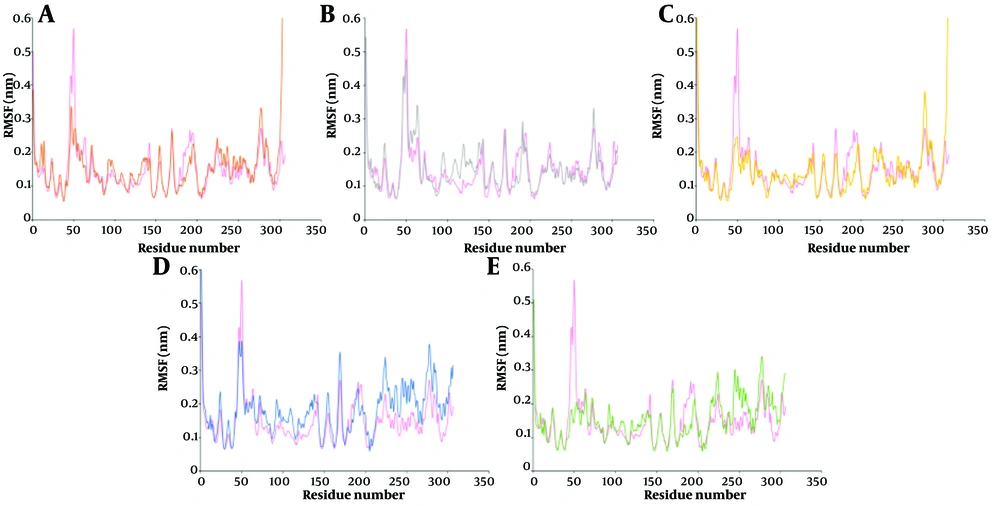
Figure 3 illustrates how the binding of marine-derived ligands to the 3CLpro influences residue flexibility across its domains. In the 3-Methoxydebromoaplysiatoxin-3CLpro complex, root mean square fluctuation (RMSF) decrements were observed at residues in domains I (41 - 45, 46 - 52, 59 - 70, 84), II (139 - 142, 180 - 187), and III (188 - 193). Along with increased fluctuations in residues 7 - 15, 91 - 100 (domain I), 101 - 111, 118 - 124, 128 - 137 (domain II), and 223 - 234, 236 - 258, 275 - 306 (domain III), these suggested variable changes in the flexibility of domains I and II, and increased flexibility in domain III.
Root mean square fluctuation (RMSF) profiles of Cα atoms for five protein–ligand complexes: A, 3-Methoxydebromoaplysiatoxin; B, Aspernolide A; C, Ehrenbergol C; D, Isobutyrolactone II; and E, Penipanoid C. The RMSF profile of the free protein is shown in pink for comparison.
For Aspernolide A, RMSF increased at residues in domains I (19 - 24, 55 - 65, 92 - 98), II (105 - 115, 116 - 134, 137 - 141, 158 - 165), and III (188 - 191, 274 - 279), while decreases occurred at residues 7 - 17, 50 - 52, 72, 76 - 87 (domain I), 177 - 183, 185 - 190 (domain II), and across most of domain III. The Ehrenbergol C complex showed RMSF decreases at residues 43 - 50, 63 - 65, 72, 83 - 86 (domain I), 140 - 142, 169 - 174, 177 - 181 (domain II), and 182 - 194, 224 - 226, 229 - 239, 252 - 263 (domain III). Increases were found at residues 106 - 116, 120 - 134, 155 (domain II) and 202 - 220, 245 - 252, 275 - 306 (domain III). Isobutyrolactone II caused increased RMSF at residues in domains I (67 - 70, 75 - 83), II (88 - 100, 102 - 116, 118 - 145, 153 - 171), and III (200 - 207, 213 - 227, 237 - 306), while decreases were noted at 46 - 50, 56, 61 - 63 (domain I), 183 - 196 (domain II), and 208 - 211 (domain III). Penipanoid C induced RMSF decreases at residues 14, 41 - 52, 54 - 59, 64 (domain I), 115, 119 - 135, 139 - 142, 168 - 182 (domain II), and 183 - 196, 209, 231 - 235 (domain III), with increases at 71, 75 - 80, 91 - 98 (domain I), 102 - 112 (domain II), and 203 - 306 (domain III). In conclusion, ligand binding significantly affects the flexibility of key regions in 3CLpro involved in catalysis and substrate binding, supporting the inhibitory potential of these marine-derived compounds.
The radius of gyration (Rg) analysis measures the overall changes in the diameter of a protein. Changes in Rg indicate conformational variations that could affect substrate binding to the catalytic pocket. The Rg profiles of the free protein and its complexes with various marine compounds are shown in Appendix 4. The free protein showed some compactness with fluctuations around an average of 2.16 nm, showing a downward trend during the simulation. In contrast, complexes with all ligands prevent the final Rg reductions in ligand-bonded protein when compared with the free protein. The highest fluctuations were seen in complexes with Ehrenbergol C, Isobutyrolactone II, Aspernolide A, and 3-Methoxydebromoaplysiatoxin, suggesting more structural instability and potential enzyme dysfunction.
Solvent-accessible surface area (SASA) analysis, shown in Appendix 5, revealed a small increase in the SASA value in the Isobutyrolactone II complex, indicating a structural change of the protein in the presence of this ligand. As shown in the figure, in other complexes, the final SASA value is in the range of the free protein with some differences in diagram patterns. The most severe fluctuations in SASA value during the simulation are observed in the protein complex with Penipanoid C and 3-Methoxydebromoaplysiatoxin.
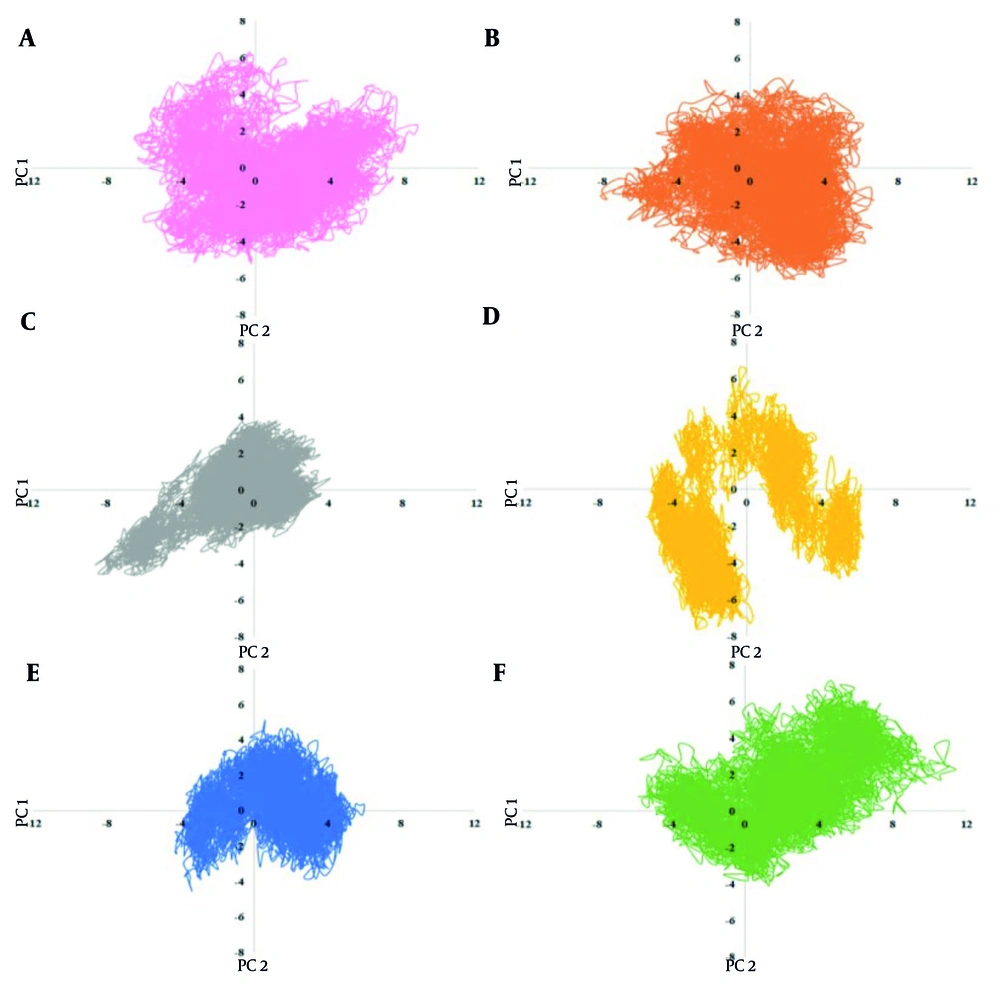
Principal component analysis (PCA) extracted the protein’s movement patterns, as shown in
Figure 4. The free protein exhibited a value range of -7 to 8 nm in PC1. All marine compounds altered the range and pattern of conformational values in PCs, indicating their potential to destabilize the structure. Notably, Penipanoid C caused the largest increase in protein mobility, consistent with the Rg results, showing significant fluctuations. In contrast, complexes with Isobutyrolactone II, Aspernolide A, and Ehrenbergol C showed reduced protein mobility, with the most severe restriction observed in Isobutyrolactone II. These findings suggest that these marine compounds could cause conformational changes and movement patterns of the protease, hindering the protein's activity.
Principal component analysis (PCA) patterns of: A, free protein, and protein complexes with B, 3-Methoxydebromoaplysiatoxin; C, Aspernolide A; D, Ehrenbergol C; E, Isobutyrolactone II; and F, Penipanoid C.
The Define Secondary Structure of Proteins (DSSP) analysis (Appendix 6 in Supplementary File) demonstrated changes in the protein's secondary structures resulting from ligand binding. For example, 3-methoxydebromoaplysiatoxin destabilized an alpha-helix between residues 50 - 60 and removed a turn between 170 - 180. Aspernolide A disrupted beta - sheets between residues 90 - 130, while Ehrenbergol C removed a turn at residues 40 - 50. Isobutyrolactone II induced an alpha-helix formation between residues 10 - 20 and removed a turn at 40 - 50. Penipanoid C promoted alpha-helix formation at residues 10 - 20 and 50 - 60, and coils at 190 - 200. These alterations suggest that ligand binding impacts the protein’s secondary structure and may affect its enzymatic activity.
Pharmacokinetic analysis of the marine compounds (Appendices 1 and 2 in Supplementary File), performed using the Swiss ADME server, revealed that all compounds exhibited good drug-likeness. Notably, Ehrenbergol C and Isobutyrolactone II did not interact with hepatic metabolism enzymes, suggesting a lower likelihood of drug interactions. Aspernolide A and Penipanoid C interacted with CYP2C9, CYP3A4, and CYP1A2, potentially interfering with anti-inflammatory drug metabolism. All five compounds exhibited high digestive absorption and the ability to cross the blood-brain barrier, suggesting efficient distribution and potential effectiveness in reaching viral enzymes.
4.3. Conclusions
This study computationally assessed 80 marine-derived compounds for their inhibitory potential against the SARS-CoV-2 main protease (3CLpro). Based on binding affinity and ADMET analysis, five lead compounds — 3-methoxydebromoaplysiatoxin, Aspernolide A, Ehrenbergol C, Isobutyrolactone II, and Penipanoid C — were selected for MD simulations.
The MD results showed that complexes with Isobutyrolactone II, Ehrenbergol C, and 3-methoxydebromoaplysiatoxin exhibited the highest RMSD values, with Isobutyrolactone II causing the greatest fluctuations, confirmed by both RMSD and residue-level analysis. The Rg analysis indicated notable diagram fluctuations in 3-methoxydebromoaplysiatoxin, Ehrenbergol C, and Isobutyrolactone II complexes, while others remained structurally more stable. The results of PCA revealed altered protein motion in all complexes, with the most significant limitation in protein movement observed for Isobutyrolactone II, Ehrenbergol C, and Aspernolide A, likely affecting enzymatic function. SwissADME pharmacokinetic analysis identified Isobutyrolactone II and Penipanoid C as having the most favorable pharmacokinetic profiles due to favorable absorption and metabolic characteristics. Integrative analysis of computational data nominates Isobutyrolactone II and Aspernolide A as high-priority candidates for SARS-CoV-2 antiviral development. Their persistent interaction with the viral protease active site, alongside their negative effects on the normal dynamics of the protein, underscores their inhibitory potential, necessitating further investigation in biological systems to confirm therapeutic utility.