


1. Background
Prostate cancer (PCa) is one of the most common cancers in the United States and most Western countries (1, 2). Prostate specific antigen (PSA) test is widely used for PCa screening in men. Considerable overlap exists between PCa and benign prostatic hyperplasia (BPH) among patients with serum PSA level < 10 ng/mL (1-4). Extensive efforts have been made to increase PSA specificity in detecting PCa. Benson et al. introduced PSA density (PSAD) and transition-zone PSA density (TZPSAD) as parameters that improve detection of PCa (5). However, some studies have questioned diagnostic capability of PSAD (6). Hyperplasia of the transition zone almost exclusively results in BPH (7). Kalish et al. reported TZPSAD as a parameter, which increases PCa detection among patients with mildly elevated serum PSA (PSA between 4-10 ng/mL) (8). Due to variation of PCa prevalence and incidence in different regions (3), and importance of ethnicity in PCa pathogenesis, we conducted this study to assess the utility of TZPSAD among Iranian patients. Serum PSA level seems to be higher in Iranian patients and the PSA cut-off value of 4 ng/dL may be associated with substantial number of unnecessary biopsies (9). Therefore, finding a more specific PSA-related biomarker and determining an optimal cut-off value in Iranian patients are of utmost importance.
2. Objectives
This study aimed to assess the sensitivity and specificity of transition-zone PSA density (TZPSAD) in detection of PCa.
3. Patients and Methods
3.1. Patients
Between March 2008 and March 2013, 1712 patients underwent trans-rectal ultrasound (TRUS) guided prostate biopsy in our institution. Patients younger than 40 years were excluded from the study. Other exclusion criteria were abnormal rectal exam findings, serum PSA level > 20 ng/mL, genitourinary manipulation and intervention (within one month of biopsy) and the use of an indwelling Foley catheter. A total of 1120 patients were eligible and included for the statistical analysis. The institutional review board approved the study.
3.2. Ultrasonography and Biopsy
Trans-rectal ultrasound was performed using a linear array probe. Interrogation of the prostate parenchyma was performed in both transverse and sagittal planes. Anteroposterior and transverse diameters of prostate and transition zone were recorded. Ultrasonography in sagittal plane was also applied to determine a longitudinal diameter of the prostate and transition zone. Prostate volume and transition-zone volume were calculated using ellipsoid volume formula (width × length × height × 0.52). The transition-zone PSA density was calculated as PSA (ng/mL) divided by transition-zone volume (mL). Biopsy procedure from prostate was consisted of 12 cores. Additional biopsies were also obtained from hypo-echoic regions detected by TRUS.
3.3. Statistical Analysis
Receiver operating characteristic curve was used to evaluate the diagnostic accuracy of TZPSAD in detecting PCa.
4. Results
A total of 1349 men with mean age of 65.7 ± 8.4 years (age range, 43 - 96 years) were included. Prostate cancer was detected in 340 (25.2%) men. Mean serum PSA level was 8.9 ± 4.1 ng/mL in the study population and was significantly higher among patients with PCa (10.0 ± 4.4 ng/mL vs. 8.6 ± 3.9 ng/mL in men with and without PCa, respectively; P < 0.001).
Mean TZPSAD value was 0.70 ± 0.97 ng/mL/mL in study population (range from 0.03 to 12.73 ng/mL/mL). We noted a significantly higher TZPSAD among patients with PCa (1.18 ± 1.19 vs. 0.55 ± 0.84 ng/mL/mL; P < 0.001). Table 1 compares various characteristics between patients with and without PCa.
The areas under the curves for PSA, PSAD and TZPSAD were 0.585, 0.749 and 0.766, respectively (Figure 1). Optimal cut-off values for PSA, PSAD and TZPSAD were 5.6 ng/mL, 0.14 and 0.32 ng/mL/mL, respectively. At these cut-off values, sensitivity and specificity were 85% and 24% for PSA, 85% and 40% for PSAD and 85% and 45% for TZPSAD, respectively. Applying TZPSAD for PCa screening reduced 50% of unnecessary biopsies.
| Patients With Prostate Cancer | Patients Without Prostate Cancer | P Value | |
|---|---|---|---|
| Age, y | 68.4 ± 8.5 | 64.7 ± 8.1 | < 0.001 |
| BMI, kg/m 2 | 26.5 ± 10.3 | 24.2 ± 3.2 | 0.147 |
| Prostate Volume , ng/mL | 35.7 ± 18.0 | 53.3 ± 24.4 | < 0.001 |
| Transition Zone Volume , ng/mL | 14.0 ± 11.1 | 24.8 ± 15.0 | < 0.001 |
| PSA, ng/mL | 10.0 ± 4.4 | 8.6 ± 3.9 | < 0.001 |
| PSA Density , ng/mL | 0.34 ± 0.23 | 0.20 ± 0.33 | < 0.001 |
| Transition Zone PSA Density , ng/mL | 1.18 ± 1.19 | 0.55 ± 0.84 | < 0.001 |
a Abbreviations: BMI, Body Mass Index; PSA, Prostate Specific Antigen.
b Data are presented as Mean ± SD.
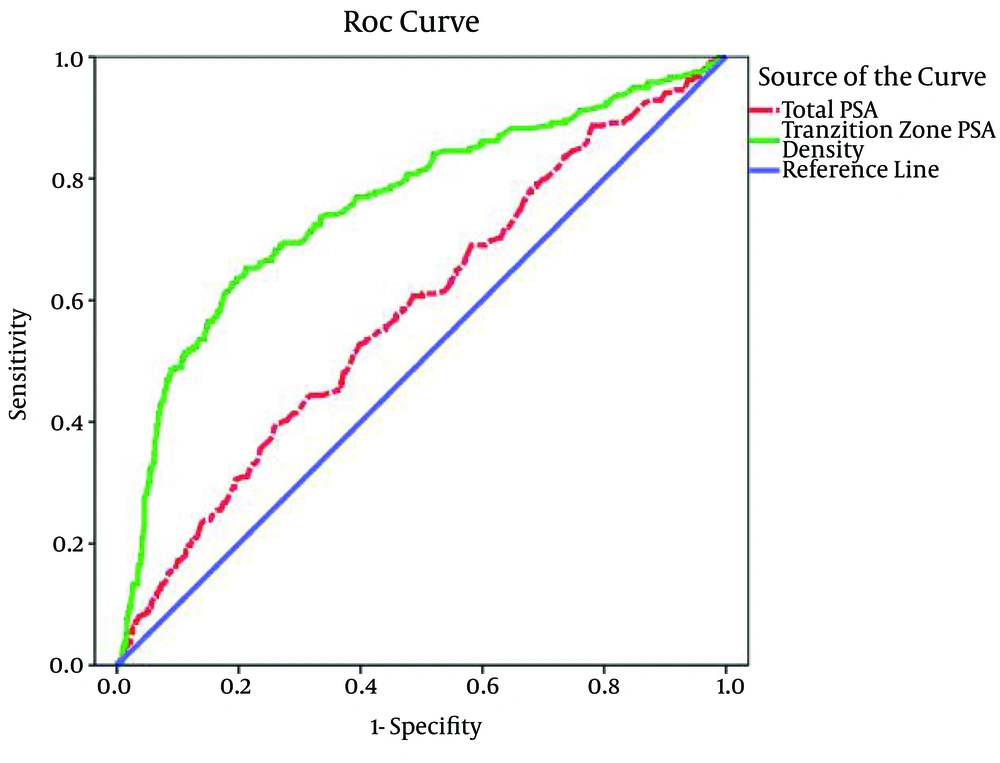
Figure 1.
ROC Curve Analysis for Total PSA and PSA Transition Zone Density in the Diagnosis of Prostate Cancer
5. Discussion
Serum PSA is an invaluable biomarker for detection of PCa. Patients with elevated serum PSA levels should undergo TRUS guided prostatic biopsy. Prostate specific antigen is a tissue specific marker. However, it is not specific for PCa. Serum PSA level increases by disruption of cell architecture within the gland which occurs as a consequence of different prostatic disorders, inflammation or lower urinary tract intervention. Moreover, benign prostatic hyperplasia may increase serum PSA level, especially when it is associated with prostatitis. Therefore, PSA lacks specificity for PCa detection and many patients with elevated PSA undergo unnecessary prostatic biopsies. Applying PSA related parameters (i.e. PSAD, PSA velocity, etc.) have been postulated to increase specificity and decrease the number of unnecessary biopsies. In the present study, we noted that applying TZPSAD as a marker for PCa detection is associated with significantly higher specificity and decreases the number of unnecessary biopsies. Since transition-zone enlargement occurs mainly in BPH patients, TZPSAD is hypothesized to more accurately discriminate between BPH and PCa. In 1994, Kalish et al. reported that TZPSAD at cut-off value of 0.45 ng/mL/mL is more specific than PSA and PSAD in detecting PCa among patients with intermediate PSA levels of 4-10 ng/mL (8). Similarly Sung et al. reported TZPSAD at cut-off value of 0.35 ng/mL/mL as an specific marker in PCa diagnosis (10). In the present study, we also revealed that at cut-off value of 0.32 ng/mL/mL, TZPSAD has significantly higher specificity compared to PSA. Although PSAD was more specific compared to PSA, it was not as specific as TZPSAD in our study. Accuracy of PSAD has been evaluated in several reports. Benson et al. first recommended applying PSAD as a marker for distinguishing PCa from the benign causes of PSA elevation (5). Lam et al. showed that PSAD at cut-off value of 0.15 ng/mL/mL spread 50% of men from undergoing unnecessary biopsies (11). In addition, some investigators have shown that PSAD is more specific compared to free to total PSA ratio especially when serum PSA level is at lower range (12-14). In our study, TZPSAD was found to be even more specific compared to PSAD and spread more patients from undergoing unnecessary biopsies.
Prostate specific antigen is not a good predictor for PCa diagnosis. Using TZPSAD can improve the efficiency of PSA in PCa diagnosis and decrease unnecessary biopsies. Applying TZPSAD for PCa screening can reduce 50% of unnecessary biopsies in Iranian men.
