
Tip of Peritoneal Catheter of Ventriculo- Peritoneal Shunt in Scrotum

Author(s):
Seyed Amir JavadiSeyed Amir JavadiSeyed Amir Javadi ORCID1,*, Fereshteh NaderiFereshteh Naderi2
1Neurosurgery Department, Tehran University of Medical Sciences, Tehran, Iran
2Neurology Department, Alborz University of Medical Sciences, Karaj, Iran

Archives of Neuroscience:Vol. 4, issue 3; e58389
Published online:Jul 30, 2017
Article type:Letter
Received:Jul 21, 2017
Accepted:Jul 24, 2017
How to Cite:Javadi SA, Naderi F. Tip of Peritoneal Catheter of Ventriculo- Peritoneal Shunt in Scrotum. Arch Neurosci. 2017;4(3):e58389. doi: https://doi.org/10.5812/archneurosci.58389

Dear Editor,
A ten-month male infant referred at emergency room with enlargement and fluid accumulation in right scrotum without any history of epididymitis or orchitis. Patient had a history of V-P shunt surgery two months earlier. At physical examination, no sign of hydrocephalus or fever was detected. However, a hard substance could be palpated at scrotum. Ultrasonography detected CSF hydrocele with echogenic tip of peritoneal catheter in right scrotum passing through inguinal canal without any sign of intestinal hernia. Radiologic assessment indicated radio-opaque catheter at pelvic area (Figure 1). CSF analysis detected no bacteria and the CSF profile, CBC and urine analyses were normal. The patient underwent direct repair of patent processus vaginalis and repositioning of catheter into peritoneum. Hydrocele improved at early postoperative period and the 6 months follow up outcome was excellent.
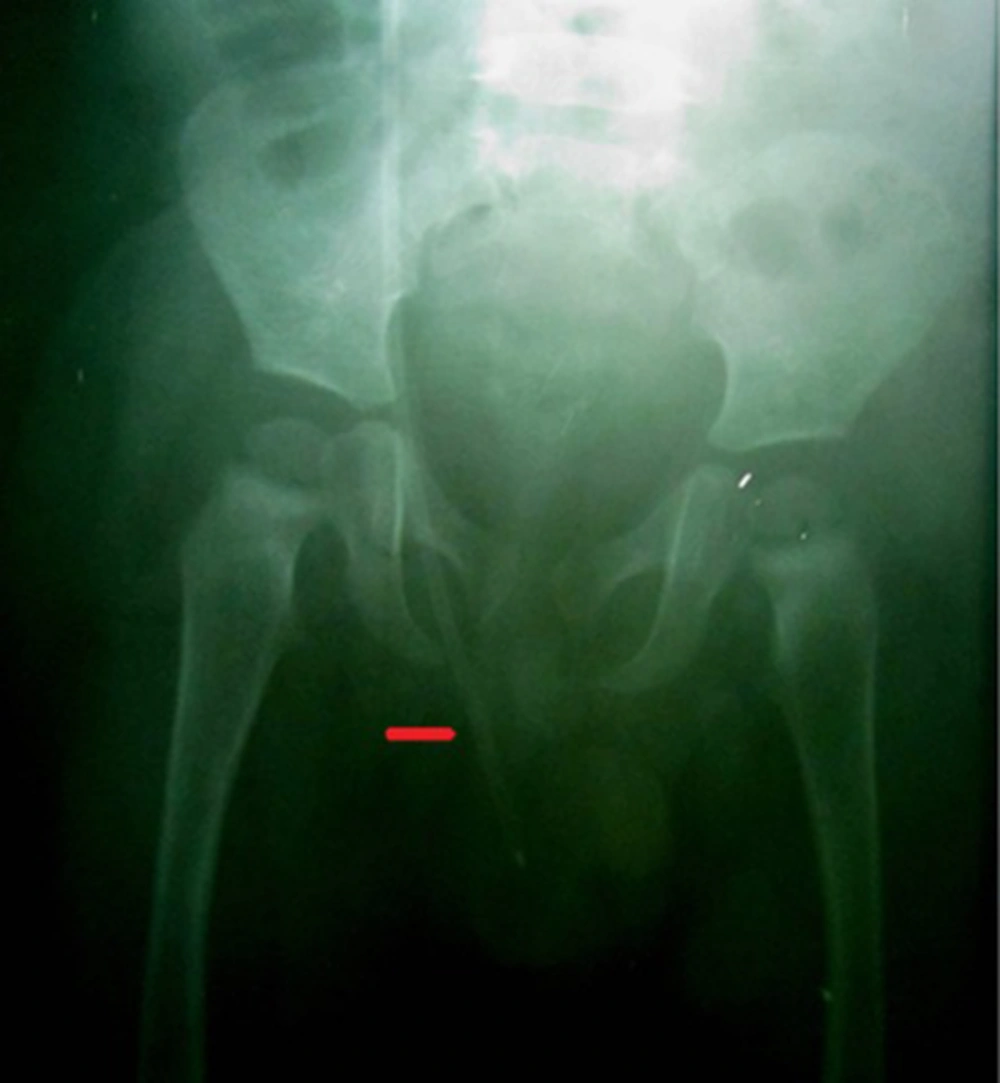
X-ray of peritoneal catheter displacement into scrotum through inguinal canal; red pointer indicates opaque peritoneal catheter.
Figure 1.

X-ray of peritoneal catheter displacement into scrotum through inguinal canal; red pointer indicates opaque peritoneal catheter.

A total of 30 cases of peritoneal shunt displacement into scrotum are reported in literature (1); their pattern follows the time course of patent processus vaginalis (PPV) which remains patent up to 60% of neonates during the first year of life (1, 2). The residual peritoneal cavity correlates with body surface, therefore younger pediatric patients have a higher tendency to have V-P shunt distal catheter migrate into the scrotum due to patent processus vaginalis and smaller peritoneal cavity (3).
The most suggested and acceptable treatment for such pediatric cases is direct repair of PPV and ligation of the sac, since increased CSF pressure prevents spontaneous occlusion of PPV (2-5). Some even suggest assessment and prophylactic repair of the other side, when applicable. Early and accurate intervention could prevent further complications and make significant improvements. Laparoscopic approach has been shown to be associated with a lower rate of malposition, distal obstruction and distal shunt failure (2, 6, 7).
References

  • 1.
    Mohammadi A, Hedayatiasl A, Ghasemi-Rad M. Scrotal migration of a ventriculoperitoneal shunt: a case report and review of literature. Med Ultrason. 2012;14(2):158-60. [PubMed ID: 22675718].
  • 2.
    Ricci C, Velimirovic BM, Fitzgerald TN. Case report of migration of 2 ventriculoperitoneal shunt catheters to the scrotum: Use of an inguinal incision for retrieval, diagnostic laparoscopy and hernia repair. Int J Surg Case Rep. 2016;29:219-22. [PubMed ID: 27883967]. https://doi.org/10.1016/j.ijscr.2016.11.002.
  • 3.
    Oktem IS, Akdemir H, Koc K, Menku A, Tucer B, Selcuklu A, et al. Migration of abdominal catheter of ventriculoperitoneal shunt into the scrotum. Acta Neurochir (Wien). 1998;140(2):167-70. [PubMed ID: 10398996].
  • 4.
    Ozveren MF. Migration of the abdominal catheter of a ventriculoperitoneal shunt into the scrotum. Neurol Med Chir. 1999;39(4):313-5.
  • 5.
    Hung SW. A 5-month-old infant with right scrotum swelling; a case report. Emerg. 2017;5(1):14.
  • 6.
    Phan S, Liao J, Jia F, Maharaj M, Reddy R, Mobbs RJ, et al. Laparotomy vs minimally invasive laparoscopic ventriculoperitoneal shunt placement for hydrocephalus: A systematic review and meta-analysis. Clin Neurol Neurosurg. 2016;140:26-32. [PubMed ID: 26615465]. https://doi.org/10.1016/j.clineuro.2015.10.025.
  • 7.
    Svoboda SM, Park H, Naff N, Dorai Z, Williams MA, Youssef Y. Preventing Distal Catheter Obstruction in Laparoscopic Ventriculoperitoneal Shunt Placement in Adults: The "Falciform Technique". J Laparoendosc Adv Surg Tech A. 2015;25(8):642-5. [PubMed ID: 26186206]. https://doi.org/10.1089/lap.2015.0196.

Similar Articles

16
Apr
2023
Innov J Pediatr

Dose Hydrocele in Children Caused by Ventriculoperitoneal Shunt Migration Always Need Surgical Intervention? Watch and Wait - A Rare Cause of Hydrocele

Shih-Wei Tzeng,
Ming-Cheng Tsai

Tzeng S, Tsai M. Dose Hydrocele in Children Caused by Ventriculoperitoneal Shunt Migration Always Need Surgical Intervention? Watch and Wait - A Rare Cause of Hydrocele. Inn J Pediatr. 2023;33(3):e122323. doi: https://doi.org/10.5812/ijp-122323

31
Jan
2011

Evaluation of Medical Insertion of Peritoneal Dialysis Catheters

Tahawar A Rana,
Hilary Cramp,
Jacob A Akoh

Rana T, Cramp H, Akoh J. Evaluation of Medical Insertion of Peritoneal Dialysis Catheters. Nephro-Urol Mon. 2011;3(1):. doi:

29
Dec
2012

Outcome of Immediate Use of the Permanent Peritoneal Dialysis Catheter in Children with Acute and Chronic Renal Failure

Ahmad-Ali Nikibakhsh,
Hashem Mahmoodzadeh,
Mohamad Vali,
Ali Enashaei,
Abdolreza Asem,
Zahra Yekta

Nikibakhsh A, Mahmoodzadeh H, Vali M, Enashaei A, Asem A, et al. Outcome of Immediate Use of the Permanent Peritoneal Dialysis Catheter in Children with Acute and Chronic Renal Failure. Inn J Pediatr. 2013;23(2):. doi:

1
Aug
2017

Surgical Outcome of Peritoneal Dialysis Catheter Insertion in Pediatric Patients: An Experience in Iran

Fariba Jahangiri,
Nakysa Hooman,
Nasibeh Khaleghnejad-Tabari

Jahangiri F, Hooman N, Khaleghnejad-Tabari N. Surgical Outcome of Peritoneal Dialysis Catheter Insertion in Pediatric Patients: An Experience in Iran. Inn J Pediatr. 2017;27(5):e9728. doi: https://doi.org/10.5812/ijp.9728

27
Dec
2017

Intraperitoneally Located Tip of Femoral Vein Catheter; Clinical Suspicion for Avoidance of Unnecessary Laparotomy

Hamed Shafiee,
Saeid Safari,
Reza Aminnejad

Shafiee H, Safari S, Aminnejad R. Intraperitoneally Located Tip of Femoral Vein Catheter; Clinical Suspicion for Avoidance of Unnecessary Laparotomy. Anesth Pain Med. 2017;7(6):e64557. doi: https://doi.org/10.5812/aapm.64557


Crossmark
Crossmark
Checking
Share on
Cited by
Metrics

Ordering Reprints

Articles are published under the Creative Commons license stated on each article. No permission or royalty fee is required for uses permitted by that license. CCC handles optional bulk and customized reprint orders. Any quotation covers production and delivery services only, not copyright permission. > Request Reprints from CCC 

Search Relations

Author(s):

Related Articles