1. Context
Aging may be regarded as a natural, progressive, and irreversible process characterized by an overall functional decline of the organism (1-5), and it is closely associated with negative alterations in the neuromuscular system, with consequent impairments in the performance of daily life activities (6-8).
On the other hand, several studies have demonstrated that resistance training (RT) is promising for disease prevention and rehabilitation in this population. According to Gambassi, dos Santos and Almeida (9) RT may be defined as any exercise which promotes force movements against the opposition of some type of resistance. When prescribing this type of training, a range of variables and protocols may be used, e.g. periodization (periodized vs. non-periodized); types and order of exercises; types of contractions; contraction velocity; range of motion; rest between sets, exercises, and sessions; duration (number of exercises, number of sets, and number of repetitions) (9).
It is now widely acknowledged that the practice of exercise training may provide several benefits for the overall health of the elderly (10-19). Additionally, it has been demonstrated that RT resulted in small to moderate significant improvements in physical ability (15). Liu and Latham (15) have demonstrated improved strength and performance of simple and more complex activities of the elderly. In this sense, an elegant study conducted by Lopez et al. (16) has shown positive effects of RT (i.e., included or not in multimodal training) on muscle strength, muscle power, and functional outcomes in the physically frail elderly. In addition, these positive structural and functional changes in the neuromuscular system have been found to decrease the risk of depression, falling, and problems with and quality of life (20, 21).
Usually, review studies on RT and functional parameters focus on the effects of protocols. Given the many ways of manipulating RT variables and the several protocols used in the literature, we can safely state that any of these resistance exercise protocols would lead to improved performance of activities of daily living (functional parameters - e.g. timed-up-and-go, gait speed, getting out of a chair) of the elderly? Lopez et al. (16) have demonstrated benefits in functional outcomes in physically frail elderly undertaking RT alone or combined with a multimodal exercise intervention.
Thus, since the important role of RT in improving functional parameters has been widely acknowledged, the next step would be to safely state that any of these resistance exercise protocols would be effective for this purpose. In this sense, further studies are needed with a more detailed and accurate assessment of the different RT protocols, using functional tests (directly related to daily activities) in the elderly population.
The aim of this review study was to assess the effects of RT on functional parameters (e.g. timed-up-and-go, gait speed, getting out of a chair) among elderly people and undertake a detailed analysis of the exercise protocols surveyed.
2. Methods
This review was conducted following both the Systematic Reviews and Meta-Analyses (PRISMA) guidelines and the methodology adopted in recent studies (22-24).
2.1. Elegibility Criteria
The PICOD strategy (population, intervention, control/comparison outcome variables, and study design) was used for the search criteria. Studies were selected for inclusion if they met the following 4 criteria: (P) humans aged over 60 years of both sexes; (I) structured RT protocols with a clear description of the variables related to intensity, volume, and duration; (C) controlled/intervention; (O) benefits on functional parameters (e.g., timed-up-and-go, gait speed, getting out of a chair, eight-foot up-and-go) and (D) randomized controlled trials (Figure 1).
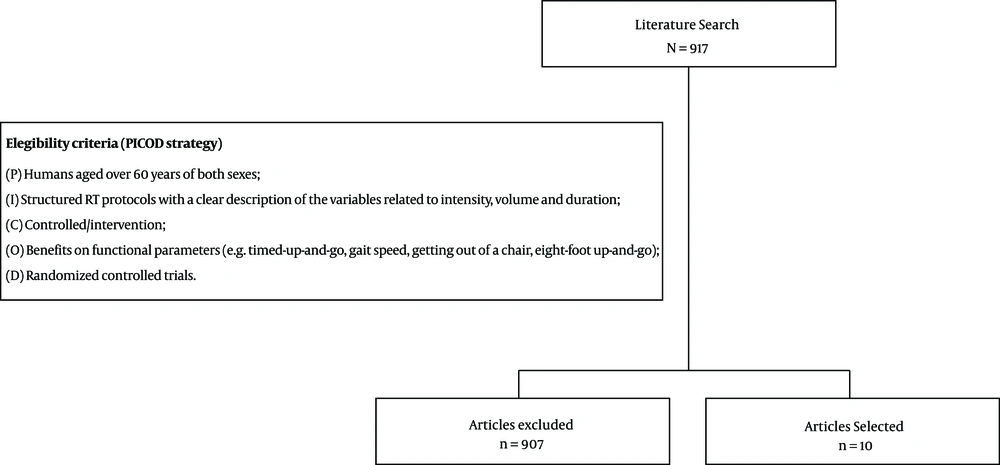
Figure 1.
Flowchart of the literature review process
2.2. Study Identification and Selection
Relevant studies were identified through computerized and manual searches. For data collection, PubMed, Cochrane Central Register of Controlled Trials (CENTRAL), and Physiotherapy Evidence Database (PEDro) databases were systematically searched between 2009 (January) and 2020 (May). The following keywords were used for our search: elderly; older; functional capacity, functional fitness, physical function, functional autonomy, functional performance, physical capacity; resistance training; and resistance exercise (Figure 1).
The screening phase was performed by 2 independent reviewers. For each article, any discrepancy between the 2 reviewers was resolved by third reviewers reading and further analysis. In the first screening stage, studies were selected by titles plus abstracts, while the second screening stage required the assessment of full texts. The reviewers evaluated the methodological quality of the studies and extracted relevant data.
2.3. Article Quality Assessment
The methodological quality of the studies was evaluated by two independent reviewers using the PEDro scale (25).
The PEDro scale evaluates the following methodological quality aspects: 1- detailed eligibility criteria, 2- random allocation, 3- concealed allocation, 4- baseline prognostic similarity, 5- participant blinding, 6- physical therapist blinding, 7- outcome assessor blinding, 8- more than 85% follow-up for at least one primary outcome, 9- intention-to-treat analysis, 10- between- or within-group statistical analysis for at least one primary outcome, and 11- point estimates of variability given for at least one primary outcome. A study with a PEDro score of 6 is equated to a level 1 of evidence (6 – 8 good, 9 – 10 excellent), while a study with a score of 5 is given a level 2 of evidence (4 – 5 acceptable, 4 poor).
2.4. Data Extraction
The following characteristics were recorded for all articles: type of study; author; year of publication; participants (age); functional parameters (functional capacity, functional fitness, physical function, functional autonomy, functional performance, physical capacity; and details of RT protocols used (intensity, volume, and duration).
3. Results
A total of 917 articles were initially selected, of which 10 peer-reviewed articles met the search criteria. The 10 studies involved 433 elderly individuals (289 females, 144 males). The extracted data and population characteristics, outcomes and details of the RT protocols used are shown in Tables 1 and 2.
Table 1.
Main Characteristics of Randomized Controlled Trials Included (n = 8)
| Authors | Year | Samples | Positive Aspects of the Study | Negative Aspects of the Study | Main Findings | Quality (PEDro Scale) |
|---|---|---|---|---|---|---|
| da Silva et al. (26) | 2009 | 40 subjects (females) were randomized to either the experimental group (EG; n = 20; mean age of 64.5 ± 3.7 years) or control group (CG; n = 20; mean age of 71.9 ± 5.8 years) | Experimental study with the design of randomized groups tests before and after treatment. Adequate description of the variables of the resistance training. | Evaluations were not conducted by blinded investigators. | functional autonomy and general GDLAM index | Poor (3) |
| Emerson et al. (27) | 2015 | 23 subjects (females and males) were randomized to either the resistance exercise group (EXE; n = 11; mean age of 72.1 ± 6.6 years) or control group (CG; n = 12; mean age of 70.3 ± 5.6 years) | Experimental study with the design of randomized groups tests before and after treatment. | Lack of description about contraction velocity (concentric and eccentric phases) Evaluations were not conducted by blinded investigators. | chair ri cdse test | Poor (3) |
| Kalapotharakos et al. (28) | 2010 | 22 subjects (males) were randomized to either the resistance exercise group (RT; n = 7; mean age of 83.4 ± 2.8 years), resistance-exercise detraining (RDT; n = 8; mean age of 82.2 ± 2.2 years) or control group (CG; n = 7; mean age of 82.5 ± 3 years) | Experimental study with the design of randomized groups tests before and after treatment. | Lack of description about: contraction velocity (concentric and eccentric phases); rest interval between sets and exercises during the sessions. | timed-up-and-go and chair rising time tests | Acceptable (5) |
| Beltran Valls et al. (29) | 2013 | 23 subjects (11 females, 12 males) were randomized to either the trained group (TG) (n = 13) (mean age of 72 ± 1 years) or control group (CG) (n = 10) (mean age of 72 ± 1 years) | Experimental study with the design of randomized groups tests before and after treatment. | Lack of description about: rest interval between the sessions; Evaluations were not conducted by blinded investigators. | functional capacity | Acceptable (4) |
| Ramírez-Campillo et al. (30) | 2014 | 45 subjects (females) were randomized to either the high-speed resistance training group (n = 15; mean age of 66.3 ± 3.7 years), low-speed resistance training group (n = 15; mean age of 68.7 ± 6.4 years) or control group (CG; n = 15; mean age of 66.7 ± 4.9 years) | Experimental study with the design of randomized groups tests before and after treatment. | Lack of description about: rest interval between the sessions; rest interval between exercises during the sessions; Evaluations were not conducted by blinded investigators. | functional capacity for both RT interventions | Acceptable (4) |
| Turpela et al. (31) | 2017 | 92 subjects (50 females, 42 males) were randomized to either the training one group (EX1; n = 24; mean age of 70 ± 3 years), training two group (EX2; n = 23; mean age of 69 ± 3 years), training three group (EX3; n = 25; mean age of 70 ± 3 years) or control group (CON; n = 20; mean age of 69 ± 2 years) | Experimental study with the design of randomized groups tests before and after treatment. The long duration of the exercise program. | Lack of description about: contraction velocity (concentric and eccentric phases); number of exercises performed during each session; rest interval between exercises during the sessions; Evaluations were not conducted by blinded investigators. | functional parameters and functional capacity | Acceptable (5) |
| Marcos-Pardo et al. (32) | 2019 | 45 subjects (27 females, 18 males) (65-75 years) were randomized to either the moderate-to-high intensity resistance circuit training group (MHRCTG; n = 24) and control group (CG; n = 21). | Experimental study with the design of randomized groups tests before and after treatment. | Lack of description about: contraction velocity (concentric and eccentric phases); number of sets; rest interval between the exercises during the sessions. Evaluations were not conducted by blinded investigators. | functional tests | Acceptable (4) |
| Liao et al. (33) | 2017 | 46 subjects (females) were randomized to either the experimental group (EG; n = 25; mean age of 66.3 ± 4.4 years) or control group (CG; n = 21; mean age of 68.4 ± 5.8 years) | Experimental study with the design of randomized groups tests before and after treatment. Patients and examiners were blinded to the group assignment. | Lack of description about: number of exercises performed during each session; rest interval between sets and exercises during the sessions; rest interval between exercises during the sessions. | functional tests | Good (7) |
| Gray et al. (14) | 2018 | 53 subjects (36 females, 17 males) (≥ 70 years) were randomized to either the resistance training high-velocity group (HV; n = 20), resistance training low-velocity group (LV; n = 25), or active group (AG; n = 8) | Experimental study with the design of randomized groups tests before and after treatment. The long duration of the exercise program. | Lack of description about: rest interval between sets and exercises during the sessions; rest interval between exercises during the sessions; Evaluations were not conducted by blinded investigators. | agility (eight-foot up-and-go) | Good (6) |
| Botton et al. (34) | 2018 | 44 subjects (22 females, 22 males) were randomized to either the resistance training group (RTG; n = 22; mean age of 70.6 ± 6.7years) or control group (CG; n = 21; mean age of 68.6 ± 7.06) | Experimental study with the design of randomized groups tests before and after treatment. The allocation was blinded also with a response email containing a respective group that patient was allocated. | Lack of description about: rest interval between exercises during the sessions; rest interval between exercises during the sessions; Fewer patients than we expected attended to 70% or more of interventions sessions | functional tests | Good (7) |
Table 2.
Main Characteristics of the Different Resistance Training Protocols Applied on Functional Parameters of the Elderly (n = 8)
| Authors | Year | Number of Sets and Repetition | Intensity | Number of Exercises | Weekly Frequency and Duration of Program | Rest Interval | Type of Contraction | Contraction Velocity (Concentric and Eccentric Phases) | ||
|---|---|---|---|---|---|---|---|---|---|---|
| Between Sets | Between Exercises | Between Sessions | ||||||||
| da Silva et al. (26) | 2009 | 3 X 13 | 50% of 1RM | 7 | 3 days per week for 20 weeks | 40 seconds | 40 seconds | 48 to 72 hours (4 weeks) | Isotonic | Slow to moderate |
| 3 X 6 | 90 – 100% of 1RM | 1-2 minutes | 1-2 minutes | 48 to 72 hours (16 weeks) | ||||||
| Emerson et al. (27) | 2015 | 3 X 8 - 15 | 70 - 85% of 1RM + OMNI scale ranging from 0 to 10 | 12 | 2 days per week for 6 weeks | 90 seconds | 90 seconds | 48 hours | Isotonic | - |
| Kalapotharakos et al. (28) | 2010 | 3 X 10 | 70% of 3RM | 6 | 2 days per week for 14 weeks | - | - | 24 hours | Isotonic | - |
| Beltran Valls et al. (29) | 2013 | 1 - 2 weeks: 4 X 15 | 40 - 50% de 1RM | 4 | 2 days per week for 12 weeks | 2 minutes | 3 minutes | - | Isotonic | As quickly as possible/ moderate |
| 3 - 12 weeks: 3 - 4 X 10 - 12 | 70% of 1RM | |||||||||
| Ramírez-Campillo et al. (30) | 2014 | 3 X 8 | 45 - 75% of 1RM | 6 | 3 days per week for 12 weeks | 1 minute | - | - | Isotonic | High-speed resistance training group: 1 second or less / 3 seconds |
| 3 X 8 | 75% of 1RM | Low-speed resistance training group: 3 seconds / 3 seconds | ||||||||
| Turpela et al. (31) | 2017 | 2 - 5 x 4-12 | 70% - 100% of 1 RM) and 75% - 85% and 100% of 10 RM | - | EX1 group: 1 day per week; EX2 group: 2 days per week; EX3 group: 3 days per week; 6 months for all groups | 1-3 minutes | - | 24 hours | Isotonic | - |
| Marcos-Pardo et al. (32) | 2019 | 8 - 12 | 60 - 80% of 1RM | 6 | 3 days per week for 12 weeks | 1-2 minutes | - | 24 hours - | Isotonic | - |
| Liao et al. (33) | 2017 | 3 X 10 | rate of perceived exertion: moderate | - | 3 days per week for 12 weeks | - | - | - | Isotonic | slow |
| Gray et al. (14) | 2018 | high-velocity: 3 X 10 | 50 - 80% of 1 RM | 8 | 2 days per week for 48 weeks | - | - | - | Isotonic | High-velocity: as quickly as possible / 2 seconds |
| low-velocity: 3 X 10 | 80% of 1 RM | low-velocity: 2 seconds / 2 seconds | ||||||||
| Botton et al. (34) | 2018 | 2-3 X 10 - 15 | OMNI scale ranging - 6 | 11 | 3 days per week for 12 weeks | 60 - 90 seconds | - | - | Isotonic | slow to moderate |
There were no accidents with individuals during the protocol (physical exercise sessions) in the 10 studies selected. However, individuals were excluded for the following reasons: absence from training days; lack of motivation; lack of interest; scheduling conflicts, health problems; problems with evaluation; cardiac arrhythmia; back pain; family factors; hospitalization for reasons unrelated to the study; personal reasons; being part of the control group; and dropping out of the study.
4. Discussion
To date, this is the first review study investigating the effects of RT on functional parameters of the elderly, after undertaking a detailed analysis of the exercise protocols surveyed (Tables 1, 2). We cannot safely state that any of these resistance exercise protocols would lead to improved performance of functional parameters (eg timed-up-and-go, gait speed, getting out of a chair) of this population, given the limitations we found (e.g. lack of description of important RT variables and methodological quality in most of the studies).
For elderly individuals, due to their loss of fast twitch fibers, moderate to high intensity training is recommended after an adaptation phase (35). In this sense, an interesting way to prioritize the recruitment of these fibers is to perform isotonic resistance exercises with the fastest contraction possible during the concentric phase. Gray et al. (14) have demonstrated improved physical function among community-dwelling older adults using a RT protocol performed with rapid contractions. Similarly, Beltran Valls et al. (29) and Ramírez-Campilloet al. (30) have used protocols involving rapid contractions and found positive effects on the components of the functional capacity of the elderly.
Additionally, it was possible to observe improvements in functional parameters through other resistance exercise protocols. Kalapotharakos et al. (28) have demonstrated positive changes in functional parameters of the elderly after only 16 and 28 sessions of RT. In this sense, other relevant studies conducted by da Silva et al. (26) and Emerson et al. (27) have observed positive effects on the functional capacity components of elderly women after only 12 RT sessions. The findings of these studies are probably associated with the effects of RT on the neural system, which promote positive changes in the frequency of firing of the nerve impulses, better intra and intermuscular recruitment, and greater synchronization of motor units.
In addition, Liao et al. (33) have found improvements in the components of the functional autonomy of the elderly after the practice of RT for 12 weeks. A key finding of their study was the positive effects of elastic bands in RT since this is a cost-effective, user-friendly protocol (36).
As mentioned before, many conditioning and strength professionals prescribe exercises based on the available literature, and this led us to discuss some key issues observed in the studies selected for this review study. In this sense, we observed (Table 2) a lack of description of some key variables (14, 27-34) in the prescription of RT [contraction velocity (concentric and eccentric phases); number of sets; number of exercises performed during each session; rest interval between sets and exercises during the sessions; rest interval between the sessions]. Other non-randomized studies have likewise observed the same problem (10, 37). Although Gray et al. (14) and Liao et al. (33) have demonstrated positive effects of RT, they did not describe the rest intervals used between sets in their research. In addition, we found it difficult to identify the number of exercises performed and the rest interval between the exercises in the otherwise interesting studies conducted by these authors.
Furthermore, another important variable in the prescription of RT is intensity, based on percentages of one repetition maximum (1RM). In the study conducted by da Silva et al. (26), RT was administered in the following way: 4 weeks (3 sets of 13 repetitions at 50% of 1RM) plus 16 weeks (3 sets of 6 repetitions at 90 - 100% of 1RM). However, performing 6 repetitions with a pre-determined intensity does not seem feasible; according to Gambassi et al. (9) and Baechle and Earle (38), it is only possible to perform a maximum of 6 repetitions at 85% of 1RM.
This review study found that the practice of different resistance exercise protocols (duration, frequency, and pre-established intensity) may promote improvements in the functional parameters of the elderly (e.g., timed-up-and-go, gait speed, getting out of a chair, eight-foot up-and-go). However, only 3 of the included studies presented good methodological quality (PEDro Scale), and the main RT variables were described in only 1 research. Given the above, we cannot state, with a reasonable degree of certainty, that the majority of the RT protocols surveyed are indeed effective in improving the functional parameters of the elderly. Thus, strength and conditioning professionals should exercise caution when choosing a resistance exercise protocol aimed at improving the functional parameters of the elderly.