1. Background
Adipose tissue is now emerging as a unique active endocrine organ secreting various adipokines. The complement C1q tumor necrosis factor-related protein 3 (CTRP3), adiponectin, tumor necrosis factor alpha (TNF-alpha), as well as other proteins with distinct C1q domain are collectively grouped as C1q/TNF superfamily. CTRP3 is one of the novel adipokines acknowledged as an anti-inflammatory, anti-apoptotic, pro-angiogenic, and cardio-protective molecule, with numerous anti-diabetic properties according to various studies conducted in diet-induced obese mouse models (1-4). Previous studies suggest that CTRP3 is the closest functional homologue of adiponectin, which has an important role in inflammation and metabolism (5, 6).
In particular, CTRP3 attracted a great attention in recent years especially in glycolipid metabolism and pathogenesis of cardiovascular diseases. Cardiovascular function can be non-invasively reflected by the autonomic functions disturbed in cardiovascular diseases leading to mortality (7). Decreased cardiac vagal outflow in obesity may be contributed to chronic hyperinsulinemia (7). Sympathetic overactivity in obesity is likely to be multifactorial and adipokines play a fundamental role amongst all of them (8-10). The components of the metabolic syndrome that may directly or indirectly enhance sympathetic drive include hyperinsulinemia, leptin, non-esterified fatty acids, and pro-inflammatory cytokines (11). Sympathetic overdrive may be a common thread to the functional evolution of metabolic syndrome and its consequences. In several clinical adult populations, a negative association is demonstrated between adiponectin and sympathetic activity, as well as a positive association with parasympathetic activity. However, there is ambiguity in results with regards to the association between the autonomic balance and leptin (12-15). Heart rate variability (HRV) is a good tool to quantify the tone of autonomic nervous system to the myocardium called the cardiac autonomic tone (16).
Compared with other adipocytes, there is still a paucity of data with conflicting results about the role of CTRP3 in metabolic syndrome, systemic inflammation, and Insulin resistance (17-21). The potential use of circulating CTRP3 levels as a biomarker for risk or the presence of cardiovascular disease is not yet established. Moreover, to the best of authors` knowledge, no study explored the clinical correlation of CTRP3 with autonomic functions in obesity yet. This motivated the authors to study the clinical characteristics of CTRP3 with autonomic and metabolic parameters in obesity, understand their complex interplay in the body, and work together and independently.
2. Objectives
The current study aimed at assessing and correlating CTRP3 levels with the metabolic and autonomic parameters in obesity.
3. Methods
3.1. Study Design
The current retrospective, analytical, case-control study was conducted from October 2015 to April 2017, in a tertiary care community hospital in India. It was a non-randomized study with convenient sampling strategy; since the subjects were recruited from the general population based on their body mass index (BMI). The studied outcome measures were serum CTRP3, fasting metabolic parameters, and cardiac autonomic function tests including HRV in both groups.
Prior written informed consent was obtained from all subjects explaining the duration, type, and objectives of the study. Ethical clearance was obtained for the study from the Institutional Research Protocol and Ethics Committee Board.
3.2. Subjects
The study design was consistent with the emphasis made by World Health Organization (WHO) Western Pacific Regional Office to use BMI > 25 kg/m2 as a new cutoff point to redefine obesity in the Indian population (21). Newly diagnosed treatment/drug naïve subjects with BMI 25-35 kg/m2, without comorbidity, smoke, and alcohol consumption were included in the study group as cases (group I, n = 30) and the same number of age-, gender-, and socioeconomic-status-matched subjects with BMI 19 - 23 kg/m2 were taken as controls (group II, n = 30). Subjects with diabetes mellitus, hypertension, or any other chronic illness such as malignancy, tuberculosis, hepatic or renal disease, any clinically proven endocrine disorders pertaining to obesity such as hypothyroidism, the Cushing syndrome, polycystic ovarian syndrome (PCOS), pregnant/lactating females, history of weight loss surgery, long-term medications such as steroids, weight loss intervention, oral contraceptive pills, and history of substance abuse were excluded from the study.
Autonomic functions, metabolic parameters, and CTRP3 levels were assessed in both groups under similar laboratory conditions. Ophthalmologic examination was also performed as a prerequisite for Valsalva maneuver for each subject.
3.3. Anthropometric and Clinical Measurements
The subjects were diagnosed as obese and treatment naïve based on complete history and physical examination, and BMI was calculated as the subject's weight in kilograms to height in meters squared. Venous blood (5 mL) sample was collected in the morning under aseptic conditions after overnight fasting. Blood was centrifuged at 3000 rpm for 20 minutes; serum was aliquoted and stored at -80°C to analyze the metabolic parameters (fasting blood glucose, aspartate aminotransferase (AST), alanine aminotransferase (ALT), total cholesterol, triglyceride, low-density lipoprotein (LDL)-cholesterol, high density lipoprotein (HDL)-cholesterol, and glycated hemoglobin (HbA1c).
3.4. Metabolic Parameters (Specific Laboratory Measurements)
3.4.1. CTRP3
CTRP3 was estimated using the commercial human ELISA (enzyme-linked immunosorbent assay) kit from Wuhan EIAab Science Co., Ltd. for quantitative determination of human CTRP3 in biological fluids. Assay format was 96 wells. The undiluted standard (5000 pg/mL) was recombinant protein based and the detection range of the kit was 78-5000 pg/mL. Normal CTRP3 levels ranged in plasma and serum from 0.1 to 1 μg/mL.
3.4.2. Human Adiponectin
Adiponectin was estimated using the AssayMax Human™ Adiponectin ELISA research kit by Assaypro LLC, designed to detect adiponectin in human plasma, serum, urine, milk, saliva, and cell culture supernatants. The human adiponectin standard (125 ng) in a buffered protein base was reconstituted with 2.5 mL of mix diluents to generate a 50 ng/mL standard stock solution.
3.4.3. Human Leptin
Leptin was estimated using commercial human leptin ELISA kit from Boster Biological Technology Co., Ltd. The standard product used in this kit was recombinant human leptin standard solution (10 ng/mL = 10,000 pg/mL).
3.4.4. Human Insulin
Fasting insulin levels were measured using insulin ELISA kit from DiaMetra Co., Ltd. It is a direct solid-phase enzyme immunoassay to quantitatively determine insulin in human serum or plasma. The highest concentration of the given calibrator was 200 µIU/mL. Insulin resistance was calculated using homeostasis model assessment of insulin assessment (HOMA-IR) (22).
3.5. Atherogenic Index of Plasma
Atherogenic index of plasma (AIP) is a logarithmically transformed ratio of molar concentrations of triglycerides to HDL-cholesterol (23).
3.6. Autonomic Function Tests for Cardiac Autonomic Tone
Autonomic function tests of all subjects were recorded using AD Instruments Finometer-MIDI system, Model 2, Finapres Medical Systems BV. It is a noninvasive finger arterial pressure measurement instrument for a continuous noninvasive hemodynamic monitoring.
Autonomic function tests were performed after giving proper instructions to the subjects prior to the test. The subjects were asked to fast overnight and abstain from coffee, nicotine, or alcohol, including over-the-counter cough and cold medications, 24 hours prior to the test. On the day of testing, the patients were asked to wear loose and comfortable clothing. They were instructed to rest in comfortable supine position with eyes closed and refrain from sleep or any body movement for about 10 - 15 minutes. The ambient room temperature was maintained at 24°C. Both electrocardiogram (ECG) and respiration were recorded continuously throughout the testing period.
The ECG data was analyzed offline for HRV, excitation: inhibition (E:I) ratio, 30:15 ratio, and Valsalva maneuver. Beat-to-beat blood pressure data was also analyzed for autonomic tests of sympathetic activity, lying to standing test (LST), sustained handgrip test (SHT), and cold pressor test (CPT) (24).
3.7. Heart Rate Variability
Offline analysis of ECG was performed using Labchart Pro 8 (AD Instruments, Australia) for HRV. A five-minute ECG segment was selected to compute baseline HRV in all subjects while lying supine for about 5 - 10 minutes. During each set, continuous individual RR intervals were computed from ECG using Labchart Pro 8 and the time and frequency domain indices were computed automatically. Time domain indices of HRV used for the current study were SDNN (standard deviation of all NN intervals), RMSSD (square root of the mean squared differences of successive NN intervals), and pNN50 (the proportion of differences in consecutive NN intervals that are longer than 50 ms). In frequency domain indices, low frequency (LF) band (0.04 - 0.15 Hz), high frequency (HF) band (0.15 - 0.45 Hz), and LF: HF ratio were used for the current study. The measurement of LF and HF power components were generated both in absolute values of power (ms2) and normalized unit (nu) by the software (16).
3.8. Statistical Analysis
The data were analysed with SPSS (Statistical Package for the Social Sciences) version 20 and expressed as mean ± standard deviation (SD). The baseline values of the two groups were checked for normal distribution by the nonparametric Kolmogorov-Smirnov test. The unpaired Student t-test was applied to compare the metabolic and autonomic parameters between the cases (group I) and the controls (group II); P < 0.05 was considered the level of significance. Pearson correlation and linear regression analysis were performed to correlate CTRP3 with all the other parameters in group I.
4. Results
The current study was conducted on 60 age- and gender-matched subjects (M:F = 30:30) with a mean age of 27 ± 5.3 years (range: 19 - 40) with matched socioeconomic status (Kuppuswami scale 2017). Mean BMI of the cases (group I, n = 30) was 33.70 ± 4.40 kg/m2 and that of the controls (group II, n = 30) was 22.25 ± 1.62 kg/m2. The baseline characteristics of all the subjects are summarized in Table 1.
Table 1.
| Baseline Parameter | Group I Cases (N = 30) | Group II Controls (N = 30) | P Value Unpaired t-Test |
|---|---|---|---|
| Age, y | 27.70 ± 5.34 | 27.40 ± 5.30 | 0.83 |
| Gender, No. | |||
| Male | 15 | 15 | |
| Female | 15 | 15 | |
| Socioeconomic status (the Kuppuswamy scale) | 23.73 ± 5.86 | 23.67 ± 5.35 | 0.96 |
| Weight, kg | 87.88 ± 10.73 | 59.23 ± 7.45 | < 0.001 |
| Height, m | 1.62 ± 0.09 | 1.63 ± 0.07 | 0.57 |
| BMI, kg/m2 | 33.70 ± 4.40 | 22.25 ± 1.62 | < 0.001 |
| Systolic blood pressure, mmHg | 118.20 ± 6.54 | 117.92 ± 6.20 | 0.99 |
| Diastolic blood pressure, mmHg | 84.00 ± 2.20 | 80.00 ± 3.16 | 0.99 |
| HbA1c, % | 5.51 ± 0.08 | 5.49 ± 0.09 | 0.54 |
| TSH, mIU/L | 3.39 ± 1.36 | 3.28 ± 1.13 | 0.74 |
Abbreviations: BMI, body mass index; HbA1c, glycated hemoglobin; TSH, thyroid stimulating hormone.
a P value < 0.05 was considered the level of significance.
bValues are expressed as mean ± SD unless otherwise indicated.
In the current study, serum CTRP3 levels significantly decreased in subjects with obesity (P < 0.001). A comparison of various metabolic parameters between the cases (group I) and controls (group II) is shown in Table 2. Significantly lower circulating levels of adiponectin (P = 0.025) and significantly higher levels of leptin (P = 0.043) were observed in the obese cohort. Significantly higher means of BMI, fasting glucose, LDL-cholesterol, serum triglycerides, Insulin, and HOMA-IR were observed in obese subjects as compared to the controls.
| Metabolic Parameter | Group I Cases (N = 30) | Group II Controls (N = 30) | P Value Unpaired t-Test |
|---|---|---|---|
| Fasting blood sugar, mg/dL | 91.27 ± 2.56 | 84.10 ± 7.04 | < 0.001 |
| Insulin, mIU/L | 9.06 ± 6.97 | 4.92 ± 1.66 | 0.003 |
| HOMA-IR | 829.96 ± 641.17 | 413.13 ± 141.33 | < 0.001 |
| Total cholesterol, mg/dL | 186.90 ± 24.93 | 187.73 ± 38.78 | 0.92 |
| HDL-cholesterol, mg/dL | 44.97 ± 10.19 | 53.03 ± 7.15 | < 0.001 |
| LDL-cholesterol, mg/dL | 116.80 ± 20.77 | 106.67 ± 27.09 | 0.05 |
| Triglyceride, mg/dL | 141.60 ± 40.41 | 94.86 ± 23.93 | < 0.001 |
| Atherogenic index of plasma | 0.49 ± 0.15 | 0.24 ± 0.13 | < 0.001 |
| Total bilirubin, mg/dL | 0.89 ± 0.39 | 0.51 ± 0.19 | < 0.001 |
| AST, IU/L | 28.77 ± 19.4 | 30.03 ± 16.4 | 0.79 |
| ALT, IU/L | 28.77 ± 19.49 | 30.03 ± 16.40 | 0.59 |
| ALP, IU/L | 93.23 ± 20.74 | 92.93 ± 17.89 | 0.95 |
| CTRP3, ng/mL | 258.22 ± 147.62 | 588.48 ± 342.64 | < 0.001 |
| Adiponectin, ng/mL | 100.77 ± 31.64 | 118.50 ± 27.60 | 0.02 |
| Leptin, pg/mL | 27.48 ± 11.97 | 22.79 ± 2.26 | 0.04 |
Abbreviations: ALP, alkaline phosphatase; ALT, alanine aminotransferase; AST, aspartate aminotransferase; CTRP3, C1q/TNF- related protein-3; HOMA-IR, homeostasis model assessment of insulin resistance.
a P value < 0.05 was considered the level of significance.
bValues are expressed as mean ± SD.
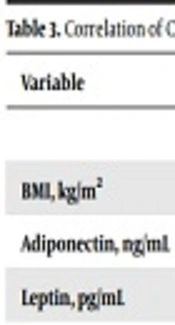
A negative correlation of CTRP3 with serum triglycerides, atherogenic index, and leptin was observed in group I as well as a positive correlation between CTRP3 levels and adiponectin. However, no significant correlation was observed between CTRP3 and insulin or HOMA-IR (Table 3).
Table 3.
Correlation of CTRP3 with Metabolic Parameters in Subjects with Obesitya
| Variable | r Value | P Value |
|---|---|---|
| BMI, kg/m2 | -0.22 | 0.24 |
| Adiponectin, ng/mL | 0.42 | 0.02 |
| Leptin, pg/mL | -0.39 | 0.02 |
| Insulin, mIU/L | 0.10 | 0.57 |
| HOMA-IR | 0.65 | 0.62 |
| Triglyceride, mg/dL | -0.09 | < 0.001 |
| Atherogenic index of plasma | -0.37 | 0.04 |
Abbreviations: BMI, body mass index; HOMA-IR, homeostatic model assessment of insulin resistance.
a P value < 0.05 was considered as the level of significance.
The comparison of various autonomic parameters between the case (group I) and controls (group II) is depicted in Table 4. There was a significant decrease in parasympathetic indices (pNN50, RMSSD, E:I ratio, 30:15 ratio, and Valsalva ratio), and an increase in sympathovagal balance (LF:HF ratio) in the subjects with obesity as compared to those of the controls, which is suggestive of a sympathetic overdrive in obesity.
| Variables | Group I Cases (N = 30) | Group II Control (N = 30) | P Value Unpaired t-Test |
|---|---|---|---|
| HRV parameter | |||
| RMSSD | 25.91 ± 15.06 | 56.30 ± 27.09 | < 0.001 |
| pNN50 | 6.42 ± 11.34 | 31.79 ± 19.42 | < 0.001 |
| LF | 135.81 ± 404 | 38.38 ± 8.06 | 0.20 |
| HF | 74.35 ± 202.56 | 59.56 ± 7.62 | 0.70 |
| LF/HF ratio | 1.77 ± 0.54 | 0.67 ± 0.18 | < 0.001 |
| Parasympathetic function tests | |||
| E: I ratio | 1.35 ± 0.27 | 1.52 ± 0.23 | 0.02 |
| 30:15 ratio | 1.31 ± 0.12 | 1.45 ± 0.17 | 0.003 |
| Valsalva ratio | 2.09 ± 0.83 | 1.66 ± 0.26 | 0.01 |
| Sympathetic function tests | |||
| Lying to standing test (SBP in mmHg) | 7.87 ± 0.57 | 8.30 ± 0.95 | 0.08 |
| Sustained handgrip test (DBP in mmHg) | 21.77 ± 7.01 | 21.80 ± 4.59 | 0.98 |
| Cold pressor test (DBP in mmHg) | 21.87 ± 6.44 | 22.33 ± 6.28 | 0.77 |
Abbreviations: 30:15 ratio, quotient of the maximal (around 30th heart beat) to minimal (near 15th heart beat) RR interval; CPT, cold pressor test; DBP, diastolic blood pressure; E:I ratio, ratio of the longest RR interval during expiration and the shortest RR interval during inspiration; HF, high frequency; LF, low frequency; LST, lying to standing test; pNN50, proportion of differences in consecutive NN intervals that are longer than 50 ms; RMSSD, square root of mean squared difference of successive NN intervals; SBP, systolic blood pressure; SHT, sustained handgrip test.
a P value < 0.05 was considered as the level of significance.
b Values are expressed as mean ± SD.
A significant positive correlation of CTRP3 in obesity was observed with various parasympathetic indices (pNN50, 30:15 ratio); while an inverse correlation was found with sympathovagal balance (LF: HF ratio) (Table 5).
Table 5.
Correlation of CTRP3 With Heart Rate Variability and Autonomic Parameters in the Study Groupsa
| Variable | r Value | P Value |
|---|---|---|
| Heart rate variability | ||
| RMSSD | 0.15 | 0.42 |
| pNN50 | 0.17 | 0.05 |
| LF | -0.27 | 0.13 |
| HF | 0.25 | 0.17 |
| LF/HF ratio | -0.35 | 0.05 |
| Parasympathetic function tests | ||
| E:I ratio | 0.02 | 0.88 |
| 30:15 ratio | 0.62 | < 0.01 |
| Valsalva ratio | 0.14 | 0.30 |
| Sympathetic function tests | ||
| Lying to standing test (SBP in mmHg) | -0.30 | 0.09 |
| Sustained handgrip test (DBP in mmHg) | -0.04 | 0.80 |
| Cold pressor test (DBP in mmHg) | -0.06 | 0.74 |
Abbreviations: 30:15 ratio, quotient of the maximal (around 30th heart beat) to minimal (near 15th heart beat) RR interval; CPT, cold pressor test; DBP, diastolic blood pressure; E:I ratio, ratio of the longest RR interval during expiration and the shortest RR interval during inspiration; HF, high frequency; LF, low frequency; LST, Lying to standing test; pNN50, proportion of differences in consecutive NN intervals that are longer than 50 ms; RMSSD, square root of mean squared difference of successive NN intervals; SBP, systolic blood pressure; SHT, sustained handgrip test.
a P value < 0.05 was considered as the level of significance (calculated by Pearson correlation and linear regression analysis).
5. Discussion
The findings of the current study suggested that serum CTRP3 levels significantly reduced in subjects with obesity. However, the reported associations between obesity and CTRP3 levels are contradictory in literature. According to literature, CTRP3 levels is elevated, showed no changes, or even reduced with obesity (3, 17-20, 25-27). Although previous studies support that BMI was a significant predictor of CTRP3 levels (3, 19, 20, 25, 26), the current study data indicated no significant correlation between CTRP3 and BMI, considering a mean BMI of 33.70 ± 4.40 kg/m2 in the group I (classification of obesity by WHO for Asian population). This could be due to lower BMI and small sample size in the current study. In most of the previous studies, varying proportions of male and female subjects were selected (3, 20, 21, 26, 28). The number of male and female subjects was equal in group I- the current study obese cases- and the obtained results on gender did not show any gender predilection for CTRP3 levels. Deng et al. reported smoking, alcohol consumption, and hypertension as confounding factors in obesity (25), while Wagner et al. found no significant correlation of CTRP3 levels in cases with coronary artery disease, dyslipidemia, hypertension, or tobacco use, but their CTRP3 levels were positively correlated with BMI in males and negatively correlated with BMI in female subjects (26).
In a recent article, contrary to the initial hypothesis of the current study, it was reported that breast milk CTRP3 levels elevated with obesity, indicating that the mammary gland may also express and regulate CTRP3 concentration in breast milk (29). Another recent research by Sawicka et al. reported an obesity paradox where they explained that although obesity is a risk factor for cardiovascular diseases, in case of heart failure, patients with obesity and overweight have a more favorable prognosis as compared to patients with normal body weight. They explained it partly by a positive effect of adipokines including CTRP3 produced by adipose tissue, particularly by the tissue located in the direct vicinity of the heart and blood vessels (30). It was contradictory to the previously known fact that the expression and production of CTRP3 significantly reduces in post-myocardial infarction (MI) patients and replenishment of CTRP3 protects the heart by attenuating post-ischemic pathologic remodeling and promoting cardiomyocyte-endothelial cell communication (4). These conflicting results can be explained by the fact that all of these studies examined the total level of CTRP3, but not considering the different splice variants or the multimeric structures of the circulating CTRP3. The high-order oligomeric complexes of CTRP3 occur solely between its two splice variants, CTRP3A and CTRP3B (31). Moreover, lysosomal-associated membrane proteins 1 and 2 (LAMP I and LAMP II) are identified as receptors for CTRP3, both being widely expressed in a number of different tissue involved in a variety of functions attributed to CTRP3 (31). Since CTRP3 is endogenously co-expressed in many tissues with other proteins within the C1q/TNF superfamily, it may diversify functions and is likely to modify the function of CTRP3. Further research is required to understand the diversified molecular functions of CTRP3.
In the current study, decreased expression of CTRP3 was observed in subjects with obesity, which may alter the functions of various other adipokines such as adiponectin and leptin. This may contribute to dysregulation of metabolic homeostasis even in the absence of any associated co-morbid conditions. It was also observed that CTRP3 levels were inversely correlated with AIP, which is supposed to be an indicator of increased cardiovascular risk. The current study was probably the first to establish a correlation between CTRP3 and AIP.
To the best of authors knowledge, this is also probably the first study to correlate the CTRP3 levels with the results of autonomic function tests and heart rate variability. The presence of cardiac autonomic dysfunction is considered when at least one parasympathetic test result is abnormal, irrespective of a gynoid or android type of obesity (32). A significantly higher LF:HF ratio in the frequency domain and lowered values of pNN50 and RMSSD in the time domain indices of HRV represented a reduced vagal tone in subjects with obesity in the current study. The significant positive correlation of CTRP3 with parasympathetic indices (pNN50 and 30:15 ratio), and an inverse correlation between CTRP3 and sympathovagal LF/HF ratio in the current study also suggested that with decreasing CTRP3 levels in obesity, the sympathetic overdrive in the body increases. The lesser the CTRP3 levels, the greater the HRV may be unfavorable for the body. Thus, CTRP3 is a cardioprotective adipokine that may play an important role in pathophysiology of cardiovascular diseases.
No significant correlation was observed between CTRP3 and insulin or HOMA-IR in the current study; although the levels of insulin and HOMA-IR significantly raised in group I. In previous studies, CTRP3 reduced inflammation by improving the insulin signaling transduction and insulin sensitivity of IR 3T3-L1 in adipocytes (33, 34). CTRP3 may also exert its effect through adiponectin-like AMPK (5’AMP-activated protein kinase) insulin signaling pathways (as they bear structural homology to adiponectin) or through expression of Akt-HIF1α-VEGF axis or peroxisome proliferator-activated receptor-gamma (PPAR-γ) mediated pathway (35). Further studies are needed to determine signal transduction and molecular mechanisms supporting this hypothesis in order to link CTRP3, insulin sensitivity, and obesity.
One of the strengths of the current study was the inclusion and exclusion criteria designed to exclude the confounding factors that might alter CTRP3 levels, unlike most of the previous other studies. Moreover, autonomic function tests and their correlation with CTRP3 in obesity are not studied much. Hence, CTRP3 may be considered as a potential biomarker to develop therapeutic interventions and molecular targeted strategies to improve health and decrease risks associated with obesity.
Smaller sample size, type and sensitivity of antibodies used in ELISA, or a lower mean BMI for obesity as compared to previous studies could be certain limitations of the current study. Further analyses and larger sample sizes are needed to interpret this conflicting gender-dependent association of obesity and circulating CTRP3 levels.
5.1. Conclusions
Higher circulating levels of CTRP3 may promote a favorable autonomic and metabolic profile in obesity. Hence, CTRP3 may prove a potential novel biomarker to facilitate the prognosis of obesity and its co-morbidities.