1. Background
Social phobia is one of the most prevalent psychiatric disorders (1-5) and usually begins at young ages, between 14 and 34 years (2, 6-9). Studies have shown that on average people with severe symptoms have suffered from this disorder for 20 years (10, 11). Social phobia is a durable disorder even after years of treatment (12, 13). More than 80% of people who suffer from social phobia have another comorbid disorder (14, 15). This disorder causes more pervasive problems than other anxiety disorders (15-18). Retrospective and prospective epidemiological studies suggest that social phobia can create confusion and deep problems in life, including problems in school and college achievement (2, 11, 18) and can disrupt job performance (15, 16) and social development (2, 15, 16). Studies have shown that regardless of the cost of comorbidities, the annual per capita costs of social phobia is $ 6100 (19).
A wide range of therapies has been introduced for the treatment of social phobia (20). Pharmacotherapy (21), psycho-education, cognitive-behavioral therapy (22), behavior therapy (23) and psycho-analytic psychotherapy are common treatment methods for social phobia (24).
Effectiveness of different types of drugs has been studied in the treatment of social phobia (21). Selective serotonin reuptake inhibitors (SSRI) are first-line treatments of social phobia (Effect size of 0.65 with 95% confidence interval, 0.81 to 0.50) (20). Effectiveness of sertraline in several studies has been confirmed too (25-29).
Some studies have shown that social phobia or social anxiety disorder may respond to cognitive and behavioral therapy very slowly (30) and response to treatment with Cognitive behavioral therapy (CBT) for the treatment of social phobia-about 50%-is not satisfactory (31, 32). Also it seems that relaxation training alone is ineffective for the treatment of social phobia (33).
Although the effectiveness of psychodynamic psychotherapy on the treatment of several disorders has been studied, Fonagy (2005) stated “there is no controlled research study for two common problems; anxiety and social phobia” (34). Blanco and colleagues’ study (2003) also confirmed the absence of empirical studies on the effectiveness of psychodynamic psychotherapy on the treatment of social phobia (20).
McCullough’s approach, called Affect Phobia Treatment (APT), is one of the well-known short-term dynamic psychotherapies (35). McCullough has developed a specific manual for her therapeutic approach. According to her, facilitating the occurrence of emotions and leaving defense mechanisms ultimately leads to the relief of symptoms of the disorder. APT focuses on resolving emotional conflicts and the underlying psychodynamic framework. Three techniques are used in APT: affect restructuring, defense restructuring, and self/other restructuring (36). Affect restructuring consists of two parts. First, the therapist helps the patients to slowly become more related with their own internal emotional experiences. Second, they learn how to express emotions in interpersonal relationships. Defense restructuring consists of two parts. First of all, the therapist helps the patients to recognize their defenses against emotional problems. Then, the patients become familiar with the advantages and disadvantages of using these defenses and gradually give them up. Restructuring the sense of self and others consists of two parts. First, the individual’s relationship with oneself is guided toward creating more positive feelings. Second, person’s communications with others are guided to create satisfactory and good mutual relations (37).
2. Objectives
With regard to inadequate information about effectiveness of psychodynamic approaches in treating social phobia and relatively low impact of other treatment approaches, also considering the high prevalence and extensive damage of social phobia, the aim of this study was to compare the effectiveness of McCullough’s short-term dynamic psychotherapy versus medication (sertraline) in treating social phobia.
3. Materials and Methods
This study used a quasi-experimental design with pretest-posttest repeated measures in multiple groups. The data were gathered from 22 December 2011 to 19 June 2012. The sample consisted of 45 male students of Tehran University who met the criteria for social phobia. The inclusion criteria were as follows: SPIN score ≥ 24, age between 18 to 50 years, and meeting the DSM-IV-TR criteria for social phobia based on SCID. The exclusion criteria were as follows: being psychotic, or obsessive-compulsive; having bipolar, or organic brain disorders; drug and alcohol dependency; having impulse control disorders, cluster A and B personality disorders, active disorder on axis III, a history of suicidal thoughts and actions, a history of violent behavior; being on psychotropic medications or receiving psychotherapy for the treatment of social phobia during the last 6 months, or experiencing the symptoms of social phobia as part of other psychiatric disorders. The participants were randomly assigned into 3 groups: 1- psychotherapy (STDP), 2- medical therapy (MED) and 3- waiting list (WL).
The inclusion and exclusion criteria were evaluated by the demographic characteristic questionnaire and the Structural Clinical Interview for DSM-IV (SCID-I, II) (42). The Social Phobia Inventory (SPIN) (43) was used for the primary effectiveness variable, Global Clinical Impression-Severity and Improvement (CGI-S, CGI-I) (44) and Global Assessment of Functioning (GAF) (45) were used for the secondary effectiveness variables. All instruments have acceptable validity and reliability (SPIN: r > 0.80, CGI: r > 0.65, GAF: r > 0.69, and SCID: r > 0.90). Diagnostic interviews were conducted by a psychiatrist.
Patients in the STDP group received 21 individual psychotherapy sessions, twice per week, in addition to 4 initial and posttest evaluation sessions. The therapy sessions were conducted using McCullough’s manual. Members of the MED group received pharmacotherapy (sertraline) for 12 weeks. Patients in the WL group received no intervention. However, after the waiting period, they received preferred treatment services. Each group was evaluated 4 times during the study.
Statistical analyses were performed using SPSS version 16. Differences between groups in pretest and posttest scores of SPIN, GAF, CGI-I, CGI-S were assessed using analysis of variance, analysis of covariance, and Bonferroni as Post hoc test. Differences created during the T1, T2, T3, and T4 evaluations were analyzed using General Linear Model repeated measures analysis of variance.
Remission was defined as CGI-I = 1 and SPIN < 16. Response to treatment was defined as CGI-S ≤ 2 and 50% reduction in SPIN scores at posttest (T4) compared to the baseline (T1) scores (46). Differences between the groups in the percentages of the patients showing remission and responding to treatment were determined using Fisher exact test. The effect size was calculated using pretests and posttest mean scores and was evaluated by Cohen’s scale (Figure 1).
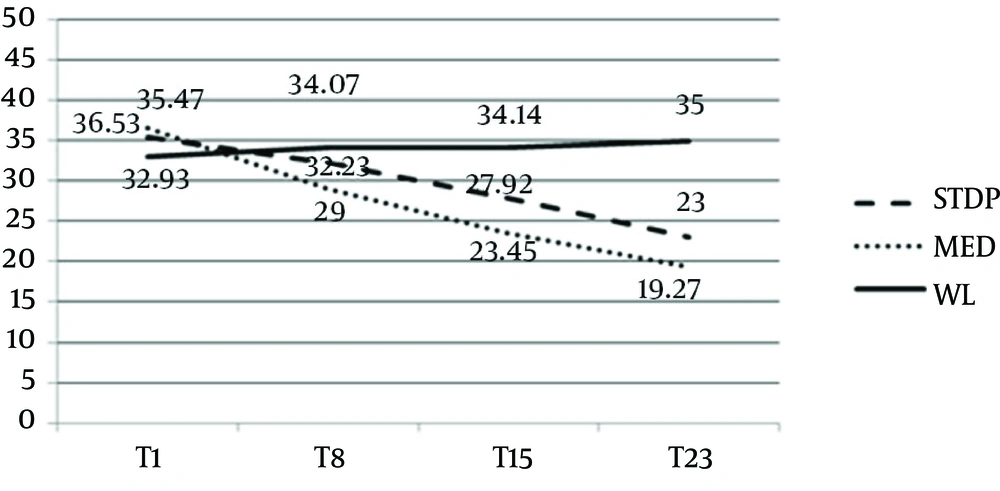
Figure 1.
SPIN Scores in the Assessments of T1, T2, T3, T4
4. Results
The demographic characteristics of the study sample are presented in Table 1. No significant differences were observed among the groups regarding the demographic variables, history of psychiatric problems, and drug use. Means and standard deviations of SPIN, GAF, and CGI-S scores at pretest and posttest evaluations for each group are presented in Table 2. There were no significant differences between the groups in terms of the pretest mean scores of SPIN (F = 0.737, P < 0.485), CGI-S (F = 1.35, P < 0.269), and GAF (F = 2.571, P < 0.88).
ANCOVA showed significant differences between the three groups regarding the posttest scores of SPIN (F = 23.51, P < 0.001). Pretest scores were considered as covariate. Bonferroni revealed that the posttest scores of STDP and MED were significantly different from WL scores (STDP-WL: x̅dif
Supplementary PDF file generated by publisher.
= -15.76, P < 0.001, MED-WL: x̅difSupplementary PDF file generated by publisher.
= -15.91, P < 0.001). However, no significant difference was noted between the STDP and MED groups (STDP-MED: x̅difSupplementary PDF file generated by publisher.
= 0.143, P < 0.313). Similar findings were obtained regarding CGI-S, CGI-I and GAF mean scores (Table 3).Repeated measures ANOVA revealed no significant differences regarding various assessments of SPIN between STDP and MED (within group effect, time group: F = 0.423, P = 0.658, between group effect, time group: F = 0.219, P = 0.645). But the measures of both groups were significantly different from WL (within group effect, time group: F = 14.86, P < 0.01, between group effect, time group: F = 25.28, P < 0. 01).
The numbers and percentages of the patients who had responded to treatment and had shown remission in each group are presented in Table 4. There were no significant difference among the groups regarding the number and percentages of the patients who had responded to treatment and showed remission. The effect sizes of interventions were calculated by comparing the pretest and posttest mean scores based on Cohen’s scale (Table 5).
| Group | STDP | MED | WL |
|---|---|---|---|
| Masters | 3 (20) | 5 (33) | 4 (26.7) |
| Bachelor | 12 (80) | 10 (67) | 11 (73.3) |
| Single | 15 (100) | 14 (93.34) | 15 (100) |
| Married | 0 (0) | 1 (6.66) | 0 (0) |
| Employed | 1 (6.66) | 0 (0) | 0 (0) |
| Unemployed | 14 (93.34) | 15 (100) | 15 (100) |
| Having | 2 (13.3) | 3 (20) | 1 (6.7) |
| No | 13 (86.7) | 12 (80) | 14 (93.3) |
| 24.26 ± 1.5 | 24.62 ± 2.8 | 24.47 ± 1.6 |
a Abbreviations: MED, medication; STDP, short-term dynamic psychotherapy; WL, waiting list.
b Data are presented as mean ± SD or No. (%).
Table 2.
The Means and Standard Deviations of Pretest and Posttest Scores for Each Group
| Group | STDP | MED | WL |
|---|---|---|---|
| Pretest | 35.47 ± 8.56 | 36.53 ± 9.13 | 32.93 ± 7.22 |
| Posttest | 23 ± 10.39 | 19.27 ± 8.86 | 35 ±7.22 |
| Pretest | 59.06 ± 6.94 | 63.46 ± 5.96 | 64.07 ± 6.4 |
| Posttest | 71.46 ± 6.85 | 70.72 ± 9.23 | 62.64 ± 7.76 |
| Pretest | 4.47 ± 0.990 | 3.93 ± 0.884 | 4.20 ± 0.775 |
| Posttest | 3.31 ± 1.43 | 2.73 ± 1.34 | 4.43 ± 0.851 |
a Abbreviations: CGI-S, Clinical Global Impression-severity; GAF, Global Assessment of Functioning; MED, medication; SPIN, Social Phobia Inventory; WL, waiting list.
b Data are presented as mean ± SD.
Table 3.
| Scale | CGI-S (F =11.54), (P < 0.001) | CGI-I | GAF (F = 19.97), (P < 0.011) |
|---|---|---|---|
| STDP-MED | 0.025 (0.98) | -0.035 (0.293) | 3.22 (0.510) |
| STDP-WL | -1.56 (0.001) | -1.37 (0.001) | 13.75 (0.001) |
| MED-WL | -1.58 (0.001) | -1.344 (0.001) | 10.52 (0.001) |
a Abbreviations: CGI-S, Clinical Global Impression-severity; CGI-I, Clinical Global Impression-improvement; GAF, Global Assessment of Functioning; MED, medication; STDP, short-term dynamic psychotherapy; WL, waiting list.
b Data are presented as x̅dif
Supplementary PDF file generated by publisher.
(P value).c CGI-I posttest scores were analyzed using ANOVA.
| Response to Treatment | Fisher Exact Test | Remission | Fisher Exact Test | |
|---|---|---|---|---|
| 4 (30.76) | P = 0.675 | 2 (15.38) | P = 1 | |
| 5(36.11) | 2 (18.18) |
a Abbreviations: MED, medication; STDP, short-term dynamic psychotherapy.
b Remission: CGI-I = 1 and SPIN < 16. Response to treatment: CGI-S ≤ 2 and 50% reduction in SPIN T4 scores than baseline.
| Scale | SPIN | CGI-S | GAF |
|---|---|---|---|
| STDP | 1.19 | 0.811 | 1.81 |
| MED | 1.94 | 0.895 | 0.79 |
| WL | 0.286 | 0.270 | 0.184 |
a Abbreviations: CGI-S, Clinical Global Impression-severity; GAF, Global Assessment of Functioning; MED, medication; STDP, short-term dynamic psychotherapy; WL, waiting list.
b Cohen’s d: 0 - 0.2, small; 0.3 – 0.5, medium; 0.6- 0.8, large; > 0.9, very large.
5. Discussion
Based on the results of the study, both short-term dynamic psychotherapy and treatment with sertraline were effective in significantly reducing the symptoms of social phobia as compared to the waiting list. These results are consistent with the findings of Bogels (47), and considering general psychiatric symptoms are in line with Crits-Christoph (48), Leichsenring (49, 50), and Lewis (51) studies. Both short-term psychodynamic and pharmacological interventions were almost equally effective in improving the overall functioning of patients with social phobia and had advantage over no treatment condition. These findings are consistent with the findings of Knekt (52) and Blanco (20) regarding the positive effects of psychodynamic psychotherapy on the various functions. Leichsenring (49) obtained an effect size of 1.29 for psychodynamic psychotherapy regarding the improvement in the overall functioning, which is lower than the one we obtained in the present study (ES = 1.81).
No significant differences were found between two groups in the number of patients who responded to the treatment (P = 0.675). Response to treatment rate obtained in this study (STDP: 30.76%) was smaller than the rates reported by Knijnik (79.3%) (53) and Bressi (60%) (54). There was no significant difference between two groups regarding remission rate (P = 1). However, the percentage of patients who had remission was higher in this study than the percentage reported by Knijnik (10.3%) (53).
In MED group, the percentages of patients who had remission and responded to treatment were 18.18% and 36.11%, respectively, which were lower than the findings of Van Ameringen study (25).
The obtained within group effect size based on Social Phobia Inventory for the psychodynamic psychotherapy (ES = 1.19) was almost similar to the ones reported by Leichsenring (ES = 1.39) (49) and Abbass (ES = 1.35) (55). However, the effect size for the psychotherapy group was lower than the one for the medication group (ES = 1.94). This result was consistent with the findings reported by Anderson (56) and Svartberg (38). In the medical intervention group, the obtained effect size (0.895) based on CGI-S scores was greater than the ones reported in other studies (25, 53, 57). Effect sizes obtained for both intervention groups were "very large" based on Cohen’s scale. Means of repeated evaluations in both medication and psychotherapy groups were not significantly different from each other (F = 0.219, P = 0.645), but both were significantly different from the waiting list (F = 14.86, P < 001).
Apparently, patients who received this therapy (APT) by becoming familiar and controlling their own defense mechanisms (such as pseudo altruism, projection, and idealization) get opportunity to better understand their feelings (mainly their fears) (37, 38) toward themselves and others and were able to show more easily their emotions. It also seems that this treatment modified and improved patients’ expectations and behaviors (37). These changes led to a reduction in symptoms of social phobia.
Overall, according to the results of this study, short-term psychodynamic psychotherapy is as effective as medication in alleviating the symptoms of social phobia and both interventions have large effect sizes in treatment of social phobia disorder. Thus, APT method of short-term psychodynamic psychotherapy can be considered as an effective method of treatment for social phobia.