1. Background
Chronic renal failure is a progressive, irreversible kidney disorder in which the body’s ability to maintain liquid and electrolytes is lost; it is considered a major problem in the health system, and is one of the leading causes of death and inability worldwide (1). The prevalence of chronic renal failure is 242 cases per one million people and this increases 8% annually worldwide (2).
Methods for the treatment of end-stage renal disease include long-term treatment with dialysis and kidney transplantation. The best method is kidney transplantation, but in most countries there is an insufficient number of donated kidneys; hence, hemodialysis is the most common treatment worldwide (3). In Iran, there are more than 13,000 dialysis patients, and 150,000 dialysis sessions are conducted each month (4).
Although hemodialysis as the main treatment for chronic renal failure increases dialysis patients’ lifespans, it causes numerous psychosocial problems for them (5-7). Economic problems, therapy-related stresses, dietary restrictions, and family problems are among factors that makes hemodialysis patients prone to anxiety (8). In addition, because of multiple and complex drug therapies, various difficulties and serious changes in lifestyle affect their psychosocial performance (9). The length of the disease course, the period of treatment, and dysfunction in the support system of hemodialysis patients leads to their inability to adapt to stressful situations (10). These conditions provide for increasing anxiety in patients undergoing hemodialysis, so that they experience high levels of stress, anxiety, and depression (11). In fact, it can be said that depression and anxiety are the most important reactions of patients with chronic renal failure (8).
Anxiety is a common psychological problem in patients with end-stage renal disease (10-12); it consists of unpleasant mental feelings, worry, and ambiguous tension along with physical symptoms such as perspiration, headache, restlessness, and heart palpitations. Normal anxiety can be rescuable. However, sometimes anxiety becomes escalated and changes into a mental disorder; such patients suffer from excessive anxiety (13).
According to the world health organization, from among the 870 million people who live in Europe, about 100 million suffer from anxiety and depression. The prevalence of 12-month anxiety disorder is 17.7%; lifetime anxiety disorder in women is 30.5%, and lifetime anxiety disorder in men is 19.2% (14). Prevalence of anxiety in hemodialysis patients is between 20% and 60% percent. Studies show that stress has a dramatic effect on hemodialysis patients and can increase illness, mortality, frequency of hospitalization, and cost of treatment (1). It also prevents adherence to diet and recommended therapies, and has a negative impact on self-care and treatment outcomes (11-15). In addition, it increases vulnerability to suicide of patients undergoing hemodialysis (16).
In addition to anti-anxiety drug treatments for these patients (7), there are several ways to treat anxiety, including psychological treatment and complementary medicine treatments. Complementary medicine and herbal medicine have developed globally, and these new treatments have gained a special status and value (17). Complementary medicine treatment is accepted as a part of nursing care in the United Kingdom. Nurses in over 30 countries are licensed to use complementary medicine therapies, such as aromatherapy, in nursing care (18).
Aromatherapy is a type of complementary medicine in which the volatile oil of plants is used to promote the level of physical, spiritual, and physiological health (19, 20). Aromatherapy is used in several forms, including massage, inhalation, compresses, baths, or topical application. Inhalation and massage are the most widely used forms, especially in nursing interventions (20, 21).
A large number of plants have been found useful for aromatherapy, including tea oil, chamomile, lemon balm, and rose oil (22). Damask rose is a native Iranian plant whose water has been used to improve physical and mental health since ancient times (23, 24). According to the studies conducted concerning this substance, it can relieve thirst, stop bladder bleeding, control pests, and enhance digestion. Also, it has antispasmodic, anti-bacterial, anti-virus, and hematopoietic effects. The damask rose can also be used to strengthen the nerves and to treat anxiety and depression (24-26).
Nursing care of the hemodialysis patients is very important, taking into account the high prevalence of chronic renal failure, the significant increase of hemodialysis patients, and their significant need for physical and psychological care. Rose water inhalation could be used as a safe, simple, and low-cost method in nursing care if it can be proved to be effective for the reduction of anxiety in hemodialysis patients. Currently, aromatherapy is only used with herbal scents such as lavender and orange. However, in light of the tranquilizing and anxiolytic effects of rose water noted since ancient times, the pleasant scent of this substance, and its availability, possible production, and processing in good quality within Iran, we decided to study the effects of rose water on the anxiety of hemodialysis patients in Birjand.
2. Objectives
This study aimed to investigate the effect of inhaling rose water aromatherapy on anxiety in hemodialysis patients.
3. Methods
This study is a randomized clinical trial that was conducted in the hemodialysis center of Birjand Vali-Asr hospital in 2014. The population included hemodialysis patients from Birjand and the sample was selected from the hemodialysis patients referred to the hemodialysis center. The necessary sample size for both the control and treatment group was calculated as 22 patients, and increased to 25 patients for each group given the likelihood of patients not completing the study. Convenience sampling was conducted and patients who had the inclusion criteria were divided randomly into two groups based on a previously prepared random list.
Inclusion criteria included undergoing dialysis ≥ 2 times a week and dialysis treatment ≥ 6 months. Exclusion criteria included having an acute stressful event (such as the death of a beloved one, etc) over the previous 6 months; using tranquilizers, anti-anxiety drugs, or other therapeutic interventions such as herbal essences; respiratory problems and smelling difficulties; not being able to cooperate or go on dialysis (kidney transplant, coma, death, etc) for any reason; or not having consent to continue the study. During the study, two participants were unwilling to continue cooperation: one patient underwent kidney transplant, and another patient went into a coma. Thus, 46 patients participated in the study.
The data collection tool in this study was a questionnaire containing two sections. The first section included demographic/clinical characteristics, and the second was the Spielberger’s State-Trait Anxiety Inventory. The Spielberger questionnaire included 40 items and consisted of two equal parts for measuring state and trait anxiety. Responses used the Likert scale, with each answer consisting of four options. Each item was scored from 1 to 4, and the achieved score was between 40 and 160, with higher scores indicating more anxiety. Its validity and reliability were confirmed in a study by Behdani et al.; the Cronbach’s alpha coefficient was 90% (27).
This clinical trial began after obtaining approval from the ethics committee of the Birjand University of Medical Sciences and registering in the Iranian Registry of Clinical Trials (IRCT2013052613476N1).
The patients in the active-treatment group were instructed to put three drops of rose water (at a concentration of 25%) on a clean absorbent cotton handkerchief using a dropper each night before sleeping and also 15 - 20 minutes before beginning dialysis sessions. They were requested to put the handkerchiefs in front of their noses for 15 to 20 minutes and breathe normally. The intervention continued for 4 weeks, during which time the control group received no intervention.
The data were collected by questionnaires after the research goal was completely explained to the subjects and their informed consent was obtained. The questionnaires were completed for both groups three times: before the intervention and at the end of the weeks 2 and 4 after the intervention. The data were analyzed with SPSS software (version 18) using the independent t-test, paired t-test, repeated measures analysis of variance (ANOVA), Kruscal Wallis, and one-way ANOVA statistical tests at α = 0.05.
4. Results
This study was conducted in the Vali-Asr hospital of Birjand on 46 hemodialysis patients who were assigned to two equal active-treatment and control groups. The average age for patients in the treatment group was 50.3 ± 19.4 years compared with 59.1 ± 10.1 years for the control group. In terms of age, there were no significant differences (P = 0.06) between the groups. In each of the groups, there were 12 men (52.2%) and 11 women (47.8%) (P = 1.00). Among those in the treatment group, 4 patients were single (17.4%), 17 were married (73.9%), and 2 were widowed (8.7%); in the control group, 21 patients were married (91.3%), 2 were widowed (8.7%), and there were no single patients. There was no significant difference between the groups in terms of marital status (P = 0.21). The two groups were similar with reference to education (P = 0.7) and employment (P = 0.21). Most subjects (39.1%) in both groups were illiterate.
The mean duration of dialysis for the patients in the treatment group was 2.26 ± 2.29 years and in the control group was 3.26 ± 2.52 years. In the treatment group, the cause of hemodialysis in 16 patients (69.6%) was pre-renal failure (21.7%), in 5 was renal failure, and in the others was post-renal failure; in the control group, 18 of the patients (78.3%) had pre-renal failure as the cause, 3 had renal failure (13%), and the others had post-renal failure.
Thirteen (56.5%) of the patient in the treatment group had undergone dialysis 2 times a week, and the rest had done so 3 times a week. In the control group, 14 patients (60.9%) had undergone hemodialysis 2 times a week, and it had been done three times a week for the rest. Regarding clinical characteristics, the groups were not significantly different regarding the duration of dialysis (P = 0.14), the cause of dialysis (P = 0.88), and the number of dialysis sessions per week (P = 0.76).
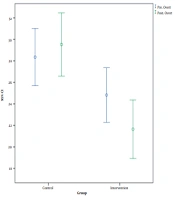
The scent of rose significantly reduced the mean state of anxiety in the treatment group from 47.47 ± 7.68 before the intervention to 37.1 ± 6.5 in week 4 after the intervention (P < 0.001), whereas the control group did not show any statistically significant difference (P < 0.43). Independent t-test results also indicate that there was a significant difference (P<0.001) between the mean state anxiety scores of the treatment group (37.1 ± 6.5) and the control group (49.5 ± 9.4) after week 4 of the intervention (Table 1).
Table 1.
Comparison of the Mean State Anxiety of Treatment and Control Groups Before the Intervention and 2 and 4 Weeks After the Intervention
| Group | Before Intervention, Mean ± SD | 2 Weeks Post-Intervention, Mean ± SD | 4 Weeks Post- Intervention, Mean ± SD | Repeated Measure ANOVA Test |
|---|---|---|---|---|
| Active treatment | 7.68 ± 47.47 | 8.7 ± 45.04 | 6.5 ± 37.1 | P < 0.001, F = 54.81, Df = 2 |
| Control | 9.47 ± 49.69 | 9.03 ± 49.04 | 9.4 ± 49.5 | P = 0.43, F = 66, Df = 2 |
| Independent T-test | t = 0.87, df = 44, P = 0.39 | t = 1.53, df = 44, P = 0.13 | t = 5.2, df = 44, P < 0.001 |
Abbreviation: ANOVA, analysis of variance; SD, standard deviation.
The results indicate that the scent of rose reduced the trait anxiety of the treatment group significantly (P < 0.001), from 49.65 ± 13.88 before the intervention to 42.91 ± 10.1 in week 4 after the intervention, whereas there is no such statistical difference in the control group (P = 0.38). Independent t-test results also indicate that there is a significant difference (P < 0.001) between the mean trait anxiety scores in the treatment group (42.91 ± 10.1) and the control group (52.8 ± 12.4) after week 4 of the intervention (Table 2).
Table 2.
Comparison of the Mean Trait Anxiety of Control and Treatment Groups Before the Intervention and 2 and 4 Weeks After the Intervention
| Group | Before Intervention, Mean ± SD | 2 Weeks Post-Intervention, Mean ± SD | 4 Weeks Post- Intervention, Mean ± SD | Repeated Measure ANOVA Test |
|---|---|---|---|---|
| Active treatment | 13.88 ± 49.65 | 10.83 ± 46.86 | 10.1 ± 42.9 | P < 0.001 |
| Control | 12.26 ± 52.78 | 12.3 ± 52.65 | 12.4 ± 52.8 | P = 0.38 |
| Independent T-test | t = 0.81, df = 44, P = 0.42 | t = 1.69, df = 44, P = 0.09 | t = 2.98, df = 44, P < 0.001 |
Abbreviation: ANOVA, analysis of variance; SD, standard deviation.
Results showed that the mean change in state anxiety scores (before and after the intervention) were independent of sex, age, education, marital status, and disease duration. The only significant factor affecting the mean change in state anxiety score was the cause of dialysis (P = 0.009) (Table 3).
Table 3.
Comparison of Differences of State Anxiety Scores Before and After the Intervention in Terms of Demographic and Clinical Variables
| Variable | Frequency | Mean Change ± SD | T-Test and ANOVA |
|---|---|---|---|
| Sex | t = 0.03, df = 44, P = 0.97 | ||
| Female | 24 | -5.8 ± 5.25 | |
| Male | 22 | -6.6 ± 5.31 | |
| Age, y | F = 0.97, df = 2 , 43, P = 0.38 | ||
| < 40 | 7 | 2.7 ± 8.27 | |
| 40 - 60 | 18 | -6.6 ± 4.83 | |
| > 60 | 21 | -6.4 ± 4.66 | |
| Marital status | F = 0.38, df = 2, 34 P = 0.68 | ||
| Single | 34 | -4.9 ± 6.3 | |
| Married | 4 | -3.1 ± 7.5 | |
| Widow | 4 | -7.6 ± 6.5 | |
| Duration, y | F = 0.81, df = 3, 42, P = 0.49 | ||
| < 1 | 12 | -6.3 ± 7.4 | |
| 1 - 3 | 20 | -6.3 ± 5.1 | |
| 3 - 5 | 8 | -5.5 ± 4.0 | |
| > 5 | 6 | -6.4 ± 3.1 |
Abbreviation: ANOVA, analysis of variance; SD, standard deviation.
The mean change in trait anxiety scores (before and after the intervention) were independent of sex, age, education, marital status, cause of dialysis, and duration (Table 4).
Table 4.
Comparison of Differences of the Trait Anxiety Scores Before and After the Intervention in Terms of Demographic and Clinical Variables
| Variable | Frequency | Mean Change ± SD | T-Test and ANOVA |
|---|---|---|---|
| Sex | t = 0.03, df = 44, P = 0.97 | ||
| Female | 24 | -2.70 ± 5.30 | |
| Male | 22 | -4.04 ± 6.84 | |
| Age, y | F = 3.42, df = 2, 43, P= 0.04 | ||
| < 40 | 7 | -8.6 ± 3.3 | |
| 40 - 60 | 18 | -2.6 ± 5.8 | |
| > 60 | 21 | -2.2 ± 6.3 | |
| Marital status | F = 4.1, df = 2, 34, P = 0.02 | ||
| Single | 34 | -10.0 ± 2.7 | |
| Married | 4 | -2.2 ± 5.6 | |
| Widow | 4 | -6.7 ± 8.0 | |
| Duration, y | F = 0.02, df = 3, 42, P = 0.99 | ||
| < 1 | 12 | -3.2 ± 7.4 | |
| 1 - 3 | 20 | -3.3 ± 5.7 | |
| 3 - 5 | 8 | -3.8 ± 6.1 | |
| > 5 | 6 | -3.0 ± 5.1 |
Abbreviation: ANOVA, analysis of variance; SD, standard deviation.
5. Discussion
In the present study, the scent of rose water was used to study the effects of aromatherapy on anxiety in hemodialysis patients. The results showed that the levels of trait and state anxiety in hemodialysis patients after the intervention were reduced significantly in the treatment group compared with the control group, whereas before the intervention there was no significant difference between the groups. This confirms the effectiveness of aromatherapy on the anxiety of patients undergoing hemodialysis.
Currently, much clinical research is being done on various applications of aromatherapy and the use of herbal oils around the world (28). Roses, lavender (lavandula), bergamot, oranges, and lemons, etc, are examples of essential aromatic oils that are commonly used to relieve anxiety, stress, and depression (29). Several studies that examined the effect of rose scents have obtained results similar to our study. For example, Sahebalzamani et al. (14) studied the effects of aromatherapy on the anxiety of undergraduate students. The results showed that aromatherapy, in the form of inhalation of a blend of rose and lavender essences, was effective on students’ anxiety. Their study was conducted on 260 students who were randomly placed into the control and treatment groups. Students receiving aromatherapy showed a significant decrease (P < 0.001) in the symptoms of anxiety and depression at the end of weeks 2 and 4 compared with the control group; anxiety scores before the intervention in the treatment and control groups were 99.6 ± 17.1 and 15.7 ± 99.3, respectively, and their depression scores in the treatment and control groups were respectively 9 ± 28.4 and 9.9 ± 29.1, respectively. Ghiasi et al. (2012) conducted a study to evaluate the effects of aromatherapy on anxiety level; the study was done on 130 veteran students randomly assigned to treatment and control groups. After the administration of the Spielberger’s State-Trait Anxiety Inventory as a pre-test to all subjects, an oil rose and lavender blend was inhaled every night for half an hour in the treatment group for 4 weeks. The control group received only sesame oil inhalation. At the end of weeks 2 and 4, a post-test was administered. The results indicated a significant reduction in anxiety symptoms of the students receiving treatment compared with the control group, thus showing the effectiveness of aromatherapy (30).
Some studies have also investigated the effects of other herbal oils, such as lavender aromas, on the anxiety of hemodialysis patients; they achieved results similar to the present study. Kanany et al. (1) studied the effects of aromatherapy on the anxiety of patients undergoing hemodialysis in 2010. The aromas used in his research included lavender, which, similar to rose, has anxiolytic effects. This clinical trial was conducted on 65 hemodialysis patients who were randomly divided into treatment and control groups. The results showed that the mean state and trait anxiety of patients were reduced after the use of aromatherapy at the end of week 4, suggesting that aromatherapy, in the form of inhaling lavender aromas, could significantly reduce anxiety levels in hemodialysis patients (1). In another study by Kanany et al. (2012), the effects of aromatherapy on anxiety in patients undergoing hemodialysis was examined using orange essence. The anxiolytic effects of orange essence are similar to those of rose, and it has been confirmed in studies, including the present study, that aromatherapy can significantly reduce trait and state anxiety (P < 0.001) compared with the time before the intervention. The mean state and trait anxiety in patients in the treatment group were reduced from 9.7 ± 46.9 and 9.2 ± 46.5 to 8.7 ± 35.9 and 8.9 ± 26.0, respectively, at the end of week 4 (31).
Itai et al. exposed hemodialysis patients to a condition in which they inhaled the scent of aromatic oils and to a condition without scents, and measured the impact of each condition on the anxiety and moods of hemodialysis patients (7). Aromatherapy to reduce anxiety in hemodialysis and other patients was studied by Oh et al. (2008). In this study, in which patients with presurgical anxiety were treated with aromatherapy in the form of a lavender and bergamot blend, the effectiveness of aromatherapy on the reduction of anxiety in those patients was confirmed (32).
Babashahi et al. (2010) investigated the effects of inhalation aromatherapy on patients’ anxiety for heart and abdominal surgery. They used a lavender essence, which significantly reduced the anxiety of the subjects after the intervention (P = 0.001) (18).
Wilkinson et al. conducted a study (2006) on 288 patients with cancer to investigate the effects of aromatherapy on the control of depression and anxiety in cancer patients in England. Sampling was done randomly and patients with cancer were divided randomly into control and treatment groups. The treatment group was treated with massage aromatherapy, and the controls were treated with common medical therapies. The results indicate a positive but short-term impact of aromatherapy on the anxiety and depression of cancer patients (33). Graham et al. (2003) examined the effects of inhalation aromatherapy on the anxiety of cancer patients during radiotherapy. Unlike the present study, this study did not confirm the effectiveness of aromatherapy on the reduction of the subjects’ symptoms of anxiety and depression, which may be due to the difference in the kind of diseases under study (hemodialysis and cancers patients) (34).
Postpartum women are another target population investigated for the effectiveness of aromatherapy on anxiety. Conrad et al. (2009), for instance, did one study on 28 postpartum women in which aromatherapy using an essential oil blend of rose otto and lavandula angustifolia was applied both through inhalation and the hand M technique for 4 weeks. The results showed that the intervention significantly decreased patients’ anxiety (35).
5.1. Conclusion
According to the results of the present study, rose water has a significant effect on the anxiety of hemodialysis patients (P < 0.001). Consequently, inhalation of rose water can be used to improve the patients’ psychological condition during hemodialysis.
We suggest that there should be further studies to compare the effects of rose water with other herbal oils and essences on hemodialysis patients and to investigate the effects of rose water and its anxiolytic property in other chronic illnesses