1. Background
Canal preparation is one of the main steps in root canal treatment (1). With the advent of rotary files in recent years, the size and taper of the prepared canal have changed compared to manual files. The canal prepared with manual files is completely irregular, while that prepared with rotary files is rounder and smoother. Theoretically, the canal is prepared with a uniform taper by rotary files leading to more uniform distribution of stresses on the canal wall and increased resistance against root fracture (2). Despite their numerous advantages, rotary files exert a larger stress on the root canal walls than manual files. On the other hand, significantly more rotations in the canal which are necessary to complete shaping with rotary instruments as compared with hand files which may cause crack formation (3). Yoldas et al. reported the formation of more dentin micro cracks during canal preparation by rotary files than manual files (4). Liu et al. observed apical dentinal detachment in 2.5% of manual files and 21.9% of rotary files (5). Moreover, NiTi rotary instruments with different tip designs and various tapers and cutting blades lead to stress concentration in dentinal walls and may increase crack formation (6, 7). The tensile strength of dentin is 160 MPa, but rotary files generate a stress of 311 - 368 MPa in the root dentin (8). Dentinal cracks and root fractures may appear when the tensile stress in the root canal walls exceeds the flexural strength of dentin (9).
Preparation taper is a factor predisposing the formation of dentinal defects so that the removal rate of dentin depends on the shape of the rotary file and its penetration rate. A larger removal rate of dentin results in a larger fracture rate. Niti rotary files with high taper cause dentinal crack formation in the dentin roots by increasing friction and stress inside the canal (10).
It is assumed that in comparison with full sequence systems, the use of a single file rotary instrument to prepare the whole canal may accumulate stress in the root canal space leading to a larger risk of dentinal cracks (11).
2. Objectives
To the best of our knowledge, there is no comparative study on the impact of single files with different kinematics and multi-file systems on the formation of dentinal cracks. Therefore, the aim of this study was to compare the Neoniti, Reciproc and ProTaper instruments on dentinal crack formation after root canal preparation of mesial roots of mandibular molars.
3. Methods
3.1. Teeth Selection
In this in-vitro study, 50 mandibular first molars with separate mesial and distal roots were selected. This study was approved by the Ethics Committee of Zahedan University of Medical Sciences (IR.ZAUMS.REC.1395.90). At first, teeth were examined radiographically and the teeth with completely formed roots, a root length of 20 - 22 mm, and a root curvature of less than 20º were included in this study. None of the teeth had signs of decay, root resorption, and calcification. The teeth with cracks, those with root surface defects or those fractured while preparing the cross sections were excluded.
3.2. Tooth Preparation
All tissue debris and plaques were removed from the root surface by manual curetting and subsequently immersing in 1.5% hypochlorite (Bojneh Co. Iran) for 10 min. After disinfection, the teeth were stored in normal saline. The distal root of the teeth were cut by diamond coated bur with air/water spray. Then all specimens were examined by stereomicroscopy (magnification: 12×) to detect any possible fractures, craze lines, cracks, and surface defects. The specimens with defects were excluded and replaced by sound molar teeth.
The specimens were randomly divided into 3 experimental groups (n = 15) and a control group (n = 5). The access cavity was prepared using a diamond fissure, air/water spray, and a high-speed handpiece. Canal patency was performed and working length of the canal was determined by k-file 15 (Dentsply, Maillefer, Ballaelues, Switzerland) at a distance of 1 mm shorter than the anatomical apex. To stimulate PDL the silicon-wash impression material (Colten Whaledent AG Altsatten, Switzerland) was used. Therefore, the roots were placed in a 5.5 putty block (Altsatten, Switzerland).
3.3. Root Canal Preparation
The teeth in Group 1 were prepared by the ProTaper universal system (Dentsply Maillefer, Ballaelous, Switzerland). The canals were prepared coupled with reduction gear rotary handpiece driven with a VDW silver Reciproc electromotor (VDW Co, Munich, Germany) according to the manufacturer’s instructions. First, the coronal region was prepared by SX file and then S1 and S2 were initially used with 300 rpm and a torque of 3 N/cm for flaring the coronal portion then F1, F2 and f3 were used to the working length with light pecking and in and out motion.
The teeth in group 2 were prepared by the Reciproc R25 system (VDW, Munich, Germany) with the File 25/0.08 according to the manufacturer’s instructions at 350 rpm and a torque of 4 N/cm with in and out motion in the “Reciproc ALL” Program to reach the working length.
The specimens in Group 3 were prepared by the Neoniti A1 system (Sjoding Sendoline, Kista, Sweden) with a single file 25/0.08 at 350 rpm and a torque of 1.5 N/cm.
In group 4 (control group) the tooth left unprepared.
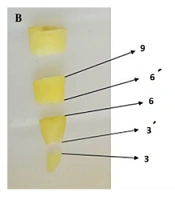
To prepare the canal through all the above methods, the canals were washed with 12 mL of 1.5% sodium hypochlorite. All specimens were cut 3, 6, and 9 mm distance from the apex by a low-speed saw (Isomet: Buehler Ltd. Lake Bluff.IL) under water spray as coolant. The samples were observed by a digital stereomicroscope (Olympus BX43). At a 12× magnification and images were taken. A total number of 45 images were taken from specimens in each group for examining the presence or absence of cracks. Two different groups were considered for crack definition (crack and no crack). To prevent confusion, non-crack was defined as dentin free of cracks and craze lines on the inner and outer surfaces of the root. In contrast, crack was defined as any line extending from the lumen inside the canal along the dentin thickness or from the outer surface of the root into dentin.
3.4. Data Analysis
Chi-square test was used to find significant differences in crack incidence between the study groups. Statistical analysis was performed using SPSS 20 software (SPSS Inc, Chicago, IL).
4. Results
Table 1 shows the distribution of dentinal defects in each group. All NiTi files significantly cause more dentinal defects compared to the control group (P < 0.05).
Table 1.
Distribution of Dentinal Defects in Different Root Canal Preparation Systems (P Value = 0.283)a
| Absolute Number of Cracks, mm | Total Cracked, Roots Per Group | |||
|---|---|---|---|---|
| 3 | 6 | 9 | ||
| Control | 0 (0) | 0 (0) | 0 (0) | 0 (0) |
| ProTaper | 0 (0) | 3 (20) | 0 (0) | 3 (20) |
| Reciproc | 0 (0) | 7 (46.7) | 0 (0) | 7 (46.7) |
| Neoniti | 0 (0) | 5 (33.3) | 1 (6.66) | 6 (40) |
aValues are expressed as No. (%).
No statistically significant difference was found between the NiTi files in terms of crack formation (P = 0.283). However, more cracks were formed in the Reciproc file than other files.
5. Discussion
According to the results, all instrumentation systems cause dentinal cracks regardless of file kinematics (full rotation or reciprocation). Previous studies have shown that different instrumentation and obturation techniques lead to dentinal cracks (7, 12). The difference between canal preparation instruments in terms of micro crack formation can be attributed to the difference in cross sections design and canal preparation techniques. The Reciproc file has an S-shaped cross-section with sharp cutting edges, while the ProTaper file has a triangular cross-section or a modified triangular cross-section with less cutting efficiency and smaller space for accumulation of debris (13). Despite the lack of a significant difference between different instruments, the reciprocation system creates more dentinal cracks than other systems. It has been reported that the reciprocal motion exerts a greater torsional force to the canal walls with a larger apical debris extrusion (14, 15).
Based on the results, the Neoniti A1 system ranks second after the Reciproc files in terms of crack formation. The large number of cracks in this system can be attributed to much more stress being imposed to dentinal walls primarily due to its high tapering. The mesial root of the mandibular first molar has a thin canal and the use of the Neoniti A1 file with a taper of 8% may cause more stress concentration resulting in the formation of micro cracks. On the other hand, this file is manufactured by EDM (electric discharge machining) process with a rough surface resulting in more crack formation (16).
According to Loizides et al., the ProTaper forms a sufficiently rounded cross section in the canal which may cause a uniform stress distribution along the canal and increased resistance against root fracture (17). The frequency of cracks in the ProTaper file is lower than other files. Preparation of a larger apical size (F3 30/0.09) by the ProTaper system can increase the stress on the canal wall and thereby crack formation, but the system has a convex triangular or modified triangular cross-sectional area which reduces its cutting efficacy. On the other hand, the preparation of the coronal region of the canal may reduce stress while preparing the apical region of the canal leading to less dentin defects. Some studies suggest an increase in crack development in the crown-down technique (7, 18). While the single length technique is used in the ProTaper system.
All cracks were formed in the middle thirds and coronal third by the Neoniti A1 and middle third by Reciproc files. According to Ustun et al., the Reciproc system results in crack formation in the coronal and middle thirds without any crack in the apical level which is somewhat consistent with our results (19). However, Gergi et al. found cracks in the apical and middle thirds (20). According to the results, the ProTaper system produces cracks in the middle third. Ustun et al. found cracks in the coronal, middle and apical thirds produced by the ProTaper system (19).
In a study by Jalali et al., the Reciproc system produced less cracks in the root canal wall than the ProTaper rotary systems (11). The occurrence of micro cracks in the Liu et al. study was reported 50% for proTaper and 5% for Reciproc. The frequency of cracks in the Reciproc system was greater than that of the ProTaper system in this study. This difference can be related to the amount of dentin removed from the canal wall. Despite flexural and rotary stresses to the dentin by the Reciproc motion, the single Reciproc files with greater taper may cause crack formation (21). According to the literature, single file systems can exert more stress than full-sequence systems. A larger stress concentration may in turn lead to micro crack formation (22). On the other hand, single files are 4 times faster than rotary files for instrumentation, and micro crack formation increases with increasing speed and torque (13, 23).
In general, micro crack formation depends on the cross-section design of the file, the final size of the canal preparation and preparation technique (24).
According to literature, factors such as age and dehydration may cause crack formation (25). Regardless of instrumentation stages, the stress to the root dentin increases with teeth dehydration (26). On the other hand, extraction time, storage condition, tooth length, canal shape, and canal volume affect the results (27). Considering the impact of the volume of root canal space, the use of CBCT before treatment for measuring the mesiodistal and buccolingual dimensions of the canal and standardization of canal shape and volume are recommended to be further investigated in future studies.
5.1. Conclusions
The ProTaper, Reciproc, and Neoniti files caused micro crack formation in the root canal. Despite the lack of a significant statistical difference between the three systems with different kinematics, the single file reciprocating systems caused more micro crack formation than single and full sequence rotary systems.