
1. Background
According to various definitions, aging starts at the age of 60 or 65. The health of the elderly is one of the most important challenges facing the global health system. The world's elderly population is projected to increase by about 2 million per year by 2050. In Iran, as in other countries, the increase in the elderly population is a significant concern, and based on recent census data, it is predicted that by 2050, aging will be considered a major health challenge in Iran (1).
In old age, progressive and irreversible physiological changes reduce a person's physical and mental abilities, leading to an inability to perform tasks. These changes may result from injuries or from the previous and current lifestyle of the elderly person. Factors such as tobacco use, lack of physical activity, failure to take preventive health measures, and lack of proper self-care when symptoms arise affect the health of the elderly person. Additionally, accidents can cause injuries or illness, and since the elderly are more vulnerable, they may be seriously injured by any accidents (2-5).
One of the common issues in old age is trauma and fractures, which often lead to hospitalization. The stress caused by a combination of diseases, injuries, and the challenging hospital environment can exacerbate symptoms in the elderly. Furthermore, patient safety may be compromised, leading to additional problems. Spinal trauma is one of the most important causes of hospitalization and safety-threatening issues in this group of patients (6-9).
Spinal cord injuries are neurological disorders in which the spinal cord is damaged to varying degrees. This disorder affects all age groups and can cause short - term or long-term complications. Such injuries have long - term effects on the individual, their family, and the healthcare system (10). Complications from spinal cord injuries include pain and depression. A meta - analysis by Hatefi et al. reported a prevalence of pain at 65.9% and depression at 22.6% (11). The incidence and prevalence of spinal cord injury vary by country and city due to factors like lifestyle, frequency of accidents, and other variables (12-14).
Spinal injuries are among the leading causes of disability and mortality, with complications considered a global problem (15). Due to the limited effectiveness of rehabilitation methods for patients with spinal cord injuries, prevention is the most crucial factor in maintaining health. In developing countries, the incidence of spinal cord injury averages about 25.5 per million people annually, while in developed countries, it ranges from 10.4 to 83 per million people. Therefore, preventive measures for these patients are essential (16-19).
2. Objectives
Considering the increase in the elderly population, it is essential to carry out studies on the factors affecting the health of this group of people in the society. For this reason, this study was aimed at the prevalence of spinal cord injuries in the elderly in Ilam city.
3. Methods
3.1. Study Design and Development
In this study, elderly patients referred to Imam Khomeini Hospital (RA) in Ilam city with a diagnosis of spinal cord injury in 2021 were examined using a retrospective method.
3.2. Inclusion Criteria
- At least 65 years of age.
- Patients who have suffered a spinal cord injury due to trauma.
- Patients who have not suffered any other trauma in addition to the spinal cord injury.
3.3. Exclusion Criteria
- At least 65 years of age.
- Patients who have suffered a spinal cord injury due to trauma.
- Patients who have not suffered any other trauma in addition to the spinal cord injury.
3.4. Data Collection
In this study, patients who were hospitalized due to trauma related to the spinal cord, as diagnosed by a doctor, were included. Information was collected using the results of radiography, radiology, and CT scans, along with patient files, demographic profile forms, and a researcher - made checklist. The definition of spinal cord injury included the cervical, thoracic, and lumbar regions.
3.5. Ethics
After obtaining the ethics code in the research (IR.MEDILAM.REC.1402.022), data was collected. Also, all of these cases were carried out in the approved proposal of the university research project.
3.6. Statistical Analysis
Data analysis was conducted using SPSS software version 16. The data analysis process involved using descriptive tests to determine the average, frequency, and percentage. In this study, descriptive statistical tests were used to measure the mean, standard deviation, frequency, and percentage, as well as the Crosstab test.
4. Results
The demographic characteristics of the patients are shown in Table 1. The results showed that most of the patients were male, with a rate of 256 (67.6%) (Tables 1 and 2).
Table 1.
Demographic Characteristics of the Elderly with Spinal Cord Injuries
| Variables | No. (%) |
|---|---|
| Gender | |
| Man | 256 (67.6) |
| Female | 123 (32.4) |
| Age | |
| 65 - 70 | 96 (25.3) |
| 71 - 75 | 104 (27.4) |
| 76 - 80 | 93 (24.5) |
| 81 - 85 | 62 (16.3) |
| > 85 | 25 (6.6) |
| Marital status | |
| Have a wife | 290 (76.3) |
| Single | 90 (23.7) |
| Housing | |
| City | 189 (49.7) |
| Village | 191 (50.3) |
| season of occurrence | |
| Spring | 67 (17.6) |
| Summer | 93 (24.5) |
| Fall | 153 (40.3) |
| Winter | 67 (17.6) |
| GCS | |
| 3 - 7 | 129 (33.9) |
| 8 - 11 | 199 (52.4) |
| 12 - 15 | 52 (13.7) |
| Triage level | |
| Level 1 | 276 (72.6) |
| Level 2 | 100 (26.3) |
| Level 3 | 4 (1.1) |
| How to transfer | |
| By ambulance | 212 (55.8) |
| Other than the ambulance | 168 (44.2) |
| The time of the incident | |
| 8 - 12 | 78 (20.5) |
| 12 - 18 | 114 (30) |
| 18 - 24 | 165 (43.4) |
| 00 - 8 | 23 (6.1) |
Table 2.
The Condition of the Elderly with Spinal Cord Injuries in Terms of the Investigated Variables
| Variables | No. (%) |
|---|---|
| Final status | |
| Discharge | 209 (55) |
| Leaving the hospital with personal consent | 10 (2.6) |
| Sending to other medical centers | 156 (41.1) |
| Death | 5 (1.3) |
| The cause of the damage | |
| Fall | 119 (31.3) |
| Quarrel and conflict | 88 (23.2) |
| Heavy object collision | 63 (16.6) |
| Sports events | 21 (5.5) |
| traffic accidents | 89 (23.4) |
| Complications caused | |
| infection | 17 (4.5) |
| Hyponatremia | 35 (9.2) |
| Bedsore | 32 (8.4) |
| Urinary | 30 (7.9) |
| thrombosis | 21 (5.5) |
| Bleeding | 15 (3.9) |
| Others | 20 (5.3) |
| No | 210 (55.3) |
| The site of the injury is damaged | |
| Cervical | 43 (11.3) |
| Thoracic | 61 (16.1) |
| Lumbar | 54 (14.2) |
| Cervical + thoracic | 70 (18.4) |
| Cervical + lumbar | 82 (21.6) |
| Thoracic + lumbar | 55 (14.5) |
| Cervical + thoracic + lumbar | 15 (3.9) |
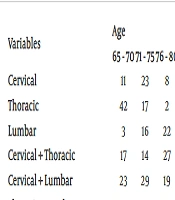
The results showed that the number of patients with damage was 43 in the cervical area, 61 in the thoracic area, and 54 in the lumbar area (Table 3).
Table 3.
Analysis of the Condition of the Type of Injury and age and Consciousness in the Examined Patients
| Variables | Age | GCS | ||||||
|---|---|---|---|---|---|---|---|---|
| 65 - 70 | 71 - 75 | 76 - 80 | 81 - 85 | > 85 | 3 - 7 | 8 - 11 | 11 - 15 | |
| Cervical | 11 | 23 | 8 | 1 | 0 | 11 | 24 | 8 |
| Thoracic | 42 | 17 | 2 | 0 | 0 | 21 | 30 | 10 |
| Lumbar | 3 | 16 | 22 | 10 | 3 | 18 | 30 | 6 |
| Cervical + thoracic | 17 | 14 | 27 | 11 | 1 | 22 | 40 | 8 |
| Cervical + lumbar | 23 | 29 | 19 | 10 | 1 | 23 | 47 | 12 |
| Thoracic + lumbar | 0 | 5 | 15 | 28 | 7 | 27 | 22 | 6 |
| Cervical + thoracic + lumbar | 0 | 0 | 0 | 2 | 13 | 7 | 6 | 2 |
| Total | 96 | 104 | 93 | 62 | 25 | 129 | 199 | 52 |
In this study, the results showed that 17 (4.5%) of the patients had infections, 35 (9.2%) had hyponatremia, 32 (8.4%) had bedsores, 30 (7.9%) had urinary complications, 21 (5.5%) had thrombosis, and 15 (3.9%) had other complications (Table 4).
Table 4.
Analysis of the State of Injury and Consciousness of the Examined Patients
| Variables | Complication | |||||||
|---|---|---|---|---|---|---|---|---|
| AGE | Infection | Hyponatremia | Bedsore | Urinary | thrombosis | Bleeding | Others | No |
| 65 - 70 | 1 | 7 | 10 | 10 | 2 | 5 | 0 | 61 |
| 71 - 75 | 5 | 6 | 5 | 2 | 5 | 3 | 4 | 74 |
| 76 - 80 | 6 | 8 | 9 | 10 | 11 | 3 | 4 | 42 |
| 81 - 85 | 3 | 12 | 8 | 8 | 0 | 4 | 6 | 21 |
| > 85 | 2 | 2 | 0 | 0 | 3 | 5 | 1 | 12 |
| Total | 17 | 35 | 32 | 30 | 21 | 15 | 20 | 15 |
5. Discussion
Spinal injuries have a significant prevalence among the types of trauma caused to patients. Due to the importance and numerous complications associated with spinal cord trauma, it is necessary to conduct epidemiological studies in this field (20, 21). For instance, in a study by Ramezani et al. in Guilan, Iran, the incidence of spinal cord injuries was 0.6% in 2015, 0.3% in 2016, and 0.2% in 2017 (22), indicating a significant prevalence of these types of traumas.
Results from this study showed that 17 (4.5%) of the patients had infections, 35 (9.2%) had hyponatremia, 32 (8.4%) had bedsores, 30 (7.9%) had urinary complications, 21 (5.5%) had thrombosis, and 15 (3.9%) had other complications. Additionally, 210 (55.3%) patients did not report any complications. In a study by Wang et al., the rates of complications were as follows: Infection at 306 (79.5%), death at 9 (2.3%), septic shock at 14 (3.6%), respiratory failure at 100 (26%), and paralytic ileus at 2 (0.5%). Wang et al. reported 385 people with complications and 1421 without complications, which is consistent with our study's finding that most patients did not report complications (23). In Wang et al.'s study, the rates of pulmonary infection, bedsores, deep venous thrombosis, and hyponatremia were 437 (32.59%), 219 (16.33%), 157 (11.71%), and 326 (24.31%), respectively (19).
In this study, the number of patients with damage was 43 in the cervical area, 61 in the thoracic area, and 54 in the lumbar area. Similarly, in Ramezani et al.'s study, the location of SCI was as follows: 52 in the cervical area, 37 in the thoracic area, and 81 in the lumbar area (22). In a study by Yousefzadeh et al., 24 patients had fractures in the cervical area, 9 in the thoracic area, and 23 in the lumbar area (24). Additionally, another study reported cervical rates of 245 (78%), thoracic rates of 56 (18%), and lumbar/sacral rates of 12 (4%) (25). According to the findings of this study and other studies, the incidence of cervical, thoracic, and lumbar injuries is significant.
The Glasgow Coma Scale (GCS) level of the patients at the time of admission was reported as follows: 129 (33.9%) patients had a GCS in the range of 3 - 7, 199 (52.4%) in the range of 8 - 11, and 52 (13.7%) in the range of 12 - 15. In Grossman et al.'s study, 11 (4%) patients had a GCS of less than 8, 60 (19%) were in the range of 9 - 14, and 242 (77%) were in the range of 15 (25). In Stephan et al.'s study, the mean (SD) was 10.8 (4.7) (26).
5.1. Conclusions
Considering the significant prevalence of spinal cord injuries among the elderly in Ilam city, it is necessary to implement interventions to prevent such injuries in this population.