1. Background
Aquaporins (AQPs), a family of water channel proteins, play a major role in water transport in plasma membrane of many human tissues and cell types (1). Some members of the aquaporin family such as AQP1, AQP4, AQP9 and AQP11 have been identified in the central nervous system (2). AQP4 and AQP1 play vital roles in the dynamic regulation of brain water homeostasis and the regulation of cerebrospinal fluid (CSF) production (3). AQP1 is abundant on the apical surface of choroid plexus (CP) epithelium, a branched structure made up of a single layer of epithelial cells and fenestrated blood capillaries; CSF is mainly produced by this structure (4). The process of CSF secretion involves regulated transport of Na+, Cl−and HCO3- from the blood to the ventricles, creating an osmotic gradient that drives the secretion of water through AQPs. Less is known, however, about the route by which water is transported to the CSF (2). Recent data suggests that water transport across the CP epithelium is transcellular (5), and AQP1 plays a major role in mediating water transport from the cell to the CSF, across the apical membrane during CSF secretion (6, 7). However, the route by which water crosses the basolateral membrane of CP cells remains unknown. AQP4 is the predominant water channel in the brain. This protein is expressed in the basolateral membrane of many epithelia including the kidney collecting duct, colon, trachea, and the basolateral membrane of the ependymal cells lining the brain ventricles (8, 9). Thus, AQP4 is a likely candidate for the water transport route in the basolateral membrane of the CP epithelium. However, there are conflicting data on AQP4 expression in the choroid plexus. In several studies, western analysis, immunocytochemical survey and in situ hybridization have demonstrated the expression of AQP4 in the epithelial cells of rat’s lateral ventricle choroid plexus (5, 10). In contrast, some recent immunofluorescence, RT-PCR and in situ hybridization studies failed to detect AQP4 in the rat lateral ventricle CP (11-14).
2. Objectives
Thus, as an initial step, the present study examined AQP4 expression in lateral ventricles CP. To understand the mechanism of CSF secretion, the localization and quantity of AQPs in CP cells has to be determined.
Hence, the second aim of the present study was to investigate the distribution and expression of three AQPs (AQP1, AQP4 and AQP5) in the rat lateral ventricles CP through western analysis, flowcytometry and immunocytochemistry for a better comparison.
3. Materials and Methods
3.1. Materials
Chemicals were obtained from the following sources: DMEM supplement, fetal bovine serum (FBS) and epithelial growth factor (EGF) from Gibco-invitrogen; cytosine arabinoside, phenyl methyl sulfonyl fluoride (PMSF), protease inhibitor cocktail and poly-L-lysin from Sigma; AQP1, AQP4 and AQP5 primary antibodies, and anti-rabbit IgG secondary antibody from Abcam; NP40 lysis buffer from Invitrogen; biotinylated goat anti-rabbit secondary antibody, Vectastain Avidin Biotin complex- Alkaline Phosphatase (ABC-AP) Reagent kit and Vector Blue-AP Substrate kit from Vector Laboratories; Protein ladder from Fermentase. Other chemicals were obtained from standard sources and were of the highest quality available.
3.2. Primary Cell Culture
Primary cultures of epithelial cells from rat CPs were prepared using the method described by Zheng et al. (15) with some modifications. In brief, four to six week-old Wistar rats (either sex) were killed and their brains were exposed. CPs from lateral ventricles were rapidly dissected under a stereomicroscope. Having washed the tissues with Hank's balanced salt solution (HBSS), they were chopped with fine ophthalmologic scissors to fragments of about 1 mm. The minced tissue preparation was mixed with 1 mL of 0.25% trypsin and incubated at 37 °C for 10 minutes. The digestion was stopped when 5 ml of phosphate-buffered saline (PBS) solution was added to the digestion mixture. Following centrifugation (1500 rpm for 5 min), the pellet of epithelial clumps was resuspended in PBS and mechanically dissociated by passages through an eighteen-gauge needle. Following re-centrifugation, cells were resuspended in 4 mL of DMEM supplemented with 10% FBS, 100 units penicillin per mL, 100 pg streptomycin per mL, 20 µl cytosine arabinoside and 10 ng/mL EGF. Cells were maintained at 37°C, 5% CO2 on Poly-L-lysine-coated culture wells, and the medium was changed every 48 hours.
3.3. Immunocytochemistry
For immunocytochemical examination of AQP1, AQP4 and AQP5 expression, CP cell cultures were washed with PBS and fixed in 4% paraformaldehyde (PFA) (30 minutes) followed by three washes with PBS. The wells were rinsed with 0.05% Triton X-100 and blocked with 1% bovine serum albumin (BSA) in PBS (45 minutes) prior to incubation with a 1:100 dilution of the primary antibody. Following incubation with the primary antibody for 60 minutes at 37°C, the cultures were incubated in the dark with a flourescence labeled goat anti-rabbit IgG antibody. for 45 minutes at 37°C. Finally, the cells were washed in PBS solution and mounted for microscopic visualization.
3.4. Sodium Dodecyl Sulfate Polyacrylamide Gel Electrophoresis and Western Blot Analysis
Western analysis was performed to examine AQP1, AQP4 and AQP5 expression in the rat CP epithelium. The CP tissues from lateral ventricles were incubated in 500 µL of NP40 lysis buffer (supplemented with 1 mM PMSF and 500 µL of protease inhibitor cocktail 10x) for 10 minutes and centrifuged at 10,000 rpm. The content was measured by Bradford assay, and aliquots were stored at -70°C. A protein sample of 35 μg was solubilized (1:1) in Laemmli sample buffer [0.32 M Tris (pH 6.8), 5% (w/v) sodium dodecyl sulfate, 25% (v/v) glycerol, 1% (w/v) bromphenol blue, 5% (v/v) β-mercaptoethanol] and incubated at 95°C for 4 minutes. Protein samples were run on 10% polyacrylamide mini gels. Proteins were then transferred to nitrocellulose membranes during a three-hour period at 300 mA and 50 V using a Bio-Rad trans-blot system. Nitrocellulose sheets were washed with Tris-buffered saline-Tween (TBST). After blocking with TBST containing 3% BSA for 1 hour at room temperature, the membranes were separately incubated with anti-AQP1, anti- AQP4 and anti-AQP5 primary antibodies (1:1000 in Tween-PBS) overnight at 4ºC. After washing, they were incubated with the biotinylated goat anti-rabbit secondary antibody for 1 hour. These membranes were washed again with TBST, prior to incubation in 10 mL of Vectastain ABC-AmP Reagent for 10 minutes. Following a washing step, the membranes were incubated in the substrate solution, and subsequent to the reaction, the membranes were air-dried.
3.5. Flowcytometry
In addition to the qualitative analysis (i.e. western blotting and immunocytochemistry), the expression of AQP1, AQP4 in CP cells was also studied using a quantitative method of flowcytometry. The AQP5 primary antibody (Abcam, ab92320) was not suitable for flowcytometry. Briefly, cells were trypsinized and washed with PBS. Following centrifugation (2000 rpm/5 minutes), the supernatant was aspirated, and 500 µL of 0.01% paraformaldehyde was added to each tube and left for 10 minutes. The cells were washed and resuspended in 0.04% Triton X-100, and the samples were separately incubated with 100µLof AQP1 or AQP4 primary antibodies (diluated 1:100 in blocking buffer BSA/PBS 3%) overnight at 4°C. Cells were then washed with PBS and centrifuged at 2000 rpm for 5minutes. These cells were later incubated in the dark with 100 µL of fluorescein-labeled goat anti-rabbit secondary antibody (diluted 1:100 in blocking buffer BSA/PBS 3%) for 45 minutes at 37°C. After washing with PBS and centrifugation at 2000 rpm for 5 minutes, 500 µL of PBS was added to each tube and the samples were immediately subjected to measurement by a Becton Dickinson Fluorescence- activated cell Scan analyzer.
4. Results
4.1. Cell Morphology
The light microscope micrograph in Figure 1 shows the confluent monolayer of rat CP epithelial cells after five days of culture in 10% FBS/DMEM. Formation of a polarized monolayer with functional cell attachment occurred by 48 hours. As observed in Figure 1, cells grew as densely packed, polygonal shapes, and produced a monolayer displaying a typical cobblestone appearance.
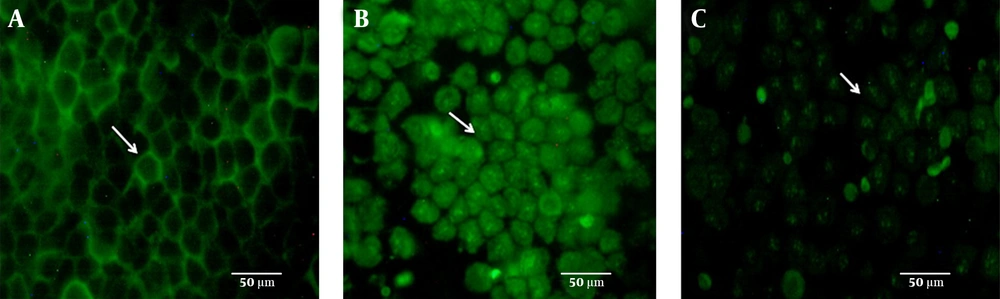
Figure 1.
Note the cobblestone appearance of confluent cultured epithelia.
4.2. Immunocytochemical Staining
At first, the expression of AQPs was evaluated in the lateral ventricles CP by Immunocytochemistry. According to the results of this qualitative method, AQP1 is only expressed in the cell membranes (Figure 2 A). Immunocytochemistry was also employed to examine the localization of AQP4 and AQP5 within the CP cells. The Immunocytochemical signal with the AQP4 antibody was diffusively distributed throughout the cytoplasm, and there was no evidence for AQP4 expression in the cell membrane (Figure 2 B). In addition, AQP5 was weakly expressed in the cytoplasm of the CP cells (Figure 2 C).
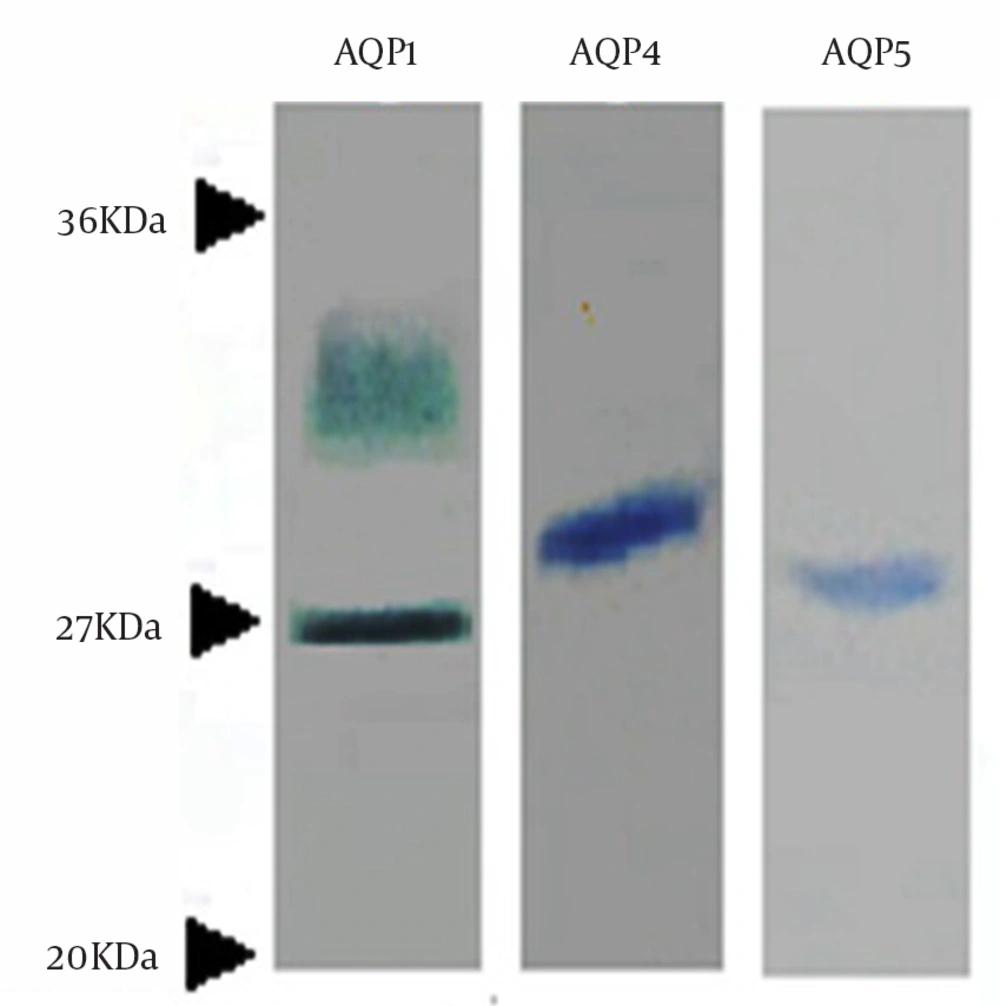
Figure 2.
The cells were separately immune labeled with primary antibodies followed by fluorescein isothiocyanate (FITC) conjugated secondary antibody and visualized by fluorescence microscopy at 400x magnification. Arrows indicate the cell membrane. A: the immunoreactivity of APQ1 with the arrow showing that AQP1 is selectively localized in the membrane of choroid plexus cells. B: immunoreactivity of CP cells with an antibody against AQP4, with the arrow showing the unstained cell membrane; an indication that AQP4 expression only occurs in the cytoplasm of the cells. C: expression of AQP5 in CP cells; this protein is weakly expressed in the cytoplasm of CP cells. Arrow points to the lack of expression of AQP5 in the cell membrane.
4.3. Western Blot Analysis
Western blot analysis of protein samples prepared from the lateral ventricle choroid plexus tissues, separately probed with the AQP1, AQP4 and AQP5 antibodies, is shown in Figure 3. The AQP1 antibody detected two bands of approximately 27 and 32 kDa. These molecular masses related to unglycosylated and glycosylated forms of the AQP1 protein (16). A single peptide of approximately 29 kDa was identified by the AQP4 antibody. Furthermore, AQP5 was detected by western analysis of the CP tissue. The antibody against AQP5 recognized a pale and slim band of approximately 28 kDa.
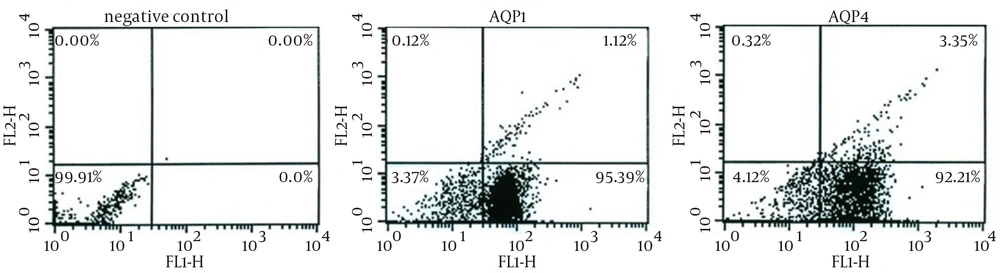
Figure 3.
The AQP1 antibody detected two bands of approximately 27 and 32 kDa (Lane 1). A peptide of approximately 29 kDa was identified by the AQP4 antibody (Lane 2). The antibody against AQP5 recognized a slim band of approximately28 kDa (Lane 3).
4.4. Flow Cytometry
Flowcytometry revealed CP cells exhibiting a high level of AQP1 and AQP4 proteins (95.39% and 92.21%, respectively), compared with the negative control (Figure 4). The AQP5 primary antibody (Abcam, ab92320) was not suitable for flowcytometry. The flowcytometry results correlated with the immunocytochemistry images and Immunoblot bands, which revealed a high level of AQP1 and AQP4 proteins in CP cells.
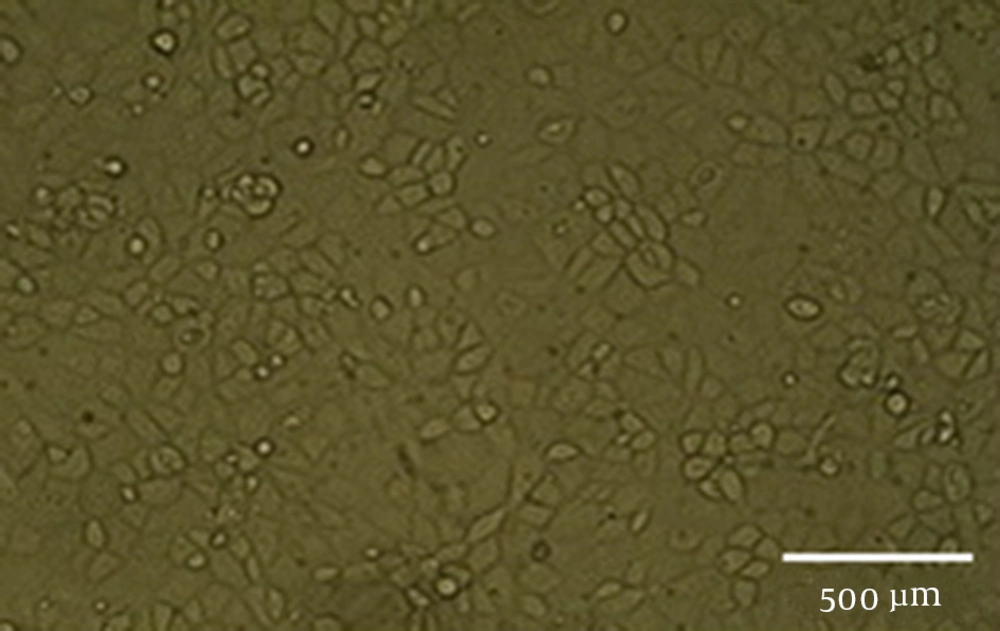
Figure 4.
Cells were stained with the primary antibody followed by FITC conjugated secondary antibody and analyzed with a flow cytometer. Results are expressed as relative fluorescent intensity. In each graph, the bottom left quadrant represents the percentage of cells not showing AQPsexpression, while the bottom right quadrant represents the percentage of the cells expressing AQPs. A: negative control. B: AQP1 expression in CP cells (95.39%). C: AQP4 expression in CP cells (92.21%).
5. Discussion
The choroid plexuses are responsible for secreting the majority of CSF by a process leading to diffusion of water into the ventricles of the brain through AQP water channels (17, 18). Thus, the localization of AQPs in the CP is a useful development in the study of CSF secretion. There is evidence that AQP1 and AQP4 are expressed in CPs (19). AQP1, which is highly expressed in the CP, has an undeniable role in mediating water transport across the apical membrane of the choroid plexus during CSF secretion. It has been demonstrated that CP exhibits the highest expression level of AQP1 compared to any other human tissue (20). Thus, both quantitative and qualitative studies of AQP1 expression in the CP are important. Studies have indicated that AQP1 is expressed in the apical membrane of the rat choroid plexus epithelium (16, 21). In the first part of this study, we examined the localization of AQP1 in CP cells by immunocytochemistry. The results demonstrated that AQP1 is only expressed in the cytoplasmic membrane of CP cells. Also, western blot analysis of AQP1 detected two bands of approximately 27 and 32 kDa for this protein. Immunocytochemical and immunoblot data are in line with previous studies on AQP1 expression(5, 21, 22). In addition, flowcytometry was used to quantitatively examine AQP1 expression, and it was revealed that CP cells exhibit a high level of AQP1 (95.39%). AQP4 is another water channel that is widely expressed in the brain (23). This protein is expressed in the basolateral membrane of many epithelia. In this study, we tested the hypothesis that AQP4 is expressed in the basolateral membrane of rat choroid plexus.
In contrast to previous reports (11-14), using immunocytochemistry, we found that AQP4 is densely packed in the cytoplasm of CP cells with no expression in the membrane. This observation may suggest that these proteins may have no role in water transport across the basolateral membrane of CP cells. In contrast to previous reports (12, 24, 25), western analysis revealed a single peptide of approximately29 kDa for AQP4. In addition, quantitative examination of AQP4 expression by flowcytometry revealed that 92.21% of CP cells exhibit AQP4 expression. Thus, it is suggested that this protein may have an important role in CSF production.
AQP5 is also a member of the aquaporin subfamily. AQP5 mRNA has been detected in the rat brain using RT-PCR (29). However, the distribution of AQP5 in the CP has not been previously reported. In the present study, AQP5 expression, as another AQP water channel, was examined in the CP cells. Immunocytochemical analysis was applied to examine the localization of AQP5 in rat lateral ventricles CP. These results showed that AQP5 is weakly expressed in the cytoplasm of CP cells (Figure 2C). Western analysis using AQP5 antibody recognized a pale band of approximately 28 kDa (Figure 3). The low level of AQP5 expression in the cytoplasm is probably an indication of its lack of involvement in water transport as a whole, suggesting the involvement of other AQP channels in the CP. In conclusion, by immunocytochemistry immunoblotting and quantitative flowcytometry, AQP4 was abundantly detected in the rat lateral ventricles CP. These observations may suggest the prominent role of AQP4 in CSF secretion. However, as no expression of AQP4 or AQP5 was detected in cell membranes, thus, the route by which water crosses the basolateral membrane of CP cells remains to be determined.