Cover image of the article: Anterior Communicating Artery Aneurysm With Refractory Central Vomiting: A Case Report

Image Credit:Arch Neurosci

Anterior Communicating Artery Aneurysm With Refractory Central Vomiting: A Case Report

Authors

Masood Mehrpour1,*, Leila Hashami1, Elham Ghaebi1, Fatemeh Taherian1, Hoda Karimiyan2
1Department of Neurology, Iran University of Medical Sciences, Tehran, IR Iran
2Department of Emergency Medicine, Iran University of Medical Sciences, Tehran, IR Iran
*Corresponding Author: Corresponding author: Masood Mehrpour, Department of Neurology, Firoozgar General Hospital, Behafarin St., Valiasr Sq., Tehran, IR Iran. Tel: +98-2182141265, E-mail: Email: mehrpour.m@iums.ac.ir

Archives of Neuroscience:Vol. 3, issue 3; e36577
Published online:Jun 05, 2016
Article type:Case Report
Received:Jan 27, 2016
Accepted:Mar 05, 2016
How to Cite:Mehrpour M, Hashami L, Ghaebi E, Taherian F, Karimiyan H. Anterior Communicating Artery Aneurysm With Refractory Central Vomiting: A Case Report. Arch Neurosci. 2016;3(3):e36577. doi: https://doi.org/10.5812/archneurosci.36577

Abstract

Introduction:

Anterior communicating artery aneurysm produces symptoms by compression of adjacent neural structures. It can cause nausea and vomiting because of direct compression or destruction of the hypothalamus.

Case Presentation:

We described a 59-year-old man with refractory nausea and vomiting. He was evaluated completely for this problem yet no gastrointestinal pathology was found. Gastroenterologic examination was normal and he was referred to our center for neurological evaluation. We found anterior communicating artery aneurysm in his brain magnetic resonance imaging (MRI). This finding was confirmed by digital subtraction angiogram (DSA). It was decided to coil the aneurysm. After aneurysm embolization, the patient’s symptoms were surprisingly improved completely.

Conclusions:

We hereby report refractory vomiting as a rare presentation of un-ruptured anterior communicating artery aneurysm. This may be explained by a direct compressive effect of the aneurysm on adjacent structures.

Highlights

1. Introduction

Endocrine disturbance and vomiting may be provoked by compression of hypothalamus and hypothalamic-pituitary complex by the compression effect; this compression may be due to tumors or rarely aneurysms. This is particularly true for anterior communicating artery (AcomA) because arteries derived from this vessel supply a portion of the hypothalamus (1). It is also known that vomiting can be elicited by stimulation of the supraoptic area of the hypothalamus. We herein report a rare case of anterior communicating aneurysm with refractory vomiting.

2. Case Presentation

A 59-year-old man was admitted to the neurology ward of Firoozgar hospital affiliated to Iran University of Medical Sciences, in November 2013 with a six-month-history of refractory nausea and vomiting. He did not report any other accompanying symptoms during this period. He was a retired man and his past medical and drug history were not significant. He was a smoker but denied use of alcohol or illicit drugs.
His physical and neurological exams were normal. The blood investigations revealed normal hematological, biochemical and hormonal profile. Endoscopy and colonoscopy had been performed before referral to this center; reported to be normal. Abdominopelvic computed tomography (CT) scan with oral and intravenous contrast showed no evidence of abnormality. Unenhanced brain CT scan showed a (12 × 7 mm) hyperdense suprasellar lesion. Brain MRI suggests that the lesion could be an AcomA aneurysm. Digital subtraction angiography (DSA) confirmed the findings of imaging and revealed saccular aneurysm of AcomA. It was decided to treat the aneurysm by the endovascular approach. The aneurysm was completely obliterated by coiling. The operation was successful and interestingly, his symptoms were resolved immediately after the embolization. During the follow up, after six months, he did not experience nausea and vomiting any more.
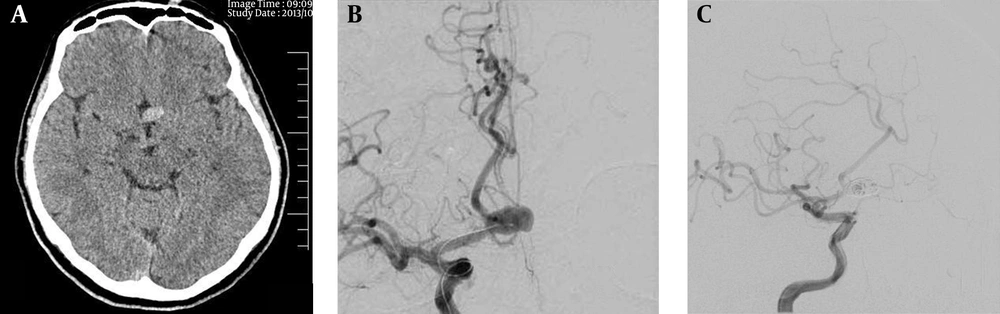
A, Brain computerized tomography scan showed a hyperdense suprasellar lesion(arrow); B, digital subtraction angiography (DSA) revealed a saccular aneurysm of the anterior communicating artery (A1 - A2 junction); C, anterior communicating aneurysm after coil embolization (arrow).
Figure 1.
A, Brain computerized tomography scan showed a hyperdense suprasellar lesion(arrow); B, digital subtraction angiography (DSA) revealed a saccular aneurysm of the anterior communicating artery (A1 - A2 junction); C, anterior communicating aneurysm after coil embolization (arrow).

3. Discussion

Twenty-five to thirty-eight percent of all cases of cerebral aneurysms occur in AcomA, making it the most common site among intracranial arteries (2). In the setting of un-ruptured aneurysm, the symptoms arise from either the mass effect of a large aneurysm over the surrounding tissues, or possibly from minimal leakage of blood irritating the meninges (3). Nevertheless, occurrence of large AcomA aneurysms is extremely rare because they are generally susceptible to rupture while they are relatively small (4). Thus, an AcomA aneurysm is expected to cause symptoms due to hemorrhage (mainly subarachnoid hemorrhage) rather than compression effects. According to the literature, an un-ruptured AcomA may present, through its pressure effect, in different ways, with visual disturbance (4-6) being the most common reported presentation, followed by central vomiting, hypopituitarism (7), and cognitive impairment (5). Our patient presented chronic refractory nausea and vomiting without any other accompanying symptom such as headache, which to the best of our knowledge, is a rare presentation of an un-ruptured AcomA and we could not find any other similar report in the literature. Neurons, in the para-ventricular nucleus of the hypothalamus, project to the preganglionic neurons of the sympathetic and parasympathetic divisions in the brainstem and spinal cord. These cells exert hypothalamus control over the visceral motor system and modulate autonomic reflexes such as respiration and vomiting. Compression of these cells by the aneurysm could be responsible for symptoms of intractable nausea and vomiting in our patient (8). In this setting, we expect the occurrence of symptoms after aneurysm treatment.

3.1. Conclusion

The aneurysm of anterior communicating artery may present itself through its pressure effect over the adjacent cerebral tissues, and not through hemorrhage. In such a setting, the patient may experience chronic refractory vomiting, which is expected to response to the treatment.
Footnotes

  • Authors’ Contribution:Masood Mehrpour and Leila Hashami developed the original idea and the protocol, abstracted and analyzed the data, wrote the manuscript and were the guarantors. Elham Ghaebi and Fatemeh Taherian contributed to the development of the protocol, abstracted the data and prepared the manuscript.

  • Funding/Support:This study was supported by the Iran University of Medical Sciences.

References

  • 1.
    Crompton MR. Hypothalamic lesions following the rupture of cerebral berry aneurysms. Brain. 1963;86:301-14. [PubMed ID: 14023946].
  • 2.
    Proust F, Debono B, Hannequin D, Gerardin E, Clavier E, Langlois O, et al. Treatment of anterior communicating artery aneurysms: complementary aspects of microsurgical and endovascular procedures. J Neurosurg. 2003;99(1):3-14. [PubMed ID: 12854737]. https://doi.org/10.3171/jns.2003.99.1.0003.
  • 3.
    Keedy A. An overview of intracranial aneurysms. Mcgill J Med. 2006;9(2):141-6. [PubMed ID: 18523626].
  • 4.
    Park JH, Park SK, Kim TH, Shin JJ, Shin HS, Hwang YS. Anterior communicating artery aneurysm related to visual symptoms. J Korean Neurosurg Soc. 2009;46(3):232-8. [PubMed ID: 19844624]. https://doi.org/10.3340/jkns.2009.46.3.232.
  • 5.
    Lownie SP, Drake CG, Peerless SJ, Ferguson GG, Pelz DM. Clinical presentation and management of giant anterior communicating artery region aneurysms. J Neurosurg. 2000;92(2):267-77. [PubMed ID: 10659014]. https://doi.org/10.3171/jns.2000.92.2.0267.
  • 6.
    Shukla DP, Bhat DI, Devi BI. Anterior communicating artery aneurysm presenting with vision loss. J Neurosci Rural Pract. 2013;4(3):305-7. [PubMed ID: 24250165]. https://doi.org/10.4103/0976-3147.118765.
  • 7.
    Nukta EM, Taylor HC. Panhypopituitarism secondary to an aneurysm of the anterior communicating artery. CMAJ. 1987;137(5):413-5. [PubMed ID: 3304601].
  • 8.
    Swanson LW, Sawchenko PE. Hypothalamic integration: organization of the paraventricular and supraoptic nuclei. Annu Rev Neurosci. 1983;6:269-324. [PubMed ID: 6132586]. https://doi.org/10.1146/annurev.ne.06.030183.001413.

Copyright

Copyright © 2016, Tehran University of Medical Sciences. This is an open-access article distributed under the terms of the Creative Commons Attribution-NonCommercial 4.0 International License (http://creativecommons.org/licenses/by-nc/4.0/) which permits copy and redistribute the material just in noncommercial usages, provided the original work is properly cited.

Similar Articles

19
Sep
2016
Symptomatic Occlusion of Internal Carotid Artery Caused by Pituitary Macro Adenoma Among the Patients Without Apoplectic Signs; Case Report and Review of the Literature

Symptomatic Occlusion of Internal Carotid Artery Caused by Pituitary Macro Adenoma Among the Patients Without Apoplectic Signs; Case Report and Review of the Literature

Omidvar Rezaei,
Guive Sharifi,
Kaveh Ebrahimzadeh,
Mohammad Hallajnejad

Rezaei O, Sharifi G, Ebrahimzadeh K, Hallajnejad M. Symptomatic Occlusion of Internal Carotid Artery Caused by Pituitary Macro Adenoma Among the Patients Without Apoplectic Signs; Case Report and Review of the Literature. Int J Cancer Manag. 2017;10(3):e5301. doi: https://doi.org/10.5812/ijcp.5301

20
Jan
2019
Effect of Intraventricular Hemorrhage on the Surgical Outcome of Ruptured Anterior Communicating Artery Aneurysm

Effect of Intraventricular Hemorrhage on the Surgical Outcome of Ruptured Anterior Communicating Artery Aneurysm

Mahmood Ramak Hashemi,
Karan Bavand,
Mostafa Raei,
Ramin Mahmoodi

Ramak Hashemi M, Bavand K, Raei M, Mahmoodi R. Effect of Intraventricular Hemorrhage on the Surgical Outcome of Ruptured Anterior Communicating Artery Aneurysm. Arch Neurosci. 2019;6(1):e83934. doi: https://doi.org/10.5812/ans.83934

19
Jun
2004
Subarachnoid Hemorrhage in a patient with Aortic Coarctation, a Case Report

Subarachnoid Hemorrhage in a patient with Aortic Coarctation, a Case Report

N Razazian

Razazian N. Subarachnoid Hemorrhage in a patient with Aortic Coarctation, a Case Report. J Kermanshah Univ Med Sci. 2004;8(1):e81322. doi:

17
Sep
2012
Skull Base Aneurysmal Bone Cyst Presented with Foramen Jugular Syndrome and Multi-Osseous Involvement

Skull Base Aneurysmal Bone Cyst Presented with Foramen Jugular Syndrome and Multi-Osseous Involvement

Leila Aghaghazvini,
Nahid Sedighi,
Parisa Karami,
Omid Yeganeh

Aghaghazvini L, Sedighi N, Karami P, Yeganeh O. Skull Base Aneurysmal Bone Cyst Presented with Foramen Jugular Syndrome and Multi-Osseous Involvement. I J Radiol. 2012;9(3):. doi: https://doi.org/10.5812/iranjradiol.7952

1
Aug
2014
Percutaneous Transarterial Embolization of Spontaneously Ruptured Ovarian Artery Aneurysm Using N-Butyl Cyanoacrylate

Percutaneous Transarterial Embolization of Spontaneously Ruptured Ovarian Artery Aneurysm Using N-Butyl Cyanoacrylate

Jae Hyun Kwon

Hyun Kwon J. Percutaneous Transarterial Embolization of Spontaneously Ruptured Ovarian Artery Aneurysm Using N-Butyl Cyanoacrylate. I J Radiol. 2014;11(3):e13371. doi: https://doi.org/10.5812/iranjradiol.13371

More by these authors

Masood MehrpourPubMedScholar
Leila HashamiPubMedScholar
Elham GhaebiPubMedScholar
Fatemeh TaherianPubMedScholar
Hoda KarimiyanPubMedScholar
Share
Cited by
Metrics