1. Introduction
Neonatal sepsis remains a major cause of morbidity and mortality despite advances in infection control (1, 2). Nosocomial infections caused by pathogens such as E. coli and P. aeruginosa pose a serious challenge because they are associated with prolonged hospitalization, invasive procedures, and the use of broad-spectrum antibiotics (3). Although the management of neonatal sepsis has traditionally relied on antimicrobial susceptibility testing (4), emerging evidence suggests that even antibiotic-susceptible infections can lead to poor outcomes in neonatal populations because of complex host-, pathogen-, and treatment-related factors (5-7). This case describes an infant who developed a severe infection with E. coli and P. aeruginosa during hospitalization, ultimately resulting in fatal septic shock and multiorgan failure.
2. Case Presentation
A 49-day-old female infant weighing 4.5 kg, who had experienced cough and fever for the previous 5 days, was admitted to Hakim Children's Hospital on February 24, 2025 (Day 1). She was born at term and had no history of prior hospitalization. Given the sudden onset of cough and fever and the absence of distress between coughing episodes, pertussis was suspected, and empirical treatment with oral azithromycin syrup, normal saline nebulization, and salbutamol nebulization was initiated. However, her symptoms did not improve significantly. Physical examination revealed a body temperature of 39 °C and generalized wheezing on lung auscultation; the other vital signs at admission were within normal limits. Initial laboratory tests showed leukocytosis with lymphocyte predominance and normal erythrocyte sedimentation rate (ESR), C-reactive protein (CRP), and venous blood gas (VBG) values. The initial chest radiograph was normal. Because the chest radiograph showed no cardiomegaly, the ECG was normal, and the clinical signs were consistent with a pulmonary etiology, echocardiography was not performed. COVID-19 and influenza RT-PCR tests were negative. Supportive care with nebulized salbutamol (0.15 mg/kg/dose) was initiated for generalized wheezing. Azithromycin (10 mg/kg/day) was continued for 5 days to target possible atypical or pertussis-related pathogens.
After 48 hours (Day 3), methylprednisolone (1 mg/kg) and clarithromycin syrup were added after a pulmonology consultation because of persistent wheezing and lack of clinical improvement. On Day 6, the infant developed tachypnea, desaturation, and retractions. Radiography showed perihilar infiltrates, predominantly on the right. Laboratory tests revealed a white blood cell count (WBC) of 37,300, with 32% neutrophils, 55% lymphocytes, and 13% bands. The ESR and CRP levels were normal, and VBG analysis showed respiratory alkalosis. Given the acute clinical deterioration, radiographic progression, and emerging bandemia, an infectious disease consultation led to discontinuation of clarithromycin and initiation of cefotaxime to expand coverage for possible bacterial pneumonia or sepsis. The patient was then transferred to the pediatric intensive care unit (PICU).
Two days later, the patient experienced two apneic episodes with desaturation and thick airway secretions, requiring intubation, dopamine, and epinephrine. Given the rapid progression of respiratory failure consistent with septic shock, the antibiotic regimen was changed to vancomycin, meropenem, and amikacin to provide broad-spectrum empirical coverage pending culture results. Stress-dose hydrocortisone was initiated for septic shock. Laboratory tests revealed a WBC count of 96,000 (59% neutrophils, 34% lymphocytes, 4% bands, and 3% metamyelocytes), an ESR of 7 mm/h, and a CRP level of 19. The patient also had coagulopathy (elevated PT/PTT/INR), elevated hepatic enzyme levels, hypoalbuminemia, elevated pro-BNP, hyperkalemia, increased CPK, elevated LDH, and metabolic acidosis on VBG analysis. Because of anuria, a nephrology consultation resulted in initiation of peritoneal dialysis. Hematologic evaluation, including bone marrow aspiration (BMA) and bone marrow biopsy (BMB), was negative for malignancy. Flow cytometry was also performed to rule out hematologic malignancy because of the marked leukocytosis with immature forms.
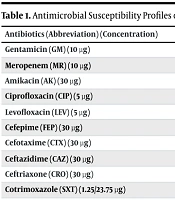
Despite all interventions, the patient died after 9 days because of multiorgan failure secondary to septic shock. Blood culture results obtained 9 days after admission were positive for E. coli and P. aeruginosa in three sets, supporting their role as true pathogens rather than contaminants. Antimicrobial susceptibility testing was performed using the Kirby-Bauer disk diffusion method according to CLSI guidelines, and the results for both isolates are presented in Table 1. Extended-spectrum β-lactamase (ESBL) production was not tested for either isolate.
Table 1.
Antimicrobial Susceptibility Profiles of E. coli and P. aeruginosa Isolates a
| Antibiotics (Abbreviation) (Concentration) | E. coli Susceptibility Result | P. aeruginosa Susceptibility Result |
|---|---|---|
| Gentamicin (GM) (10 μg) | S | — |
| Meropenem (MR) (10 μg) | S | S |
| Amikacin (AK) (30 μg) | I | — |
| Ciprofloxacin (CIP) (5 μg) | I | S |
| Levofloxacin (LEV) (5 μg) | — | S |
| Cefepime (FEP) (30 μg) | R | S |
| Cefotaxime (CTX) (30 μg) | R | — |
| Ceftazidime (CAZ) (30 μg) | R | I |
| Ceftriaxone (CRO) (30 μg) | R | — |
| Cotrimoxazole (SXT) (1.25/23.75 μg) | R | — |
| Imipenem (IPM) (10 μg) | R | S |
| Piperacillin/tazobactam (PTZ) (100/10 μg) | R | S |
a Abbreviations: S, susceptible; I, intermediate; R, resistant; —, not tested for this isolate.
3. Discussion
This case report describes fatal septic shock in a 49-day-old infant. Despite the susceptibility of E. coli and P. aeruginosa to several antibiotics, the infant did not respond to treatment and died. This discrepancy suggests that antimicrobial susceptibility results alone are insufficient to predict treatment outcomes in neonatal sepsis and underscores the need to consider additional factors. In this case, three factors may have contributed to the poor outcome despite antibiotic susceptibility: delayed initiation of effective antibiotic therapy, neonatal host vulnerability, and pathogen virulence or biofilm formation.
Prompt, effective antibiotic treatment is associated with lower mortality in severe sepsis and septic shock (8). Some data show that, for each hour of delay in administering effective antibiotic therapy, the chance of survival decreases by 7.6% in sepsis cases (5). Additionally, other research indicates that delaying effective antibiotic therapy by 6 hours increases the mortality risk from 1.00 to 1.50 in sepsis (8). The infant received multiple antibiotics—azithromycin, clarithromycin, and cefotaxime—that were not active against the bacteria. Effective therapy with meropenem was initiated on Day 8, only 1 day before death, potentially contributing to the fatal outcome.
However, even timely and appropriate antimicrobial treatment does not guarantee a successful outcome in neonates because they are intrinsically immunologically immature. The neonatal adaptive immune response tends to promote tolerance, resulting in limited protective immunity (9). Neonates also exhibit substantial differences in drug absorption and clinical responses because of rapid physiologic changes and unique pathophysiologic conditions, which may affect drug efficacy (10). Accordingly, immunologic and pharmacokinetic immaturity in this 49-day-old infant may have limited the effectiveness of therapy despite the organisms' in vitro susceptibility.
Pathogen-related factors may also contribute to treatment failure. Isolates with greater virulence may not respond to antimicrobial therapy regardless of the agent selected (6), and in vivo biofilms can resist both host defenses and high antimicrobial concentrations over extended periods (11). Although virulence and biofilm-forming capacity were not assessed in these isolates, the rapid clinical deterioration raises the possibility that such mechanisms contributed to treatment failure.
Limitations of this case analysis include its single-patient nature and delayed pathogen identification. In addition, molecular characterization of the isolates, including ESBL testing, was not performed, and virulence factors and biofilm-forming capacity were not assessed. The lack of information on other variables, such as pharmacokinetic data, further limits understanding of the reasons for treatment failure. Antimicrobial susceptibility results alone may not accurately reflect in vivo clinical efficacy, and no comparative data were available to contextualize the findings.
In conclusion, this case showed that antimicrobial susceptibility results alone may not predict favorable outcomes in neonatal sepsis. Several factors, including delayed initiation of effective therapy, neonatal immunologic immaturity, and possible pathogen virulence factors, may together explain treatment failure despite appropriate antimicrobial treatment; however, these factors were not assessed in this case. These findings underscore the need to investigate additional factors to improve outcomes in neonatal sepsis.