Salmonella and Shigella infections are global public health concerns that are increasingly acquiring resistance to commonly used antibiotics, posing serious problems in antimicrobial treatment worldwide.
In this study, the prevalence of
Salmonella spp. was 7%, which is similar to that reported by Awole et al. from Ethiopia (7.2%) (
13) and lower than those found in other studies as 11.5% (
14) and 15.4% (
15).
The prevalence of
Shigella spp., in the current investigation, was 8.9%, which is similar to that reported by studies from Ethiopia (8.7%) (
16) and South Africa (8.5%) (
17), but higher than those reported in other similar studies in Iran as (5.1%) and (3.8%) (
18,
19). The prevalence of shigellosis reported in other developing countries such as Cameroon (4.5%) (
20), India (5%) (
21), and Ghana (5%) (
22) was also lower than that observed in the current study.
This discrepancy may be due to the levels of public health and the availability of safe drinking water among populations, the source of samples, sample size, geographical distribution, the season in which samples were collected, differences in personal hygiene and the age of the target group.
Based on the results of the present study, low levels of
Salmonella resistance was observed to ampicillin (12%), which is lower than that reported by Jimma (59.3%) (
15) and Harar (71.4%) (
14).
Salmonella isolates were highly susceptible to cefotaxime (94.1%), which was similar to that found by Hamze et al. (
23) but dissimilar to the findings of Bialvaei et al. (
9).
Our results showed that among the
Salmonella serogroups, group C had the highest level of antibiotic resistance to nalidixic acid (68.7%) and co-trimoxazole (48.8%). Various studies have reported different levels of resistance to these antibiotics; for instance, Anvarinejad et al. found 31.5% and 15.79% resistance to nalidixic acid and co-trimoxazole, respectively (
3). In another study carried out by Mamuye et al., resistance to nalidixic acid and co-trimoxazole was reported, respectively, as 20% and 60% (
8). Moreover, 93.4% of
Salmonella spp. was resistant to co-trimoxazole as reported by Bialvaei et al. (
9).
In this study,
S. sonnei (60.8%) was the most common
Shigella species followed by
S. flexneri (39.2%), which is in contrast with the results of studies by Jomezadeh et al. (
18) and MoezArdalan et al. (
24) that showed
S. flexneri as the most prevalent
Shigella species in Abadan and Karaj, respectively. Our results, however, are in agreement with the results of studies from Shiraz and Tehran (
25,
26), confirming recent reports claiming a change over the last years in the prevalence of
Shigella spp. in Tehran (
5).
In this study, most of the
Shigella isolates were resistant to ampicillin and co-trimoxa-zole, which is in accordance with the previous studies from Iran (
18,
27) and other countries such as Nepal (
28) and India (
29). The wide use of co-trimoxazole and ampicillin, as broad spectrum and low priced empirical treatments for diarrheal diseases (
30), has led to the advent of resistance of
Shigella strains to these antibiotics. According to the results of the present study, these two antibiotics are no longer suitable choices for the treatment of
Shigella infections. It seems that resistance to nalidixic acid, as the first line of treatment for diarrheal infections, is on the rise in Iran. A study carried out in 200 - 2003 by MoezArdalan in Iran showed that only 1% of the
Shigella isolates were resistant to nalidixic acid (
24), whilst our study showed a rise of 47.4% resistance to this antibiotic. In other countries, like India, the resistance of
S. sonnei to nalidixic acid was reported as 94% - 100% (
31,
32).
In this study, 39.5% of
S. flexneri and 33.4% of
S. sonnei isolates were resistant to cefotaxime, which is consistent with the results of Bialvaei et al. (
9) but much higher than the prevalence found by Barari Savadkoohi et al. (
33) and Mamuye et al. (
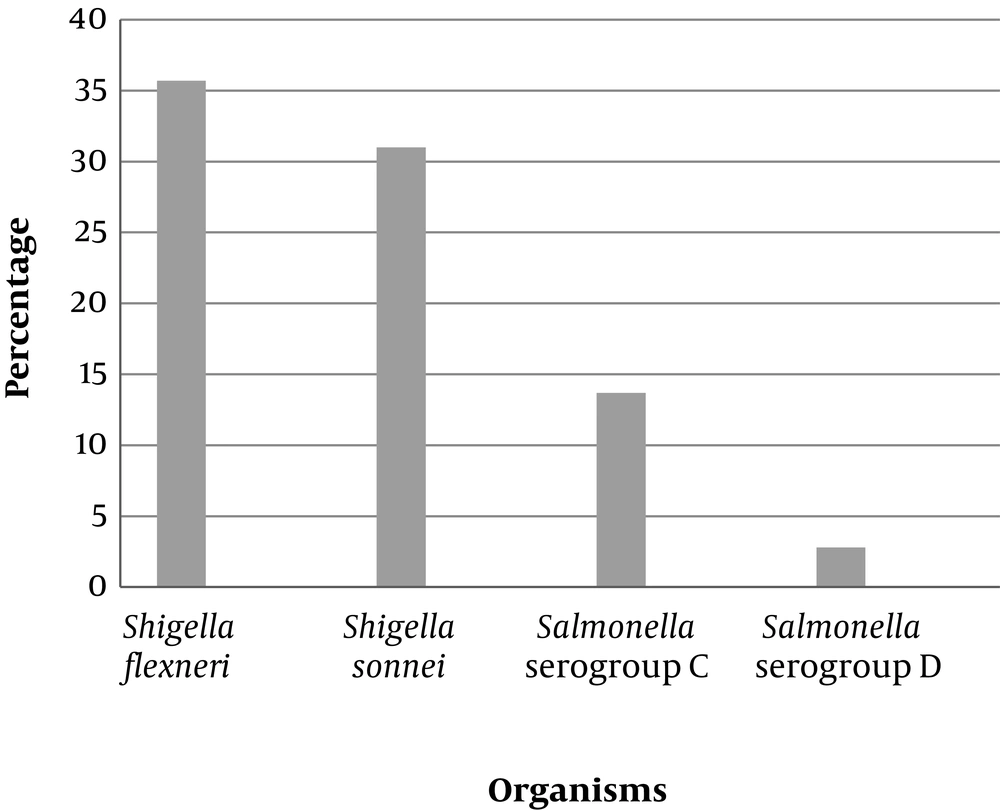
8). Moreover, 35.7% of
S. flexneri and 31% of
S. sonnei isolates produced ESBL in the present study, which is in agreement with the results of Bialvaei et al. (
9) but higher than those reported by Nath et al. (2.8%) (
21), Ranjbar et al. (7.3%) (
7), and Sakhaei et al. (11.4%) (
34).
ESBL producing
Shigella species can be problematic in near future and therefore, treatment guidelines should be designed to monitor the emerging ESBL producing isolates at a national level (
21).
High rates of antibiotic resistance may result from the uncontrolled or inappropriate use of antibiotics. This can cause antibiotic-resistant bacteria to spread easily between hospital wards, leading to protracted outbreaks with high mortality and morbidity rates (
35). The epidemiological information and monitoring system are, therefore, necessary to control
Salmonella and
Shigella infections in public health sectors.
5.1. Conclusion
This study provided information on the prevalence and antimicrobial susceptibility patterns of Salmonella and Shigella infections in Tehran, Iran. The antimicrobial resistance patterns suggest the widespread resistance of Shigella to ampicillin and co-trimoxazole, which requires specific attention because co-trimoxazole is considered the drug of choice for the treatment of patients with inflammatory diarrhea. Due to the continuous change in antibiotic resistance profiles, Salmonella and Shigella strains should be under-scrutinized surveillance in order to monitor local susceptibility patterns for the administration of appropriate antibiotics.