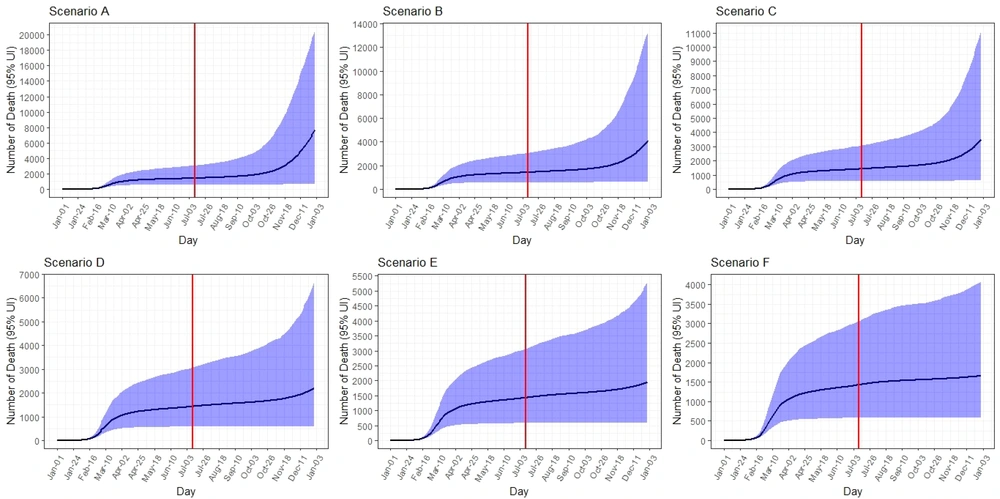
The COVID-19 outbreak has become a clinical threat to the general population and healthcare workers worldwide. However, the world's knowledge about this new virus is limited. In this study, we projected the COVID-19 outbreak in Qom, Iran using available data on new infected, hospitalized, and death cases based on six scenarios between January and the end of December 2020. In each scenario, the contact rate and isolation rate changed. In practice, politicians can control these rates by closing schools and businesses, imposing travel restrictions, as well as case-finding and isolation of the infected cases. We studied the impact of making changes in the mentioned parameters, on the peak date of outbreak, number of new cases per day during peaks, and the number of new infected, hospitalized, and death cases.
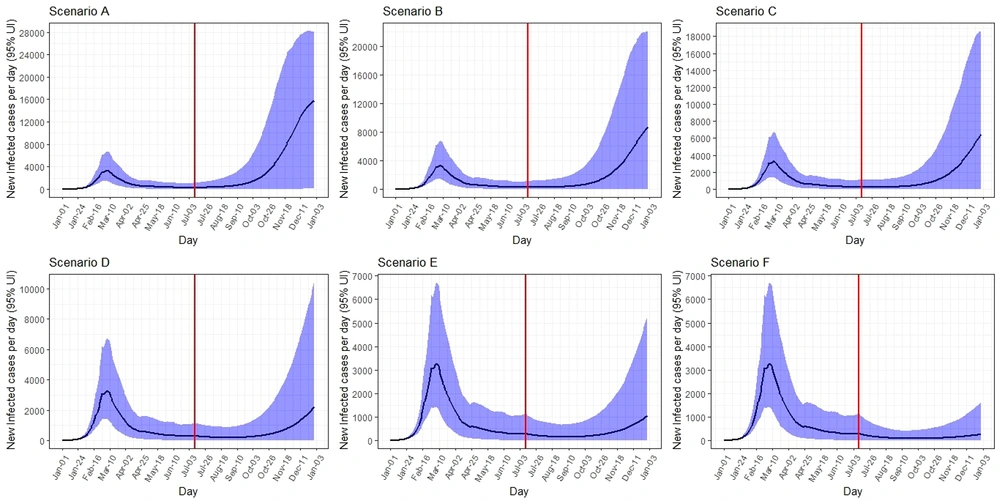
According to the results, the reduced contact rate and increased isolation rate were effective in reducing the size of the epidemic in all scenarios. By reducing the contact rate from eight to six, the number of new cases in peak days, as well as the total number of hospitalized cases by the end of the period (31 December), decreased. For example, in Scenario A, compared to Scenario E, with a decrease in contact rate from eight to six, the number of new cases on peak days decreased from 15,700 to 1,100. The largest decrease in the number of new cases on peak days was related to Scenario F with 270 cases. Also, the total number of cases decreased from 948,000 to 222,000 between the scenarios, and the largest decrease in this regard was related to Scenario F, with 188,000 cases. This trend is visible in all A - F scenarios and follows almost the same trend, which is consistent with some previous studies that reported the importance of personal hygiene, social distance, and reducing contact in reducing death and infected cases (
32,
34-
37). In a study in China, the researchers showed that to control the epidemic, the contact rate should be kept below 30% of the normal level (
38). Also, to minimize the contact rate, people should pay attention to wearing masks and avoid crowded places (
39,
40).
Several studies conducted around the world showed that interventions on contact and isolation rates could have a positive effect on delaying the onset of the epidemic (
41-
43). In a study by Kuniya in Japan, the closures of schools and social events led to a decrease in the number of people in the community, which had a positive impact on the epidemic control (
41).
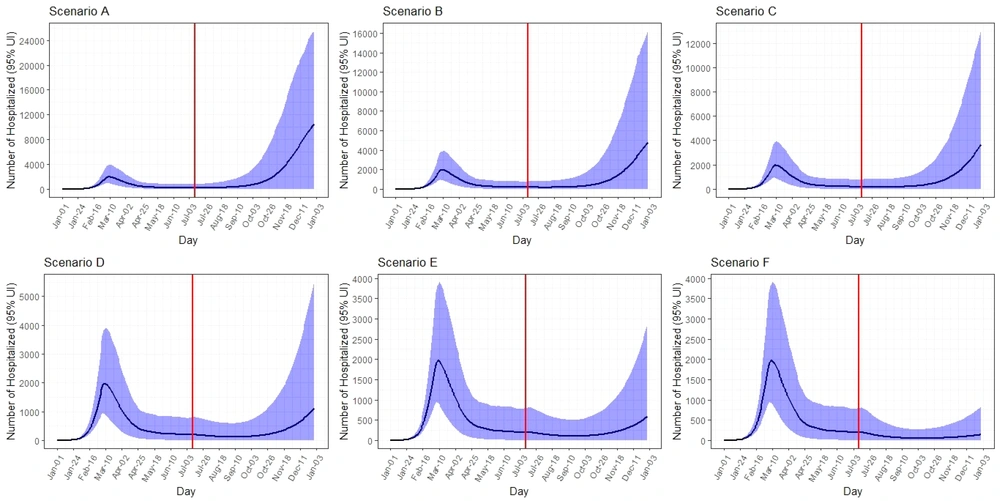
In addition, our results showed that with the increase of isolation rates in different scenarios, the new cases decreased. This reduction is quite true for the total number of cases, hospitalizations, and deaths due to COVID-19. For example, in the case of hospitalization in the basic scenario A with a contact rate of eight and minimal isolations, a minimum of 10,700 people would be hospitalized per day during the epidemic, and the total number of hospitalizations during the study period is estimated at 120,000 people. In the scenario with a contact rate of six and isolation rate of 40%, the number of admissions per peak day was estimated to be 150, and the total number of hospitalizations during this period was estimated to be 23,700, indicating a decrease of 98.5% and 80%, respectively. Regarding the death of people in scenario A, 8,000 people will die during the study period, and in scenario F, which can be the best-case scenario, the number of deaths will be reduced to 1,700. Some previous studies also confirmed this hypothesis (
43-
46).
The results of study showed that in scenario A, in early October 2020, we will have an epidemic peak again, which will be higher than the initial peak, so that in the short period of one to two months after October, the peak rate can reach four to five times the first peak. In scenarios B and C, we will have an increase from late October to mid-November, and the peak will reach two to three times the first peak. In scenario D, in late mid-December, we will have a brief peak that will be slightly higher than the first peak. If scenario E occurs, there will be a re-peak in December 2020, which will be less than the initial peak. If scenario F occurs, a very slight but very short and almost flat increase in new cases of the disease will occur in December 2020; but a second peak is not seen, which is the most ideal scenario possible. Some previous studies also confirmed this result (
47-
50).
It seems that the best scenario for controlling the disease is scenario F, which almost eliminates the possibility of recurrence. However, due to the economic sanctions in Iran and various economic problems, it is practically impossible to implement it at present. On the other hand, the results of this study showed that if scenarios A to C are followed in late autumn in Qom, a re-epidemic peak will occur, which on average will be between three to five times the previous peak, and if there is no effective intervention, the number of people with the disease in a relatively short period of two to three months can increase to 948,000 people, in which case the number of new deaths can be estimated between 2,000 and 3,000 people in Qom province. If there is no effective reduction of contacts and isolation, it can send between 500 and 1,500 new patients daily to the city hospitals, which can have catastrophic consequences due to the lack of sufficient beds in hospitals, medical equipment, special wards and devices, ventilators, and limited human resources. On the other hand, if effective interventions are performed under scenarios D and E, the results can be good. For example, to reduce the number of calls, schools and universities and all educational centers in the province should not be reopened in any way during the academic year, and trainings should be done in absentia and virtually. Physical distancing should be observed at the community level, and it should be adequately monitored. Also, religious ceremonies, celebrations, and funerals should be prohibited. Meanwhile, city-level stores to provide offline services on the Internet and activate delivery systems should be applied.
To isolate patients with the aim of reducing or stopping the transmission chain at the community level, finding and isolating the infected people and their effective treatment and extensive tracking and testing can be performed (
51). All contact cases should be treated and isolated. It is also necessary to provide support to the vulnerable people. The results of the study also indicated that the simultaneous change of both contact rate and isolation rate, compared to the implementation of each of these rates alone, can better control the outbreak. In general, it seems that the best scenario to implement is scenario F, in which the contact rate was six and the isolation rate was 40%. These results are similar to the studies by Paul et al. (
52), Yang et al. (
53), Heymann et al. (
54) and Cheung et al. (
55).
5.1. Limitations
Firstly, some of the parameters used in the model were not from empirical data from Qom and were from other studies. Secondly, our results about the projection of the epidemic in Qom depended on the assumption of implementing physical distancing. So, any changes in policy and public interventions may change the course of the epidemic. However, the results of this study under different scenarios provide a foundation to measure the effect of interventions in Qom.
5.2. Conclusions
The results of this study showed that the parameter of contact rate and isolation rate can reduce the number of infected people and prevent the outbreak, or at least delay the onset of the peak. This can help health policymakers and community leaders to upgrade their health care systems, as well as have enough time to provide the infrastructure for health care interventions, including equipping health care facilities. Also, they will have enough time to perform effective therapeutic interventions for patients and prevent the burnout of medical staff, including physicians, nurses, and all health care providers.