1. Background
Widespread immunization against varicella has resulted in considerable reduction of the incidence of chickenpox throughout the world. Mortality due to varicella was also decreased since the initiation of vaccination program, with approximately 66% reduction in some studies (1-3). Therefore, knowledge on the seroprevalence of varicella can lead to development and improvement of vaccination strategies and minimization of the economic load. Adverse events of infectious diseases, particularly chickenpox, can pose higher threat to military personnel and conscripts because of higher exposure to extreme temperatures, higher mobility, and often, hostile environmental conditions, especially if they fail to develop immunity prior to enlistment (4, 5). The American academy of pediatrics and the advisory committee on immunization practices (ACIP) expanded its recommendations to promote varicella vaccination for military personnel, as one of the susceptible and high-risk groups for this infection (6). Developing strategies to prevent varicella morbidity in some developed countries, such as the United States, led to a decline in the number and incidence of varicella hospitalizations for army active duty soldiers in the recent decade (7-9). In Iran, as a developing country, some investigations were done to determine immunological status against chickenpox in different age subgroups, which revealed that the prevalence of antibodies to varicella gradually increased throughout adolescence and adulthood (10). No data on immunization against varicella among military personnel and conscripts have been published in Iran.
2. Objectives
The present study aimed to address the seroprevalence of varicella infection and its immunization level among Iranian military conscripts.
3. Methods
In this cross-sectional study, which was registered at the ethics committee of Baqiyatallah University of Medical Sciences (Reference No. IR.BMSU.REC.1394.IR), 464 conscripts, who were selected using cluster stratified sampling method from all military garrisons in Tehran, Iran (2011 - 2012), were included. All participants signed an informed consent before taking part in the study. Conscripts were provided with a self-administered questionnaire, which included data on demographics characteristics, marital status, education level, place of residence (capital or out of capital) and duration of military service. All participants’ information was kept anonymous. Garrisons with 18 and more years of age were included and those not willing to participate in the study or those with suspicious symptoms were excluded from the study.
To determine the seroprevalence of infection, a three-milliliter sample of blood was drawn from each participant for varicella IgG antibody level detection via the enzyme-linked immunosorbent assay (ELISA) (IBL International GmbH, Hamburg, Germany), according to the manufacturer’s instructions. Positive antibody serology titers > 1.10 EU/mL were assumed to confer the subject with immunity to varicella (11).
All the statistical analyses were performed using SPSS version 15.0 (SPSS Inc., Chicago, IL, USA). Results are expressed as mean ± Standard Deviation (SD) for quantitative variables and percentages for categorical variables. Categorical variables between the groups were compared using χ2 square test and continuous variables were compared by using the t-test. Individual characteristics were first considered in a univariate analysis to estimate the strength of the relationship between these factors and seropositivity. In the subsequent analysis, all determinants were simultaneously considered in a multiple logistic regression analysis to screen for independent significant predictors. P values of 0.05 or less were considered statistically significant.
4. Results
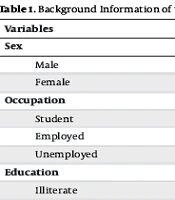
The demographic characteristics of the participants are presented in Table 1. All participants were male, with a median age of 22 years (range 19 to 32 years). Most of the participants were single. Only 14.7% had an academic degree. Fifty-one soldiers lived in areas other than Tehran at the time of study and most of them (89.0%) were born in Tehran and lived in this city. Mean duration of military service was 12.37 ± 4.98 months (range 1 to 21 months). From the serological tests, the mean antibody titer obtained among the participants was 109.66 ± 127.47 mAU/mL, and 86.9% of studied samples were seropositive. This seropositivity was frequently observed in soldiers less than 25 years old. Among soldiers that lived in Tehran, 85.8% were seropositive and this rate was significantly higher than those, who lived in other regions (P = 0.043). Rate of seropositivity was comparable in single and married individuals (86.2% vs. 96.4%, P = 0.154). Although seropositivity was numerically reduced with the elevation of education level (primary level 100%, secondary level 87.3% and academic level 82.4%), this trend was not statistically significant (P = 0.115). There were no significant relationship between seropositivity and the age of participants (P = 0.311). Also, duration of military service was not associated with seropositivity (P = 0.633).
Table 1.
Sociodemographic Characteristics of Studied Conscripts (n = 464)a
| Age, y | 22.14 ± 1.99 |
| Marital status | |
| Single | 436 (94.0) |
| Married | 28 (6.0) |
| Education level | |
| Primary | 63 (13.6) |
| Secondary | 333 (71.8) |
| Higher | 68 (14.7) |
| Region of living | |
| Tehran | 413 (89.0) |
| Out of Tehran | 51 (11.0) |
avalues are expressed as No. (%).
Multivariate regression analysis showed that place of residence slightly predicted the seropositivity against varicella so that seropositivity was significantly higher in participants, who lived in the capital than those, who lived in other regions (OR: 4.008, 95%CI: 0.947 - 16.953, P = 0.059).
5. Discussion
The present study showed that the overall prevalence of varicella seropositivity in Tehran military conscripts was 86.9%, which is comparable to that reported for Iranian general population that was estimated at 88% in 20 to 24 year-olds, 89.4% in the 25 to 29 year-olds and 87.9% in 30 to 39 year-olds (10). However, this seropositivity rate had a wide spectrum in other populations. The published seropositivity in the United States was between 93.1% in 1989 and 95.8% in 1995 that was higher than our obtained prevalence (Table 1). However, our obtained prevalence was significantly higher than Singapore with an estimate of 76.0% between the years of 2000 and 2005 (11). Therefore, our results showed that the prevalence of seropositivity against varicella for military soldiers is comparable with that of the general population. However, it is lower than similar military groups in some developed countries such as the United States. In some developing countries, it has been tried to improve general hygienic conditions and promote more responsible sexual behavior among military recruits that resulted in a decrease of infectious diseases, such as mumps, typhoid fever, tuberculosis, viral hepatitis, scabies, syphilis and gonorrhea, and therefore a dramatic decrease in cases, associated hospitalizations, and costs (5, 12).
In our study, among sociodemographic characteristics, only region of birth and place of residence of conscripts could predict the prevalence of seropositivity against varicella; living in the capital of Iran was accompanied with higher seropositivity. However, the age of conscripts or their social level did not affect the prevalence of seropositivity. In similar previous studies, various determinants have been found for this seropositivity. In a study by Gray et al. (13), more than half of the total varicella admissions occurred in personnel with less than a year of military service and therefore this time interval could be a major predictor for seropositivity against varicella. Also, Jerant et al. (14) showed that trainees, who lived with no or one sibling while growing up, were most likely to be seronegative. Similar studies emphasized on the pivotal role of race/ethnicity so that some of them indicated that varicella susceptibility was greater in female and black soldiers (7, 15, 16). Regarding the effect of place of residence of conscripts, Lee et al. (7) similarly showed that varicella incidence rates for active duty soldiers were significantly higher than those whose home of record was tropical island regions; however Ryan et al. (4) could not confirm an association between susceptibility to varicella and home state. It seems that most studied soldiers that lived in cities other than the capital of Iran were born and lived in tropical regions of this country. In addition, high seropositivity against varicella in Tehran can be due to high population capacity in this city in comparison with other regions in the country. This study was the first in Iran and is unique in terms of sample size. However, for determination and confirmation of the impact of living region on susceptibility to this infection, further studies with greater samples size are recommended. Furthermore, for improving seropositivity against varicella in Iranian young population, routine vaccination against this infection during childhood should be considered.
5.1. Conclusion
According to our study findings, 13.1% of conscripts in military garrisons in Tehran may be susceptible to varicella infection and higher susceptibility is associated with their living state. The present study could not provide a comprehensive picture of the immunological status of the varicella in conscripts in Iran military garrisons but can help aid in the design of immunization programs in these individuals.