


1. Background
Hydatid cyst disease (HCD) is a well-known parasitic disease globally (1, 2). Tapeworm is an agent that causes HCD (3). It is one of the most important zoonotic parasitic diseases produced by the larval stage of Echinococcus granulosus (4, 5). HCD develops in humans after ingestion of Echinococcus granulosus eggs. In order to better prevent and control hydatid cyst disease, it is crucial to identify the epidemiologic aspects of this parasitic infection (6, 7). Annually, HCD occupies a significant percentage of hospital beds in Iran, and it is one of the most prevalent parasitic zoonotic diseases in Iran and the world (8). Nowadays throughout the world, hydatidosis or echinococcosis is one of the important helminthic diseases (5, 9). One of the regions in the world that are reported endemic for this disease by WHO is Iran, the Middle East (10-12). The main risk factors for HCD are residence area, direct contact with dogs, using raw vegetables, and using unwashed vegetables (2, 8, 10). The most important factors influencing the prevalence rate of HCD are economic, occupational, agricultural, educational factors, and factors related to public health and cultural habits (3, 13, 14). Dogs play a critical role in the transmission of the disease agent (10, 12). Liver and Lungs are two organs that are extremely risky for involvement by hydatid cyst (2, 9, 12). Clinical signs, epidemiological data, and ultrasonography are important for diagnosis and classification of hydatid cysts (2, 3, 14). The most important health effects of HCD are anaphylaxis, superimposed infection, rupture into the peritoneal cavity, and toxic reaction to the parasite (3, 14-19). It is noteworthy that investigating the epidemiology and clinical features of this disease is very crucial for health centers and medical universities for educational purposes as well as for prevention and control of the disease and providing health in a known endemic region.
2. Objectives
The current study aimed to assess the demographic characteristics, epidemiology, and clinical features of HCD in a livestock-raising area in Khuzestan, southwest of Iran, during 2000 - 2015.
3. Methods
This descriptive-analytical study was performed in Khuzestan province, southwest of Iran. It is bounded to the west by Iraq and to the south by the Persian Gulf. Khuzestan province has an area of 63,238 km2. Ahvaz is the capital of this province and it is located in the Middle East, between 48° and 29’ east of the Greenwich meridian, 31° and 45’ minutes north of the equator (20-29). The location of Khuzestan province in the southwest of Iran is presented in Figure 1. Data were collected during a period of 15 years from April 2000 to 2015, including demographic information (age, sex, nationality, living area, and occupation), dog contact, vegetable disinfection, number of the cysts, types of organs involved, laboratory data, and clinical features. The patients included in the study were 360 persons from different areas of Khuzestan Province, with a diagnosis of HCD by means of biopsy from suspected lesions. Patients with HIV infection were excluded from the study.
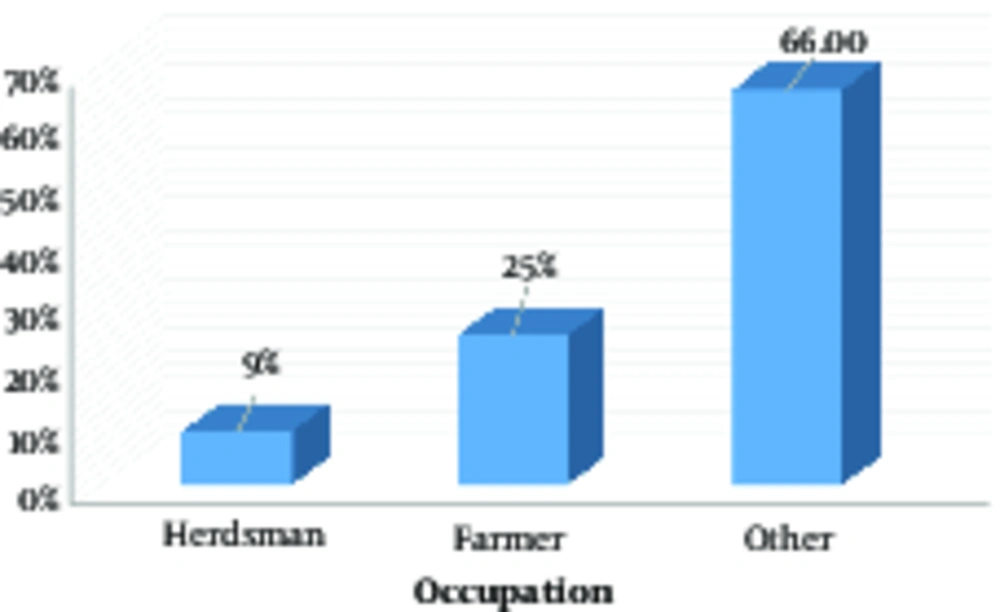
Figure 1.
Distribution of Hydatid Cyst Disease Cases by Occupation; Khuzestan, Southwest of Iran, 2000 - 2015
3.1. Statistical Analysis
Data gathered by examining the patient’s records were analyzed using SPSS version 15. A P value < 0.05 was considered significant. Chi-Square test was used for comparing proportions.
4. Results
Three hundred sixty patients with HCD participated in the study, from whom 158 patients (43.9%) were male and 202 (56.1%) were female (Table 1). Table 1 shows that the mean age of the patients was 37.36 ± 15.2 years (> 10 - > 50 years), with no statistically significant difference between males and females (P = 0.61). The nationality, living region, the way of contact with dogs, the way of using vegetables, and types of organs involved are presented in Table 1.
Table 1.Demographic and Epidemiologic Characteristics of Hydatid Cyst Disease Cases; Khuzestan, Southwest Iran, 2000 - 2015
| Characteristics | Number (Percent) |
|---|---|
| Patients | 360 |
| , years | |
| up to 10 | 19 (5.3) |
| 11 - 20 | 32 (8.9) |
| 21 - 30 | 69 (19.2) |
| 31 - 40 | 68 (18.9) |
| 41 - 50 | 69 (19.2) |
| over 50 | 103 (28.6) |
| Sex | |
| Male | 158 (43.9) |
| Female | 202 (56.1) |
| Nationality | |
| Iran | 356 (98.9) |
| Neighboring Countries (Iraq, Kuwait) | 4 (1.1) |
| Living Region | |
| Urban | 226 (62.8) |
| Rural | 134 (37.2) |
| Way of contact with dogs | |
| Direct | 41 (10.7) |
| Indirect | 342 (89.3) |
| Way of using vegetables | |
| Washing before use | 87 (24.2) |
| Not washing before use | 273 (75.8) |
| Type of organs involved | |
| Liver | 234 (65) |
| Lung | 85 (23.6) |
| Abdomen | 5 (1.4) |
| Other organs | 36 (10) |
Figure 1 shows the distribution of different occupations among patients with HCD. As the Figure shows, only about one-third of the patients had occupations requiring animal contacts.
The number of HCD patients with different organs involved is shown in Figure 2. It is evident from this Figure that liver was the organ involved in most cases of HCD.
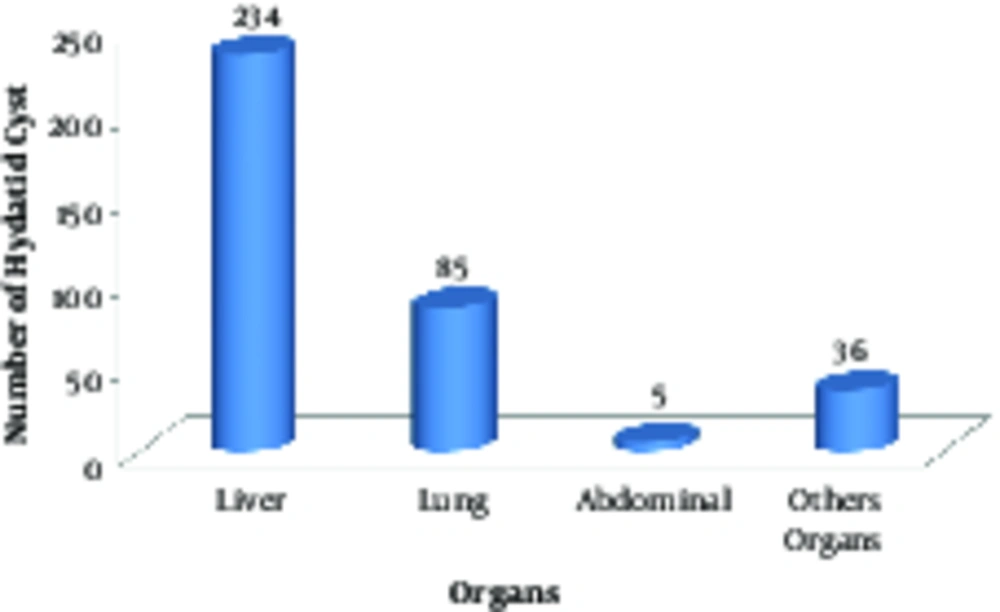
Figure 2.
Number of Hydatid Cyst Disease Patients with Different Organs Involved; Khuzestan, Southwest of Iran, 2000 - 2015
5. Discussion
In recent years, parasitic zoonotic diseases are considered as a major concern for contemporary communities. In this study, we evaluated the epidemiology and demographic features of this disease in a livestock-raising area in Khuzestan, southwest of Iran. It should be noted that a low public health level of the society makes Khuzestan one of the areas with the highest number of HCD cases in Iran.
Based on the results of this study, most patients were in the over-50-year-old age group (103 (28.6%)), and the less-than-10-year-old age group had the lowest number (19 (5.3%)). Rezaei et al. in their study evaluated the association of demographic features with clinical status of sufferers of hydatid cysts in Qom, Iran. They demonstrated that the mean age of patients was 38.80 ± 17.20, which was not much different from our results, and the highest percentage of hydatid cyst was seen in men in the age group of 31 - 40 years (37.15%) (8).
According to the findings of this study, HCD cases were mostly females (56.1%). This finding was similar to the results of Rezaei et al. in Qom during 2002 to 2013 (57.3% females) (8). Based on the study results of Ibrahim in 2007 in Egypt, hydatid cyst cases were more frequent in females (35%) than in males. In another study in Meshkinshahr, Ardabil Province, northwestern Iran, Heidari et al. reported that the rate of human hydatidosis is higher in males than in females (5). In a similar study in Jordan, Yaghan et al. reported hydatid cyst with a rate of 60% was more common in females than in males.
The results of this study showed that 226 patients (62.8%) were living in urban areas. This finding was similar to the results of a large review by Mardani et al. in 2010 who reported that the highest rate of infection was in urban regions (89.5%) (2). Another study in Jordan in 2004 found the same results. According to the results of our study, about one-third of patients were farmers (25%) and herdsmen (9%). Of all patients, 41 (11.4%) reported a direct contact with dogs. In another study, Heidari et al. reported that farmers and ranchmen had the highest rate of infection (5). In the present study, most patients who were asked about eating safe vegetables reported they do not wash vegetables properly before use (273 (75.8%)). Based on the results of Khalili’s study, using unwashed vegetables could be a significant risk in acquiring HCD. According to the results of this research, most of the cysts were detected in the liver (65%). This finding was in accordance with the results obtained by Mardani in 2010, Rezaei in Qom, Ibrahim in 2007, and Khalili in 2010 (2, 8).
There was no statistically significant association between sex and residing area, animal contact, and number of cysts (P = 0.12, 0.36, and 0.95, respectively); however, a significant association was found between sex and the body organ involved (P = 0.007), so that liver involvement was mostly detected in females (79.9%), while involvement of the lung was mostly found in males (66.4%). No statistically significant association was found between age and number of cysts or body organ involvement (P = 0.35 and 0.61, respectively).
5.1. Limitations
The main limitation of the current study appears to be a relatively small sample size.
5.2. Conclusion
According to the results of this study, having contact with vegetables contaminated with parasite ova is the most important way of infection transmission. Based on our findings, the highest frequency of the disease was reported in individuals residing in urban areas, and farmers were more at risk for this disease than others were. Planning training programs for the prevention and control of the disease in special groups at risk appears to be essential.


