Full Text
Full text is available in PDF
Archives of Clinical Infectious Diseases
Infectious Diseases and Tropical Medicine Research Center, SBUMS
Authors
Nosocomial infections are generally occurring 72 hours after admittance and are not present or incubating prior to admittance. The most common nosocomial infection is urinary tract infection (UTI). Scanty data are available regarding the nosocomial infections in Iranian teaching hospitals. The aim of the present study was to determine the frequency of symptomatic nosocomial UTI, identify the etiologic organisms, and determine their antimicrobial susceptibility pattern.
This cross sectional study was conducted on ICU patients of Firoozgar hospital affiliated to Iran University of Medical Sciences from September 2003 to September 2005. Antimicrobial susceptibility pattern was achieved by disk-agar diffusion and E. test methods.
Totally, 306 patients were admitted to ICU, of whom 28 (9.2%) suffered from symptomatic UTI. The most common isolated organism was Klebsiella (13 cases, 46%) followed by E.coli, Pseudomonas and Enterobacter spp. Ahigh level of resistance was observed for third generation cephalosporins (Pseudomonas 100%, Klebsiella 92%, E.coli 71% and Enterobacter 25%), however, microorganisms were less resistant to imipenem and cefepime.
Based on observed results, carbapenems and cefepime are the drugs of choice for empiric antibiotic therapy of nosocomial UTIs in Firoozgar hospital.
© 2009, Author(s). This open-access article is available under the Creative Commons Attribution 4.0 (CC BY 4.0) International License (https://creativecommons.org/licenses/by/4.0/), which allows for unrestricted use, distribution, and reproduction in any medium, provided that the original work is properly cited.
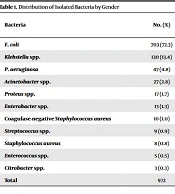
Noori M, Aghamohammad S, Ashrafian F, Gholami M, Dabiri H, et al. A Retrospective Cross-sectional Study on Prevalence and Susceptibility Pattern of Bacterial Pathogens Causing Urinary Tract Infections at a Teaching Hospital in Tehran, Iran. Arch Pediatr Infect Dis. 2023;11(2):e120903. doi: https://doi.org/10.5812/pedinfect-120903
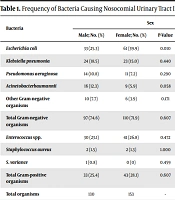
Mostafavi Esfahani SN, Rostami S, Shafiei AH. The Causative Agents and Antibiotic Susceptibility Patterns of Healthcare-Associated Urinary Tract Infections (HAUTIs) in Isfahan, Iran: The Impact on Empiric Therapy. Nephro-Urol Mon. 2023;15(4):e140033. doi: https://doi.org/10.5812/numonthly-140033
Farhadi K, Rahimi M, Shahmohammadi A. The Epidemiology of Hospital-Acquired Urinary Tract Infections in Intensive Care Units in Kermanshah Hospitals (Iran). J Kermanshah Univ Med Sci. 2023;27(3):e137000. doi: https://doi.org/10.5812/jkums-137000
Lashgari N, Noroozi-Aghideh A, Goharimoghaddam K, Goudarzi L, Bahmani S. Frequency and antimicrobial resistance pattern of pathogens implicated in urinary tract infection at a hospital in Tehran. Ann Mil Health Sci Res. 2015;13(2):e62597. doi:
Sarrafzadeh F, Sohrevardi SM. Evaluation of Bactereuria and Antimicrobial Susceptibility among Hospitalized Patients With and Without Catheter in Kerman Province- Iran in 2011. Iran J Pharm Res. 2013;12(1):e125616. doi: https://doi.org/10.22037/ijpr.2013.1263
Last Update: 1 month ago
Last Update: 1 month ago
Last Update: 1 month ago
Last Update: 5 days ago
Last Update: 1 hour ago
Last Update: 2 days ago