1. Background
Cancer is one of the leading causes of death in the world. Based on the WHO reports, 7.6 million deaths (about 13% of all deaths) were recorded in 2008 due to cancer (1). More than 70% of all cancer deaths occurred in low-income or middle-income countries. Furthermore, given the growing worldwide risk of cancer, it is expected that 11 million deaths will occur due to cancer in 2030 (1). The literature review has reported that colorectal cancer is also the third most frequent cancer in men and the second most common cancer in women around the world (2). The reasons for an increased incidence of colorectal cancers can be justified in either real or false (3). A real change in the incidence of colon cancer can be due to a number of risk factors of the disease, including the change in “westernized” regime, standards of living, and absence of healthcare organization. On the other hand, false change in incidence may be due to improved methods of collecting information about cancer (3). In recent years, infection has been considered one of the most important causes of cancer through different pathways; therefore, about 1.9 million cases of cancer with infectious origin were estimated in 2002 (4, 5).
Nowadays it has been proven that one of the most important causes of cancer is microbial pathogens such as Helicobacter pylori, Human papillomavirus, Hepatitis B and C viruses, Epstein-Barr virus, human immunodeficiency virus (HIV), and herpesvirus (6). However, other pathogens such as parasites can also be a cause of cancer. Among the helminthic parasites, common trematodes such as Schistosoma hematobium can cause bladder cancer, and some of the liver and bile duct trematodes, including Opisthorchis viverrini and Clonorchis sinensis, are sometimes associated with cholangiocarcinoma. In addition, in recent years, the relationship between Trichomonas vaginalis parasite and cervical cancer has been proven (6-8).
Blastocystis hominis is well-known as one of the most frequent intestinal protozoan parasites in humans and animals (9). In developed countries, the prevalence of this parasite is varying between 0.5% - 23%. This high rate of blastocystosis in developing countries can be related to deprived hygiene, non-compliance with personal health, and contact with animals (10-12). The clinical signs in blastocystosis are common symptoms such as abdominal pain, diarrhea, nausea, vomiting, and flatulence. Previous researches established that Blastocystis sp. facilitate cancer cell growth through detecting the cytopathic result, cellular immunomodulation, and apoptotic responses of B. hominis, particularly in malignancy (13).
2. Objectives
Based on the above and considering the high prevalence of B. hominis in Iran, the aim of this study was to determine the prevalence of B. hominis infection in patients with colorectal cancer compared with healthy individuals.
3. Methods
3.1. Ethical Considerations
The protocol of this investigation was reviewed and approved by the Ethics Committee of Lorestan University of Medical Sciences, Khorramabad, Iran. However, all participants were provided with written informed consent before the study.
3.2. Study Subjects
The present descriptive case-control study was performed on 67 patients with colorectal cancers attending the general hospitals Lorestan Province, Western Iran from October 2017 until August 2018. Colorectal cancers were diagnosed by an experienced gastroenterologist. Healthy individuals (67 subjects) without existing or previous gastrointestinal manifestations, referring to hospitals during the above period for routine examination or accompanying with other patients, were included in the control group. The exclusion criteria were patients who were unwilling to sign written informed consent, patients who had viral/bacterial infections causing colorectal cancers, patients who had taken systemic antibiotics in the last three months, as well as immunocompromised patients.
3.3. Questionnaire
All demographic and possible risk factors, such as age, gender, and education, residence, unwashed vegetable/fruit consumption, handwashing, and agriculture activity, were collected by an applied questionnaire from all of the studied subjects.
3.4. Collection and Processing of Samples
A fresh stool specimen was collected from each subject in a sterile labeled container. The collected stool samples were then transferred to the Parasitology Laboratory of Faculty of Allied Medicine, Lorestan University of Medical Sciences, Khorramabad, Iran for microscopic examinations. A small portion of each collected stool was tested microscopically using saline and iodine wet preparations. Moreover, a part of polyvinyl alcohol (PVA)-preserved fecal sample was stained with trichrome stain according to the manufacturer’s instruction. In addition, a portion of the samples was stored at -20°C for DNA extraction. The samples were examined under a light microscope for B. hominis forms (14).
3.5. DNA Extraction
DNA was extracted according to the method described elsewhere (15), then DNA of samples was extracted and stored at -20°C until PCR.
3.6. Polymerase Chain Reaction Test
Polymerase chain reaction (PCR) was carried out to determine the presence of Blastocystis spp. by means of the specific primers with similar sequences according to the previous studies (15-17).
The used primers were B11400 for 5’-GGA ATC CTC TTA GAG GGA CAC TAT ACAT-3’, B11710 Rev 5’-TTA CTA TCC AAA GTG TTC ATC GGA C-3’. To do PCR, it initially performed with one cycle for 5 min at 94°C, and then 30 cycles including 1 min at 94°C, 1 min at 58°C, 1 min at 72°C, and finally, one cycle for 5 min at 72°C. The expected size of PCR product was 310 bp. The obtained PCR products were assessed on 1.5% agarose gel. Positive and non-DNA samples were used as positive and negative controls, respectively.
3.7. Statistical Analysis
The statistical analysis of the results was done using SPSS 24.0 software (SPSS Inc., Chicago, IL, USA). Numerical statistics were displayed as mean ± SD. Variables that were significantly related to B. hominis prevalence were analyzed as possible risk factors by means of univariate logistic regression. P < 0.05 was measured to be statistically significant.
4. Results
4.1. Participants
In this cross-control study, a total of 134 participants, including 67 patients with colorectal cancers and 67 healthy individuals referred to the general hospitals of Lorestan province, Iran were studied to determine the prevalence of B. hominis as well as the associated risk factors among them. The mean age of the participants in the case and control groups was 41.3 ± 3.5 and 44.6 ± 2.5 years, respectively. Most participants were male in the case (54, 80.6%) and control (51, 76.1%) groups. Moreover, 53 (79.1%) and 57 (87.1%) participants in the case and control groups lived in urban areas, respectively and the rest lived in rural parts.
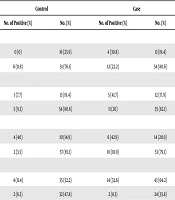
Among the participants in the case and control groups, 24 (35.8%) and 32 (47.8%) participants had diploma or higher, respectively, whereas the remaining were in the lower than diploma group. Also, 56 (83.6%) and 57 (87.1%) participants in the case and control groups washed their hands before eating, respectively, while the rest of the participants did not perform it. Furthermore, 17 (25.4%) and 18 (26.9%) participants in the case and control groups consumed unwashed fruit and vegetables, respectively; however, the remaining did not consume unwashed fruit and vegetables. Regarding agriculture activity, 16 (23.9%) and 12 (17.9%) participants in the case and control groups had agriculture activities, respectively, whereas other participants did not have agriculture activity (Table 1).
Table 1.
Demographic Characteristics and Prevalence of Blastocystis hominis Among the Participants in Both Tested Groups
| Variables | Control | Case | ||
|---|---|---|---|---|
| No. of Positive (%) | No. (%) | No. of Positive (%) | No. (%) | |
| Gender | ||||
| Female | 0 (0) | 16 (23.9) | 4 (30.8) | 13 (19.4) |
| Male | 6 (11.8) | 51 (76.1) | 12 (22.2) | 54 (80.6) |
| Age group, y | ||||
| < 30 | 1 (7.7) | 13 (19.4) | 5 (41.7) | 12 (17.9) |
| > 30 | 5 (9.3) | 54 (80.6) | 11 (20) | 55 (82.1) |
| Residence | ||||
| Rural | 4 (40) | 10 (14.9) | 6 (42.9) | 14 (20.9) |
| Urban | 2 (3.5) | 57 (85.1) | 10 (18.9) | 53 (79.1) |
| Education | ||||
| < Diploma | 4 (11.4) | 35 (52.2) | 14 (32.6) | 43 (64.2) |
| > Diploma | 2 (6.3) | 32 (47.8) | 2 (8.3) | 24 (35.8) |
| Handwashing | ||||
| Yes | 4 (7) | 57 (85.1) | 15 (26.8) | 56 (83.6) |
| No | 2 (20) | 10 (14.9) | 1 (9.1) | 11 (16.4) |
| Consumption of unwashed fruit and vegetables | ||||
| Yes | 3 (16.7) | 18 (26.9) | 11 (64.7) | 17 (25.4) |
| No | 3 (6.1) | 49 (73.1) | 5 (10) | 50 (74.6) |
| Animal contact | ||||
| Yes | 4 (33.3) | 12 (17.9) | 3 (30) | 10 (14.9) |
| No | 2 (3.6) | 55 (82.1) | 13 (22.8) | 57 (85.1) |
| Agriculture activity | ||||
| Yes | 5 (41.7) | 12 (17.9) | 7 (43.8) | 16 (23.9) |
| No | 1 (1.8) | 55 (82.1) | 9 (17.6) | 51 (76.1) |
4.2. Prevalence of Blastocystis hominis Infection
Of 67 patients with colorectal cancers (case group), B. hominis was found in 16 (23.9%) patients, whereas of 67 healthy participants in the control group, B. hominis was found in 6 (9%) participants, indicating the significant difference (P < 0.001) in the prevalence of B. hominis among the participants in the case and control groups.
Considering gender, there was a significant correlation between gender and the prevalence of B. hominis (P = 0.017). The obtained findings revealed that there is a significant relationship between the positivity of the test and the gender of the female in the two groups; thus 4 (30.8%) and 0 (0%) female participants were found positive for B. hominis in the case and control groups, respectively. However, there was no significant relationship between the positivity of the test with male gender in both groups (P = 0.122).
There was a significant correlation between age and the prevalence of B. hominis (P = 0.011). In the study of age-related subgroups, there was no significant correlation in the prevalence of B. hominis in participants with age less than 30 years (P = 0.063) and age over 30 (P = 0.094) in the case and control groups.
In general, there was a significant relationship between residence and the prevalence of B. hominis (P = 0.017). The results showed a significant association between the prevalence of B. hominis and residence in urban areas (P = 0.01). In this regard, among participants who lived in urban areas, 10 (18.9%) and 2 (3.5%) participants were found positive for B. hominis in the case and control groups, respectively. However, there was no significant correlation between the prevalence of B. hominis and residence in rural regions in the case and control groups (P = 0.611).
Considering education, there was a significant association between education and the prevalence of B. hominis (P = 0.01). There was a significant correlation between the prevalence of B. hominis and the education with lower than diploma (P = 0.023). In this regard, 14 (32.6%) and 4 (11.4%) participants with lower than diploma were found positive for B. homonis in the case and control groups. However, there was no statistically significant association between the positivity of the test and the education level lower than diploma in the two groups (P = 0.21).
A significant relationship was observed between handwashing and the prevalence of B. hominis (P = 0.007). The results demonstrated that the prevalence B. hominis among the participants who did not wash their hands before eating was significantly higher (P = 0.005) than the participants who washed their hands before eating (P = 0.46).
The results indicated that a significant association was found between the prevalence of B. hominis and consumption of unwashed fruit and vegetables (P = 0.001). In this regard, 11 (64.7%) and 3 (16.7%) participants who consumed unwashed fruit and vegetables were found positive for B. homonis the in case and control group, respectively (P = 0.005). However, no significant association was observed in the prevalence B. hominis in participants who did not consume unwashed fruit and vegetables in both groups (P = 0.35).
Regarding agriculture activity, there was a significant correlation between agriculture activity and the prevalence of B. hominis (P = 0.003). The obtained results showed that 9 (17.6%) and 1 (1.8%) participants who had agriculture activity (P = 0.006) were found positive for B. homonis in the case and control groups, respectively. The statistical analysis also demonstrated that there was no significant correlation in the prevalence of B. hominis in participants who had no agriculture activity in both groups (P = 0.35) (Table 1).
4.3. Risk Factors Related to Blastocystis hominis Infection
The obtained results by the multifactorial logistic regression models demonstrated that among tested risk factors, agriculture activity (0.24; 95% CI: 0.075 - 0.809), as well as consumption of unwashed fruit and vegetables (0.136; 95% CI: 0.040 - 0.459), were significantly related to the prevalence of B. homonis infection (Table 2).
Table 2.
Logistic Regression Analysis of the Potential Factors Associated with the Prevalence of Blastocystis hominis Among the Tested Groups
| Variables | OR (95% CI) | P-Value |
|---|---|---|
| Gender | 0.806 (1.82 - 3.562) | 0.776 |
| Age | 1.14 (0.243 - 5.336) | 0.868 |
| Residential place | 1.67 (0.383 - 7.273) | 0.495 |
| Education | 1.64 (0.419 - 6.421) | 0.476 |
| Unwashed vegetable/fruit consumption | 0.136 (0.040 - 0.459) | 0.001a |
| Handwashing before eating | 0.201 (0.29 - 1.391) | 0.105 |
| Agriculture activity | 0.246 (0.075 - 0.249) | 0.023a |
aSignificant.
4.4. PCR Test
All 22 positive samples (16 patients and 6 (9%) healthy people) were also positive by PCR method, indicating the presence of Blastocystis and accuracy of microscopic examination, extraction and PCR reaction.
5. Discussion
Cancers are defined by uncontrolled development of atypical cells, which can affect and damage nearby tissues. In recent years, the worldwide rate of cancer was reported nearly 14.1 million new cases and 8.2 million related deaths (15). Nowadays, it has been proven that among the most common cancers, liver, stomach, colorectal, and esophagus cancers are frequently related to a number of infectious diseases (15, 18). A number of microbial pathogens, including H. pylori, HBV, HCV, O. viverrini, C. sinensis, S. haematobium, HPV, EBV, human T-cell lymphotropic virus type, human herpesvirus type 8, and HIV-1 are considered group 1 carcinogens (6, 7, 19).
The present investigation aimed to determine the prevalence of Blastocytosis infection in patients with colorectal cancer and healthy individuals. The findings herein revealed B. hominis was found in 16 (23.9%) patients out of 67 patients with colorectal cancers (case group), whereas B. hominis were found in 6 (9%) participants out of 67 healthy participants in the control group, indicating a significant difference (P < 0.001) in the prevalence B. hominis among the participants in the case and control groups.
In line with our results, in a study conducted by Mohammad et al. (16) in Saudi Arabia, the prevalence of B. hominis among patients with colorectal cancer was 29.7%. In another investigation carried out by Steer in the United Kingdom (2007), the prevalence of B. hominis infection was reported 53% among patients with colorectal carcinoma patients (20).
Considering the correlation between the Blastocystis and cancers, Kumarasamy et al. (13) demonstrated that Blastocystis sp. play a key role in increasing azoxymethane (a potent carcinogen)-induced carcinogenesis through harm to the epithelium of the intestine and stimulating oxidative destruction in infected rats with Blastocystis sp. Chandramathi et al. (17) also reported that although some antigens derived from Blastocystis can destroy peripheral blood mononuclear cells, they can trigger the proliferation of human colorectal cells.
On the other hand, Chan et al. (21) revealed that a number of antigens of Blastocystis sp. isolated from symptomatic patients can promote the proliferation of colorectal cancer cells in comparison to the asymptomatic individuals. In a study conducted by Ajjampur and Tan (22), it has been proven the negative effects of Blastocystis sp. on the epithelial cells of the intestine through apoptosis as well as degradation and destruction of proteins. Oxidative stress is considered a vital act in the body but if it persists for a long time it can cause a lot of pathophysiological disorders leading to some diseases such as cancers (23). Recently, Chandramathi et al. (24) showed that oxidative stress is increased in patients with cancer infected with intestinal parasites such as Blastocystis sp.
The findings of the present study demonstrated that in the multifactorial logistic regression models, some tested risk factors such as agriculture activity (0.24; 95% CI: 0.075 - 0.809) and consumption of unwashed fruit and vegetables (0.136; 95% CI:0.40 - 0.459) were significantly related to the prevalence of B. homonis infection, whereas other risk factors had no significant relationship with the prevalence of B. homonis infection. Similarly, it has been proven in several studies that handwashing before eating and consumption of unwashed fruit and vegetables are found related risk factors for Blastocistis infection (25-27).
5.1. Conclusions
The present investigation for the first time was done in Iran, indicating the prevalence of Blastocystis infection among patients with colorectal cancer in comparison to healthy individuals. The obtained findings reveal that Blastocystis may strongly link with human colorectal cancers, giving novel information regarding the important role of Blastocystis in the progress of colorectal cancer. Nevertheless, further investigations are required to clarify this hypothesis.