
The number of tuberculosis cases in Iran continues to decline, indicating many signs of progress in controlling the incidence of tuberculosis (TB). However, different factors such as immigration from neighboring countries, wars, and malnutrition can affect TB infection. TB is an occupational disease among health care workers (HCWs), particularly TB laboratory staff who are at a high risk of catching the infection (1).
The recently updated recommendations for TB screening, testing, and treatment of HCWs have been issued by the CDC and the national TB control association. It is important to note that the recommendations for facility risk assessment and infection control practice are unchanged. According to the new guidelines, it is recommended conducting a TB risk assessment, symptom screening, and TB blood/skin test for HCWs upon hiring or during the pre-placement process (2).
HCWs who have a positive TB test should receive a symptom evaluation and chest X-ray to rule out the disease. HCWs diagnosed with latent TB infection are strongly inspired to forestall TB by taking treatment (2).
Short-course treatment regimens that last 3 - 4 months are encouraged instead of six or nine-month treatment regimens, as they need higher rates of completion. Annual screening for the symptoms of TB should be done for HCWs with untreated latent TB infection.
If there is a known exposure or ongoing transmission in a health care setting, the annual testing for TB is recommended for HCWs including laboratory workers. Moreover, in some institutions, because of occupational risks, certain groups of HCWs should undergo annual TB testing (3).
Education regarding TB risk factors, sign and symptoms, and control policies should be provided for all HCWs annually. In this regard, information obtained from the baseline individual TB risk assessment should be used to interpret the result of Quantiferon (IGRA) TB blood test or TB skin test done upon hiring. In order to rule out the disease, chest X-ray and symptom evaluation should be performed for HCWs with positive TB results. A baseline individual TB risk assessment and TB symptom screening upon hiring should give to HCWs with a documented history of positive TB test (3).
All people who are at risk of TB infection such as people who work or are volunteers in health care settings, hospitals, home-based clinics, and non-traditional settings such as clinics in prisons should be aware of these recommendations (3).
If there is no known exposure or ongoing transmission at a healthcare facility, the annual TB test of HCWs is not recommended. However, annual TB symptom screening should be done in HCWs with a history of untreated latent TB infection. These symptoms include a cough lasting longer than three weeks, unexplained weight loss, night sweat or fever, and loss of appetite (3).
In certain groups at a high occupational risk of TB exposure, annual TB screening should be considered and to make this decision, facilities should work with their state and local health departments (3).
If indicated, all HCWs with known exposure to TB should receive TB symptom screening and timely testing. HCWs with a previous negative TB test result should be tested immediately and retested 8 to 10 weeks after the last known exposure. For consistency, the same type of TB test should be used upon hiring and those with a documented history of positive TB result do not need to be retested after exposure to TB but should receive TB symptom screening (3).
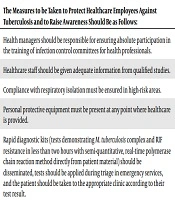
In Iran, we screen all HCWs who wish to have a new job in health care settings and they should receive TB individual risk assessment, TB symptom screening, and TB testing. Annual TB test is not recommended unless there is known exposure and ongoing transmission. TB education of all HCWs is highly recommended and should be performed for all HCWs annually.