1. Background
Futsal is a small-sided indoor version of football with different rules (1). Popularity of futsal in different communities is growing and more than one million official futsal players have already been registered by national federations worldwide. Although a few efforts have been done to run research studies on injuries and medical complaints of futsal players (2-5), these studies continue to lag behind the progress of the sport (6-14). Schmikli SL et al. (2), showed that futsal is among the top ten injury-prone sports with an incidence rate of 55.2 injuries per 10000 hours of sports participation (95% CI: 42.7 to 71.3). This shows that the incidence rate of injury among futsal players is almost 2.7 times more than footballers who had an injury rate of 20.3 injuries per 10000 hours of sports activity (95% CI 18.4 to 22.4). The higher prevalence of injury might be due to the differences in age and physiological demands of the two groups. Jung and his colleague (4) studied the injury characteristics in top level international futsal tournaments and reported an incidence rate of 195.6 injuries per 1000 player hours (95% CI 165.8 to 225.6) and 130.4 injuries per 1000 player matches (95% CI 110.5 to 150.3). More than one third of the injuries were reported during non-contact activities and the majority of injuries occurred in the lower extremity, head and neck, upper extremity and trunk respectively. On basis of this study, it was suggested that the location of injuries might be similar among football and futsal players, although the rate of non-contact injuries in futsal is more than football. In order to provide more information about the pattern, characteristics and incidence rate of injuries in futsal, this study was designed to record and analyze the injuries in Iran futsal national teams.
2. Objectives
These findings could be beneficial for educational and preventive efforts to protect futsalers’ health in this country and also at the international level.
3. Patients and Methods
This prospective cohort study includes all Iranian futsal players (17 players of women’s team, 23 players of men’s team, and 15 players of U-23 men’s team) who were invited to national team camps from March 2011 to September 2012. Prior to the start of study, all 55 players participated in the Pre-competition Medical Assessment (PCMA) based on the FIFA protocol (15). At the beginning of the study all 55 futsal players (17 females and 38 males) were interviewed and their demographic data including age, BMI (Body Mass Index), years of playing in the premier futsal league, and average time of training per week were collected. All players were asked to sign a consent letter for the study. They were followed in national team camps for about 18 months. In this period, all injuries sustained by the subjects during the matches and also training sessions were recorded. In addition, match and training exposure times were recorded for all the subjects during the study period. Exposure times were obtained by the special exposure report form. The players’ exposures were categorized into 2 time spans: 1-training period; 2- matches’ period. During the two periods, regular face-to-face contacts were conducted to all the subjects by their team physicians to record their injuries and complaints. Whenever a subject incurred an injury, a sports medicine physician reevaluated his/her condition and in a standard form. The characteristics of each injury including type, location, cause and time of injury and also duration of absence from the match or training (in days) was recorded. In this study, both the injury definition and the procedure of the recording of the player’s injuries were compliant with the international consensus statement for the epidemiological studies of injuries in football (16). In this regard, injury was defined as “any physical complaint sustained by a futsal player that results from a football match or career related training sessions, irrespective of the need for medical attention or time loss from football activities”. Also, in this study the medical complaints of the futsal players were recorded. In this regard, all team physicians were also asked to record any gradual-onset injury not attributable to any recognized event. In this study, the severity of injury was classified based on players’ period of absence from playing into four categories of: slight (0-3 days), mild (4 to 7 days), moderate (8 to 30 days), and severe (more than 30 days) (17). This study was approved by the Ethics Committee of the Iran University of Medical Sciences. The incidence rate of injury was indicated as the number of injuries per 1000 player-hours of exposure (sum of the training and match hours). Data were analyzed using statistical software SPSS 16.0.0. (SPSS Inc. Chicago, IL, USA).
4. Results
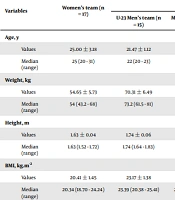
This study included 55 Iranian national futsal players. Baseline characteristics of the study participants are presented in Table 1. The total exposure time of all players was 24326 hours (21138 hours during training and 3188 hours during matches). In total 54 injuries sustained by 32 players were reported (incidence rate = 2.22 injuries per 1000 players-hours). The incidence rate of injury was significantly higher in female players than male players and U-23 men’s players (P = 0.001 and P < 0.001, respectively; Table 2). This difference seems to be mostly due to training sessions since when it comes to match periods, no significant differences in the incidence rate of injuries between the groups was found (Table 2). Our data showed that the incidence rate of injury during match hours was significantly more than training sessions (6.27 vs. 1.61 injuries per 1000 player-hours, P = 0.001). The majority of incurred injuries were due to non-contact trauma. The incidence rate of non-contact injuries was significantly higher in female players compared to the male players (P = 0.02, Table 2). The ankle (40.7%) was the most frequent site of injury, followed by knee (22.2%) and groin (13%) (Table 3). Regarding the type of injuries, it was found that sprain; strain and lesion of meniscus or cartilage were the most frequent types of injury in Iranian national futsal players (Table 2).
Table 1.
Baseline Characteristics of Players
| Women’s Team (n = 17) | Men’s Teams | Total (n = 55) | P Value | |||
|---|---|---|---|---|---|---|
| U-23 Men’s Team (n = 15) | Men’s Team (n = 23) | Total (n = 38) | ||||
| Age, y | 0.7 | |||||
| Mean ± SD | 25.00 ± 3.18 | 21.47 ± 1.12 | 26.61 ± 3.71 | 24.58 ± 3.89 | 24.71 ± 3.66 | |
| Median | 25 | 22 | 25 | 24 | 24 | |
| Range | 20-31 | 20-23 | 22-36 | 20-36 | 20-36 | |
| Weight, kg | < 0.0001 | |||||
| Mean ± SD | 54.6 ± 5.7 | 70.3 ± 6.5 | 75.1 ± 6.9 | 73.2 ± 7.0 | 67.3 ± 10.9 | |
| Median | 54 | 73.2 | 74.6 | 74.2 | 69.1 | |
| Range | 43.2-68.0 | 61.5-81.0 | 62.4-94.8 | 61.5-94.8 | 43.2-94.8 | |
| Height, m | < 0.0001 | |||||
| Mean ± SD | 1.6 ± 0.04 | 1.7 ± 0.1 | 1.8 ± 0.05 | 1.7 ± 0.05 | 1.7 ± 0.1 | |
| Median | 1.6 | 1.74 | 1.8 | 1.8 | 1.7 | |
| Range | 1.5-1.7 | 1.6-1.8 | 1.6-1.9 | 1.6-1.9 | 1.5-1.9 | |
| BMI, kg/m2 | < 0.0001 | |||||
| Mean ± SD | 20.4 ± 1.4 | 23.2 ± 1.4 | 24.3 ± 1.5 | 23.8 ± 1.5 | 22.7 ± 2.2 | |
| Median | 20.3 | 23.4 | 24.2 | 23.74 | 23.0 | |
| Range | 18.7-24.2 | 20.4-25.4 | 21.7-27.7 | 20.4-27.7 | 18.7-27.7 | |
| Fat, % | < 0.0001 | |||||
| Mean ± SD | 21.2 ± 3.5 | 10.9 ± 1.8 | 14.4 ± 3.1 | 13.0 ± 3.2 | 15.5 ± 5.0 | |
| Median | 20.1 | 11 | 13.6 | 12.9 | 15.3 | |
| Range | 15.7-27.8 | 8.2-14.5 | 8.4-20.1 | 8.2-20.1 | 8.2-27.8 | |
Table 2.
Comparison of Injuries Among Iranian National Futsal Teamsa
| Women’s Team | Men’s Teams | Total Injuries | P Valuec | |||||||||
|---|---|---|---|---|---|---|---|---|---|---|---|---|
| U-23 Men’s | Men’s Team | Totalb | ||||||||||
| No. | IRd | No. | IR | No. | IR | No. | IR | No. | IR | |||
| Number of injuriese | 28 | 4.17 | 8 | 0.90 | 18 | 2.07 | 26 | 1.48 | 54 | 2.22 | 0.001 | |
| Location of injury | ||||||||||||
| Head and trunk | 3 | 0.45 | 1 | 0.11 | 1 | 0.12 | 2 | 0.11 | 5 (9.3) | 0.21 | 0.2 | |
| Upper extremity | 2 | 0.30 | 0 | 0 | 1 | 0.12 | 1 | 0.06 | 3 (5.6) | 0.12 | 0.3 | |
| Lower extremity | 23 | 3.43 | 7 | 0.78 | 16 | 1.84 | 23 | 1.31 | 46 (85.2) | 1.89 | 0.01 | |
| Groin | 4 | 0.60 | 1 | 0.11 | 2 | 0.23 | 3 | 0.17 | 7 (13.0) | 0.29 | 0.2 | |
| Thigh | 0 | 0 | 2 | 0.22 | 1 | 0.12 | 3 | 0.17 | 3 (5.56) | 0.12 | 0.08 | |
| Knee | 5 | 0.74 | 1 | 0.11 | 6 | 0.69 | 7 | 0.40 | 12 (22.2) | 0.49 | 0.3 | |
| Lower Leg | 1 | 0.15 | 0 | 0 | 0 | 0 | 0 | 0 | 1 (1.8) | 0.04 | 0.3 | |
| Achilles tendon | 1 | 0.15 | 0 | 0 | 0 | 0 | 0 | 0 | 1 (1.8) | 0.04 | 0.3 | |
| Ankle | 12 | 1.79 | 3 | 0.34 | 7 | 0.81 | 10 | 0.57 | 22 (40.7) | 0.9 | 0.03 | |
| Type of injury | ||||||||||||
| Concussion | 1 | 0.15 | 0 | 0 | 1 | 0.12 | 1 | 0.06 | 2 (3.7) | 0.08 | 0.6 | |
| Fracture | 1 | 0.15 | 0 | 0 | 0 | 0 | 0 | 0 | 1 (1.8) | 0.04 | 0.3 | |
| Stress fracture | 1 | 0.15 | 0 | 0 | 0 | 0 | 0 | 0 | 1 (1.8) | 0.04 | 0.3 | |
| Tendon rupture | 1 | 0.15 | 0 | 0 | 0 | 0 | 0 | 0 | 1 (1.8) | 0.04 | 0.3 | |
| Lig. rupture | 2 | 0.3 | 1 | 0.11 | 1 | 0.12 | 2 | 0.11 | 4 (7.4) | 0.16 | 0.4 | |
| Sprain | 16 | 2.38 | 4 | 0.45 | 8 | 0.92 | 12 | 0.68 | 28 (51.8) | 1.15 | 0.01 | |
| Meniscus or cartilage | 2 | 0.30 | 0 | 0 | 5 | 0.58 | 5 | 0.28 | 7 (13.0) | 0.29 | 0.9 | |
| Strain | 2 | 0.30 | 2 | 0.22 | 3 | 0.35 | 5 | 0.28 | 7 (13.0) | 0.29 | 0.9 | |
| Contusion, hem, bruise | 1 | 0.15 | 0 | 0 | 0 | 0 | 0 | 0 | 1 (1.8) | 0.04 | 0.3 | |
| Muscle cramps/spasm | 0 | 0 | 1 | 0.11 | 0 | 0 | 1 | 0.06 | 1 (1.8) | 0.04 | 0.3 | |
| Cause of injury | ||||||||||||
| Overuse | 3 | 0.45 | 0 | 0 | 0 | 0 | 0 | 0 | 3 (5.6) | 0.12 | 0.08 | |
| Non-contact trauma | 18 | 2.68 | 5 | 0.56 | 15 | 1.73 | 20 | 1.14 | 38 (70.4) | 1.56 | 0.02 | |
| Contactf | 7 | 1.04 | 3 | 0.34 | 3 | 0.35 | 6 | 0.34 | 13 (24.1) | 0.53 | 0.09 | |
| Time of injury | ||||||||||||
| In training hours | 18 | 3.11 | 3 | 0.37 | 13 | 1.79 | 16 | 1.04 | 34 (63.0) | 1.61 | 0.01 | |
| In match hours | 10 | 10.75 | 5 | 6.10 | 5 | 3.48 | 10 | 4.43 | 20 (37.0) | 6.27 | 0.09 | |
| First half | 5 | - | 2 | - | 1 | - | 3 | - | 8 (40) | - | - | |
| Second half | 5 | - | 3 | - | 4 | - | 7 | - | 12 (60) | - | - | |
| Duration of absence | ||||||||||||
| 1-3 days | 11 | 1.64 | 2 | 0.22 | 5 | 0.58 | 7 | 0.4 | 18 (33.3) | 0.74 | 0.02 | |
| 4-7 days | 9 | 1.34 | 3 | 0.34 | 9 | 1.04 | 12 | 0.68 | 21 (38.9) | 0.86 | 0.2 | |
| 8-28 days | 5 | 0.74 | 2 | 0.22 | 1 | 0.12 | 3 | 0.17 | 8 (14.8) | 0.33 | 0.1 | |
| > 28 days | 3 | 0.45 | 1 | 0.11 | 3 | 0.35 | 4 | 0.23 | 7 (13.0) | 0.29 | 0.4 | |
aAbbreviation: Lig, Ligamentous; hem, hematoma; IR, incidence rate.
bTotal male players.
cP value for the comparison of incidence rates of variables between male and female players.
dNumber of injuries per 1000 player-hours of exposure.
eNumber of injuries during training or matches which caused at least one day of absence.
fContact trauma with another player.
Table 3.
Injury Severity for Different Types and locations in 55 National Futsal Playersa
| Type and Location | Injury Severityb | ||||
|---|---|---|---|---|---|
| Slight | Minor | Moderate | Severe | Total | |
| Sprain (joints or ligaments injuries) | 9 (0.37) | 14 (0.58) | 5 (0.21) | 0 | 28 (1.15) |
| Ankle | 5 (0.21) | 13 (0.53) | 4 (0.16) | 0 | 22 (0.90) |
| Other | 4 (0.16) | 1 (0.04) | 1 (0.04) | 0 | 6 (0.25) |
| Strain | 5 (0.21) | 2 (0.08) | 0 | 0 | 7 (0.29) |
| Groin | 3 (0.12) | 2 (0.08) | 0 | 0 | 5 (0.21) |
| Other | 2 (0.08) | 0 | 0 | 0 | 2 (0.08) |
| Lesion of meniscus or cartilage (knee) | 2 (0.08) | 2 (0.08) | 1 (0.04) | 2 (0.08) | 7 (0.29) |
| Ligamentous rupture of Knee | 0 | 0 | 0 | 4 (0.16) | 4 (0.16) |
| Other injuriesc | 2 (0.08) | 3 (0.12) | 2 (0.08) | 1 (0.04) | 8 (0.33) |
| Total | 18 (0.74) | 21 (0.86) | 8 (0.33) | 7 (0.29) | 54 (2.22) |
aData are expressed as number of injuries (Incidence of injuries), where incidence of injuries is defined as the number of injuries per 1000 player-hours of exposure.
bThe injury severity was classified into four categories according to their duration of absence: slight (1 to 3 days), mild (4 to 7 days), moderate (8 to 28 days), and severe (more than 28 days).
cOther injuries: Moderate: fracture and dislocation/subluxation; Severe, tendon rupture.
5. Discussion
This prospective study is one of few surveys which examines the incidence and characteristics of injuries in top-level futsal players and to our knowledge, is the first one in Asia. According to our findings the incidence rate of injury among futsal players was 2.22 injuries per 1000 players-hours. This finding is in contrast with the study by Junge and Dvorak (4) which reported 195.6 injuries per 1000 players-hours and also the reported incidence rate of injury in the FIFA World Cups 1998, 2002 and 2006 (mean incidence rate of 74.2 injuries per 1000 players-hours) (4, 7, 12). This difference might be due to the different level of playing futsal in the FIFA World Cups and Iranian futsal league, besides, in these studies only the injuries incurred during the matches were recorded while we reported all injuries that happened in the matches and training sessions. A major obstacle in the evaluation of the incidence and characteristics of injuries in futsal is that there is no specific consensus for the definition of injuries among futsal players, while standard protocols have been developed for footballers (18-21). In previous studies, consecutive absence from training or match has been used as the definition of injury (19). However, by use of this definition, many chronic and mild injuries will be missed (20, 21). In this study, we used the definition which was developed by Fuller et al. for footballers (16). On this basis injury defined as any physical complaint that results from a career related training session or a match, irrespective of the need for medical attention or time loss from sports activities (4, 21). So, in addition to limited number of studies regarding the injury characteristics among futsal players, comparison between the studies due to the use of different definitions is not possible. This study is one of the very few surveys which compares the incidence and characteristics of injuries between men and women in the top-level futsal players. The results show that the rate of injury is higher in female players than male players (P = 0.001, Table 2). As it is mentioned before, this significant difference was mostly due to non-contact injuries. The level of fitness of the players is one of the important factors which is highly associated with the risk of sports injuries (11, 20). Considering the nature of futsal which requires multiple sprints and frequent changes in the direction of movements, the physical fitness factors (particularly speed and agility) of the athletes should be much improved to make the players able to participate in the competitions. Therefore, it seems rational that rate of injury among female futsal players with lower level of physical fitness than men is much more than male futsal players, as is shown in this study (6, 12, 22). While Junge and Dvorak reported that the majority of injuries in Futsal World Cups were caused by contact trauma (4), the majority of injuries sustained by the athletes in the current study were due to non-contact trauma. Inclusion of injuries which occurred during training sessions might be considered as a possible explanation for this difference. In the present study, 85.2 % injuries were located at the lower extremities with the ankle being the most frequent location of injury (40.7%). These results are similar to the results that were reported previously for elite football male players (4, 6, 22). Also, in the study of Junge and Dvorak (4) the majority of injuries in futsal were observed at the lower extremity, and the most frequent diagnoses were contusions of the lower leg and ankle sprain. Serrano and colleagues (23) showed that the sprain of the tibial-tarsal joint was the most common part of injury in Futsal (48.8% of total) which is in accordance with the results of our study. As the most important limiting factor in this study, we had to let some players leave the national team camp for some periods to play for their own team in the futsal league. However, whenever they came back to national team camp, the team physicians reexamined them and they recorded every new observed injury. Considering the growing popularity of futsal, further studies in order to evaluate the incidence, characteristics, and cause of injuries in futsal are required (24-26). Such studies could be the cornerstone for development of injury-prevention programs, based on the FIFA 11+ prevention program. The incidence of injury in futsal is high and female players in comparison with male players are more prone to be injured especially by non-contact trauma. The ankle is the most frequent part of injury followed by the knee and the groin in all futsal players. In addition, sprain is the most frequent type of injury among Iranian futsal players. More information on injury mechanisms in futsal is needed to develop specific injury-preventive strategies.