1. Background
The postural control system returns the statically unstable body to the equilibrium position after facing a perturbation. Postural stability is commonly measured by the assessment of time-varying coordinates of center of pressure which is the instantaneous point of application of ground reaction force to the foot soles (1). Impaired postural control has been regarded to be associated with poor balance control and falls (2) and used to predict fall risk in the elderly (3). Postural steadiness has been defined as the ability to maintain the standing posture with minimal motions (4, 5). Center of pressure (COP) displacement has been used to reflect postural sway (2).
The force platform has been considered as the gold standard for the assessment of the postural control system (2, 6). The assessment of postural control by clinical tests such as Berg’s balance test, while shown to provide valuable information (7), adheres to limitations such as subjectivity of scores and the ceiling effect and may thus not differentiate subtle changes (7). The use of sophisticated instruments such as force platforms brings up other issues regarding the costs, set-up difficulties and transport inconvenience (6). The Wii balance board (WBB) originally being part of a video game device (Nintendo, Kyoto, Japan) has been already used as a balance training biofeedback device in the rehabilitation of neurological balance deficit patients (8) and elite athletes and non-athlete adults (9). With its four force transducers at the corners of the standing platform, WBB can yield COP coordinates. The low cost and easy transportation capabilities make WBB a tempting alternative for much more expensive devices. Like any other testing device, utilization of WBB depends on its validity being tested against the gold standard. Clark et al. have examined the COP measures obtained from WBB and a standard force platform under bi- and uni-lateral stance under the eyes open and closed conditions and reported an acceptable level of agreement between the COP path length values obtained from the two devices (6). This is while other commonly used somatosensory test conditions have not been implemented in this study. The WBB validity has also been investigated in some other studies with different experimental conditions: administrating inverted pendulum dynamics of a dead weight to monitor COP displacements (10); comparing the COP displacement measurements on WBBs with different wears (11) or 2-D (not differentiating AP and ML direction sways) assessment of postural control under narrow base of support (single leg stance) (12). The discrepancies between the testing conditions and experimental paradigms make it impossible to extrapolate the findings of these studies to other conditions and sample populations which is an external validity issue.
One of the most commonly administered test conditions by which the stabilometry has been performed is standing on unstable foam. This condition challenges the postural control system by altering the proprioceptive input to the sole of the feet which is one of the major sources of information on which the central nervous system decides how to regulate balance control. It seems thus warranted to compare the COP measures of postural control obtained from a convenient, inexpensive portable device like WBB and those from the gold standard force platform under different commonly used postural conditions.
The aim of this study being a preliminary one was to compare COP path length and antero-posterior (AP) displacement range obtained from these two devices during postural tasks with different levels of difficulty (based on the availability of somatosensory and visual information).
2. Methods
2.1. Participants
Twenty university students (15 female and 5 male) with mean (standard deviation) age, height and weight of 24.6 (3.82) years, 166.85 (9.84) cm and 65.75 (16.74) kg, respectively voluntarily participated in this methodological study after being informed about the content of the study and signing the informed consent form approved by the human ethics committee of the Shahid Beheshti Medical University (registered on Nov. 12, 2014 under the protocol number). None of the participants had neither a regular sports activity nor any neurological, balance or uncorrected visual disorder or lower extremity surgery or observable deformity.
2.2. Procedure
The postural sway of the participants was recorded by the same rater during three successful trials on two independent sessions 5 - 7 days apart with each of the measuring devices (force platform and WBB). The subjects were asked to stand freely barefoot with their arms hanging freely beside their trunk looking to a target circle at their eyes level on a wall being three meters away. The subjects were free to choose their feet distance on the first trial of the first session. This distance was measured and kept fixed for other trials (13, 14). Four experimental conditions were used to assess the effect of visual deprivation and somatosensory modification of the sensory afferent information from the support surface: eyes open- stable support surface (OS), eyes open- foam support surface (OF), eyes closed- stable support surface (CS) and eyes closed foam- support surface (CF) (13, 14). A blindfold was used for the closed eye conditions. Ten centimeter height foams completely covering the surfaces of the force platform and WBB were used to provide the unstable condition. The tests were performed in a random order. Each trial would last 30 seconds. To avoid fatigue, the trials were 1 - 2 minutes apart.
2.3. Instruments
2.3.1. Force Platform
Bertec Digital Acquire 4060 - 08 force platform was used as the gold standard to calculate COP measures and evaluate postural sway. Four strain-gauge force transducers implemented at the corners of the 30 cm × 50 cm platform would measure the force distribution in the horizontal and vertical directions. The sampling frequency was set at 100 Hz.
2.3.2. WBB
WBB RVL-021(KOR) is part of a video game with a 26 cm × 44 cm platform with 4 force transducers implemented under the four corners. The visual monitoring system of the device providing visual feedback was eliminated from the system. To acquire digital data for COP processing we used an analogue to digital converter and custom made software written in MATLAB R2009b. WBB was connected to a data acquisition computer via Bluetooth and COP data were acquired by the frequency of 40 Hz.
2.4. Data Reduction
COP path length and AP range were the two COP measures used for postural sway assessment. The path length variable describes the whole distance taken by COP during the test trial and was computed by the formula:
Equation 1.
where axi and ayi denote the horizontal and vertical coordinates of COP for the ith data point. AP range was defined as the farthest distance between COP coordinates in the sagittal plane.
2.5. Statistical Analysis
Two way random effects single (1, 2) and average measure (2, 3) model ICC tests were used for intra- and inter-session reliability analysis of the COP score measurements, respectively. ICC points of estimate were categorized as poor or little (0 - 0.39), moderate (0.40 - 0.74), good (0.75 - 0.89) and excellent (0.90 - 1). Correlation of the measurements of the two devices does not necessarily guarantee the validity of the WBB since even two quite different series of data points might show strong correlation. Separate one-sample t-tests were thus used to check if the difference between the scores of the methods statistically differed from zero or not. This measure would evaluate the concordance of the two devices’ measurements and thus assess the construct validity of the WBB against the presumably standard force platform device.
The Bland and Altman scatter plot was used for the purpose of descriptive evaluation of the concordance of the scores from the two devices. In this plot the differences of the measurements of the two devices are plot against the pooled mean values (mean of the scores of the two devices). Investigation of the Bland and Altman plot can descriptively show if there is a systematic bias in the differences of the measurements and their mean values. In addition it demonstrates the distribution of the difference magnitude of values around the mean difference of the measurements of the two devices. Regression analysis of the data from this plot can statistically tell us if there is a systematic bias or not. Limits of agreement (LoA) on this plot predict the difference value of any other measurements by the two devices (with 95% certainty) by multiplying the standard deviation (SD) of the mean difference of the scores by 1.96. The mean difference plus and minus this value yields the upper and lower LoA, respectively being demonstrated by two extra lines drawn above and below the mean difference line on the Bland and Altman plot.
3. Results
All COP measures from both devices showed statistically significant relative reliability assessed by ICC test. The intra-session relative reliability of COP measures were mostly rated as moderate for both devices. The AP range in the CS condition of both devices and CU condition in force platform showed poor reliability. The path length of COP trajectory in the CU condition was the only measure demonstrating good intra-session reliability (Table 1).
Table 1.
Intra-Session Reliability of AP Range and Path Length Measures of COP of the Two Devices Under the Four Testing Conditions
| Device | COP Measure | Condition | ICC | 95% CI | P Valuea |
|---|---|---|---|---|---|
| Force platform | AP | OS | 0.682 | 0.458 - 0.846 | < 0.001 |
| OU | 0.552 | 0.290 - 0.769 | < 0.001 | ||
| CS | 0.387 | 0.111 - 0.659 | 0.003 | ||
| CU | 0.369 | 0.093 - 0.645 | 0.004 | ||
| PL | OS | 0.465 | 0.192 - 0.713 | < 0.001 | |
| OU | 0.461 | 0.188 - 0.710 | < 0.001 | ||
| CS | 0.631 | 0.389 - 0.817 | < 0.001 | ||
| CU | 0.676 | 0.449 - 0.842 | < 0.001 | ||
| WBB | AP | OS | 0.544 | 0.281 - 0.764 | < 0.001 |
| OU | 0.442 | 0.167 - 0.697 | 0.001 | ||
| CS | 0.365 | 0.089 - 0.642 | 0.004 | ||
| CU | 0.497 | 0.228 - 0.734 | < 0.001 | ||
| PL | OS | 0.560 | 0.237 - 0.740 | < 0.001 | |
| OU | 0.487 | 0.216 - 0.728 | < 0.001 | ||
| CS | 0.518 | 0.251 - 0.748 | < 0.001 | ||
| CU | 0.809 | 0.647 - 0.912 | < 0.001 |
Abbreviations: AP, Anterior-Posterior Displacement Range; CI, Confidence Interval; CS, Closed Stable; CU, Closed Unstable; ICC, Intra-Class Correlation; OS, open stable; OU, Open Unstable; PL, Path Length; WBB, Wii Balance Board.
aIndicates statistically significant correlation.
Most COP measures showed moderate level of inter-session relative reliability in both devices. While path length derived from the force platform demonstrated good reliability in all conditions except OS, the only item having a poor level of reliability was the WBB AP range during the CS condition (Table 2).
Table 2.
Inter-Session Reliability of AP and PL Measures Of COP of the Two Devices
| Device | COP Measure | Condition | ICC | 95% CI | P Valuea |
|---|---|---|---|---|---|
| Force platform | AP | OS | 0.747 | 0.360 - 0.900 | 0.002 |
| OU | 0.716 | 0.283 - 0.888 | 0.004 | ||
| CS | 0.697 | 0.236 - 0.880 | 0.006 | ||
| CU | 0.712 | 0.272 - 0.886 | 0.005 | ||
| PL | OS | 0.669 | 0.164 - 0.869 | 0.010 | |
| OU | 0.831 | 0.572 - 0.933 | < 0.001 | ||
| CS | 0.871 | 0.675 - 0.949 | < 0.001 | ||
| CU | 0.760 | 0.395 - 0.905 | 0.002 | ||
| WBB | AP | OS | 0.604 | 0.167 - 0.831 | 0.007 |
| OU | 0.738 | 0.339 - 0.896 | 0.003 | ||
| CS | 0.584 | 0.336 - 0.835 | 0.032 | ||
| CU | 0.337 | 0.327 - 0.738 | 0.036 | ||
| PL | OS | 0.696 | 0.233 - 0.885 | 0.006 | |
| OU | 0.697 | 0.235 - 0.880 | 0.006 | ||
| CS | 0.651 | 0.118 - 0.862 | 0.013 | ||
| CU | 0.739 | 0.341 - 0.897 | 0.003 |
Abbreviations: AP, Anterior-Posterior Displacement Range; CI, Confidence Interval; CS, Closed Stable; CU, Closed Unstable; ICC, Intra-Class Correlation; OS, open stable; OU, Open Unstable; PL, Path Length; WBB, Wii Balance Board.
aIndicates statistically significant correlation.
The mean and SD of the COP measures (AP range and total path length) besides the standard error of measurement (SEM as an absolute reliability index) and minimal detectable change (MDC) showing smallest alteration of the variable to be considered a true, error independent change, are presented in Table 3. One sample t-test found the mean differences of the COP measures derived from the two devices not to be statistically different from zero (Table 4). This confirms that the COP measures of the two devices were not statistically different.
Table 3.
Mean ± SD, SEM and MDC of the COP Measures Under the Four Testing Conditions
| Variables | Force Platform | WBB | ||||||||||
|---|---|---|---|---|---|---|---|---|---|---|---|---|
| COP measure | AP | PL | AP | PL | ||||||||
| Condition | Mean ± SD | SEM | MDC | Mean ± SD | SEM | MDC | Mean ± SD | SEM | MDC | Mean ± SD | SEM | MDC |
| OS | 1.20 ± 0.54 | 0.30 | 0.84 | 23.27 ± 5.56 | 4.07 | 11.27 | 1.49 ± 0.44 | 0.30 | 0.82 | 26.93 ± 6.44 | 4.27 | 11.84 |
| OU | 2.37 ± 0.90 | 0.60 | 1.67 | 35.97 ± 9.66 | 7.09 | 19.66 | 2.45 ± 0.89 | 0.66 | 1.84 | 40.79 ± 7.27 | 5.21 | 14.43 |
| CS | 1.49 ± 0.69 | 0.54 | 1.50 | 29.17 ± 8.06 | 4.90 | 13.57 | 1.78 ± 0.51 | 0.41 | 1.13 | 32.42 ± 7.96 | 5.53 | 15.32 |
| CU | 3.28 ± 1.14 | 0.91 | 2.51 | 59.54 ± 15.52 | 8.83 | 24.49 | 3.64 ± 1.02 | 0.72 | 2.01 | 66.07 ± 18.31 | 8.00 | 22.18 |
Abbreviations: AP, Anterior-Posterior Displacement Range Expressed in Centimeters; CU, Closed Unstable; CS, Closed Stable; MDC, Minimal Detectable Change; OU, Open Unstable OS, Open Stable; PL, Path Length Expressed in Centimeters; SEM, Standard Error of Measurement; SD, Standard Deviation.
Table 4.
One-Sample T-Test of the Difference of the Scores of the Two Devices
| COP Measure | Condition | Mean Differencea | 95% CI | P Value |
|---|---|---|---|---|
| AP | OS | -0.22 | -0.50 - 0.06 | 0.120 |
| OU | -0.08 | -0.71 - 0.54 | 0.779 | |
| CS | -0.29 | -0.72 - 0.14 | 0.173 | |
| CU | -0.35 | -1.13 - 0.42 | 0.346 | |
| PL | OS | -3.65 | -7.84 - 0.53 | 0.083 |
| OU | -4.81 | -10.19 - 0.56 | 0.076 | |
| CS | -3.25 | -8.11 1.61 | 0.178 | |
| CU | -6.53 | -13.75 - 0.69 | 0.074 |
Abbreviations: AP, Anterior-Posterior Displacement Range; CI, Confidence Interval; CU, Closed Unstable; CS, Closed Stable; OU, Open Unstable; OS, Open Stable; PL, Path Length.
aMean difference: Force platform derived measure minus WBB derived measure.
Visual description of the relationship between the COP AP range and path length are provided in Figures 1 and 2, respectively.
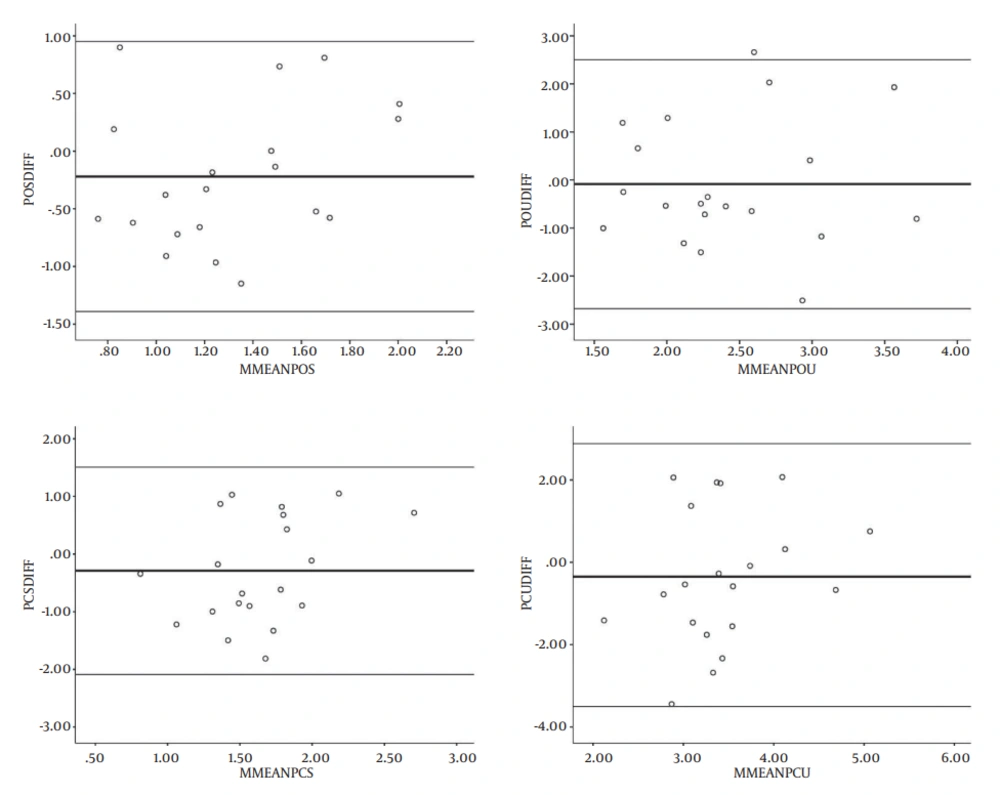
Figure 1.
Bland-Altman description of the mean difference of the AP displacement range derived from the two devices plotted against the mean AP displacement range values in the open stable (top, left), open unstable (top, right), closed stable (bottom, left) and closed unstable (bottom, right) conditions. The ordinate and abscissa demonstrate the COP scores difference of the two devices and the mean COP values, respectively. The median bold line indicates the mean difference value and the upper and lower thinner lines show the upper and lower limits of agreement, respectively.
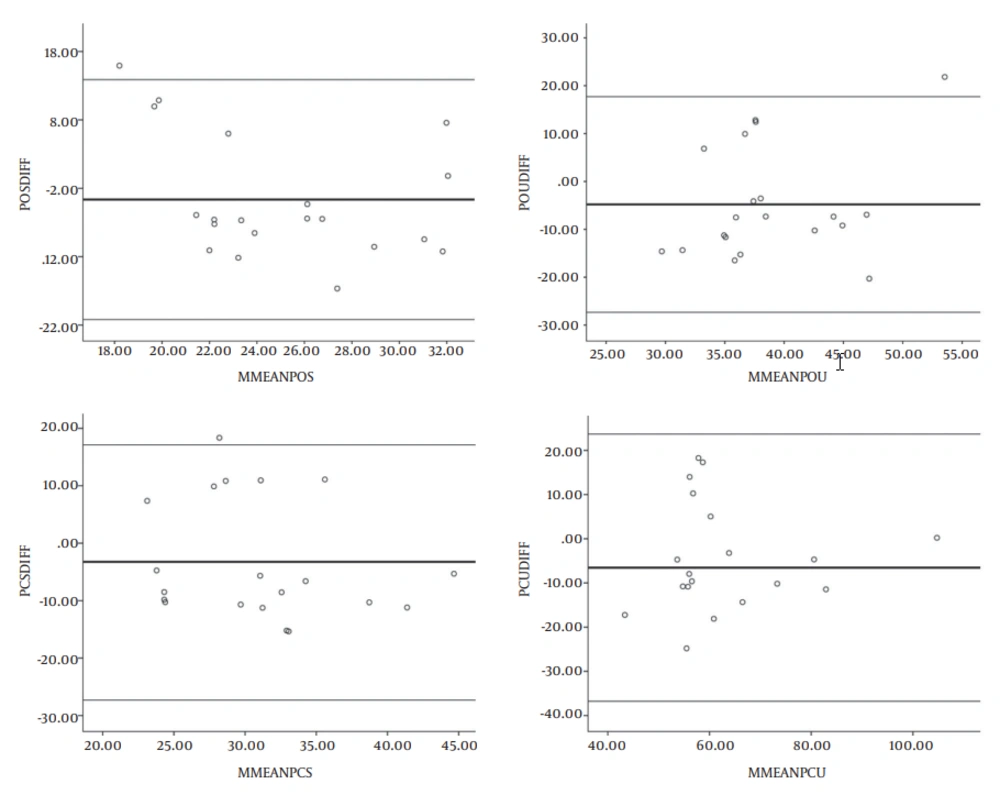
Figure 2.
Bland-Altman description of the mean difference of the path length scores derived from the two devices plotted against the mean path length values in the open stable (top, left), open unstable (top, right), closed stable (bottom, left) and closed unstable (bottom, right) conditions. The ordinate and abscissa demonstrate the COP scores difference of the two devices and mean COP values, respectively. The median bold line indicates the mean difference value and the upper and lower thinner lines show the upper and lower limits of agreement, respectively.
Regression analysis of the pooled mean scores of COP AP displacement range and path length and the differences of the scores between the two devices revealed no statistically significant systematic bias between them (Table 5). In other words the difference between the scores derived from the two devices was independent of the mean values of the COP measures.
Table 5.
Regression Analysis of the Mean Difference of the Scores from the Two Devices and the Mean Values of the Dependent Variables
| COP Measure | Condition | r2 | P Value |
|---|---|---|---|
| AP | OS | 0.083 | 0.219 |
| OU | 0.002 | 0.845 | |
| CS | 0.131 | 0.116 | |
| CU | 0.072 | 0.252 | |
| PL | OS | 0.142 | 0.102 |
| OU | 0.063 | 0.285 | |
| CS | 0.042 | 0.386 | |
| CU | 0.048 | 0.351 |
Abbreviations: AP, Anterior-Posterior Displacement Range; CI, Confidence Interval; CU, Closed Unstable; CS, Closed Stable; OU, Open Unstable; OS, Open Stable; PL, Path Length.
4. Discussion
Postural sway measurement is a crucial component of the motor control system study. Measurements of the COP displacement and calculation of the consequent time and frequency domain variables have been widely performed using standardized force platforms assessing the COP instantaneous location by measuring vertical and shearing horizontal ground reaction forces (15-17). Expensive, non-portable and difficult to implement properties of these force platforms have encouraged the exploration of alternatives for the gold standard measurements of COP. In the last decade some researchers have assessed the reliability and validity of different balance training devices including Chattecx (18), Nintendo WBB (6) and the GKS systems (2) by comparing their measurements with those of force platforms. The purpose of the current study was to follow this line of investigations by assessing the relative and absolute reliability and the concurrent validity of WBB against Bertec strain-gauge force platform under some frequently used conditions for the assessment of standing balance.
The results indicated a negative value for the mean difference of the two devices for all conditions of both COP measures. Although none of the differences reached statistical significance level (ranging from -0.08 cm to -6.53 cm), it shows that WBB almost consistently overestimated the COP variables in comparison with the force platform. Thus while the measurements of the two devices seem to be comparable, caution should be made while interpreting the absolute size of COP displacement driven from WBB specifically comparing the raw data with those of force platform. Clark RA et al. suggested the differences of the support surface texture to be one of the causes of such differences but since the greatest magnitude of mean difference was seen on the foam standing conditions of our study (OU, CU) where the texture of the support surface remained the same for both devices, this hypothesis might not be easily accepted. Since the test trials duration were fixed for all testing conditions and subjects, the mean velocity of COP displacement, being suggested to describe standing postural control best (1, 19), is expected to follow the path length pattern of alterations.
The findings also indicated the mean difference of the two devices to be greater in more complex conditions (unstable support surface). This is in contrast with the findings of Donath et al. who found larger systematic bias sizes for easy task conditions (2). This discrepancy might be explained by the difference of the nature of the tasks in the two studies. Donath et al. used the single leg standing task to challenge the standing balance, while we made the support surface less stable by the use of foam. Modifying the support surface texture and firmness alters sensory afferent inputs of the postural control system in a different manner from just reducing the base of support (20).
Investigation of the relative reliability of the two devices reveals that while both are statistically reliable, the force platform shows relatively higher levels of intra- and inter-session reliability. The repeatability of measurements via WBB especially in terms of intra-session reliability seems to be a concern. The absolute reliability of COP measures derived from both devices were found to be comparable with each other.
The Bland and Altman plots of COP AP range and path length demonstrated most differences of the COP measures of the two devices to be distributed around the mean difference line. Lack of significant correlation between the mean and the difference between the measurements of the two devices is indicative of lack of systematic bias for the differences. In other words the differences between the measurements of the WBB and Bertec force platform were not dependent on the magnitude of COP AP range or path length. It is also noticeable that random variability of these differences was higher in more complex conditions of standing balance for both COP measurement tasks particularly in the unstable support surface (foam) condition. Having data points out of the LoA range (although rare) is indicative of a high level of variability in the measurement differences.
4.1. Limitations
The current study was conducted on a young, symptom free sample of participants under still standing condition. The results should be cautiously expanded to other populations and dynamic tasks.
4.2. Conclusions
In the current study both Bertec force platform and WBB devices showed acceptable levels of reliability. The findings also suggest that while the COP driven variables measured by the two devices are comparable, there is a trend toward overestimation of these variables by the WBB. The difference between the measurements of the two devices was found to be highly variable without any significant systematic bias.