Full Text
Full text is available in PDF
Asian Journal of Sports Medicine
Sports Medicine Research Center, TUMS
Authors
Universal goniometer (UG) is commonly used as a standard method to evaluate range of motion (ROM) as part of joint motions. It has some restrictions, such as involvement of both hands of the physician, leads to instability of hands and error. Nowadays smartphones usage has been increasing due to its easy application.
The study was designed to compare the smartphone inclinometer-based app and UG in evaluation of ROM of elbow.
The maximum ROM of elbow in position of flexion and pronation and supination of forearm were examined in 60 healthy volunteers with UG and smartphone. Data were analyzed using SPSS (ver. 16) software and appropriate statistical tests were applied, such as paired t-test, ICC and Bland Altman curves.
The results of this study showed high reliability and validity of smartphone in regarding UG with ICC > 0.95. The highest reliability for both methods was in elbow supination and the lowest was in the elbow flexion (0.84).
Smartphones due to ease of access and usage for the physician and the patient, may be good alternatives for UG.
© 2016, Author(s). This open-access article is available under the Creative Commons Attribution 4.0 (CC BY 4.0) International License (https://creativecommons.org/licenses/by/4.0/), which allows for unrestricted use, distribution, and reproduction in any medium, provided that the original work is properly cited.
Ahmadi M, Taghizadeh Delkhoush C. Comparison of Joint Mobilization with and without Repeated Active Motion on the Restricted Range of Motion in the Elbow Joint after Immobilization: A Randomized Clinical Trial. Koomesh. 2024;26(4):e149349. doi: https://doi.org/10.69107/koomesh-149349
Chamorro C, Fuente CDL, Jerez D, Campos C, Chirosa LJ. Reliability of Shoulder Rotators Isometric Strength Test using a Novel Pulley Electromechanical Dynamometer. Influence of the Assessment Position. Asian J Sports Med. 2018;9(2):e60406. doi: https://doi.org/10.5812/asjsm.60406
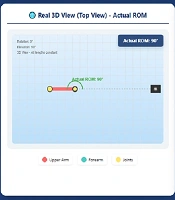
Soltani Sartakhti A, Siyah Mansoory M, Abbasi S. A Vision-Based, Game-Integrated Framework for Elbow Rehabilitation with Perspective Error Compensation: A Proof-of-Concept Study. J Clin Res Paramed Sci. 2026;15(1):e170829. doi: https://doi.org/10.5812/jcrps-170829
Lotfian S, Safar Cherati A, Jamshidi A, Sanjari MA. Assessment of Correlation between Electrogoniometer Measurements and Sports-Specific Movement in Karate Elites. Asian J Sports Med. 2014;5(2):23020. doi:
Sheykhi F, Sharini H, Safarpoor A, Dehlaghi V. Game-Based Rehabilitation and EEG Rehabilitation for Shoulder Recovery Post-stroke. J Clin Res Paramed Sci. 2024;13(2):e156704. doi: https://doi.org/10.5812/jcrps-156704
Last Update: 4 days ago
Last Update: 4 days ago
Last Update: 4 days ago
Last Update: 6 days ago
Last Update: 2 days ago
Last Update: 4 days ago