
1. Background
Musculoskeletal disorders (MSDs) are among the most prevalent and costly work-related conditions globally (1). These disorders lead to losses that impact not only individuals but also the organizations and societies in which they reside (2). Both the International Labour Organization (ILO) and the World Health Organization (WHO) classify MSDs as work-related diseases, referring to them as a "new epidemic" that requires urgent investigation and intervention. These disorders significantly contribute to absenteeism and are a major cause of lost workdays (3).
The direct and indirect costs associated with MSDs account for approximately 1% of the gross national product in industrialized countries (4). Health care workers face a higher risk of MSDs compared to those in industries such as construction, mining, and manufacturing (5). Between 60 - 90% of adults experience back pain at some point in their lives, with around 15 - 20% of worker compensation claims related to these issues (6). Estimates from the ILO suggest that approximately 1.2 million workers have been forced to leave their jobs due to disability, with nearly 28% of these cases attributed to work-related MSDs (7). These disorders are among the most significant occupational challenges for healthcare providers (8). In Iran, nurses comprise 80% of the medical workforce, with a prevalence rate of MSDs reported between 60 - 80% among them (9).
Studies indicate a relationship between MSDs and job performance, with these disorders ultimately affecting productivity (1, 10-14). Limited research on operating room (OR) staff worldwide has shown a high prevalence of MSDs in this group. According to studies by Andersen et al. and the Canadian Centre for Occupational Safety and Health (CCOHS), various risk factors such as patient transfer, night shift stress, prolonged standing, fixed postures, and the physical demands of handling heavy equipment alongside personal factors like age, gender, and obesity, contribute to MSDs in the back, legs, and other areas of the body. Evidence suggests that OR staff experience musculoskeletal pain within one year of clinical work, with muscular pain affecting 58 - 90% of personnel (15).
Job performance is defined as an individual's efficiency in executing roles and responsibilities related to patient care. It encompasses the effective fulfillment of specified roles and responsibilities. Job performance is a complex, multidimensional concept influenced by factors such as personal characteristics, workload, job satisfaction, competencies, social support, and organizational climate (16, 17). These factors can be categorized into internal (e.g., intelligence, awareness, emotions, personality) and external (e.g., fatigue, stress) moderators, each influencing job performance in various ways (18).
In a high-stress environment like healthcare, job performance is closely tied to effectiveness, knowledge management, and quality, as well as organizational management, finance, and development. For healthcare professionals, job performance is crucial because of its direct impact on patient safety (14). Although research has been conducted on MSDs in hospital and medical center staff, there is a lack of interdisciplinary studies examining the impact of these disorders on job performance, a critical performance indicator. Given the sensitivity of OR work, where staff have direct patient contact, it is essential to assess the effects of MSDs on job performance. The findings of this study may serve as a guide for implementing managerial and technical controls in ORs.
2. Objectives
Therefore, the present study aims to investigate the prevalence of MSDs and their relationship with job performance among OR personnel.
3. Methods
A cross-sectional descriptive-analytical study was conducted among the OR staff at Abadan University of Medical Sciences in 1402.
3.1. Participant, and Collection Data
In this study, the sample size was determined to be 100 participants using statistical methods (equation).
The study utilized purposive sampling, the most frequently employed approach for selecting a sample based on the investigator's convenience. Convenience sampling, based on participant availability, is commonly used in clinical research. The study included healthcare professionals working in the OR department, comprising five anesthesiologists, four general surgeons, two neurosurgeons, seven orthopedists, two ophthalmologists, 40 anesthesiology personnel, and 40 OR staff members. Their attributes are presented in Table 1.
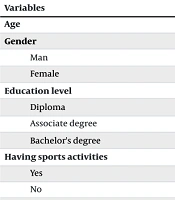
Table 1.
Demographic Information a
| Variables | Abundance |
|---|---|
| Job performance | |
| Lowest score (23) | 38 |
| Highest score (45) | 62 |
| Gender | |
| Female | 43 |
| Man | 57 |
| Marital status | |
| Single | 62 |
| Married | 38 |
| Education level | |
| Diploma | 7 |
| Associate degree | 23 |
| Bachelor's degree | 61 |
| Graduate | 9 |
| Having sports activities | |
| Yes | 29 |
| No | 71 |
| Wrist injury | |
| Yes | 38 |
| No | 62 |
| Thigh injury | |
| Yes | 45 |
| No | 55 |
| Yes | 66 |
| Neck injury | |
| No | 34 |
| Yes | 62 |
| Knee injury | |
| No | 38 |
| Yes | 66 |
| Shoulder injury | |
| No | 34 |
| Yes | 66 |
| Ankle injury | |
| No | 34 |
| Yes | 69 |
| Lower back injury | |
| No | 31 |
| Yes | 63 |
| Upper back injury | |
| No | 37 |
| Yes | 58 |
| Elbow injury | |
| No | 42 |
| Yes | 76 |
| Hip injury | |
| No | 24 |
| Total | 100 |
| Changeable | |
| Age | 27.37 ± 6.45 |
| Weight | 69.02 ± 11.08 |
| Work experience | 13.23 ± 6.24 |
a Values are expressed as (%) or mean ± SD.
Inclusion criteria were as follows: No history of MSDs, no prior accidents resulting in fractures, no secondary employment, and working hours of at least six hours per day. In Abadan hospitals, due to the lack of specialized surgical procedures, staff members participated in a wide range of surgical interventions, making it challenging to assess specific variables. Additionally, the staff worked in rotating shifts. Therefore, these variables were omitted from the study to avoid introducing bias.
3.2. Tools and Data Collection
3.2.1. Tools
The tool employed for this investigation was a questionnaire. In this study, data was gathered using three distinct questionnaires: The first being a demographic questionnaire, the second being the Nordic Musculoskeletal Questionnaire, and the third being Patterson's Job Performance Questionnaire.
A questionnaire on demographic characteristics was used to collect data, including items such as occupation, second occupation, history of illness, total working hours, work history, history of accidents, fractures, and hospitalizations.
The Nordic Musculoskeletal Questionnaire was used to evaluate MSDs. This questionnaire was developed and implemented in 1987 by the Institute of Occupational Health of Scandinavian countries with the aim of determining the prevalence of work-related MSDs. The validity and reliability of the Persian version of this questionnaire was verified by Choobineh et al.’s (19, 20).
This questionnaire includes three parts: In the first part, demographic information such as age, gender, marital status, education level, and Body Mass Index (BMI) is collected. In the second part, the participant indicates if they experienced pain in any of nine body parts (neck, shoulder, elbow, hand/wrist, upper back, waist, thigh/hip, knee, foot/ankle) over the past year. In the third part, participants answer whether these disorders led to any absences from work.
The job performance questionnaire was developed and assembled based on Patterson's survey (21). This questionnaire was translated and validated by Arshadhi and Shokrkon in Iran, ensuring its reliability (22). The questionnaire contains 15 questions and measures employees’ performance in occupational and organizational duties. Each of the 15 questions is scored using a four-option format: "Very Poor (Rarely)" (0 points), "Poor (Sometimes)" (1 point), "Good (Often)" (2 points), and "Excellent (Always)" (3 points). The score range for each participant is between 0 and 45, with scores from 23 to 45 indicating acceptable job performance, while scores below 23 indicate unsatisfactory job performance.
3.2.2. Data Collection Process, and Data Analysis
Prior to the commencement of the study, written consent was obtained from all participants, who then received in-person training from a qualified individual on how to complete the questionnaires. Questionnaires were administered through semi-structured interviews, each lasting approximately 20 minutes, over a 9-month period. Data analysis involved descriptive statistics, including tables, mean, and standard deviation for descriptive variables. Analytical statistics, such as chi-square, Fisher's exact, Mann-Whitney, independent t-tests, and logistic regression, were used to determine relationships between variables. A significance level of 0.05 was considered for all tests in this study. SPSS version 16 statistical software was utilized for data analysis.
4. Results
This study included 100 participants, of whom 43% were women, with an average age of (37.27 ± 45.6). Of the participants, 38% demonstrated acceptable job performance (23 - 45 points), while 62% did not reach an acceptable performance level (scoring less than 23 points). The average weight was (69.02 ± 8.08) kg, and the average work experience was (23.13 ± 24.6) years. A total of 83% of participants reported at least one injury, 64% had at least two injuries, and 62% had three or more injuries in various body areas. The most frequently affected areas were the pelvic and upper back regions, while the thigh area had the lowest injury frequency among body parts. Additional injury details are comprehensively presented in Table 1.
In this study, we examined the relationship between various variables and job performance. Table 2 presents the associations between the independent variables and the dependent variable, providing a comprehensive overview of these relationships.
Table 2.
Relationship Between Independent Variables and Dependent Variable
| Variables | P-Value |
|---|---|
| Age | < 0.001 a |
| Weight | 0.018 a |
| Work experience | 0.015 a |
| Gender | Chi-square |
| Marital status | 0.018 b |
| Education level | 0.032 b |
| Having sports activities | 0.004 b |
| Wrist injury | 0.002 b |
| Thigh injury | 0.013 b |
| Neck injury | 0.001 b |
| Knee injury | 0.033 b |
| Shoulder injury | 0.002 b |
| Ankle injury | 0.001 b |
| Lower back injury | 0.012 b |
| Upper back injury | < 0.001 b |
| Elbow injury | < 0.001 b |
| Hip injury | 0.012 b |
a Mann-Whitney test.
b Correlation.
Initially, the variables were entered into the backward binary logistic model, followed by entry into the final enter binary logistic model. According to the results in Table 3, variables including gender, literacy level, sports activity, wrist injury, hip injury, knee injury, shoulder injury, ankle injury, lower back injury, upper back injury, hip injury, age, weight, and work experience had a significance level of less than 0.02, allowing their inclusion in the model.
Table 3.
Relationship Between Variables and Job Performance
| Variables | Odd Ratio (OR) | CI (Confidence Interval) | P-Value |
|---|---|---|---|
| Age | 0.926 | 0.217 - 0.784 | 0.018 |
| Gender | 0.435 | 0.217 - 0.784 | < 0.001 |
| Man | |||
| Female | |||
| Education level | 2.361 | 2.130 - 2.635 | 0.036 |
| Diploma | |||
| Associate degree | |||
| Bachelor's degree | |||
| Having sports activities | 1.369 | 1.123 - 1.409 | 0.005 |
| Yes | |||
| No | |||
| Thigh injury | 1.458 | 1.269 - 1.648 | < 0.001 |
| Yes | |||
| No | |||
| Damage to the lower back | 1.963 | 1.685 - 2.128 | 0.030 |
| Yes | |||
| No | |||
| Upper back injury | 1.563 | 1.415 - 1.639 | < 0.001 |
| Yes | |||
| No | |||
| Hip injury | 1.745 | 1.678 - 1.978 | < 0.001 |
| Yes | |||
| No | |||
| Work experience (y) | 0.425 | 0.325 - 0.547 | 0.031 |
In the final model, variables such as gender, literacy level, sports activity, thigh injury, knee injury, lower back injury, upper back injury, hip injury, age, and work experience were found to be significant, indicating their influence on the job performance of employees.
5. Discussion
In this study, the results indicated that MSDs in the elbow, back, neck, hip, knee, wrist, ankle, shoulder, and thigh impact job performance. Statistical tests also showed that age, gender, sports activity, and literacy level are associated with job performance. A study conducted by Bhatia et al. in 2024 showed a high prevalence of MSDs in the back, neck, shoulder, and back, which aligns with the results of this study (23). Overall, MSDs are prevalent among nurses and other hospital staff (3, 24-27) as well as OR staff, as observed in this study (15, 28).
The results revealed that 62% of OR workers scored low in job performance, and a significant relationship exists between MSDs and job performance, which is consistent with other studies (29-31). In a 2016 study by Odebiyi et al., neck, shoulder, upper back, and lower back disorders were most common among the study population. Similar to the present study, discomfort in the neck, lower back, and knee was noted to impact job performance adversely due to MSDs (29). Research by Ou et al. in 2021 also determined that the prevalence of MSDs increases with workload, which, as in the current research, leads to decreased job performance (30).
In the 2019 study by Ghorbanpour et al., the impact of MSDs on job performance was also investigated, with findings indicating that such disorders can reduce performance, supporting the present study's results (31). Multiple studies have highlighted the role of physical activity in reducing MSDs, while inactivity has been linked to increased prevalence. In research by Ou et al., the frequency of symptoms was examined separately for upper and lower limbs, showing a significant relationship between MSDs and job performance, except for symptom frequency in the upper limbs (30). In this study, only 29% of participants engaged in physical activity, which could contribute to the high prevalence of MSDs and their effect on job performance (32-34).
5.1. Study limitations
The study faced several limitations. The relatively small sample size, particularly in the case group, may limit the generalizability of the findings. Future studies utilizing larger and more diverse samples could enhance the applicability of the results. Expanding the scope of research to include medical teams across various healthcare settings could provide a more comprehensive understanding of how occupational hazards impact individual performance. Additionally, the study's focus was restricted to assessing physical occupational hazards, limiting its ability to examine the long-term sustainability of improvements in physical complications. Future research could address this limitation by extending the duration of low-intervention follow-up assessments.
5.2. Conclusions
This research indicates that MSDs can adversely affect employees' job performance. Given the impact of multiple occupational factors on employee performance, it is recommended that future studies concurrently examine the effects of other detrimental occupational factors.