
1. Background
Cooperation between physicians and pharmacists is a cornerstone of modern healthcare, playing a pivotal role in ensuring patients receive safe, effective, and timely treatment (1, 2). This collaborative dynamic is integral to the continuum of care, with physicians diagnosing and prescribing treatments while pharmacists ensure the safe dispensing and appropriate use of medications (3-5). However, despite its potential to enhance patient outcomes, this relationship can be vulnerable to opportunistic behaviors by stakeholders, which may undermine the integrity of care and jeopardize patient health (6, 7). Stakeholder opportunism, defined as self-interested behavior that may compromise ethical or professional standards, poses significant challenges to the physician-pharmacist relationship and introduces risks to the healthcare system (8-10). Recent advancements in medicine and pharmacy have introduced new ethical challenges, such as patient rights, informed consent, the complexities of pharmacy-business relationships, and issues surrounding rewards and profit-sharing (11, 12). Opportunism within physician-pharmacist cooperation can take many forms, including financial incentives, profit-sharing agreements, and biased recommendations, all of which may lead to conflicts of interest that prioritize economic gain over patient welfare (5, 7, 9, 13). A pharmacist may be incentivized to promote specific medications that are more profitable for the pharmacy, regardless of whether they are the most appropriate treatment for the patient. Similarly, physicians may engage in profit-sharing schemes with pharmacies, influencing their prescribing practices in ways that do not align with patients' best interests (14, 15). These behaviors not only compromise the trust between healthcare providers but also erode patient confidence in the healthcare system, potentially leading to suboptimal treatment outcomes (16, 17).
Patients may be prescribed unnecessary, less effective, or overly expensive medications, leading to negative health outcomes, financial burdens, and decreased adherence to treatment regimens. This situation can also erode trust in healthcare providers, resulting in patient dissatisfaction, reluctance to follow medical advice, or complete avoidance of treatment (18-20). Previous studies have shown that fee splitting is an unethical act, contradicts the goals of the medical profession, and undermines the patient's best interest. In Iran, there is no code of ethics on fee splitting, but in this study, it was found that the majority of general practitioners (GPs) considered it unethical. However, among those who had negative attitudes toward fee splitting, there were physicians who did practice fee splitting. The results of the study showed that physicians who had a positive attitude toward fee splitting practiced it more than others. Therefore, if physicians consider fee splitting unethical, its rate will certainly decrease.
2. Objectives
The study claims that to decrease such practice, the healthcare system has to revise the tariffs (21). Another study of Nigerian doctors assessed their knowledge, perception, and attitude toward fee splitting. This study showed that stricter regulatory enforcement and continuous ethics education are needed to disrupt the widespread fee-splitting culture (22). Considering the pivotal role pharmacists play, they must possess comprehensive knowledge of both their ethical responsibilities and the legal frameworks governing their interactions with patients (7, 13). This study investigated the physicians' attitudes toward the challenges of stakeholder opportunism in physician-pharmacist cooperation.
3. Methods
3.1. Study Design and Sample
In this cross-sectional study, 69 medical doctors with different educational degrees (34 GPs and 35 specialists) in medical centers (public and private) in Rasht, Iran, were included. The sampling method was census. Eligibility criteria were: (1) Licensed GPs and specialists, (2) currently working in public or private healthcare centers in Rasht, Iran, and (3) willingness to provide informed consent to participate in the study. All individuals gave their informed consent to participate in the study, and the survey was approved by the ethical committee of the Guilan University of Medical Sciences, Rasht, Iran. Demographic information such as age, sex, type of hospital, and job status was gathered from participants. In this study, a 17-item questionnaire was administered to assess medical doctors’ attitudes toward stakeholder opportunism in physician-pharmacist collaboration. The questionnaire utilized a 5-point Likert scale ranging from strongly disagree (1) to strongly agree (5) and encompassed four dimensions: Awareness and understanding, ethical concerns and professional conduct, effects on patient care, and systemic and policy viewpoints. Additional demographic details collected included age, years of professional experience, and area of specialization.
3.2. Survey Instruments
The questionnaire was developed by the researchers. The research team initially crafted a comprehensive questionnaire consisting of four domains and 26 questions. To ensure the instrument's content validity, they sought expert input by consulting professors specialized in the relevant field. After carefully reviewing and analyzing the professional feedback received, the researchers made strategic modifications to the questionnaire. As a result of these expert recommendations, the final version was refined and streamlined, ultimately reducing the total number of questions to 17. To ensure validity, the study employed the Content Validity Index (CVI) and Content Validity Ratio (CVR) for assessing content validity. Regarding the CVI, all questions across three sections demonstrated simplicity, clarity, and relevance scores exceeding 0.7, while the CVR for all questions was also above 0.7. To evaluate the scientific reliability of the questionnaire, it was divided into sections, and the correlation coefficient was calculated using Cronbach's alpha, yielding a value of 0.8. The four dimensions of the questionnaire were as follows: The first dimension was awareness and understanding, covering questions (1 - 3); the second dimension was ethical concerns and professional behavior, including questions (4 - 6); the third dimension was impact on patient care, comprising questions (7 - 11); and the fourth dimension was systemic and policy perspectives, encompassing questions (12 - 17).
The questions of the applied questionnaire included: 1. “I frequently encounter cases where fee-splitting occurs in the relationships between physicians and pharmacists.” 2. “Patients are generally aware of the financial agreements between physicians and pharmacies.” 3. “Physicians should disclose their financial agreements with pharmacies to their patients.” 4. “Financial agreements between physicians and pharmacies contradict the professional conduct of both physicians and pharmacists.” 5. “Financial agreements between physicians and pharmacies are associated with ethical concerns.” 6. “I am influenced by my financial agreements with pharmacies when recommending medications to my patients.” 7. “Financial agreements between physicians and pharmacies affect patients’ trust in healthcare providers.” 8. “Financial agreements between physicians and pharmacies can lead to over-prescription or inappropriate use of medications.” 9. “Financial agreements between physicians and pharmacies have a negative impact on patient health.” 10. “Financial agreements between physicians and pharmacies create disparities in the quality of healthcare received by different individuals or groups.” 11. “Regulating financial agreements between physicians and pharmacies would positively impact patient health outcomes.” 12. “Financial agreements between physicians and pharmacies create conflicts of interest between physicians and pharmacists.” 13. “I clearly discuss my financial agreements with pharmacies with my patients.” 14. “Financial agreements between physicians and pharmacies lead to increased healthcare costs.” 15. “My financial agreement with a pharmacy influences my decision in selecting a pharmacy for my patients.” 16. “Financial agreements between physicians and pharmacies negatively affect the efficiency and effectiveness of healthcare delivery.” 17. “Guidelines and regulations should exist to address financial agreements between physicians and pharmacies in the healthcare sector.”
3.3. Statistical Analysis
All statistical analyses were carried out using SPSS (version 26.0). A two-tailed P < 0.05 was considered to be of statistical significance. Normally distributed continuous variables were represented as means and standard deviations (SDs), while medians and interquartile ranges were used for non-normally distributed data. Categorical variables were presented as numbers (n) and percentages (%). In this study, we employed MANOVA using Pillai's Trace to analyze differences between groups based on educational degree, workplace type, and gender.
4. Results
Out of 69 participants, 33 (47.8%) doctors (19 as GPs and 14 as specialists) worked at public medical centers, and 36 (52.2%) doctors (15 as GPs and 21 as specialists) worked at private clinics. The characteristics of respondents are shown in Table 1.
Table 1.
Characteristics of Respondents a
| Variables | Values |
|---|---|
| Age | |
| > 50 | 50 (72.5) |
| < 50 | 19 (27.5) |
| Gender | |
| Male | 32 (46) |
| Female | 37 (54) |
| Hospital | |
| Private (nonacademic) hospitals | 36 (52) |
| Academic public institutions | 33 (48) |
| Type of Job | |
| GPs | 34 (49) |
| Specialist | 35 (51) |
Abbreviation: GPs, general practitioners.
a Values are expressed as No. (%).
The results revealed that in public centers, 42.1% of GPs and 50% of specialists strongly agreed, while responses in private centers showed similar patterns. Regarding patient awareness of financial agreements, 36.8% of public GPs were unsure, while 47.6% of private specialists were aware. Most physicians, across both settings, supported disclosing such agreements to patients, with 73.3% of private GPs and 61.9% of private specialists agreeing. Ethical concerns were widely shared, with 63.2% of public GPs and 73.3% of private GPs agreeing that financial agreements contradict professional conduct. Physicians also recognized the potential influence of financial agreements on prescribing habits. About 33.3% of private GPs agreed that these agreements influenced their recommendations. Concerns over patient trust were also notable, with 52.6% of public GPs agreeing that financial agreements could erode trust, though specialists expressed less concern. The possibility of over-prescription due to financial agreements was debated. While 60% of private GPs disagreed, 42.9% of public specialists agreed. The impact on patient health also drew mixed responses, with 60% of private GPs agreeing that financial agreements had a negative impact. Meanwhile, 100% of public GPs and 85.7% of private specialists agreed that regulations should address these agreements.
The results of this study demonstrated the mean score of medical doctors' attitudes toward physician-pharmacist relationships among males and females. The highest mean score among both genders was for the statement regarding the disclosure of financial agreements to patients, particularly among females (3.94 ± 0.66). The lowest mean scores were observed for the statement about affecting the efficiency and effectiveness of healthcare delivery, especially among females (2.32 ± 0.74). Following the analysis of responses to the question, for the statement "I frequently encounter cases where stakeholder opportunism occurs in the relationships between physicians and pharmacists," females scored slightly higher (3.78 ± 1.03) than males (3.71 ± 1.22). For questions regarding the disclosure of financial agreements to patients, females again scored higher (3.94 ± 0.66) compared to males (3.46 ± 1.10), indicating a stronger inclination toward transparency among female physicians. Ethical concerns were similarly rated by both genders, with mean scores for the statement "Financial agreements between physicians and pharmacies contradict the professional conduct of both physicians and pharmacists" being 3.59 ± 1.32 for females and 3.59 ± 1.38 for males. This suggested that both male and female physicians share similar concerns about the ethical implications of such agreements.
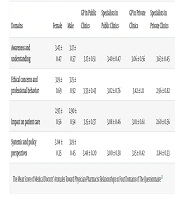
The responses were based on the four domains of the questionnaire, including awareness and understanding, ethical concerns, impact on patient care, and systemic perspectives. The GPs in private clinics showed higher awareness and ethical concerns compared to specialists in public clinics. The domain of "awareness and understanding" showed a higher mean score among specialists in private clinics (3.63 ± 0.45) compared to GPs in public clinics (3.17 ± 0.51). Conversely, in the "Impact on patient care" domain, public GPs had a higher mean score (3.15 ± 0.37) than private specialists (2.60 ± 0.56), highlighting a greater perceived impact of financial agreements on patient outcomes among public clinic physicians (Table 2).
Table 2.
The Mean Score of Medical Doctors’ Attitudes Toward Physician-Pharmacist Relationships in Four Domains of The Questionnaire a
| Domains | Female | Male | GP in Public Clinics | Specialists in Public Clinics | GP in Private Clinics | Specialists in Private Clinics |
|---|---|---|---|---|---|---|
| Awareness and understanding | 3.47 ± 0.47 | 3.17 ± 0.57 | 3.17 ± 0.51 | 3.40 ± 0.47 | 3.06 ± 0.56 | 3.63 ± 0.45 |
| Ethical concerns and professional behavior | 3.19 ± 0.69 | 3.15 ± 0.92 | 3.33 ± 0.43 | 3.02 ± 0.76 | 3.42 ± 1.11 | 2.96 ± 0.82 |
| Impact on patient care | 2.97 ± 0.56 | 2.90 ± 0.54 | 3.15 ± 0.37 | 3.08 ± 0.46 | 3.01 ± 0.61 | 2.60 ± 0.56 |
| Systemic and policy perspectives | 3.04 ± 0.35 | 3.19 ± 0.45 | 3.48 ± 0.20 | 3.00 ± 0.38 | 3.15 ± 0.42 | 2.84 ± 0.33 |
Abbreviation: GP, general practitioner.
a Values are expressed as mean ± standard deviations (SDs).
The MANOVA results indicated that for educational degree, Pillai's Trace was 0.382, showing a significant difference between groups (F(1, 61) = 8.963, P < 0.01). Similarly, for "workplace center", Pillai's Trace was 0.215 (F(1, 61) = 3.977, P = 0.006), indicating a significant difference between public and private centers. Additionally, for gender, Pillai's Trace was 0.150 (F(1, 61) = 2.557, P = 0.048), showing a significant difference between genders, which may reflect differences in opinions about financial contracts between doctors and pharmacists. However, no significant differences were found for the combined variables of "degree with type of clinic", "degree with gender", and "type of clinic with gender" (P > 0.05).
5. Discussion
Financial agreements between physicians and pharmacies raise significant ethical concerns, impacting patient care and contributing to healthcare disparities. There is strong agreement on the necessity for guidelines and regulations to manage these agreements (3, 23). The current study revealed that most doctors believe these financial arrangements contradict professional conduct. Bardet et al. reported that in Eastern Europe, common obstacles to physician-pharmacist collaboration include limited awareness of pharmacy services, challenges related to the funding structure and workload in pharmacies, as well as the absence of private consultation spaces for patients (6). Our findings indicated that private clinic GPs exhibited higher awareness regarding financial agreements compared to their public counterparts, with higher mean scores for specialists in private clinics versus GPs in public clinics. Medical doctors who work in private clinics often have more exposure to financial agreements due to their operational models, which may prioritize profitability (24, 25). Evidence revealed that a decrease in the quality of medical services would be observed, as physicians might be inclined to prescribe suboptimal medications for patients if they receive a share of drug sales. Such practices could lead to increased treatment costs if physicians and pharmacies unfairly divide profits by circumventing regulations (26, 27). Public trust in the healthcare system may erode if society believes that medical professionals are exploiting patients' healthcare needs for personal gain. This behavior could also foster corruption within the healthcare system, potentially having adverse effects on society and the economy (28, 29).
Furthermore, gender differences were observed in attitudes towards transparency in the current study, where female physicians scored higher on willingness to disclose financial agreements. Rose et al. reported that female physicians received significantly less in payments than male physicians across various categories, with gender disparities more pronounced at higher-reputation institutions. Companies should closely evaluate gender disparities in physician payments to ensure they reflect fair market value for services (30, 31). The current study found that individual factors such as educational level, workplace, and gender significantly influence physicians' views on financial agreements with pharmacies. However, the combined effects of these variables did not show statistically significant differences. The prevalence of profit-sharing between physicians and pharmacies may weaken competition and innovation in the pharmaceutical and healthcare sectors, potentially increasing inequality in access to treatment for lower-income patients. Furthermore, criticism of physicians' conduct related to profit-sharing could undermine the credibility of the medical profession and erode public trust in healthcare providers (5, 32). Corruption in the health sector worldwide hinders access to essential healthcare and medicines for vulnerable groups, reduces the effectiveness of patient care, and negatively impacts health policies, spending priorities, and overall community health (33).
5.1. Conclusions
The study highlighted significant disparities in awareness and ethical concerns regarding financial agreements among physicians in public medical centers and private clinics. While a majority of physicians across both settings supported transparency and acknowledged the potential influence of such agreements on prescribing practices and patient trust, private GPs demonstrated greater awareness and ethical apprehension compared to specialists in public clinics. Notably, gender differences emerged, with female physicians showing a stronger inclination toward transparency.
5.2. Strengths
The study highlights the perceptions of financial agreements between physicians and pharmacists, emphasizing the need for ongoing discussions and regulatory frameworks to ensure ethical practices in healthcare. It found that most doctors believe these agreements contradict professional conduct and raised concerns about prioritizing profit over patient care. The American College of Physicians (ACP) acknowledged the potential benefits of corporate involvement in healthcare but stressed the importance of maintaining physicians' ethical responsibilities.
5.3. Limitations
However, the study has limitations, including the use of convenience sampling and a small sample size that may affect the generalizability of the findings. The study was conducted only in Rasht, Iran, with participants from both public and private medical centers. While this provides valuable insights into physician-pharmacist relationships in this region, the findings may not be fully generalizable to other regions or healthcare systems with different regulatory frameworks or cultural contexts. Additionally, the study may be affected by several biases: Sampling bias due to voluntary participation from a limited group of physicians, which may not represent all medical professionals in the area and limits generalizability. Response bias as participants might have given socially desirable answers or underreported sensitive behaviors, potentially skewing the results. Systematic bias because respondent characteristics like gender, workplace, or education could have influenced their answers, affecting the assessment of attitudes and ethical concerns. Also, this design restricts our ability to infer causality between financial agreements and their impact on healthcare delivery. Therefore, future research should involve larger samples, qualitative data to explore underlying reasons for attitudes, and perspectives from pharmacists and patients for a more comprehensive understanding of the issue.