
Cover image of the article: Short-term Menstrual Distributions After COVID-19 Infection: Does Vaccine Administration Matter?

Image Credit:Fertil Gynecol Androl

Short-term Menstrual Distributions After COVID-19 Infection: Does Vaccine Administration Matter?

Authors

Sedigheh HantoushzadehSedigheh Hantoushzadeh ORCID1, Minoo Taheri2, Alireza Hadizadeh3, Pooya Mahdavi Sharif4, Malihe Fakehi5, Parisa Hajari5, Zohreh Heidary6, Fatemeh Asadi6, Razieh Akbari6, Mohammad Mehdi Hashemnejad7, Marjan GhaemiMarjan Ghaemi ORCID6,*
1Vali-E-Asr Reproductive Health Research Center, Family Health Research Institute, Tehran University of Medical Sciences, Tehran, Iran
2MOM Fertility and Infertility Research and Innovation Center, Tehran, Iran
3Research Center for Advanced Technologies in Cardiovascular Medicine, Cardiovascular Diseases Research Center Institute, Tehran University of Medical Sciences, Tehran, Iran
4School of Medicine, Tehran University of Medical Sciences, Tehran, Iran
5Shahid Akbarabadi Hospital, Iran University of Medical Sciences, Tehran, Iran
6Vali-E-Asr Reproductive Health Research Center, Family Health Research Institute, Tehran University of Medical Sciences, Tehran, Iran
7School of Medicine, Iran University of Medical Sciences, Tehran, Iran
*Corresponding Author: Vali-E-Asr Reproductive Health Research Center, Family Health Research Institute, Tehran University of Medical Sciences, Tehran, Iran. Email: [email protected]

Fertility, Gynecology and Andrology:Vol. 2, issue 1; e131433
Published online:Dec 13, 2022
Article type:Research Article
Received:Oct 24, 2022
Accepted:Nov 26, 2022
How to Cite:Hantoushzadeh S, Taheri M, Hadizadeh A, Mahdavi Sharif P, Fakehi M, et al. Short-term Menstrual Distributions After COVID-19 Infection: Does Vaccine Administration Matter?. Fertil Gynecol Androl. 2022;2(1):e131433. doi: https://doi.org/10.5812/fga-131433

Abstract

Background:

COVID-19 infection may be associated with potential sequels on the hormonal system, which can substantially alter menstrual cycles in women.

Objectives:

This study aimed to evaluate short-term menstrual distributions after COVID-19 infection and determine whether vaccination and type of vaccine could alter menstrual cycles.

Methods:

This study was carried out using an online survey to record any menstrual distributions such as any changes in duration, volume, and time of menstruation, intermenstrual bleeding (IMB) and dysmenorrhea as well as exacerbation of premenstrual syndrome (PMS) on 268 women aged 18 to 45 who were infected by COVID-19. The participants were followed at least for three months after their COVID-19 infection. The history of vaccine administration before infection was also recorded, and the results were compared regarding various vaccine types.

Results:

Short-term menstrual distributions after infection were common. in this regard46.7% had IMB, 66.1% experienced exacerbation in PMS, 67.7% had increased volume of bleeding, 62.9% had dysmenorrhea or exacerbation in dysmenorrhea. Also, 27.4% and 35.4% experienced a shorter or longer duration of menstrual cycles, respectively. All distributions returned to normal after a maximum of two cycles. However, there was a substantial difference (P = 0.024) between women who received the AstraZeneca (recombinant) and Sinopharm (inactivated) vaccines, as the number of patients who experienced changes in menstrual cycles was relatively lower in the recombinant group.

Conclusions:

Menstrual distributions are common but temporary in the short term following COVID-19 infection. Although, the recombinant vaccine (AstraZeneca) was associated with lower menstrual disturbance rates compared to Sinopharm or Sputnik vaccines.

Highlights

1. Background

Despite the relative control of COVID-19 by vaccination, we are facing a new wave of disease with increasing hospital administration. Until now, more than half a billion people have been affected globally. The long-term sequels of SARS-CoV-2 are not limited to the respiratory system, and the complications at one-year post-infection included fatigue, erythromelalgia, depression, and anxiety (1).
Women's menstruation cycle is under the delicate regulation of the hypothalamic-pituitary-ovarian (HPO) axis. The disturbance in this axis can result from any derangements in the normal hemostasis of the human organs, including infections and other febrile illnesses, mental stresses, and certain medications (2). This malfunction results in alterations in the volume, length, frequency of bleeding, inter-menstruation bleeding, and spotting. Meanwhile, Ovarian cells express ACE2 receptors (3). SARS-COV is known to have affected ACE pathways, indicating that COVID-19 infection or vaccination against COVID-19 can lead to menstrual disturbance (4, 5).

2. Objectives

Hormonal disturbances should be considered in patients with COVID-19 and post-COVID-19 syndrome (6). Although COVID-19 vaccines reduce mortality and morbidity rates, it is essential to understand potential complications and side effects. Therefore, this study aimed to evaluate short-term menstrual distributions after COVID-19 infection and determine whether vaccination and type of vaccine could alter menstrual cycles.

3. Methods

3.1. Study Design and Participants

In this online survey study, the participants were asked about possible alterations in their menstruation cycle features. The inclusion criteria were women aged between 18 and 45 years with regular menstrual cycles who had confirmed COVID-19 infection by the positive result of a polymerase chain reaction (PCR) test. The exclusion criteria were current pregnancy and/or lactation within the last one-year, using hormonal contraceptives, a positive history of gynecologic surgeries, including hysterectomy, oophorectomy, and tubal ligation, and positive history of the following conditions: Polycystic ovarian syndrome (PCOs), endometriosis, pelvic adhesions, uterine fibroids, uterine polyps, pelvic inflammatory disease (PID), primary ovarian failure (POF), and infertility. The participants were asked about the changes in their duration of menstruation and cycle, irregular cycles, the volume of bleeding in each cycle, exacerbation of premenstrual syndrome (PMS), dysmenorrhea, and intermenstrual bleeding (IMB). The history of using vaccines before COVID-19 infection was also recorded, and the menstrual irregularity (if occurred) was compared between the vaccine types. All participants followed at least three months after COVID-19 infection.

3.2. Statistical Analyses

Data were represented using frequencies for categorical variables, mean ± standard deviation (SD), and n (%) as appropriate for continuous variables. The Χ2 test and independent-sample t-test were used to compare two by two contingency data and continuous data between the groups, respectively. Statistical analyses were conducted using SPSS Statistics for Windows, Version 27.0 (IBM Corp, Armonk, NY, USA). A P-value < 0.05 was considered statistically significant.

3.3. Ethical Approval

All participants accepted and signed the online informed consent. The study was approved by the Iran University of Medical Sciences ethics committee (IR.TUMS.IKHC.REC.1400.351). This study was conducted according to the principles of the Helsinki Declaration.

4. Results

Totally, 268 (46%) individuals participated in the study. The mean ± SD age of the participants was 36.2 ± 6.4 years. Sixty-two individuals (23.1%), with a mean age of 36.6 ± 5.8 years, had alterations in at least one of their menstruation-related parameters. In this regard, 46.7% had IMB, 66.1% experienced exacerbation in PMS, 67.7% had increased bleeding volume, and 62.9% had dysmenorrhea or exacerbation in dysmenorrhea. Also, 27.4% and 35.4% experienced a shorter or longer duration of menstrual cycles, respectively. All menstrual cycle distributions returned to normal after a maximum of two cycles.
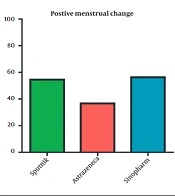
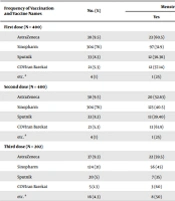
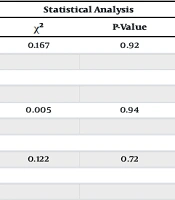
Due to the fact that the majority of participants were vaccinated (before COVID-19 infection) by three vaccine types (Sputnik, Sinopharm, and AstraZeneca) available, we assessed whether the individuals experienced menstrual irregularity after vaccination. Surprisingly, we found a significant difference between patients receiving AstraZeneca and those receiving Sinopharm (Pearson chi-square: 5.12, P-value: 0.024) (Figure 1).
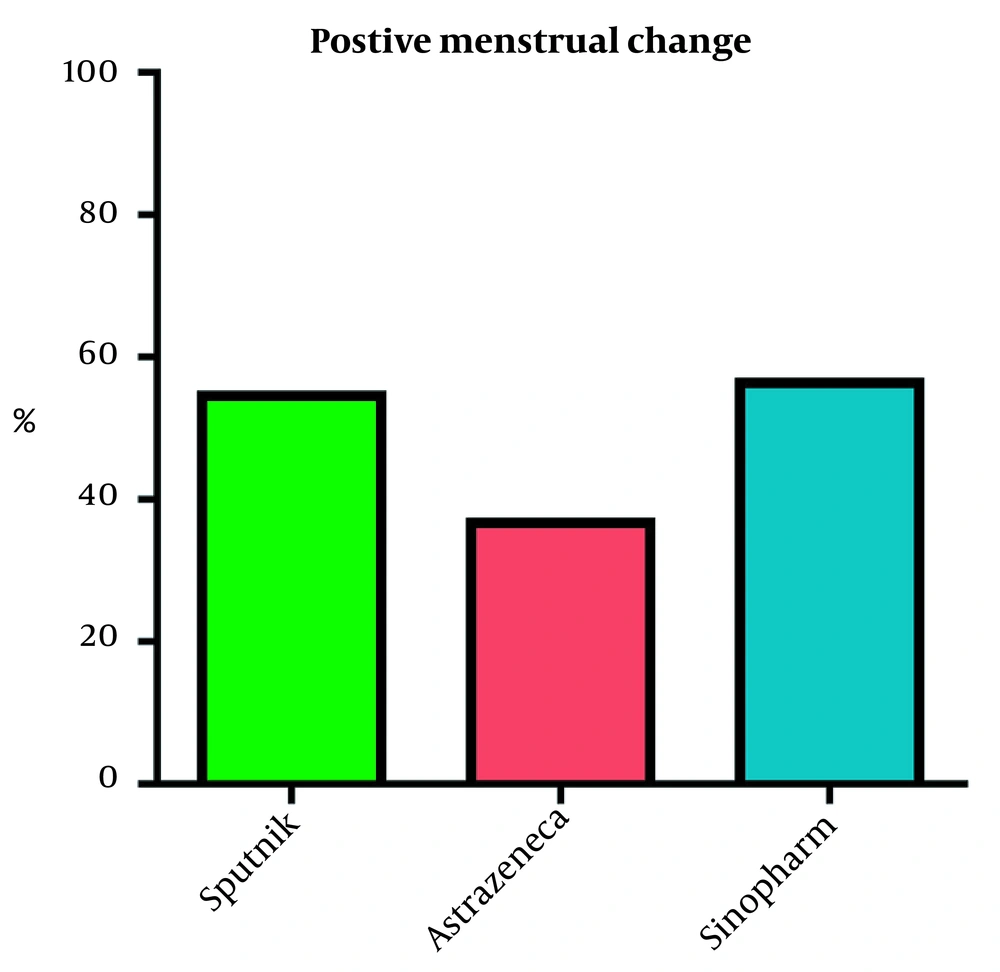
Menstrual distributions per vaccine type in women with previous COVID-19 infection despite vaccination
Figure 1.
Menstrual distributions per vaccine type in women with previous COVID-19 infection despite vaccination

5. Discussion

This study demonstrates that menstrual distribution is primarily common among reproductive-age women. Our data shows a substantial difference between the AstraZeneca 19 vaccine and the Sputnik and Sinopharm vaccines, as the number of patients who experienced changes in duration was relatively lower.
This is the first time the menstrual distributions are compared between COVID-19 vaccine types. Although, few studies have evaluated the effects of COVID-19 on the menstruation cycle. The result of a survey study has shown that 54% of participants (who have been U.S. residents) have experienced alterations in their menstrual cycle (including 54% in length, 50% in PMS, and 34% in the duration of menses). In addition, this study has found a correlation between perceived stress scale scores with the duration and volume of bleeding episodes (7). In a Turkish study of 952 female healthcare workers, about 29% reported having irregular menstrual cycles, similar to ours. In addition, such individuals have had higher COVID-19 Stress Scales scores than those with regular menses. Univariate and multivariate logistic regression models have also corroborated this difference (8).
Of note, the prevalence of menstrual disorders has been higher than that of the general Turkish female population (8). The descriptions of another Turkish study further corroborate the increased frequency of menstrual abnormalities after the spread of COVID-19 infection (9).
However, the findings regarding the trend in the frequency of menstrual disorders are discordant. For example, in a survey-based study from Jordan, the rate of menstrual problems during the total curfew has decreased from 17.5% to 10.5% (10). Likewise, a survey study on Turkish women has reported the decreased duration of menses and pads used per day compared to each individual’s parameters before the pandemic (11).
The detrimental effects of psychological stresses on the menstruation cycle are evidenced decades ago (12). For instance, post-earthquake middle students (13) and females that have experienced a short period of war (14) have higher complaints about menstrual abnormalities. It seems that the fluctuations in the sympathetic activity will affect the neural activities of the amygdala and medial prefrontal cortex, thereby causing abnormal alterations in the level of pregnanolone, with the net result of menstrual abnormalities (15). Another study has found that pre-menopausal women with higher stress levels experience shorter durations of their intermenstrual cycles and bleeding episodes (16). Also, regarding the impact of stress on the menstrual cycle, we have found that the alterations are only limited to the irregularity of menses and not the volume and duration of menses (17). The detrimental effects of COVID-19 infections on ovarian function and reserve are also reported (18).
Our study faces several limitations. There was no control group (i.e., without recent COVID-19 infection) to further delineate the relationship between COVID-19 and menstrual abnormalities. Moreover, our survey did not include any additional questionnaires to evaluate the level of stress and anxiety among the respondents.

5.1. Conclusions

Menstrual distributions are common but temporary in the short term following COVID-19 infection in women of reproductive age. Although, the recombinant vaccine (AstraZeneca) was associated with lower menstrual disturbance rates compared to the Sinopharm and Sputnik vaccines. Further large-scale studies evaluating the HPG axis serum markers are required to decipher this dilemma appropriately.
Footnotes

  • Authors' Contribution: S.H. and M.G.: Design of the work; A.H and P.M.G.: Drafting the manuscript; M.F. and P.H.: Manuscript editing; Z.GH. and F.A.: Interpretation of data; R.A. and M.M.H: Data gathering.

  • Conflict of Interests: Funding or research support: No; Employment: No; Personal financial interests: No; Stocks or shares in companies: No; Consultation fees: No; Patents: No; Personal or professional relations with organizations and individuals (parents and children, wife and husband, and family relationships): No; Unpaid membership in a government or non-governmental organization: No; Are you one of the editorial board members or a reviewer of this journal? Yes.

  • Ethical Approval: Ethical approval code: IR.TUMS.IKHC.REC.1400.351; Link: ethics.research.ac.ir/ProposalCertificateEn.php?id=233946

  • Funding/Support: This study did not receive financial support.

  • Informed Consent: All participants accepted and signed the online informed consent.

References

Copyright

Copyright © 2022, Fertility, Gynecology and Andrology. This is an open-access article distributed under the terms of the Creative Commons Attribution-NonCommercial 4.0 International License (http://creativecommons.org/licenses/by-nc/4.0/) which permits copy and redistribute the material just in noncommercial usages, provided the original work is properly cited.

Similar Articles

31
Jan
2024
COVID-19 Vaccination and Women's Menstrual Cycle: A Cross-sectional Study Performed

COVID-19 Vaccination and Women's Menstrual Cycle: A Cross-sectional Study Performed

Zahra Nahavandi,
Masoumeh Rostami,
Behnaz Alafchi,
Elahe Ezati,
Majid Barati,
Mohammad Hossin Sattari
,et al.

Nahavandi Z, Rostami M, Alafchi B, Ezati E, Barati M, et al. COVID-19 Vaccination and Women's Menstrual Cycle: A Cross-sectional Study Performed. J Nurs Midwifery Sci. 2024;11(1):e142495. doi: https://doi.org/10.5812/jnms-142495

22
Jul
2024
The Evaluation of Post-COVID-19 Effects on Ovarian Reserve and Menstruation in Reproductive-Aged Women in 2022: A Single-Centered Observational Study

The Evaluation of Post-COVID-19 Effects on Ovarian Reserve and Menstruation in Reproductive-Aged Women in 2022: A Single-Centered Observational Study

Mohadeseh Nazari,
Mojde Pajokh

Nazari M, Pajokh M. The Evaluation of Post-COVID-19 Effects on Ovarian Reserve and Menstruation in Reproductive-Aged Women in 2022: A Single-Centered Observational Study. Middle East J Rehabil Health Stud. 2024;11(3):e145630. doi: https://doi.org/10.5812/mejrh-145630

28
Dec
2023
Side Effects and Short-term Safety of COVID-19 Vaccines for Pregnant Women: A Case Study of Southeast Iran

Side Effects and Short-term Safety of COVID-19 Vaccines for Pregnant Women: A Case Study of Southeast Iran

Maysam Yousefi,
Ahu Nakhaei Madih,
Behnam Dalfardi,
Mohsen Shafieipour,
Seyyid Mohammad Keyhan Sajadi,
Anahita Behzadi

Yousefi M, Nakhaei Madih A, Dalfardi B, Shafieipour M, Sajadi SMK, et al. Side Effects and Short-term Safety of COVID-19 Vaccines for Pregnant Women: A Case Study of Southeast Iran. Arch Clin Infect Dis. 2023;18(6):e140132. doi: https://doi.org/10.5812/archcid-140132

20
Aug
2024

Short and Long-Term Effects of COVID-19 on Male Sexual Function

Ali Parandeh Shirvan,
Mohammad Karimi,
Alireza Afshari-Safavi,
Mohammad Reza Taghavi,
Samaneh Mollazadeh,
Amir Amani
,et al.

Parandeh Shirvan A, Karimi M, Afshari-Safavi A, Taghavi MR, Mollazadeh S, et al. Short and Long-Term Effects of COVID-19 on Male Sexual Function. Iran J Psychiatry Behav Sci. 2024;18(3):e146156. doi: https://doi.org/10.5812/ijpbs-146156

4
Nov
2024
Investigating the Effect of COVID-19 Vaccination on the Course of Disease and Recurrence of Attacks in Patients with Multiple Sclerosis

Investigating the Effect of COVID-19 Vaccination on the Course of Disease and Recurrence of Attacks in Patients with Multiple Sclerosis

Samira Poursaleh,
Nahid Dehghan Nayeri,
Farnaz Khatami,
Atieh Bakhshi,
Nasim Ebadati Nakhjiri,
Mahdi Shafiee Sabet

Poursaleh S, Dehghan Nayeri N, Khatami F, Bakhshi A, Ebadati Nakhjiri N, et al. Investigating the Effect of COVID-19 Vaccination on the Course of Disease and Recurrence of Attacks in Patients with Multiple Sclerosis. Jundishapur J Chronic Dis Care. 2025;14(1):e154203. doi: https://doi.org/10.5812/jjcdc-154203

More by these authors

Sedigheh HantoushzadehPubMedScholar
Minoo TaheriPubMedScholar
Alireza HadizadehPubMedScholar
Pooya Mahdavi SharifPubMedScholar
Malihe FakehiPubMedScholar
Parisa HajariPubMedScholar
Zohreh HeidaryPubMedScholar
Fatemeh AsadiPubMedScholar
Razieh AkbariPubMedScholar
Mohammad Mehdi HashemnejadPubMedScholar
Marjan GhaemiPubMedScholar
Share
Cited by
Metrics