
1. Background
Hysterectomy is the surgical removal of the uterus (1). It is the most common gynecological surgery worldwide (2) and is typically performed to treat uterine bleeding, leiomyoma, endometriosis, infection, severe pelvic pain, uterine rupture, uterine prolapse, and malignant tumors (3). In the United States, it is the most frequently recommended treatment for reproductive diseases (1). Prevalence rates are 26.2% in the United States, 22% in Australia, 22.2% in Ireland, 8.8% in Taiwan, and 7.5% in Singapore (4). The procedure is most common among women aged 40 - 45 years, and by age 65 years, approximately 37 - 39% of women have undergone a hysterectomy (5).
Although hysterectomy is a treatment, removal of the uterus can have significant physical consequences, such as pelvic floor dysfunction, urinary incontinence, and sexual dysfunction (3). Given its central role in fertility, the uterus is strongly associated with femininity; its removal is associated with psychological sequelae, including depression, anxiety, and stress (4). Women often perceive the uterus as a sexual organ that regulates physiological functions, a source of youth and energy, and a symbol of fertility (2). Current patient management largely emphasizes physical health while often neglecting psychological aspects. After hysterectomy, women may experience a loss of feminine attractiveness, diminished self-confidence, a disturbed body image, and heightened negative emotions, such as helplessness, discouragement, and depression (1). In addition, fears related to surgical outcomes, loss of attractiveness, spousal dissatisfaction, marital discord, changes in body image, reduced sexual function, and dyspareunia frequently contribute to anxiety (6).
In this context, health professionals can use care strategies based on active listening and information exchange to build trust, enabling women to receive effective care and improve their quality of life (7). Because most women lack adequate knowledge about hysterectomy and its management, health care providers must ensure that essential information is discussed (5). It is also important to assess couples' knowledge and perceptions of hysterectomy to guide appropriate educational interventions (8).
Women undergoing hysterectomy face physical, psychological, emotional, social (9), and sexual challenges (10). Given that women constitute nearly half the population, understanding the impact of this surgery on family interactions and social relationships is crucial for providing supportive care and facilitating adaptation (4). The sociocultural environment strongly influences post-hysterectomy experiences (11). Because qualitative research is well suited to exploring such culturally embedded experiences, it can offer deep insights into the perspectives of women who have undergone hysterectomy (4). Although research on hysterectomy exists, few studies examine women's subjective experiences (11).
2. Objectives
This study used content analysis to explore the lived experiences of women who had undergone a hysterectomy.
3. Methods
This qualitative study used a conventional content analysis approach to examine the experiences of 10 women who had undergone hysterectomy and were referred to the gynecological surgery department of Amir-al-Momenin Hospital in Zabol, Iran. Participants were selected through purposive sampling based on their willingness to participate and their rich experiences with hysterectomy.
The study purpose and procedures were explained to the participants, who provided informed consent for audio recording and the use of anonymized quotations, including those related to sensitive topics such as sexual behavior. Participants were assured that their identities would remain confidential and would be protected throughout the research and publication process. Each participant was assigned a numerical identifier that was used when reporting quotations. Participants were also informed of their right to withdraw at any time. The study was conducted in accordance with the Declaration of Helsinki. Ethical approval was obtained from the Research Ethics Committee of Zabol University of Medical Sciences, Iran, and an official letter of introduction was obtained. With participants' consent, the researchers offered referrals to emergency counseling services following disclosures of abuse, sexual coercion, or suicidal ideation. No participant required a referral.
Data were collected during home visits by 2 female faculty members, one with an MSc and the other with a PhD. Before the first visit, they contacted participants by telephone to explain the study purpose and schedule interviews. Both interviewers had relevant qualitative research experience and no prior personal or professional relationship with the participants. Before data collection, they reflected on their assumptions about women's experiences of hysterectomy, including lifestyle and sexual behavior, and how these assumptions might influence questioning and interpretation. Rather than assuming these views could be fully set aside, they used reflexive notes before and after interviews to consider their potential influence. The research team discussed emerging interpretations, assumptions, and disagreements during regular supervision. Where appropriate, the interviewers adjusted follow-up questions to prioritize participants' accounts. These practices helped make the interviewers' influence on data collection and analysis more transparent.
Sampling continued until data saturation was reached, defined as the point at which no new concepts or codes emerged. To ensure maximum variation, participants were selected based on differences in marriage duration, occupation, number of children, and time since hysterectomy.
Data were gathered through semistructured, in-depth interviews using open-ended questions such as "How has your life changed after the hysterectomy?", "Can you tell me about your memories after the hysterectomy?", "How do you feel about having your womb removed?", and "What was your husband's reaction to your hysterectomy?" The interviewer facilitated narration without directing responses and used probing questions when necessary. Interviews were conducted in calm environments in participants' homes and lasted 45 - 60 minutes in 1 or 2 sessions, depending on participants' conditions.
All interviews were audio-recorded, transcribed verbatim, and analyzed concurrently with data collection by 2 PhD-prepared researchers using conventional content analysis. The analysis involved careful reading of each transcript, underlining significant statements, and generating initial codes based on participants' own words or researcher interpretations. To enhance credibility, transcripts were returned to 3 participants to solicit and incorporate their feedback. Similar codes were then grouped into subcategories and categories. The overall analytic process was guided by the approach described by Graneheim and Lundman (12).
To ensure credibility, coded transcripts were returned to participants for verification, and corrections were made when needed. To ensure dependability, 2 researchers independently coded all transcripts. Agreement was assessed by comparing the independently assigned codes. Disagreements were discussed and resolved with a third researcher. Transferability was enhanced by including women with varied demographics and experiences and by the researchers' attention to diverse behavioral and social contexts. Confirmability was ensured through detailed documentation of all research stages, enabling external evaluation.
4. Results
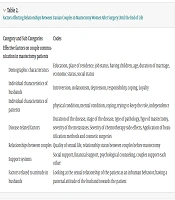
The individual characteristics of the participants are presented in Table 1. Analysis of the collected data yielded 4 main categories and 10 subcategories (Table 2).
Table 1.
Individual Characteristics of the Participants
| Participant No. | Age (y) | Time since Hysterectomy | Occupation | Birth Order | Years of Marriage | Number of Children |
|---|---|---|---|---|---|---|
| 1 | 32 | 6 months | Accountant | First child | 7 | 2 |
| 2 | 26 | 2 years | Bank employee | Last child | 3 | 1 |
| 3 | 37 | 3 years | Teacher | First child | 15 | 3 |
| 4 | 25 | 13 months | Housewife | Second child | 3 | 0 |
| 5 | 30 | 1.5 years | Housewife | First child | 11 | 2 |
| 6 | 29 | 2 years | Lawyer | Second child | 8 | 2 |
| 7 | 35 | 18 months | Housewife | First child | 8 | 2 |
| 8 | 37 | 2 years | Nurse | Second child | 12 | 2 |
| 9 | 30 | 1 year | Housewife | First child | 6 | 2 |
| 10 | 28 | 1 year | Teacher | Third child | 5 | 1 |
Table 2.
Categories and Subcategories of Women’s Experiences After Hysterectomy
| Categories | Subcategories |
|---|---|
| The dual spousal approach of support versus abuse following hysterectomy | |
| Supportive spousal approach post-hysterectomy | |
| Abusive spousal approach post-hysterectomy | |
| Fear of losses following hysterectomy | |
| Fear of losing feminine identity | |
| Fear of marital breakdown | |
| Fear of exacerbated conflicts due to in-law interference | |
| Marital disconnection post-hysterectomy | |
| Emotional neglect | |
| Sexual detachment | |
| Marital accommodations post-hysterectomy | |
| Pretending compatibility | |
| Unexpected benefits of hysterectomy | |
| Spousal companionship |
4.1. The Dual Spousal Approach of Support Versus Abuse Following Hysterectomy
Data analysis revealed a dichotomy in spousal responses. Participants’ experiences indicated that husbands adopted 1 of 2 distinct approaches following the procedure. The predominant response was a marked lack of support, often coupled with spousal abuse. However, a minority of women reported receiving meaningful and sustained support.
4.1.1. Supportive Spousal Approach Post-hysterectomy
Some participants reported positive and supportive behaviors from their husbands. This support manifested as emotional companionship, efforts to reduce anxiety, and, in some cases, protection from external pressures, such as interference from in-laws. A 26-year-old participant with 1 child described:
"When the doctor said I needed a womb surgery, my husband was really worried about my state. He actually worked with the doctor to connect me with other women who had been through the same surgery. Talking to them really helped calm my fears."
4.1.2. Abusive Spousal Approach Post-hysterectomy
Conversely, most participants reported neglect and psychological abuse from their partners. This included a lack of emotional support, verbal insults, and dissatisfaction related to infertility. A common form of psychological torment involved taunting women about their inability to bear more children, which precipitated crises such as suicidal ideation. Husbands also frequently disregarded medical advice, demanding sexual intercourse before recovery. A 32-year-old participant, 6 months after surgery, shared:
"I was still bleeding after the surgery, but my husband didn't care. He wasn't there for me at all. He even tried to have sex with me just two weeks after my operation, even though the doctor said to wait a month. When I said no, he was angry."
Another participant, aged 30 years and married for 11 years, expressed:
"Sometimes I think it was a good thing that happened. It made me see that I mean nothing to my husband."
4.2. Fear of Losses Following Hysterectomy
Participants described deep-seated fears related to the consequences of surgery, classified into 3 subcategories.
4.2.1. Fear of Losing Feminine Identity
Women reported struggles with self-image and femininity triggered by physical changes, postoperative complications, and a perceived loss of sexual function and pleasure, culminating in identity crises. A 35-year-old housewife explained:
"After they took my womb, I was devastated. I cried every night because I could never be a mother again. I also felt like I wasn't a complete woman anymore. I felt like I'd lost the part of me that made me female."
4.2.2. Fear of Marital Breakdown
Women perceived their marriages as damaged beyond repair. Emotional divorce, instability, and fears of marital dissolution, especially due to sexual intimacy issues and infertility, were common. This fear generated a strong need for psychological and sexual counseling. A 30-year-old participant shared:
"After the surgery, we just couldn't connect, especially in the bedroom. It got to the point where I couldn't enjoy being with him, so I turned to masturbation instead. We quarreled constantly. It wasn't until my cousin suggested couples counseling that things started to get better."
Even women with children feared the impact of infertility. A 30-year-old housewife with 2 sons said:
"My husband always wanted a daughter. When he knew we couldn't have any more children, he was so upset that he didn't speak to me for days. I was so sad."
4.2.3. Fear of Exacerbated Conflicts Due to in-Law Interference
Interference from in-laws was frequently cited as a destabilizing factor. A 28-year-old participant reported:
"After surgery, my in-laws called every day to harass me. I was so miserable that I told my husband to divorce me and find someone else. I told him I'd even help him find a new wife and tell everyone it was my fault."
4.3. Marital Disconnection Post-Hysterectomy
Participants described disconnection from their spouses in 2 dimensions: emotional and sexual.
4.3.1. Emotional Neglect
Emotional neglect was characterized by a lack of empathy, disregard for medical complications, avoidance of home life, and refusal to accompany women to medical visits, leaving them isolated. A 25-year-old participant explained:
"After my surgery, all the warmth just left our home. I get the feeling my husband can't bear to be near me. He's constantly finding reasons to be anywhere else but here."
4.3.2. Sexual Detachment
Vaginal dryness, painful intercourse, and low libido were linked to sexual dissatisfaction. A 37-year-old participant described:
"The operation left me with so much pain during sex that it took all the pleasure away. Of course my husband noticed my reaction, and it's driven a real wedge between us. It's become a source of constant tension and arguments."
4.4. Marital Accommodations Post-Hysterectomy
Despite the challenges, none of the participants had divorced. Several protective factors helped sustain their marriages.
4.4.1. Pretending Compatibility
Some women pretended to be satisfied or justified their husbands’ behavior to avoid conflict or abandonment. A 37-year-old teacher stated:
"I feel nothing during sex now; it's dry and painful. I have no desire anymore. But I'm terrified to tell him. I'm afraid he'll leave me, so I just fake it and pretend everything's fine."
4.4.2. Unexpected Benefits of Hysterectomy
For some women, hysterectomy reduced stress by eliminating the fear of unwanted pregnancy and resolving previous medical problems. A 26-year-old participant said:
"There's one good thing: our sex life is less stressful now. We don't have to worry about birth control or me getting pregnant again, and my husband says it's better for him too."
4.4.3. Spousal Companionship
A few women experienced genuine spousal support, with husbands assisting with chores, sharing grief, and attending counseling. A 29-year-old participant expressed:
"My husband has been my rock. He came with me to every therapy appointment. I'm so grateful for his patience and for sticking by me through all of this."
5. Discussion
The experiences of women in this study indicated that most did not receive adequate spousal support after hysterectomy. Rather than receiving emotional and psychological companionship, many experienced verbal abuse, blame for infertility, and humiliation, which brought them to the verge of psychological breakdown. From the researcher’s perspective, this may reflect husbands’ lack of preparedness to cope with post-hysterectomy changes. Providing information and counseling in advance might have enabled them to adapt more effectively. Supporting this interpretation, Nosrati et al. found that preoperative education for husbands positively influenced marital satisfaction and prevented post-hysterectomy conflicts. Similarly, Sofian et al. (1) emphasized the importance of spousal psychological support, noting that its absence exacerbates feelings of failure and helplessness. This pattern mirrors findings from phenomenological research on chronic conditions, in which a lack of partner understanding intensifies identity disruption and emotional distress (13).
Only a minority of participants reported spousal support and satisfaction. Consistent with Sofian et al. (1), such support was associated with feelings of love and improved family well-being. Overall, encouragement and affection appeared to improve quality of life after hysterectomy (1). Psychosocial factors, such as preoperative anxiety and perceived support, have also been shown to significantly influence postoperative pain and recovery in women undergoing cesarean section, suggesting that similar mechanisms may operate after hysterectomy (14).
Participants also described profound feelings of loss and fear, perceiving hysterectomy as the collapse of their world and the beginning of an emotional divorce. They expressed a need for sexual counseling, psychiatric support, and peer experiences to help them cope. These findings align with Koşar Can et al. (3), who highlighted the necessity of comprehensive patient education about medical indications, procedures, and potential long-term consequences. Zare et al. (6) further emphasized that providing information helps women recognize that hysterectomy is unrelated to feminine identity. The neglect of fertility-related concerns in this context parallels findings in oncofertility care, in which young women’s reproductive distress is often overlooked despite its profound impact on psychological well-being (15).
Another major theme was marital disconnection following hysterectomy, including emotional and sexual disconnection. Women reported difficulties in intimate relationships, feelings of shame, and loss of femininity, consistent with previous studies that identified the uterus as a symbol of womanhood and motherhood (8, 11). Additional evidence indicates increased depressive symptoms and dissatisfaction after surgery (1).
Concerns about sexual relationships included reduced frequency and pleasure, vaginal dryness, painful intercourse, spousal neglect, and marital conflict. Several studies (1, 7, 8, 16) confirm the association between hysterectomy and sexual dysfunction, reduced desire, and fear of abandonment. In addition, psychosocial factors such as catastrophizing and poor coping, identified in research on post-cesarean pain, may similarly heighten sexual distress after hysterectomy (14).
Despite these difficulties, none of the participants reported divorce. Instead, they justified or concealed spousal neglect, often feigning sexual satisfaction. This likely reflected diminished body image and self-esteem, consistent with previous findings (8, 9). This adaptive yet maladaptive coping resembles the identity concealment described in chronic illness populations (13).
Notably, some women reported positive outcomes, such as relief from bleeding, pain, or fear of unwanted pregnancy, which improved sexual satisfaction and marital stability. Similar positive perceptions have been reported (9). This heterogeneity underscores the need for individualized psychosocial assessment, as emphasized in both chronic disease and fertility-preservation literature (13, 15).
5.1. Limitations
This study has several limitations. Cultural norms may have constrained disclosure of sexual experiences, resulting in incomplete or socially desirable responses. The relatively homogeneous sample may limit the transferability of the findings to women with different backgrounds or experiences. Retrospective accounts may also be affected by recall bias. Participants may have differed in surgical indication, procedure and route, ovarian status, complications, and hormone treatment; these characteristics were not systematically collected or were unavailable for some participants.
5.2. Conclusions
This study demonstrated that most women perceived inadequate spousal support after hysterectomy, leading to a loss of feminine identity, fears of marital breakdown, and emotional and sexual disconnection. Although marital satisfaction was limited, none pursued separation, seemingly because of low self-confidence and altered body image. These findings highlight the need for preoperative education and counseling for both women and their spouses, equipping them with the knowledge and coping skills required to manage post-hysterectomy challenges and improve quality of life.