
1. Background
The improvement and development of edible mushroom species due to their great importance for humans, especially for Pleurotus species, should be an active subject for ongoing research in the field of mushroom cultivation (1). Pleurotus species are important among commercial basidiomycetes because they have medicinal and nutritional properties and can be easily grown in a wide range of substrates (2). One of the most common growing oyster mushrooms is Pleurotus florida. This mushroom has a high nutritional value due to its fiber, protein, minerals, and vitamins, and owing to its texture, unique taste, poor substrate exclusive, and high durability is widely welcomed. The most valuable feature of this mushroom has been the use of its ligninolytic system, such as the biological conversion of agricultural waste into valuable products (3). Studies have shown that most nutritional requirements for mycelial growth and mushrooms development come from lignin, cellulose, hemicellulose, and protein (4). Studies by various researchers have examined the effect of laccase, manganese peroxidase, lignin peroxidase, and glyoxal oxidases enzymes in the process of decomposition of lignin compounds in vitro in fungi decomposing lignin compounds. However, the activity of these enzymes depends on the type of studied mushrooms (5). Among them, MnP is one of the most common lignin-degrading peroxidases produced by most wood-decomposing fungi and many compost-degrading mushrooms, including P. florida and Agaricus bisporus (6). This enzyme is produced from the vegetative mycelium in the early fruiting period, and its maximum activity is at this stage of growth, but with the ripening of the fruit, the activity of this enzyme decreases (7). MnP gene cDNA is sequenced from P. florida (8) and A. bisporus (9). Hybrid production by fusion of monokaryotic and dikaryotic of Pleurotus species has been presented (10). The hybrids Pleurotus ostreatus (11) and Lentinula edodes (12) were generated using hyphae anastomosis fusion. In another study, this technique was used to produce Pleurotus pulmonarius with the aim of increasing yield and using the sequencing technique. It was found that there was a difference in the number of amino acids in the composition of amino acids between hybrid and wild strains; the highest number of amino acids (63) was produced by the hybrids and the lowest number (47) by the wild strain. In this study, changes in nucleotides may have caused differences in amino acid sequences and ultimately affected protein synthesis (13). Therefore, by changing the sequence of genes involved in the production of enzymes effective in the process of lignin degradation and subsequently, increasing the number of amino acids, and also optimizing the conditions for the action of these enzymes, they can be a suitable substrate for oyster mushroom activity and more use of compost provided.
2. Objectives
The aim of this study was to produce hybrids of P. florida by increasing the production efficiency through hyphae fusion of P. florida and A. bisporus.
3. Methods
3.1. Culture Media and Mycelium
In this study, the strains of P. florida and A. bisporus (prepared from Research Laboratory, Mohammad Farsi, Mushroomiran, Iran) were used. Pieces of fresh mycelium of mushrooms were transferred to PDA culture medium (potato-dextrose-agar), and then, the samples were stored at 23 ± 1°C in the dark for seven days.
3.2. Fusion and Hybridization
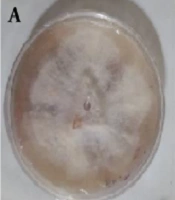
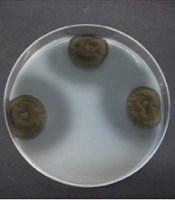
The hybridization was performed using two strains P. florida and A. bisporus. Pairings in 8 cm petri dishes containing culture medium PDA were carried out. With mycelia growing (6 days culturing), two strains were inoculated. They were incubated at 25°C until good contact was established. A junction line was created after 11 days (Figure 1).
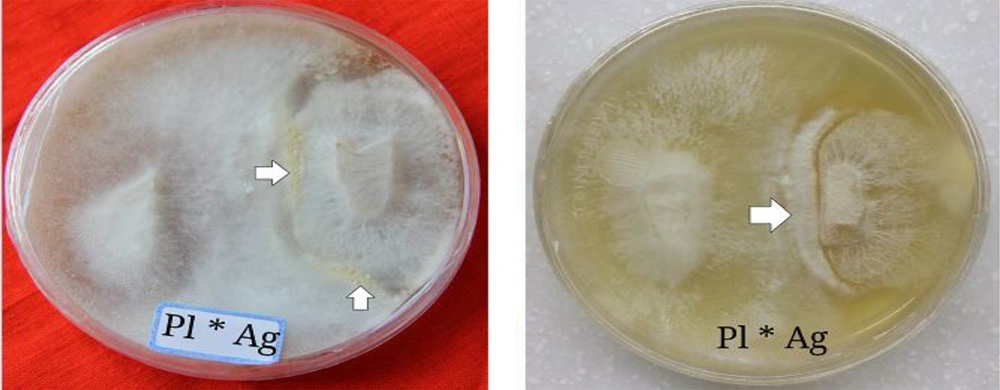
Figure 1.
The formation of clamp connections between Pleurotus florida and Agaricus bisporus.
3.3. Mycelia Growth Rate
Mycelia hybrid strains and P.florida were sampled with the same size and cultured in three stages in petri dishes (PDA), sterile glass (wheat straw), and plastic bags (wood chips) to compare growths. They were then kept in an incubator at 24°C. As a result, hybrids with higher growth compared to the parent strain were selected based on growth rate (Figure 2).
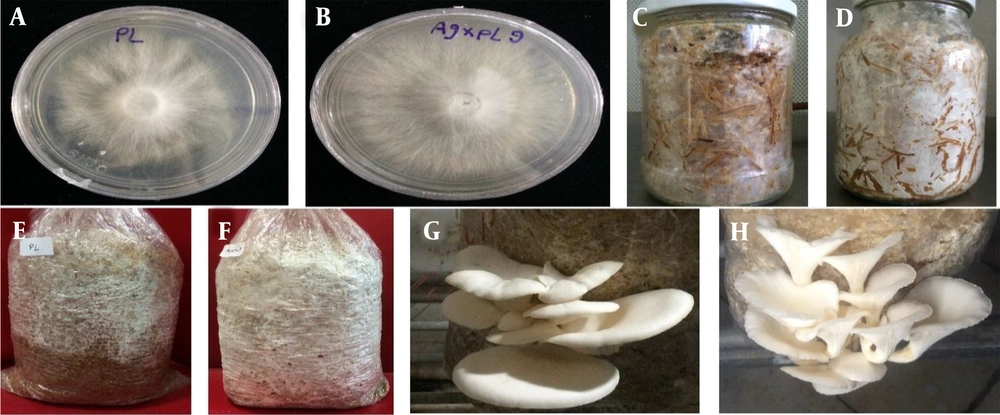
Figure 2.
A, Cultivation of Pleurotus florida mycelia on PDA media after four days; B, Cultivation of hybrid N09 strain mycelia on PDA media after four days; C, Cultivation of P. florida mycelia on wheat straw media after seven days; D, Cultivation of hybrid N09 strain mycelia on wheat straw media after seven days; E, Inoculation of P. florida mycelia on wood chips media after 12 days; F, Inoculation of hybrid N09 strain mycelia on wood chips media after 12 days; G, Fruiting bodies of P. florida in the third harvest; H, Fruiting bodies of hybrid N09 strain in the third harvest.
3.4. Spawn Preparation
In order to prepare spawn, wheat was boiled for 2 hours and then rinsed, and after reaching 25°C, 80 g of gypsum per kg of wheat to absorb excess moisture and 20 g of lime to increase pH was added, and then 1 kg of the mixture was dispensed into plastic bags. They were then placed in an autoclave for 120 minutes at 121°C. Due to the possibility of contamination, three bags of spawn were prepared from each sample.
3.5. Fruiting Test
Wheat straws were crushed and soaked for 24 hours. The straws were boiled for 3 hours for pasteurization, dried under sterile conditions, and packed in sterile bags (2.5 kg/bag), and then bags containing straw with spawn (200g/bag) were inoculated, followed by attentive shaking to distribute the spawn evenly all over the bag. The bags were kept in an incubator at 24 ± 3°C. The fruiting ready bags were placed in the cultivation room, and watering was performed for fruiting body production. During three harvest stages, daily fruits weight was measured in terms of grams, and finally, biological efficiency for each sample was calculated using Excel software (Table 1).
Table 1.
Yield Fruit Bodies Production by Pleurotus florida and Hybrids Strains on Wheat Straw
| Strains | IC (days) | PC (days) | 1st Harvesting (g) (%) | 2nd Harvesting (g) (%) | 3rd Harvesting (g) (%) | Total Weight (g) | BE (%) |
|---|---|---|---|---|---|---|---|
| P. florida | 26 | 43 | 337 (33.97) | 309 (31.15) | 346 (34.87) | 992 | 39.68 |
| N13 | 21 | 38 | 411 (35.12) | 395 (33.76) | 364 (31.11) | 1,170 | 46.80 |
| N09 | 17 | 32 | 723 (34.87) | 702 (33.86) | 648(31.25) | 2,073 | 82.92 |
| N05 | 20 | 35 | 437 (33.33) | 452 (34.47) | 422 (32.18) | 1,311 | 52.44 |
| N11 | 25 | 42 | 372 (36.43) | 320 (31.28) | 331 (32.35) | 1,023 | 40.92 |
Abbreviations: IC, incubation course (days required to form primordial); PC, production course (fruiting days in three harvests); BE, biological efficiency.
3.6. Primer Designing
Specific primer design for the MnP gene of P. florida was performed based on the mRNA sequence encoding the MnP enzyme registered in the NCBI gene bank (Accession number: CAB51617) using Primer Premer V.7.0 software. To ensure that the primers are not homologous and complementary to the nucleotide sequences in other parts of the genome, the sequences designed in the BLAST section of the NCBI BLAST search tool database at http://www.ncbi.nlm.nih.gov/Blast were examined. Primers 5'-GCCGTTTATCGCTCGTCA-3' and 3'-GCTCTGGGACAAGACCATCA-5' were prepared from CinnaGen Company in Iran.
3.7. RNA Extraction
First, the remaining culture medium on the mycelium was isolated with sterile forceps and filter paper. The mycelium was pulverized with liquid nitrogen and then transferred to 2 mL microtubes. Extraction was performed using RNA-X plus commercial kit (CinnaGen, RN7713C, Iran). The extracted RNA samples were treated with DNase I kit (Thermo Scientific, #EN0521, United States). The RNA precipitate was dissolved in 50 μL of DEPC water then was stored at -20°C. Quantitative analysis of RNA was performed by a NanoDrop device, which was calibrated using DEPC water as a control, and the amount of light absorption of RNA samples was measured at 230, 260, and 280 nm.
3.8. cDNA Synthesis
From the extracted RNA according to the kit (Thermo Scientific, #K1622, United States), cDNA synthesis was performed using reverse transcriptase enzyme M-MuLV RT. The resulting cDNA was stored at -20°C.
3.9. PCR Reaction
PCR reaction with specific primers was performed based on the kit (Thermo Scientific, #K1622, United States). Then, 5 μL of the PCR product with 1 kb size marker (Thermo Scientific Fermentase, SM1163, United States) were loaded on TAE buffer (1x), agarose gel 1%, and electrophoresed at 95 V for 60 minutes (Figure 3).
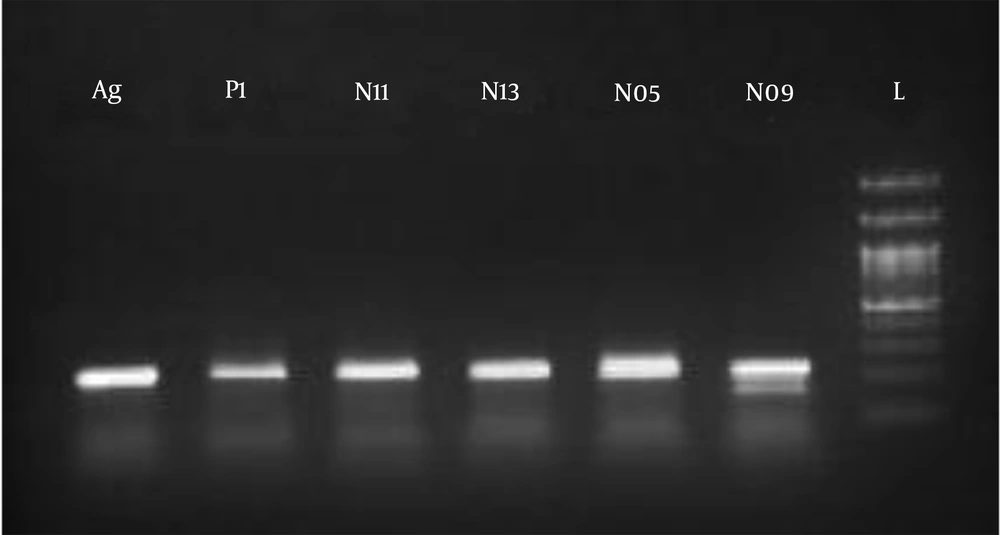
Figure 3.
Banding patterns obtained from PCR electrophoresis of parent and hybrid strains; (Ag and Pl), parent strains; (N11, N13, N05, and N09), hybrid strains.
4. Results
Fusion hyphae tests between P. florida and A. bisporus had positive results. Hybridization was performed with the formation of clamp connections at the junction line (Figure 1).
In this study, out of 15 hybrid strains resulting from hyphae fusion, four superior hybrid strains were selected, but hybrid N09 produced the highest performance in all evaluations compared to other hybrids in terms of characteristics, such as higher mycelium growth, faster pinning, higher yield, less bag contamination, and higher fruiting percentage. The results of a four-stage growth rate test in hybrid N09 strain and P. florida in Figure 2 show that the growth of mycelium and yield hybrid N09 strain was significantly higher than the P. florida.
Table 1 shows the weight of fresh fruit bodies in three harvests and days spent primordial forming for P. florida (parent strain) and hybrid strains. The shortest time to form primordial was 17 days, and the total weight of fruit bodies was 2,073 g produced by hybrid N09 strain, while the shortest time to form primordial was 26 days, and the least total weight of fruit bodies was 992 g produced by P. florida.
As a result of tracing of MnP gene in parent strains, the length of the gene in P. florida is 1095 bp and in A. bisporus is 1065 bp. The similarity of this gene in parent strains using CLC software is 58.7%. Based on the tracing of the MnP gene in the parent strains at the transcriptional level, the hybrid resulting from fusion can be distinguished.
Based on the results of PCR product electrophoresis, due to the longer MnP gene of P. florida, the Pl band (P. florida) is higher than the Ag band (A. bisporus). The banding pattern of hybrid N09 strain indicates that this hybrid, in addition to the MnP gene of P. florida, also received the amino acid sequences of this gene in A. bisporus.
5. Discussion
The advancement of a fruitful mushroom breeding strategy pivots basically on the back given by genetic data on the inheritance and behavior of major quantitative characteristics related to yield, maturity period, defilement rates, and undoubtedly to any other financial traits of concern to breeders (14, 15). The formation of clamp connections is a reason for the actual production of hybrid strains in this study (Figure 1). Hyphae fusion happens in the fruiting bodies of basidiomycete species (16). High compatibility of P. tuberregium with other Pleurotus species has been reported (17). In a study to obtain hybrids of P. pulmonarius from 231 fusions made, 88 compounds were compatible, and finally, 46 hybrids were able to create basidiocarps (18). In another study, with the aim of producing P. pulmonarius with increased yield, hyphal fusion was performed between P. pulmonarius with P. sapidus and P. ostreatus. The best hybrid obtained from this experiment showed a biological efficiency of 109.30%, while for the wild strain, it was 33.00%. Using the sequencing technique, they found that there was a difference in the number of amino acids in the composition of amino acids between hybrid and wild strains, the highest number of amino acids (63) was produced by hybrids and the lowest number (47) by the wild strain (13). Quadrupole heterothallism is a species of the genus Pleurotus and control two loci by numerous alleles (19). Hyphae fusion in filamentary fungus during vegetative growth is an intricate and very regulated process. Fusion mutants have been characterized in filamentary fungus with pleiotropic phenotypes. In any case, it is possible that all hyphae fusion mutants contain mutations in genes that are required for other biological aspects of these organisms (20). Albeit facets of morphological that are related to hyphal fusion during the life cycle of filamentary fungus have been well characterized, but little is known about the molecular machinery or signals involved in hyphae fusion during sexual expansion and vegetative growth (21). Mushroom growers should consider how to obtain sufficient heterosis for important nutritional, economic, and commercial traits to ensure high yielding, shorter maturation periods, a lower percentage of contamination, and a higher percentage of bags with prospering fruiting. In this study, as shown in Figure 2, hybrid N09 had significant changes compared to the parent strain as a result of genetic changes resulting from hyphae fusion, such as increased mycelial growth rate in all culture media, increased primordia formation rate, short fruiting period, the lowest level of contamination and most importantly increased yield of oyster mushroom. The performance, quality, and other positively breeding traits of mushrooms generation are reduced under continuous cultivation conditions. Extant strains must be maintained and improved in a stable method to meet the market demand. We recommend that high-yielding hybrid strains are produced, and endeavors are made to enhance the variety of P. florida strains.
5.1. Conclusions
The results showed that the yield of hybrid strains was more than the parent strain. The hybrid N09 strain had the highest yield in terms of mycelial growth rate, primordia formation, the total weight of fresh fruit bodies, and biological efficiency. Thus, hyphae fusion enhanced traits as a result of mixing the genetic contributions of parent strains.