
Ramadan Fasting in SARS-CoV-2 (COVID-19) Pandemic

Author(s):
Mojtaba AkbariMojtaba AkbariMojtaba Akbari ORCID1, Arefe Khaksar JalaliArefe Khaksar Jalali2, Hossein AnsariHossein AnsariHossein Ansari ORCID3, Noureddin SoltanianNoureddin Soltanian1,*
1Isfahan Endocrine and Metabolism Research Center, Isfahan University of Medical Sciences, Isfahan, Iran
2Faculty of Medical Sciences and Technologies, Science and Research Branch, Islamic Azad University, Tehran, Iran
3Department of Epidemiology and Biostatistics, Health Promotion Research Center, Zahedan University of Medical Sciences, Zahedan, Iran
*Corresponding Author: Isfahan Endocrine and Metabolism Research Center, Isfahan University of Medical Sciences, Isfahan, Iran. Email: [email protected]

Health Scope:Vol. 9, issue 3; e105045
Published online:Aug 26, 2020
Article type:Letter
Received:May 25, 2020
Accepted:Jun 24, 2020
How to Cite:Akbari M, Khaksar Jalali A, Ansari H, Soltanian N. Ramadan Fasting in SARS-CoV-2 (COVID-19) Pandemic. Health Scope. 2020;9(3):e105045. doi: https://doi.org/10.5812/jhealthscope.105045

Dear Editor,
Millions of Muslims live all over the world who fast during Ramadan every year. Various studies have been conducted on the impact of Ramadan fasting on different body organs reporting its positive results on health, such as a decrease in serum cholesterol and triglyceride and favorable impacts on the immune system (1).
Severe acute respiratory syndrome (SARS) coronavirus 2 (SARS-CoV-2) that caused coronavirus disease 2019 (COVID-19) outbreak has been a global concern from late 2019 due to its fast transmission and high pathologic effects (2).
Owing to the beginning of Ramadan during the COVID-19 pandemic, Muslims may worry whether the fasting increases the risk of coronavirus infection.
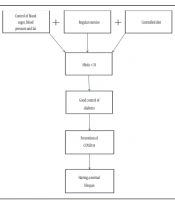
People can be categorized into two groups based on their health status (Figure 1). The first group consists of people suffering from a disease such as malnutrition and kidney disease. This group should not fast, according to the Islamic rules, since fasting can negatively affect their health condition. The second group is healthy people who can be divided into two subcategories, including healthy people who follow self-isolation and those who cannot obey self-isolation rules and are forced to leave home for work or other requisite activities.
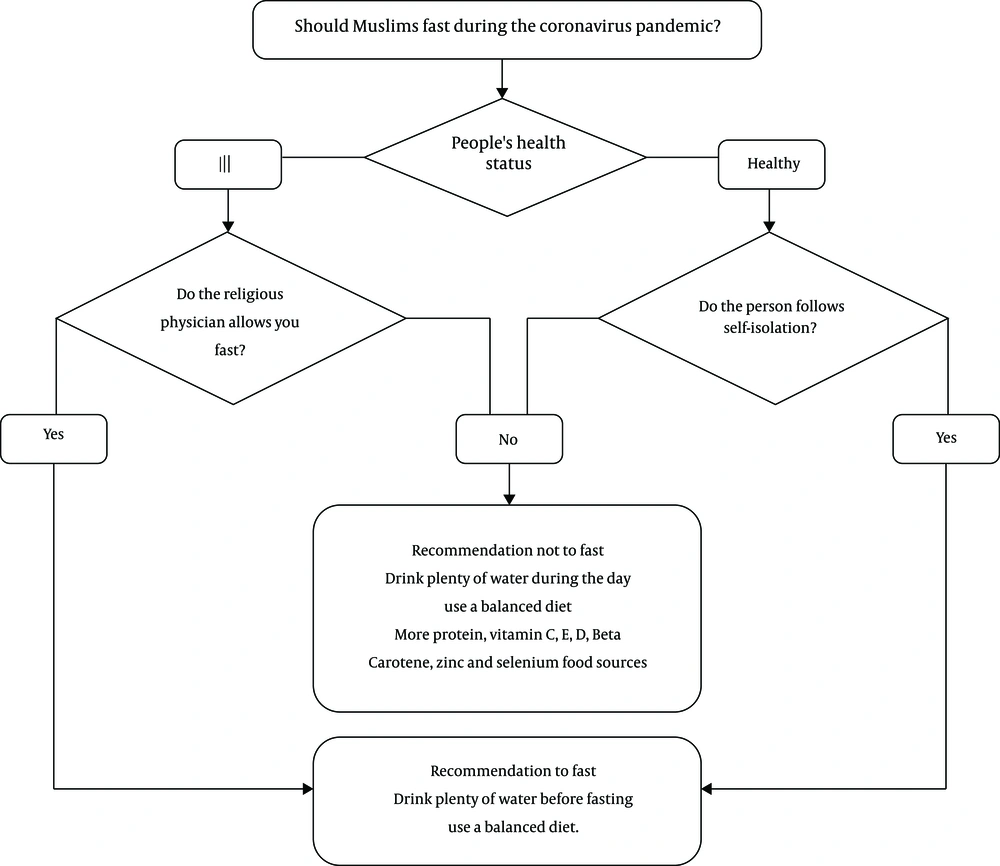
The category of people based on their health condition and recommendations about fasting
Figure 1.

The category of people based on their health condition and recommendations about fasting

Moreover, according to the results of a study published in the New England Journal of Medicine (NEJM) in 2019, intermittent fasting can improve people's health conditions (3). Moreover, the results of some studies showed salubrious effects of fasting on the immune system functions (3, 4). So, we recommend those people who can stay home during the fasting month to use a balanced diet and drink plenty of water before they start to fast to keep their bodies hydrated during the day.
Some scientists suppose that drinking plenty of water and warm liquids may prevent esophagus mucus from being infected by different micro-organisms, especially coronavirus. Although there is no strong evidence to confirm the positive effect of drinking water on preventing coronavirus infection, we recommend the group who are forced to stay out of home not to fast. People need more water as the weather is getting hot to keep their bodies hydrated. Furthermore, we recommend this group to use a balanced diet of food sources enriched with more protein, vitamin C, E, D, beta carotene, zinc, and selenium (5, 6).
Moreover, the Iranian Muslims’ religious leader said, “Not fasting during the auspicious month of Ramadan is not allowable unless an individual has a reason to believe that fasting will cause illness, intensify an illness, prolong an illness, or delay one’s recuperation. Obviously, it is enough if this conviction is obtained based on the opinion of a religious physician. Therefore, if a person has a reasonable fear of being subject to any of the above-mentioned difficulties, they should not fast, but it will be necessary to make up for these missed fasts at a later time”.
Footnotes

  • Authors' Contribution: All authors contributed to the design, implantation of the research, and to the writing of the manuscript.

  • Conflict of Interests: Authors have no conflict of interest.

  • Funding/Support: This study was not supported in any part by grant or by a teaching or research scholarship.

References

Copyright

Copyright © 2020, Author(s). This is an open-access article distributed under the terms of the Creative Commons Attribution-NonCommercial 4.0 International License (http://creativecommons.org/licenses/by-nc/4.0/) which permits copy and redistribute the material just in noncommercial usages, provided the original work is properly cited.

Similar Articles

9
Apr
2020

Insights into the SARS-CoV2 Outbreak; the Great Global Challenge: A Mini Review

Dr Behzad Pourhossain,
Ali Dabbagh,
Maryam Fazeli

Pourhossain DB, Dabbagh A, Fazeli M. Insights into the SARS-CoV2 Outbreak; the Great Global Challenge: A Mini Review. J Cell Mol Anesth. 2020;5(1):e149605. doi: https://doi.org/10.22037/jcma.v5i1.29718

23
Oct
2023
Int J Endocrinol Metab

Type 1 Diabetes and COVID-19: A Literature Review and Possible Management

Kebria Kashfi,
Narges Anbardar,
Artin Asadipooya,
Kamyar Asadipooya

Kashfi K, Anbardar N, Asadipooya A, Asadipooya K. Type 1 Diabetes and COVID-19: A Literature Review and Possible Management. Int J Endocrinol Metab. 2023;21(4):e139768. doi: https://doi.org/10.5812/ijem-139768

17
Jan
2023
Gene Cell Tissue

Diabetes and the Outbreak of Coronavirus Disease (COVID-19): A Critical Review

Mehran Kamani,
Abbas Mohammadi

Kamani M, Mohammadi A. Diabetes and the Outbreak of Coronavirus Disease (COVID-19): A Critical Review. Gene Cell Tissue. 2023;10(3):e129811. doi: https://doi.org/10.5812/gct-129811

6
Jan
2021
Arch Clin Infect Dis

The Treaty of Influenza and SARS-CoV-2: Titans Versus Olympians

Ilad Alavi Darazam,
Masoud Mardani,
Mohammad Mahdi Rabiei,
Firouze Hatami,
Farid Javandoust Gharehbagh

Alavi Darazam I, Mardani M, Rabiei MM, Hatami F, Javandoust Gharehbagh F. The Treaty of Influenza and SARS-CoV-2: Titans Versus Olympians. Arch Clin Infect Dis. 2020;15(5):e112289. doi: https://doi.org/10.5812/archcid.112289

2
May
2020

Stress Reduction Model of COVID-19 Pandemic

Mohsen Khosravi

Khosravi M. Stress Reduction Model of COVID-19 Pandemic. Iran J Psychiatry Behav Sci. 2020;14(2):e103865. doi: https://doi.org/10.5812/ijpbs.103865

Download PDF85.17 KB

Crossmark

Crossmark

Checking

Share on
Cited by
Metrics

Ordering Reprints

Articles are published under the Creative Commons license stated on each article. No permission or royalty fee is required for uses permitted by that license. CCC handles optional bulk and customized reprint orders. Any quotation covers production and delivery services only, not copyright permission. > Request Reprints from CCC 

Search Relations

Author(s):

Related Articles