1. Context
The main objective of a healthcare system is to organize, deliver, and finance so as to enhance the health of the population. This is achieved by strong health plans and evidence-based policies (1). The healthcare system aims to reduce/eliminate health inequalities (2). In 2017, the population of Iran was 80 million, being one of the most populous countries in the Middle East. The population growth rate shows a need for interventions in the healthcare system and also public health infrastructure and services. The healthcare system performance in Iran grades 96 out of 191 countries in the world (3). According to the World Health Organization (WHO) report, life expectancy was approximately 74.6 years for males and 76.9 years for females in 2018. This positioned Iran as 64th in the world's life expectancy (4). The three leading causes of death in Iran before the COVID-19 pandemic were coronary heart disease, stroke, and Alzheimer’s disease/dementia (4).
The Iranian healthcare system is constructed on the public-private sector and also NGOs. Health expenditures (healthcare goods and services consumed during each year) are a core constituent of governments’ expenditures. In 2017, it was demonstrated that the expenditure index increased 30 times than during the previous 20 years, while in the healthcare sector, the growth index was 71 times (5). Health expenditure per capita in Iran increased from 115$ in 2003 to 475$ in 2017, with an annual rate of 11.56% (6).
In the late 1980s, many economically developing nations applied to mix private and public health facilities or expand the privatization process to secure loans from, e.g., the World Bank. In Iran, the government started a rapid process of privatization of major industries, banks, insurance companies, airlines, shipping, etc., by referring to article 44 of the constitution (7). The privatization of the healthcare system rapidly increased after 2003 when the government decided to privatize 80% of the state assets (8). However, no studies have focused on the effect on the Iranian healthcare system during the period of privatization.
2. Objectives
This study aimed to systematically review the literature on the Iranian healthcare system in the time of increasing privatization.
3. Method
3.1. Data Sources and Search Strategy
A database search specialist at Mälardalen University library performed electronic database searches in consultation with the author. In the first search, the keywords were Iran AND disparity or inequality AND healthcare private, and the search was conducted in MEDLINE, CINAHL, PubMed, and APA PschInfo. Finally, 71 unique and relevant citations were identified (after duplications were removed). In the second search, the keywords were privatization or privatization AND Iran AND health, and the search was conducted in CINAHL, MEDLINE, PubMed, and Cochrane. Finally, 70 unique and relevant citations were identified (after duplications were removed). In the third search, the keywords were Iran AND out-of-pocket payment AND health expenditure AND inequality, and the search was conducted in CINAHL, MEDLINE, and PubMed. Nine relevant citations were identified (after duplications were removed). These databases were deemed appropriate for covering the existing published research on the healthcare system and privatization in Iran (Table 1).
Table 1.
Research Databases in the Search Done on 2020-10-30
| Database | Search Words | Filter | Number of Articles |
|---|---|---|---|
| First search | |||
| CINAHL | Iran AND disparity or inequality AND health care private | 1992 - 2020; Linked full text | 153 |
| MEDLINE | Iran AND disparity or inequality AND health care private | 1985 - 2020; Linked full text | 327 |
| APA PschInfo | Iran AND disparity or inequality AND health care private | 1989 - 2020; Linked full text | 54 |
| Pub Med | Iran AND disparity or inequality AND health care private | 1984 - 2020; Free full text | 574 |
| Second search | |||
| CINAHL | privatization or privatization AND Iran AND health | 1992 - 2020; Linked full text | 772 |
| MEDLINE | privatization or privatization AND Iran AND health | 1985 - 2020; Linked full text | 1218 |
| Pub Med | privatization or privatization AND Iran AND health | 1976 - 2020; Free full text | 627 |
| Cochrane | privatization or privatization AND Iran AND health | 1985 - 2020; Cochrane reviews | 55 |
| Third search | |||
| CINAHL | Iran AND out of pocket payment AND health expenditure AND inequality | 1992 - 2020 | 2 |
| MEDLINE | Iran AND out of pocket payment AND health expenditure AND inequality | 1985 - 2020 | 6 |
| Pub Med | Iran AND out of pocket payment AND health expenditure AND inequality | 2011 - 2020 | 27 |
A grey literature search plan was used by incorporating three different search strategies: (1) customized Google search engines; (2) targeted academic websites and key organizations in Persian; and (3) online newspapers and magazines in Persian, which were the sources of non-academic information but could often provide a source of evidence for news and governmental policy documents/reports on expanding the privatization process in healthcare. The search keywords were Iran, privatization, healthcare, public health, and inequality. Additionally, 30 citations were identified in grey literature sources.
In total, 180 unique citations were identified (after duplications were removed). All citations were screened based on title, keywords, and abstract, resulting in the remaining 72 citations. These 72 citations were read in full text, and two of them were excluded due to not meeting the inclusion criteria. The PRISMA flow diagram maps out the number of records identified, included, excluded, and the reasons for exclusions (PRISMA flow diagram of literature review) (Figure 1). The remaining 70 citations (39 peer-reviewed articles, two editorial/correspondence articles in peer review journals, and 29 documents and reports) were included in this study (Table 2).
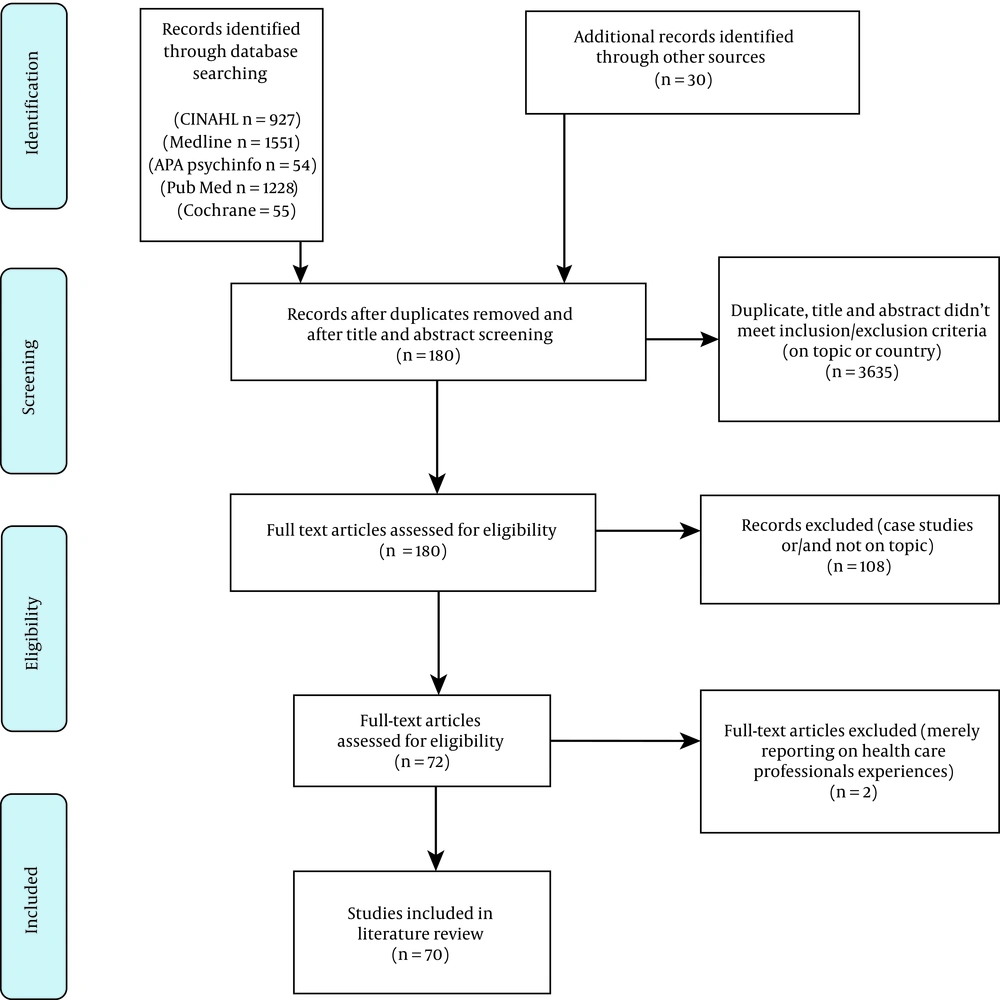
Figure 1.
PRISMA flow diagram of literature review
Table 2.
Articles, Reports, and Documents Published in Peer-Reviewed Journals Which are Included in the Analysis
| Authors | Year | Title | Design | Aim | Findings |
|---|---|---|---|---|---|
| Barati Marnani and Gudaki (9) | 2005 | Comparative Study on Privatization of Health Care Provision on Contract Basis. (In Persian). | A descriptive-analytic and cross-sectional study in which the data were gathered from selected countries | To produce a practical model for contracting with the private sector | According to the findings, different kinds of contracts can be used in purchasing logistic and paraclinical services in hospitals, screening and control of specific diseases, patient transportation, and primary health care. Also, the use of a performance-based contract for the allocation of resources to different levels of the health system, insurance companies, and hospitals was emphasized, but outsourcing of clinical services and build-own-operate contracts was not approved. |
| Siddiqi et al. (10) | 2006 | Contracting but not without caution: experience with outsourcing of health services in countries of the Eastern Mediterranean Region. | A multi-country policy effectiveness study | To assess the range of health services contracted out, the process of contracting, and its influencing factors in 10 countries of the Eastern Mediterranean Region | Our results showed that Afghanistan, Egypt, the Islamic Republic of Iran, and Pakistan had experience with outsourcing primary care services. Jordan, Lebanon, and Tunisia extensively contracted out hospital and ambulatory care services, while Bahrain, Morocco, and the Syrian Arab Republic outsourced mainly non-clinical services. The interest of the non-state sector in contracting was to secure a regular source of revenue and gain enhanced recognition and credibility. While most countries promoted contracting with the private sector, the legal and bureaucratic support in countries varied with the duration of experience with contracting. |
| Mehrdad (11) | 2009 | Health System in Iran. | An informative article about the health care system in Iran | - | An informative article about health care system in Iran: Health system organization, financing, status and challenges |
| Aghaei et al. (12) | 2010 | Occupational stress and mental health of employees of a petrochemical company before and after privatization | Steinmetz occupational stress and GHQ-28 questionnaires | To determine the level of occupational stress and mental health of employees of a petrochemical company in Isfahan, Central Iran, before and three months after privatization | After privatization, the job stress of employees increased significantly. This increase was associated with a decrease in mental health. To lessen the side effects of privatization, the process should be performed cautiously. |
| Ghassemzadeh (13) | 2010 | Privatization of health organization in Iran: how to avoid too much of a good thing? | Editorial | - | Based on the presented experience from other countries and on account of the unique features of NIOC’s Health Organization, considering the current evidence, I believe that it is still too early to reach a conclusion on the issue of privatization of this Organization. Certainly, further analysis should be undertaken if we all have common interests for competitive acquisition due to the roadmap of the privatization governed by IPO, since obviously this will not be an advisable option to privatize blindly one of the oldest healthcare providers in Iran. |
| Hajizadeh and Nghiem (14) | 2011 | Out-of-pocket expenditures for hospital care in Iran: who is at risk of incurring catastrophic payments? | The concentration index and the Heckman selection model were used to assess inequality and factors associated with these expenditures. | To provide a greater understanding of the inequality and determinants of out-of-pocket expenditure (OOPE) and the related catastrophic expenditure (CE) for hospital services in Iran | The results of the Heckman selection model indicated that factors such as length of stay, admission to a hospital owned by the private sector or Ministry of Health and Medical Education, and living in remote areas are positively associated with higher OOPE. Also, we found that households living in East Azarbaijan, Kordestan, and Sistan, and Balochestan face a higher level of CE. Based on our findings, the current employer-sponsored health insurance system does not offer equal protection against hospital expenditure in Iran. It seems that a single universal health insurance scheme that covers health services for all Iranians- regardless of their employment status- can better protect households from catastrophic health spending. |
| Davari et al. (15) | 2011 | Pharmaceutical Policy and Market in Iran: Past experiences and future challenges | Mixed methods. A systematic literature search and semi-structured interviews with key informants | To consider the pharmaceutical market and relevant government policies in Iran, which may have broader resonance with similar issues in other middle-income countries | The literature review showed how past challenges forced changes to the pharmaceutical policy in Iran. It also showed that the Iranian ‘Generic Scheme’ (started in 1980) was very successful in improving accessibility to pharmaceuticals, particularly in the 1980s. However, recent policies have created new challenges in the Iranian pharmaceutical market. The interviewees highlighted these as increasing pharmaceutical utilization, rising pharmaceutical expenditures, and the lack of a unifying clear pharmaceutical policy. |
| Davari et al. (16) | 2012 | The Iranian Health Insurance System; Past Experiences, Present Challenges, and Future Strategies | Interviews with key opinion leaders and empirical evidence | To review the history of the Iranian healthcare system and its impact on healthcare performance | A wide range of issues has affected the efficiency, quality, and equity of the services provided by the Iranian healthcare system. The initial and most important step toward improving the efficiency, equity, and quality of the health insurance system is to focus on evidence-based policymaking to generate feasible, reasonable, and comprehensive reforms. |
| Nedjat et al. (17) | 2012 | Decomposing socioeconomic inequality in self-rated health in Tehran | Structured interviews of 2,464 residents of Tehran in 2008 | To estimate health inequality between different socioeconomic groups and its determinants in Tehran, the capital of Iran | Age, marital status, level of education, and household economic status were significantly associated with SRH in both crude and adjusted analyses. The main contributors to inequality in SRH were economic status (47.8%), level of education (29.2%), and age (23.0%). Sub-optimal SRH was more in lower than in higher economic status. After controlling for age, the level of education and household wealth had the greatest contributions to SRH inequality. |
| Davari et al. (18) | 2012 | Health Care Financing in Iran; Is Privatization A Good Solution? | This study used mixed methods: A systematic literature review and semi-structured interviews with key informants | To consider a range of issues related to the financing of the health care system and relevant government policies in Iran. | The health care market in Iran is in a period in which financial issues have enhanced managerial complexity. Privatization of health care services would appear to be a step too far in assisting the system to confront its challenges at the current time. The most important step toward solving such challenges is to focus on a feasible, relevant, and comprehensive policy, which optimizes the use of health care resources in Iran. |
| Ashna Delkhosh et al. (19) | 2013 | Decentralization and hospital pharmacy services: the case of Iranian university-affiliated hospitals | An observational-descriptive study in which a questionnaire was used | To evaluate the satisfaction rate of hospital managerial/clinical teams with services presented by private sectors directing 10 pharmacy departments in hospitals | Assuming that the satisfaction scores under 75% of the total obtainable score (i.e. 48 out of 64) could not be considered an indicator of desired pharmacy services, our results revealed that the status of the services offered by private sectors was far behind the desired satisfactory level. |
| Abolhallaje et al. (20) | 2013 | Determinants of Catastrophic Health Expenditure in Iran | Analysis of shares of households’ expenditures was applied | To identify the measures of fair financing of health services and determinants of fair financing contribution, regarding the required share of households that prevents their catastrophic payments. | The growth of spending in nominal values within the years 2002-2008 was considerably high, and the rate of out-of-pocket payments was nearly the same or greater than the rate for total health expenditure. In 2008, urban and rural households on average paid 6.4% and 6.35% of their total expenditures for health services. Finally, three categories of determinants of unfair and catastrophic payments by households were recognized in terms of households' socioeconomic status, equality/inequality conditions of the distribution of the risk of financing, and economic aspects of the health expenditure distribution. |
| Hajizadeh and Nghiem (21) | 2013 | Hospital care in Iran: An examination of national health system performance | Analyzing patient satisfaction information collected in a national health service survey | To examine the extent to which the health care system in Iran protects people from the financial consequence of health care expenses and whether inpatient care is distributed according to needs | The Iranian health care system has unequal access to hospital care, the mismatch between the distribution of services and inpatients’ needs, and the high probability of financial catastrophe due to out-of-pocket (OOP) payments for inpatient services. Our analysis indicated that the quality of hospital care among Iranian provinces favors patients residing in provinces with high numbers of hospital beds per capita such as Esfahan and Yazd. Patients living in provinces with low levels of accessibility to hospital care (e.g., Guilan, Kermanshah, Hamadan, Chahar Mahall and Bakhtiari, Khuzestan, and Sistan and Baluchestan) receive lower-quality services. |
| Sedighikamal and Talebnia (7) | 2014 | A Review of Privatization in Iran | No method was mentioned | To discuss the reasons for this policy, forms and trends, privatization process, and volume will be surveyed, article 44 and at the end, the performance of the government on privatization will be explained. | If privatization must of necessity brings forth the desired benefits, it has to be viewed not as an end itself, but as a means to get the government interested in fostering a new division of labor between the public and private sectors to increase the efficiency and contribution to the development of both sectors. Therefore, the success of privatization should be judged not in terms of the sale or contract itself or the price paid to the government, or even the survival or expansion of the enterprise sold, but rather, on the basis of whether there are net benefits to the economy. Privatization must result in better service at lower prices. The ongoing privatization is a good policy measure, and the government must pursue it with vigor. |
| Markazi-Moghaddam et al. (8) | 2014 | The First Stages of Liberalization of Public Hospitals in Iran: Establishment of Autonomous Hospitals and the Barriers | Using a qualitative approach in 2013, we consulted key informants at the autonomous hospitals and their affiliating universities. | To explore the obstacles and barriers caused such a failure and their mechanisms for granted autonomy to 54 public hospitals | Nine obstacles were recognized, including "autonomous hospitals' board composition", "delay in announcing autonomous hospitals' charges by the Ministry of Health and Medical Education (MOHME)”, “lack of financing by the committed organizations”, “poor follow-up for implementation of the reform”, “irregular board meetings”, “lack of an external overseer”, “shortage of full-time physicians”, “lack of management stability”, and “health insurance organizations’ delayed payments”. The MOHME and insurance organizations did not pay the reform expenses. There were some competing motives as well to slow the reform or to shut it down. The stages of policy formulation and implementation were done separately in Iran, so this big organizational reform encountered serious obstacles. |
| Kavosi et al. (22) | 2014 | Catastrophic health expenditures and coping strategies in households with cancer patients in Shiraz Namazi hospital | A descriptive-analytical study was conducted in a cross-sectional manner | To determine the percentage of households with cancer patients that faced catastrophic health expenditures | According to the results, 67.9% of households with cancer patients faced catastrophic health expenditures. There was a significant relationship between facing these costs and type of insurance, residence, use of outpatient services, type of treatment, and other family members who refrained from using healthcare services. Paying special attention to cancer patients, considering cancer as a specific disease, revising the country’s insurance system, and reconsidering the provided services can be the priorities of the health system. |
| Rezapour et al. (23) | 2015 | Inequity in household's capacity to pay and health payments in Tehran-Iran-2013 | In a cross-sectional study, the required data were collected through questionnaires. | To assess the inequality in household's capacity to pay and out-of-pocket health care payments | The concentration index in a household's capacity to pay was estimated to be 0.11, which indicated inequality to the benefit of the rich. The households used financing strategies like savings, borrowing, or lending to pay their health care expenditures. According to this study, the poor spend a greater portion of their capacity than the rich to pay for outpatient and inpatient health care costs and prepayment. Thus, supporting the vulnerable groups of society to decrease out-of-pocket payments and increasing the household's capacity to pay through government support in order to improve the household economic potential must be considered very important. |
| Sefiddashti et al. (24) | 2016 | Trends of geographic inequalities in the distribution of human resources in the healthcare system: the case of Iran | A cross-sectional study investigated inequality in the distribution of human resources using the Gini coefficient and the dissimilarity index. | To determine the trend of inequality in the allocation of human resources to the health sector in Tehran between 2007 and 2013 | The distribution of specialists had the highest inequality in 2010 (GC = 0.298), 2011 (GC = 0.300), and 2013 (GC = 0.316). General practitioners had the lowest Gini coefficient for 2007, 2008, and 2012. Nurses for 2009 and Behvarzs for 2010, 2011, and 2013 had the lowest value of the Gini coefficient. Over time, inequalities in the distribution of resources in the health sector have been increasing. By developing the private sector and considering the trend of this sector to operate in more developed regions, health policy-makers should continually evaluate the distribution of human resources, and they should arrange a specific plan for the allocation of human resources to the health sector. |
| Kahouei et al. (25) | 2016 | The commitment in diagnostic reports documentation in case of privatization of health information technology. | The data collection tool was a researcher-made questionnaire. | To investigate employees’ commitment to diagnostic reports documentation in case of privatization of health information technology. | 45.4% reported the privatization increases physicians' commitment to complete the patient's diagnostic reports. 39.4% believed the privatization process equips the health information technology department. 42.7% reported the privatization increases nursing staffs' commitment to complete the patient's reports. The results showed that employees had various approaches to the privatization of health information technology. Some of them embrace this process, and some believe that it cannot make clients satisfied or improve the commitment to diagnostic reports. |
| Heshmati and Joulaei (26) | 2016 | Iran’s health care system in transition. | Correspondence in Lancet | - | Overall, health-sector reforms should include sustainable and purposeful changes to improve efficiency, equity, and effectiveness, otherwise, reform could be harmful rather than useful. The system is fragmented not only in financial resources but also in leadership. A disparity between public and private service, separated health insurance, and an absence of universal protocols and guidelines are hampering this system. |
| Khosravi et al. (5) | 2017 | Health care expenditure in the Islamic Republic of Iran versus other high spending countries | A comparative panel study | To examine health care expenditure in the Islamic Republic of Iran versus other high spending countries | Iran has the lowest health expenditure per capita among other countries, and the USA has the highest health expenditures per capita. In Iran, out-of-pocket expenditure, with more than 50%, had the most cost, while in Luxembourg, it had the least cost from 2004 to 2014, with less than 12%. |
| Chavehpour et al. (27) | 2017 | 'Seeking affluent neighborhoods?' a time-trend analysis of the geographical distribution of hospitals in the Megacity of Tehran | A longitudinal time-series study (1966 to 2011) in Tehran to measure inequality in the distribution of hospital beds | To assess the 'inverse care law' hypothesis: whether hospitals tended to be built in the relatively better-off areas through the time. | We found a clear relationship between socioeconomic status and the number of hospital beds per capita. Gini coefficients were about 0.6 and 0.8 for public and private beds, respectively. One-third of variations in hospital bed distribution were explained by the welfare status of the district. For every extra residential room per capita, 130 to 280 extra beds were observed per 10000 population at the district level. In 2011, out of 162 hospitals, 110 were located in six districts around the center and northern parts of the city. During the period, only two private hospitals were built in relatively disadvantaged districts. |
| Almaspoor Khangah et al. (28) | 2016 | Comparing the Health Care System of Iran with Various Countries | A descriptive-comparative study | To compare the health care system of Iran and some selected countries around the world. | The findings of this study showed that in most selected countries, primary care services were provided by the private sector, and the public sector was mostly functioning as a supervisor in this area, but in Iran, primary care services were provided by the government. The findings of this study also showed that hospital services in Iran and selected countries (second and third-level services) were provided by both public and private sectors, yet the public sector had a bigger share. Moreover, payment for primary health care in the majority of the selected countries was mostly capitation and FFS payments, or a combination of the two. |
| Moradi et al. (29) | 2018 | Decomposing inequality in financial protection situation in Iran after implementing the health reform plan: What does the evidence show based on a national survey of households' budget? | The data of Statistical Center of Iran (SCI) Survey on Rural and Urban Households Income‐Expenditure from 2015 to 2016 were used. | To decompose inequality in financial protection of Iranian households after the implementation of the Health Transformation Plan. | Values of corrected concentration index indicated that in urban households, the main burden of catastrophic health expenditures is on households with lower economic status, while among rural households, the burden is on households with higher economic status. The natural logarithm of difference in households' income levels had the highest contribution to explaining the inequality in facing catastrophic health expenditures between poor and non-poor households. The results showed that income is still the greatest determinant of facing catastrophic health expenditures, and in urban households, those in lower socioeconomic groups are more likely to face catastrophic health expenditures. However, in rural areas, there have been some reductions in inequalities. |
| Rezaei et al. (30) | 2018 | Socioeconomic Inequalities in Poor Health-Related Quality of Life (HRQoL) in Kermanshah, Western Iran: ADecomposition Analysis | A self-administrated questionnaire was used for 1730 adults sampled from Kermanshah, Iran. | To quantify socioeconomic-related inequality in poor-HRQoL among adults in Kermanshah, western Iran | Wealth, physical inactivity, the presence of chronic health condition(s), and lack of health insurance coverage were the main factors contributing to the concentration of poor-HRQoL among socioeconomically disadvantaged adults. Socioeconomic-related inequalities in poor-HRQoL among adults should warrant more attention. Policies should be designed to not only improve HRQoL among adults but also reduce the pro-rich distribution of HRQoL among adults in Kermanshah. |
| Tabrizi et al. (31) | 2018 | New public management (NPM) in Iran's health complex: a management framework for primary health care system. | A series of semi-structured interviews were conducted | To identify the elements and infrastructures suitable for implementing New Public Management in the Iranian health complex | The NPM was generally identified to be an effective alternative to the traditional administration method. These reforms may be helpful in strengthening the public health complex and the management capacity, as well. NPM also seems to be useful in interacting the public health sector with the private sector in terms of personnel and resources, performance, reward structure, and methods of doing business. |
| Asadi Piri et al. (32) | 2018 | Models of "Public-Private Partnership" and their Effects on Hospital Mid-Indicators: A Critical Review (In Persian) | Literature review | To investigate the effects of different models of public-private partnership on hospital mid-indicators and identify factors affecting its successful implementation | Six models of public-private partnership, i.e., the Alzira Model, Design, Build, Finance, Operate Contract/Private Finance Initiative, Management contract, Co-location and Outsourcing, and Privatization were used in hospitals. Each model has different effects on equity, quality, efficiency, and accessibility. The factors influencing the successful implementation of public-private partnership projects included legal support, political support, financial incentives, and capacity building. |
| Ahmadnezhad et al. (33) | 2019 | The impact of health reform in Iran on catastrophic health expenditures: Equity and policy implications | Using data from two rounds (2013 and 2016) of the Iranian Statistics Centre's Household Expenditure and Income Survey (HEIS), collected before and after the implementation of HTP | To investigate the impact of the HTP on the level and pattern of out-of-pocket (OOP) payments for health care | Our results indicated that per capita OOP payments for health remained stable during the observed period, with the largest proportion of OOP payments spent on medicines. Using thresholds of 10% and 25% of total consumption, there was a slight increase in the prevalence of CHE. The prevalence of CHE increased from 3.76% to 3.82% at a threshold of 25% of total consumption. Using 40% capacity to pay the threshold, the prevalence reduced modestly from 2.5% to 2.37%, and the intensity decreased from 13.16% to 12.32%. At all thresholds, CHE was more concentrated among wealthier households. |
| Amiresmaili et al. (34) | 2019 | Identifying the effective factors on the transition to the third-generation university: A qualitative study | Interviews at Kerman University of Medical Sciences | To investigate the factors affecting the Iranian medical universities transition to third-generation universities | In the present study, five main themes were identified, including reforming the bureaucracy, paying attention to the empowerment of university personnel, improving the status of graduates, reviewing the status of education and research, and connecting with the industry, and making a profit. We can use strategies such as the reduction of bureaucracy, privatization, reduction of management pyramid, culture building, creation of appropriate reward system, and taking a role model from successful people. |
| Sajadi et al. (35) | 2019 | Universal health coverage in Iran: Where we stand and how we can move forward | No method was mentioned | To introduce the latest and the most fundamental plan of the country to achieve universal health coverage. | Several challenges in the fields of sustainability of resources, service delivery, and health governance continued to exist within Iran’s health care system. These challenges should be addressed in the next steps to achieve the defined goals. To tackle these challenges, several practical solutions can be proposed, including making health financing more resilient, defining and implementing cost control policies and cost-effective package of services, changing the current method of providers’ payment, and ensuring good governance in the health system. |
| Ghorbanian et al. (36) | 2017 | The Prevalence and Determinants of Catastrophic Health Expenditures in Iran: A Systematic Review and Meta-Analysis | Systematic review | To estimate the pooled prevalence of catastrophic health expenditures (CHE) in Iran and identify and summarize the determinants of CHE among Iranian households | The decrease in CHE to less than 1%, which was the objective of the 2 of Iran’s five-year development plans in 2007 and 2015, was not met. Also, the factors revealed to be the determinants of an increase in the probability of facing CHE indicated the need for health care services and socioeconomic variables that lower one’s capacity to pay for health services. |
| Rezaei et al. (37) | 2019 | Socioeconomic Inequality in Catastrophic Healthcare Expenditures in Western Iran: A Decomposition Analysis | A cross-sectional study with data extracted from a survey conducted by the Statistical Centre of Iran | To measure and decompose socioeconomic inequality in CHE among households in Kermanshah province, Western Iran. | The results indicated that the prevalence of CHE among households was 4.12% (95% confidence interval (CI): 3.13 to 5.42%). The estimated value of the W and E indices were −0.2849 (95% CI: −0.4493 to −0.1205) and −0.0451 (95% CI: −0.0712 to −0.0190), respectively, suggesting the concentration of CHE prevalence among poor households. Decomposition analyses indicated socioeconomic status as the most important factor contributing to the concentration of CHE among the poor. In contrast, health insurance coverage was found to increase the concentration of CHE among the rich in Iran. The current study demonstrated a higher concentration of CHE among poor households in Kermanshah province. |
| Bayati and Rashidian (38) | 2019 | Descriptive Study of Economic Behavior of General Practitioners in Iran: Practice, Income, Hours of Work, and Patient Visits | A cross-sectional study with questionnaires distributed among 666 GPs | To describe the characteristics of economic behaviors of Iranian GPs | On average, every GP in Iran has an income of 2188.1 USD (6958.16 PPP), work hours of 142 h, and average visits of 494 patients/month. The results showed that the economic behavior of Iranian GPs had a significant difference in terms of gender, age, marital status, practice experience, practice location, type of practice, being a family physician, and working in different settings (P < 0.05). The Iranian GPs understudy worked less than their counterparts in other (comparison) countries. The studied GPs had a higher income (adjusted by hours of work and countries' per capita income) than their counterparts in other (studied) countries. |
| Chavehpour et al. (39) | 2019 | Inequality in the geographical distribution of hospitals and hospital beds in densely populated metropolitan cities of Iran | A cross-sectional study using geographic information system (GIS), Gini, and Concentration indices | To assess the geographical distribution of hospitals and the extent of inequalities in hospital beds against socioeconomic status (SES) of residents of five metropolitan cities in Iran | The study uncovered marked inequalities in hospital and hospital bed distributions. The Gini indices for hospital beds were greater than 0.55. The aggregated concentration indices for public and private hospital beds were 0.33 and 0.49, respectively. The GIS revealed that 216 (70.6%) hospitals were located in the two highest socioeconomic status classes in the cities. Only 29 (9.5%) hospitals were located in the lowest class. The public, private, and cumulative hospital bed distributions in Tehran and Esfahan showed a significant (p < 0.05) positive correlation with the SES of the residents. |
| Reshadat et al. (40) | 2018 | Measures of spatial accessibility to health centers: Investigating urban and rural disparities in Kermanshah, Iran | Datasets were obtained from the latest population statistics in Kermanshah Province. | To investigate the spatial patterns and accessibility levels of urban and rural residents to health centers—i.e., hospitals—in the case of Kermanshah Province located in the western part of Iran | The results revealed that: (a) spatial distribution of health centers in the Kermanshah Province followed a random pattern, (b) health centers were mainly concentrated in Kermanshah Township, (c) there was a clear inequality in terms of access to health centers in Kermanshah Province, and (d) children, women, and the elderly residing in rural areas were found to be the most vulnerable groups. The bipolar status of the rural population’s access to healthcare compared to those residing in the Kermanshah Township clearly underlined an unequal structure of the health system in Kermanshah Province. |
| Doshmangir et al. (41) | 2020 | Determinants of catastrophic health expenditures (CHE) in Iran: A systematic review and meta-analysis | A systematic review and meta-analysis | To assess the CHE at population and disease levels and its influencing factors in Iran | At the population level, the rate of CHE was 4.7% (95% CI: 4.1% to 5.3%, n = 52). Across diseases, the percentage of CHE was 25.3% (95% CI: 11.7% to 46.5%, n = 13). Cancer patients and people undergoing dialysis faced the highest percentage of CHE (54.5%). The most important factors influencing the rate of CHE in these studies were health insurance status, having a household member aged 60–65 years or older, the gender of the head of household, and the use of inpatient and outpatient services. The results suggested that catastrophic health expenditure in Iran increased from 2001 to 2015 and reached its highest level in the last five years. |
| Rezaei et al. (42) | 2020 | Trend and status of out-of-pocket payments for healthcare in Iran: Equity and catastrophic effect | This retrospective cross-sectional study utilized data extracted from the household income and expenditure survey (HIES) of Iran, collected by the Statistical Centre of Iran. | To measure equity in OOP payments for healthcare and the incidence of CHE among Iranian households over time | The findings indicated that the households’ expenditures on health out of their monthly budgets for the years 1991 and 2017 were 2.1% and 10.1%, respectively. The KPI for the OOP payment was negative for all six-year observations (1991 = − 0.680; 1996 = − 0.608; 2001 = − 0.554; 2006 = − 0.265; 2011 = − 0.225, and 2017 = − 0.207), indicating that the OOP payments for healthcare are regressive and more concentrated among the socioeconomically disadvantaged households. There was a statistically significant (p = 0.003) increase in the KPI over time. The findings of the time-series regression indicated a statistically significant (p < 0.05) increase in the incidence of CHE at 20%, 30%, and 40% levels of the households’ CTP. The current study demonstrated that the OOP payment as a source of healthcare funding in Iran was inequitable. |
| Mehrolhassani et al. (43) | 2020 | Measuring inequalities in the selected indicators of National Health Accounts from 2008 to 2016: Evidence from Iran | The data on health financing agents from provincial health accounts from 2008 to 2016 were collected. | To measure inequality in the distribution of selected indicators of national health accounts across the Iranian provinces | The distribution of resources using both bases was unequal, especially in OOP, with the highest rate over the years studied, ranging from 0.50 to 0.59. The inequality in public resources was lower, with Health Insurance Organization dropping from 0.42 to 0.40 over the years. The CV and RR also confirmed the inequality in health resources distribution. The values of the disparity index for OOP had a fluctuating trend ranging from 37.01 to 65.85%. Inequality in the distribution of public health expenditures was moderate to high. Moreover, inequality in private health expenditures was higher than in public ones. The distribution of OOP spent by households at the provincial level showed a high inequality. |
| Doshmangir et al. (44) | 2020 | Setting health care service tariffs in Iran: Half a century quest for a window of opportunity | Literature review | To explore the experience of setting health care service tariffs in the Iranian health care system over the last five decades | Our comprehensive review of changes in the medical tariff setting provided valuable lessons for major stakeholders. Most changes were implemented in a sporadic, inadequate, and non-evidence-based manner. Disparities in tariffs between public and private sectors continue to exist. Lack of clarity in tariff setting mechanisms and their process makes negotiations between various stakeholders difficult and can potentially become a source of corrupt income. Such clarity can be achieved by using fair and technically sound tariffs. Technical aspects of tariff setting should be separated from the political negotiations over the overall payment for medical professionals. Transparency regarding a conflict of interest and establishing punitive measures against those violating the rules could help improve trust in the doctor-patient relationship. |
| Tabrizi et al. (45) | 2020 | Public-Private Partnership Policy in Primary Health Care: A Scoping Review | A scoping review | To review the experiences of implementing public-private partnership policy in primary health care | Results showed that most PPPs projects were conducted to increase access and facilitate the provision of prevention and treatment services (i.e., tuberculosis, education and health promotion, malaria, and HIV/AIDS services) for certain target groups. Most projects reported challenges in providing PHC via PPPs in the starting and implementation phases. The reported challenges and recommendations on how to overcome them were related to education, management, human resources, financial resources, information technology system aspects. |
| Malekzadeh et al. (46) | 2021 | Ethical predictability of patient safety in Iranian hospitals | A cross-sectional study of clinical units of selected public, social security, and private hospitals. In total, 938 patients participated in the study. | To ascertain and compare the ethical predictability of patient safety in selected hospitals in Mazandaran Province in Iran | The results showed that ethical predictability in social security hospitals was higher than the results in private and public hospitals (p < 0.001). In addition, among the selected dimensions of ethical predictability of patient safety in the selected hospitals, blood management was the highest dimension. Safe drug management, error management, infection control, and safe clinical services were the middle priorities and management and leadership of patient safety had the lowest mean in the ethical predictability of patient safety in the selected hospitals in the province. |
3.2. Study Selection
The inclusion criteria consisted of scientific peer-reviewed empirical and original studies published in English or Persian between 1984 and October 2020. Qualitative and quantitative full-text articles, commentaries, editorials, correspondences, and brief reports were included. The exclusion criteria consisted of studies that reported on healthcare professionals, case studies, or studies not published in the English or Persian language.
All retrieved citations were imported to an EndNote X8 digital library. Based on the inclusion and exclusion criteria, the author scrutinized all citations’ titles, keywords, and abstracts. At this point, citations were excluded when the author found that the eligibility criteria were not fulfilled. Full-text articles were then retrieved of the remaining citations. These full-text articles were read to come to a consensus on which articles to be included in the study. This screening resulted in a total of 70 articles being included in this study (see PRISMA flow chart for a detailed overview).
3.3. Data Extraction
All the included articles were assessed using the John Hopkins Nursing Evidence-Based Practice Research tool. This quality guide is useful in estimating both the evidence level and quality of scientific studies. The articles were then read and categorized into groups depending on the focus of the article in relation to the healthcare system and privatization. Based on the content of the studies, six themes were created. The result and discussion sections follow the structure of these themes.
4. Results
4.1. Medical Establishments, Accessibility, and Privatization
Along with the process of privatization, the rate of private-owned medical services, clinics, and hospitals increased, and the rate of accessibility for the entire population decreased. In the year 2002, the private sector controlled almost 7% of healthcare centers, 12% of hospital beds, 38% of medical laboratories, 28% of rehabilitation facilities, and 91% of drugstores (47). In the same year, WHO reported that 70% of hospitals were public properties and almost 15% were private-owned. Furthermore, the Defense Ministry and oil industries had hospitals for their personnel and their families (48). In the year 2003, Iran possessed 730 medical establishments (hospitals and clinics). It included 488 public-owned (77,300 beds) and 120 private-owned (11,301 beds) medical establishments. The other medical establishments belonged to other organizations, such as the Social Security Organization (49). In 2006, the regional health system observatory declared “although a large private sector exists in Iran, there is very limited data available” (47). In the same year, two-third of all hospitals were privatized (8). The private sector overtakes in the healthcare system accelerated, and by 2014, it was considered as one of the definitive actors. It held more than 70% of health delivery in the outpatient sector and comprised 17% of hospitals (50). Despite this, there has not been any mechanism to control either the urged demand or the quality of services (35).
The majority of private hospitals and clinics are located in certain urban provinces and are accessible to individuals that are able to pay expensive fees. A study showed that there are inequalities in healthcare delivery in Iran favoring wealthy people (14). There are on average 597 citizens per hospital bed, which are not fairly administered. For example, Tehran has less than 500 people per hospital bed while provinces such as Illam, Sistan and Bluchistan, and Kohgiluyeh-Boyer Ahmad have more than 900 people per hospital bed. Patients in Guilan, Kermanshah, Hamadan, Chahar Mahall and Bakhtiari, Khuzestan, South Khorasan, and Sistan and Baluchestan receive the substandard quality of healthcare services compared to patients in the capital city. The distribution of hospital beds in Iran shows inequality in accessibility to inpatient services due to the place of residence (21).
4.2. Catastrophic Health Expenditure (CHE)
Health expenditure is defined as catastrophic when it exceeds a fixed amount in relation to the household’s income (22, 51). In the last decade, the Iranian governmental clerks have discussed CHE. The Health Ministry spokesperson estimated that 2.4% of households are facing upscale medical expenses. Besides, “10% of Iran’s population will be facing CHE if their healthcare expenses exceed 11$ per month”, he added (52). Along with the ongoing process of privatization of the healthcare system during 2001 - 2015, CHE increased. The highest percentage of CHE was observed in 2011 - 2017, which was 6.9% (41). For diseases, the percentage of CHE was 25.3% among cancer patients and 54.5% for patients undergoing dialysis. The most crucial elements that affect the rate of CHE are health insurance status, age, gender, and utilization of health services (41). Another study estimated the prevalence of CHE in 2016 at 3.82%. This was above the values in countries like Gabon, South Africa, Paraguay, Peru, Bosnia and Herzegovina, Romania, Turkey, Thailand, and Malaysia (33). The Iranian government in its five-year development plans in 2007 and 2015 programmed to reduce CHE to less than 1%. This plan has not been met (33, 36).
Table 3 highlights that the acceleration of expenditures on health in Iran over the last decade while privatization of the healthcare system was on the agenda. Expenditures for medicinal drugs also increased by almost three folds over the last decade (15). The probability of expenditure increase may be accountable by three factors: (1) the length of stay in the hospital; (2) a low household wealth index; and (3) admission to a private hospital. Family units living in East Azarbaijan, Kordestan, and Sistan, and Balochestan experience a higher level of CHE. Today’s employer-sponsored health insurance arrangement does not provide enough security against hospital expenditures (14).
Table 3.
Expenditures on Health in Iran (16)
| Variables | 1995 | 1996 | 1997 | 1998 | 1999 | 2000 | 2001 | 2002 | 2003 | 2004 | 2005 | 2006 | 2007 | 2008 |
|---|---|---|---|---|---|---|---|---|---|---|---|---|---|---|
| Total EOH (Million $) | 8,652,828 | 13,219,043 | 15,988,423 | 19,299,998 | 25,872,594 | 34,228,946 | 41,130,149 | 56,885,993 | 68,164,827 | 86,086,691 | 113,987,734 | 140,393,344 | 170,321,511 | 220,907,034 |
| EOH Growth Rate (%) | - | 52.83 | 20.95 | 20.70 | 34.04 | 32.32 | 20.16 | 38.32 | 19.81 | 26.31 | 32.41 | 23.16 | 21.32 | 29.70 |
| Private EOH (Million $) | 4,334,993 | 7,109,605 | 8,664,450 | 10,577,211 | 16,051,639 | 21,560,040 | 23,972,261 | 32,343,928 | 36,462,859 | 48,621,383 | 58,071,712 | 70,138,244 | 90,676,288 | 119,907,640 |
| Private EOH Growth Rate (%) | - | 64.20 | 21.80 | 22.17 | 51.70 | 34.33 | 11.18 | 34.92 | 12.74 | 33.35 | 19.44 | 20.79 | 29.28 | 32.23 |
| OOP expenditure (%) | 92.4 | 94.0 | 96.9 | 97.3 | 95.6 | 95.9 | 94.7 | 95.2 | 94.2 | 95.3 | 95.4 | 95.4 | 95.4 | 95.2 |
| Inflation growth rate | 11.4 | 15.8 | 15.6 | 15.2 | 10.4 | 11.9 | 18.4 | 25.4 |
4.3. Out-of-Pocket Payment (OOP)
Out-of-pocket Payment (OOP) can be defined as direct payments by individuals when they utilize healthcare services. The OOP for health can put pressure on a household to tolerate excessive charges, which successively may shift them into poverty. The consequence of the necessity to pay OOP may lead many households to not seek healthcare when they need it (53). Along with the process of privatization of the healthcare system in Iran, there is also an increasing trend in the OOP payment for healthcare.
In 2011, almost 60% of CHE was financed through OOP payments in Iran (54). In the last decade, OOP has had its up and downs in Iran. Although the reduction in OOP has sometimes occurred, it remains high compared to neighboring countries such as Turkey (15%) and Iraq (39%) (52). Overall, there are indications of the growing rate in OOP payment over time (42). In both 1991 and 2017, costs for healthcare increased five times out of households’ monthly budgets (11). The use of OOP for financing healthcare is considered unjust and unfair in Iran (42).
A study showed that the values of the disparity index for OOP in Iran increased from 37 to 66%, which indicates an unequal distribution of public health expenditures during 2008 - 2016. Furthermore, it shows that the private health sector had a disparity in health expenditures than public ones, especially at the provincial level (43). Income is the most considerable cause of inequality in assaulting catastrophic health expenditures (29). The most considerable causal factors of unfair and catastrophic payments by households in Iran have been recognized as follow: (1) households' socioeconomic status; (2) unequal conditions and possibilities for financing; and (3) budgetary aspects of health expenditure distribution (20). A cross-sectional study undertaken in 2013 showed that Iranian households used financial activities such as using savings or borrowing to be able to pay their healthcare expenses. According to this study, vulnerable citizens spent a larger proportion of their capability to pay for healthcare expenses and prepayment, compared to privileged people (23).
4.4. Health Inequality
The process of privatization in a country such as Iran may result in an increasing poverty rate and inequality. Previous studies have described socioeconomic inequality as a crucial health indicator in Iran (17, 30). In other words, poverty is one of the main crucial health determinants. Approximately 30% of the population experienced absolute poverty from 1984 to 2012. Poverty increased to 40% in 2013, and remained at the same level by 2015. According to the Iranian Central Bank's statistics, more than 16% of Iran's 80 million people experienced absolute poverty in 2015, and about half of the population lived below the relative poverty line (55, 56). By February 2017, an increase was seen, and 11 million people, approximately 14% of the Iranian population, lived below the poverty line (57, 58). According to the World Bank, there are strong urban/rural differences, with about 30% inhabitants in rural areas while the percentage is around 60% in urban areas. Inequality, according to the Gini index per capita expenditure, increased to 40.8 points in 2017 (59). It is estimated that at a minimum, 9.2 million citizens live in absolute and severe poverty in Iran (60).
Iran is one of the countries in the Middle East that have good health insurance coverage. The official sources claim that 90% of citizens have some form of health insurance. Other sources claim that the coverage is lower and about 80%. The problem with health insurance is that it provides different levels of service coverage by different insurance systems (11, 42, 53, 54). The field of application for public health insurance includes only primary healthcare, which means that the majority of the expensive secondary and tertiary services are not covered (28). Additionally, about 20% of the population is not covered by any form of healthcare insurance. There are no accurate figures available for the number of those left behind without any health insurance coverage (60). Poverty and different levels of service coverage by health insurance lead to poor health among those of low socioeconomic classes, which is almost half of the population. A study shows that socioeconomic status (45.5%) was an essential feature, which may contribute to poor self-rated health among citizens with lower socioeconomic status (37).
Privatization of healthcare in Iran not only increased socio-economic and health inequalities but also damaged patient safety, trust in healthcare providers, and equal distribution of healthcare in Iran. A longitudinal study that started in 1966 and continued to 2011 aimed to measure inequality in the distribution of hospital beds in Tehran. It was identified that in 45 years, only two private hospitals were built in disadvantaged quarters (27). Another study aimed to evaluate the regional allocation of hospitals and the scope of inequalities in the number of hospital beds against the socioeconomic status of citizens in five cities in Iran in 2016. The study concluded marked inequalities in the location of hospitals and the number of hospital beds. The Gini index for hospital beds was higher than 0.55. It revealed that almost 71% of hospitals were located in neighborhoods that had wealthy inhabitants. Only 9% of hospitals were located in the neighborhoods where vulnerable groups of citizens lived. Inequalities in hospital location and hospital bed distributions show increasing concern for access to healthcare regarding residence neighborhood or province (39). Moreover, studies express concerns about a clear inequality in terms of access to health centers for those who comprise the most vulnerable groups, e.g. children, women, and the elderly residing in rural areas (40). Ethical predictability of patient safety is another aspect that has been negatively affected by the privatization of healthcare in Iran (46).
Privatization has also led to a less satisfactory level of services. One study that aimed to estimate the satisfaction rate of care services provided by the private sector showed the lowest satisfaction rate observed. This study concluded that the levels of care services provided by private hospitals or clinics were much lower than the appropriate satisfactory level. (19) Another consequence of the privatization of the healthcare system in Iran is that disparities in tariffs between public and private sectors continue to exist and tariffs can be a source of corrupt income for doctors, which lead to a lack of trust in doctors and the healthcare system (44). It has been shown that Iranian medical practitioners earn more (adjusted by hours of work and countries' per capita income) than their colleagues in other (studied) countries (38). Overall, the current healthcare system in Iran after the years of rapid and un-controlled privatization is not successful to achieve justice and equality (28).
4.5. Privatization and Healthcare Providers
Along with privatization, inequalities in the distribution of resources in the health sector have increased (24). This has led to an increase in work-related stress of employees and less satisfaction in the working environment. A study identified that privatization resulted in a significant increase in job stress among employees. This increase was associated with an impact on the healthcare providers’ mental health (12).
A study investigated the privatization of health information technology in affiliated hospitals of Semnan University of Medical Sciences. The results showed that the majority of respondents reported that privatization did not increase the physicians' commitment to complete the patients' diagnostic reports. It indicated that some of the employees believed that the privatization of health information technology did not lead to patient satisfaction or improve engagement in diagnostic reports (25).
4.6. Policy and Finance of Privatization
The process of privatization of the healthcare system in Iran occurred with poor monitoring and evaluation mechanisms. A study conducted in different countries of the Eastern Mediterranean Region showed that Iran has had outsourcing of primary care services. It also showed risks of privatization such as dependence on funds, insufficient number of healthcare providers in the countryside, and groups with benefits getting control over the process of contracting (10). Another study conducted at the Kerman University of Medical Sciences emphasized the need for reduction in the privatization and management hierarchy (34).
Another study that evaluated the policy and finance of the healthcare system concluded that the privatization of the healthcare system in Iran would not facilitate the confrontation with current challenges (18). Even studies that are not against privatization criticize the process of privatization in Iran. One reflects on the privatization of the Health Organization of the National Iranian Oil Company (NIOC) and emphasizes that the process of privatization may end in political ambition if not handled properly. It is also considered that the privatization of the healthcare system will lead to grave consequences, as it is the only healthcare organization that provides unique services in Iran (13). Another study that compared the Iranian healthcare system with those of nine other countries emphasized that the private care in these particular countries was restricted to specific health services and was in charge of a minor part of financial resources while the prevailing situation was the opposite in Iran (28).
5. Discussion
The present review study investigated the Iranian healthcare system in the time of high-speed privatization in Iran. There have been various types of factors identified for pushing privatization forward. Neoliberal ideas along with new public management policies became the main ideology of many countries in the world, a policy that was supported and financed by the World Bank. It resulted in a fall in the ideas of social justice. Neoliberalism resulted in a decline in the supply of public services among other healthcare services. An important consequence of such changes has been a sharp increase in health inequalities (61).
Iran is one of the countries in which neoliberal ideas have gained political weight in policy-making. The new public management movement has tried to push the idea that privatization in the healthcare system will increase efficiency, social welfare, and the quality of the system. In their views, privatization and new public management policies will also make healthcare more consumer-driven and strengthen patient/consumer choice. Furthermore, the idea uses privatization as a tool to decrease the involvement of the state in the healthcare system by outsourcing contracting. Some research studies push for privatization rested on neoliberal arguments and redefinition of the role of the state in healthcare (9, 31, 45). Some studies use concepts such as liberalization or decentralization of the healthcare system (8, 13, 28) instead of using privatization. Furthermore, another study discussed models for public-private partnership in the Iranian healthcare system (32). The study suggested the factors influencing the successful implementation of public-private partnership projects include legal support, political support, financial incentives, and capacity building. There are arguments for efficiency, better competition, and more capacity to provide care.
Another pushing factor that contributed to the escalating of privatization was budgetary strain and advancements in medical technology. Increasing healthcare expenditures were noticed as a major concern (16) along with the introduction of new and expensive health technologies as well as costs for modernization of healthcare facilities and pharmaceutical expenditures. Both insurance systems and healthcare providers suffered from the accelerated growth in healthcare expenditure (16). This phenomenon that calls for cost control creates a necessity for rationalizing the healthcare system. Privatization through priority setting, cost-sharing, and other policy measures, including outsourcing, have been remarked as applicable policies for cost control (62, 63).
One more pushing factor that may have encouraged privatization in Iran is the large differences in socioeconomic status among healthcare users/consumers. Citizens with higher levels of socioeconomic status may prefer healthcare in the private sector, so as to break free from public healthcare. According to this group of citizens, it can be associated with quality, waiting lists, safety, effectiveness, etc. The private sector uses the same argument to set up a private healthcare system. Arguments against public healthcare can be heard everywhere, and Iran presents one of the best examples for these arguments. In the last decades, discretization of the public healthcare system has been a way to accelerate the rise of a private healthcare system. Affluent people pay for exclusive, private care quality and encourage medical entrepreneurs to invest in private healthcare. The result of this process is inequalities in the delivery of hospital care in Iran favoring the rich (21).
Healthcare systems are established to offer good and equal care to the entire population of the country. Reforms in the healthcare system should be sustainable and aim to improve efficiency, equity, and effectiveness. As quoted by a scientist from Shiraz University “… the health service in Iran has no master plan and is in a state of chaos. The system is fragmented not only in financial resources, but also in leadership. A disparity between public and private service, separated health insurance, and an absence of universal protocols and guidelines is hampering this system” (26). Iran is a country with huge differences regarding socioeconomic status, gender, age, ethnic origin, and urban-rural areas. Lack of transparency and ongoing corruption, which intensify inequality (64), along with the rapid privatization of healthcare, have damaged the healthcare system. It is time to reconsider the neoliberalism ideas of privatization of the healthcare system that has worsened healthcare performance by considering previous studies which showed for-profit healthcare systems are more expensive and often of lower quality (65, 66).
The process of increasing privatization in Iran has never been evaluated nationally and by healthcare or public health authorities. The healthcare system started to sell out as many other industries in the country sold out. A review of literature and facts showed that the privatization of the healthcare system brought about an acceleration of CHE over the last decade, inequality in accessibility and care delivery, and an increase in healthcare costs and prepayment. Privatization of healthcare in Iran not only increased socio-economic and health inequalities but also damaged patient safety, trust in healthcare providers, and equal distribution of healthcare in Iran. The process of privatization of the healthcare system in Iran occurred with poor monitoring and evaluation mechanisms. Privatization rested on neoliberal arguments, and for-profit care has worsened healthcare performance and created an unfair, expensive healthcare system of lower quality in Iran.
6. Conclusion
This literature review contributes to the understanding of healthcare privatization and the embedding of inequality. It also identifies the need for additional research about the consequences of health service privatization for equality and equity in healthcare in Iran.
6.1. Strengths and Limitations
A limitation of this study may result from the number of reviewers. Previous research shows that when eligibility screening is conducted by one person, about 8% of eligible studies would be missed. If the eligibility screening was conducted by two reviewers working independently, then no studies would be missed (67).
A strength of the study is the broad inclusion criteria of peer-reviewed articles, which covered a variety of disciplines, research questions, and methodologies. Furthermore, the inclusion of grey literature, which contributed to finding novel lines of inquiry, instead of relying on empirical research, is an additional strength. Furthermore, the study provides a comprehensive summary of previous research on the topic that has not been studied earlier.