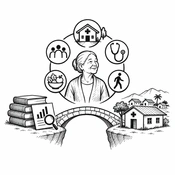

1. The Evidence Gap: From Global Guidance to Contextual Implementation
ICOPE is a complex care pathway involving multidomain screening, in-depth assessment, personalized care planning, and longitudinal follow-up, rather than a single intervention (5, 6). Although clinically meaningful, this complexity makes the pathway operationally demanding even in health systems with established primary care infrastructure. In LMICs, where geriatric medicine may be limited, primary care services may be overstretched, and health information systems may remain fragmented, the gap between the ICOPE ideal and what can be implemented may be substantial (8, 9).
A 2022 narrative review of global ICOPE adoption identified 18 study teams engaging with the framework between 2017 and 2022. Only a minority had progressed to implementation, whereas others remained at the feasibility or development stage (10). Subsequent evidence suggests that some settings have moved beyond early feasibility testing, although this progress is concentrated in upper-middle-income countries and should not be generalized to LMICs as a whole. For example, an ICOPE implementation pilot was conducted in primary care and community settings in Chaoyang District, Beijing, China, between 2020 and 2021. The pilot reported screening more than 33,000 individuals and enrolling 2,148 older adults; however, the relationship between the pilot sample and the subsequent trial sample requires careful verification against the original sources, as the two phases may have drawn on different populations. The program trained thousands of health professionals and established a group of integrated care managers to deliver personalized care pathways (7, 11).
A subsequent randomized controlled evaluation of the Chinese program provided further evidence that ICOPE could be implemented in urban and suburban primary care settings, with high reported satisfaction among participants and providers and improvements in several outcomes related to intrinsic capacity after six months (7). These findings are important because they demonstrate that ICOPE implementation is not merely hypothetical in an upper-middle-income context. However, the Chinese experience occurred within a relatively well-resourced and highly organized urban health system and therefore cannot automatically be extrapolated to rural or lower-resource settings.
Evidence from Malaysia provides a second instructive example. The GeKo Integrated Service Delivery model for frailty management was implemented in three primary care clinics and assessed using the WHO ICOPE scorecard. All three clinics reached the reported sustaining-implementation level, and changes in frailty scores were also evaluated (12). This experience suggests that adapting integrated care for older people to an existing primary care structure may be more realistic than establishing an entirely separate ICOPE service. Nevertheless, the Malaysian model also illustrates the importance of preexisting organizational infrastructure and trained personnel.
Brazil provides a complementary example at an earlier stage of implementation. The ICOPE Brazil initiative was designed as a multicenter prospective investigation involving researchers from multiple universities. It aimed to assess intrinsic capacity and the performance of the WHO screening tool among older people receiving primary care. More recent diagnostic accuracy research has further demonstrated that performance varies across intrinsic capacity domains, reinforcing the need for local validation rather than assuming uniform screening-tool performance across populations (13, 14).
Taken together, these examples suggest that the central evidence gap is no longer simply whether ICOPE can be implemented. A more useful question is under which organizational, workforce, technological, and policy conditions different ICOPE components can be implemented effectively and equitably.
2. From Extrapolation to Contextual Adaptation
Much of the early discussion of ICOPE implementation in LMICs necessarily relied on extrapolation from related implementation science literature. This remains useful, but the emergence of country-specific implementation studies now permits a more differentiated interpretation of the evidence.
For example, the Chinese experience demonstrates that a relatively comprehensive ICOPE pathway can be embedded within community and primary care structures when substantial institutional coordination, dedicated care management capacity, and systematic training are in place (7, 11). This should not be interpreted as evidence that the same workforce model is transferable to a rural district with fewer health workers. Instead, it provides proof of concept for one implementation configuration.
Similarly, evidence on task-sharing in other areas of LMIC health care supports the general principle that nonspecialist providers can deliver structured interventions when training, supervision, referral mechanisms, and role clarity are established (13, 15). However, evidence on task-sharing in mental health is not a direct substitute for evidence on geriatric functional assessment. Intrinsic capacity screening incorporates physical performance, sensory assessment, nutritional and vitality indicators, psychological function, cognition, and subsequent clinical decision-making. The appropriate degree of delegation may therefore differ across ICOPE domains rather than being treated as an all-or-none task-sharing decision. We use “task-sharing” throughout because it better captures the collaborative, supervisory relationships required for safe delegation of ICOPE components, whereas “task-shifting” can imply a unidirectional transfer of tasks without adequate support structures (16, 17).
This distinction represents an important conceptual contribution of the present commentary: task-sharing should be viewed as a domain-specific implementation decision. A community health worker (CHW) might appropriately conduct initial screening for selected domains using validated tools, while abnormal findings may require nurse-led confirmation and physician or multidisciplinary assessment (17). The question is therefore not simply whether CHWs can implement ICOPE, but which ICOPE functions can safely and effectively be delegated, under what supervisory structure, and with what escalation pathway.
The same principle applies to digitalization. Digital tools can reduce the documentation burden and facilitate data transfer, but their value depends on electricity, connectivity, device availability, digital literacy, procurement systems, maintenance, and data governance. Digitalization is therefore connected to the preceding discussion of workforce organization because both determine whether ICOPE components can be delivered reliably at the point of care. Consequently, digitalization should be considered an implementation option rather than an intrinsic facilitator (16).
3. Interpreting ICOPE Implementation Using the Consolidated Framework for Implementation Research
We apply CFIR as an analytic structure for identifying which determinants require measurement in each setting, rather than merely as a descriptive taxonomy.
3.1. Intervention Characteristics
ICOPE is a multidomain intervention rather than a single screening test. Its perceived complexity, adaptability, relative advantage over existing care, and compatibility with local clinical workflows are likely to influence implementation.
The Chinese experience illustrates the importance of adaptation: locally validated and adapted assessment tools were incorporated into the implementation program, while care managers coordinated personalized pathways (7). This suggests that implementation fidelity should not require rigid replication of every component. Instead, future studies should distinguish between core functions that must be preserved and adaptable components that can be modified according to context.
3.2. Outer Setting
The outer setting includes national policy priorities, financing arrangements, population needs, referral networks, and broader health-system constraints.
In LMICs, population aging may compete with longstanding priorities such as infectious diseases, maternal and child health, and acute care delivery. The absence of dedicated financing for functional assessment is therefore a structural determinant of sustainability (17, 18). Even when frontline providers accept the intervention, delivery remains dependent on discretionary effort or external project funding in the absence of a financing mechanism that reimburses or budgets for intrinsic capacity assessment. The WHO ICOPE implementation framework itself emphasizes assessment of system and service capacity as a prerequisite for implementation (6).
Accordingly, ICOPE implementation should be linked to existing universal health coverage, primary care, noncommunicable disease, and healthy aging strategies rather than introduced as an isolated vertical program.
3.3. Inner Setting
The inner setting includes organizational infrastructure, communication networks, available resources, implementation climate, and organizational readiness.
This domain may explain why the same ICOPE intervention produces different implementation experiences across settings. A primary care center with electronic records, multidisciplinary staff, referral pathways, and protected consultation time has fundamentally different implementation capacity from that of a rural clinic with one or two health workers and limited diagnostic infrastructure.
Rather than assuming a fixed consultation duration, future research should measure actual consultation length, patient volume, staffing ratios, workflow interruptions, and documentation burden in each setting. This would replace generic descriptions of "overburdened primary care" with measurable implementation determinants (19).
3.4. Characteristics of Individuals
ICOPE implementation also depends on the knowledge, confidence, motivation, and perceived professional roles of those delivering the intervention. Community health workers, nurses, physicians, physiotherapists, and other providers may differ substantially in their understanding of intrinsic capacity and willingness to assume additional responsibilities.
Training should therefore extend beyond technical instruction. Implementation studies should assess provider self-efficacy, perceived role compatibility, knowledge retention, workload perception, and attitudes toward multidisciplinary care.
Older people and caregivers should also be treated as active implementation stakeholders rather than passive recipients. Unpaid caregivers, the majority of whom are women, bear substantial responsibility for supporting functional assessment, referral completion, and daily care tasks. Their availability, burden, and training needs are implementation determinants that current ICOPE research largely overlooks. Cultural interpretations of aging, disability, sensory loss, depression, and dependence may influence acceptance of screening and referral (20, 21).
3.5. Process
Implementation is not complete when a screening tool is introduced. Planning, engagement, execution, monitoring, feedback, and adaptation are central processes.
The Chinese pilot demonstrates the importance of large-scale training and stakeholder mobilization (7, 11). Future LMIC programs should similarly document who was engaged before implementation, how providers were trained, how fidelity was monitored, how problems were identified, and how the intervention was adapted during implementation.
This process perspective also strengthens the rationale for mixed-methods research: quantitative indicators can establish reach, fidelity, referral completion, and clinical outcomes, while qualitative methods can explain why implementation succeeded or failed.
4. A Pragmatic Way Forward for Policymakers
Despite these gaps, inaction is not a responsible option given the rapid demographic transition underway in many LMICs. However, action should not mean the immediate nationwide adoption of an unmodified ICOPE package. A more defensible strategy is staged implementation, defined here as a sequence of 1) context assessment, 2) limited adaptation, 3) pilot testing, and 4) prospective evaluation, with explicit decision criteria at each stage for proceeding, modifying, or halting scale-up. No stage should proceed without identified actors, a timeline, cost estimates, equity indicators, and a decision rule for continuation (22).
We propose three actionable priorities:
4.1. Formalize Domain-Specific Task-Sharing Protocols
Rather than relying on ad hoc delegation of intrinsic capacity screening to CHWs, ministries of health should issue protocols specifying which ICOPE components can be performed by CHWs, which require nurses or allied health professionals, and which require referral to a physician or multidisciplinary team.
These protocols should be domain-specific and define minimum competencies, supervision ratios, referral thresholds, documentation requirements, and quality assurance procedures. The objective should be a safe and efficient distribution of tasks according to local workforce capacity, rather than maximal task-sharing.
4.2. Embed ICOPE Within Existing Primary Care Platforms
Intrinsic capacity screening should be embedded within existing NCD, primary care, community health, or healthy aging platforms rather than established as a completely separate vertical program. It should therefore be treated as a component of routine primary care assessment for older people rather than as a stand-alone addition (16).
The Malaysian GeKo experience provides a concrete example of how integrated care for older people can be incorporated into primary care infrastructure while using the ICOPE scorecard to assess implementation (12). This supports the broader principle of platform integration while also showing that local organizational structures determine what integration means in practice.
A staged model could begin with a brief screen, followed by targeted assessment for individuals with identified declines. Simplification should preserve the clinical purpose of the pathway rather than merely reduce the number of questions.
4.3. Pursue Equity-Oriented Dual-Track Simplification
Digital ICOPE tools may improve data capture and coordination in settings with adequate infrastructure, but digital-first implementation could widen inequalities where access to smartphones, connectivity, electricity, or digital literacy is limited. Equity indicators should be specified in advance—for example, the concentration index of screening reach by wealth quintile, rural/urban referral completion ratios, and disaggregation by gender and disability status—so that dual-track implementation can be evaluated against explicit equity benchmarks rather than assumed to be equitable (23).
We therefore advocate a dual-track approach:
1) A low-technology pathway using validated paper-based tools and standardized referral forms; and
2) A digital pathway for settings with adequate connectivity and technical infrastructure.
Both pathways should follow the same core clinical logic and quality standards while allowing the delivery mechanism to differ. This is an equity-oriented implementation strategy as well as a technology choice.
Tools should be co-designed with older people, CHWs, nurses, caregivers, and other local stakeholders. Co-design should be documented as an implementation process rather than presented only as a general ethical recommendation.
Ethical considerations require explicit attention to informed consent for screening and referral; avoidance of labeling that may stigmatize individuals with identified functional decline; and data governance arrangements for digital tools that specify who owns, accesses, and controls older people's functional data (23).
5. The Research Imperative: What Must Come Next?
The most urgent need is for a structured program of implementation research rather than another generic policy statement.
A formally registered scoping review compliant with the PRISMA Extension for Scoping Reviews should systematically map ICOPE implementation studies in LMICs across multiple databases, including PubMed/MEDLINE, Scopus, Embase, CINAHL, Web of Science, Global Health, LILACS, WHO Global Index Medicus, and regional sources such as SciELO and African Journals Online. The search should be supplemented by gray literature, including ministry reports and WHO country documents, with dual independent screening and transparent data extraction (24, 25).
The review should classify studies according to:
- Country and World Bank income category;
- Urban versus rural setting;
- Level of care;
- ICOPE components implemented;
- Workforce responsible for each component;
- Degree of local adaptation;
- Digital versus nondigital delivery;
- Implementation outcomes;
- Clinical and functional outcomes;
- Economic outcomes (cost, cost-effectiveness, budget impact, workforce time);
- Equity-related outcomes stratified by gender, rural/urban location, socioeconomic status, and disability; and
- Implementation framework used.
This classification would directly address the evidence-to-implementation gap identified in the present commentary and allow future researchers to distinguish between intervention effectiveness and implementation feasibility (26).
In parallel, mixed-methods implementation research should assess quantitative outcomes such as reach, adoption, fidelity, acceptability, feasibility, sustainability, referral completion, intrinsic capacity trajectories, functional ability, quality of life, costs, and health care utilization.
Qualitative interviews should include physicians and program managers, as well as CHWs, nurses, older people, and caregivers. This would ensure that implementation barriers are not inferred solely from health system structures.
The CFIR should be used prospectively to structure data collection across intervention characteristics, outer setting, inner setting, characteristics of individuals, and the implementation process. Such studies would enable cross-country comparison without assuming that identical implementation strategies should produce identical outcomes (26).
6. Conclusion
The World Health Organization (WHO) ICOPE framework represents a paradigm shift in caring for aging populations and is relevant to LMICs. However, the evidence base should no longer be described simply as either “present” or “absent.” Recent experience from China, Malaysia, and Brazil demonstrates meaningful progress while also revealing substantial variation in implementation maturity, organizational capacity, and local adaptation. These examples are drawn exclusively from upper-middle-income countries, and the Chinese pilot was situated in urban Beijing; no low-income, lower-middle-income, rural, or fragile settings are represented. The policy priorities proposed here should therefore be read as hypotheses requiring testing in these underserved settings, which are the ultimate priority.
The principal challenge is therefore to move from evidence of feasibility in selected settings toward evidence that explains how, for whom, and under what health system conditions ICOPE can be implemented sustainably and equitably.
Policymakers should consider domain-specific task-sharing, integration with existing primary care platforms, and equity-oriented simplification. These strategies should be implemented through staged, monitored adaptation rather than assumed to be universally effective.
At the research level, formally registered scoping reviews and primary mixed-methods implementation studies should prioritize underserved LMIC settings and explicitly examine all major CFIR domains. The ultimate objective should be a context-adapted ICOPE implementation model in which core functions are protected while delivery mechanisms, workforce roles, technologies, and referral pathways can be adapted to local realities.
Moving in this direction would allow the field to progress beyond both rigid replication of a high-level global framework and untested extrapolation from related health programs. ICOPE implementation in LMICs can instead become an empirically grounded process of structured adaptation, evaluation, and scale-up.