
Full Text
Full text is available in PDF
Official Publication of Health Promotion Research Center
Authors
One of the most important indicators of any society development is its health status and one of the most substantial issues in the field of community health status is its access to essential drugs so that the timely and adequate provision of essential drugs is one of the components of primary health care (PHC) principles.
This research aimed to study the influence of various factors such as drug price index, inflation rate, income, the number of physicians, etc. on the drug demand and consumption for Iranian urban households based on households' budget during 1990-2010.
This research was a descriptive-analytical study which, used time-series data econometrics method to examine the relationships between the costs of drug consumption in urban households with variables such as drug price index, inflation rate, income, and tariff of the Medical staff visits. In addition, ADF test was used to show that whether variables were stationary or not. Furthermore, the OLS technique was employed to estimate the drug demand function using Eviews7 and STATA 11 software.
The results showed that the estimated effects of sub-specialist visits tariff and general physician visits tariff on the drug demand were positive but not significant (P > 0.05) and urban households' income and drug price index had positive and significant effects on the drug demand (P < 0.05).
Based on the results of this research, it seems that allocating public resources in the form of providing health insurance or government subsidies can decline financial burden of drugs on patients.
© 2014, Author(s). This is an open-access article distributed under the terms of the Creative Commons Attribution 4.0 International License (CC BY 4.0) (https://creativecommons.org/licenses/by/4.0/) which permits unrestricted use, distribution, and reproduction in any medium, provided the original work is properly cited.
Ravangard R, Jafari A, Nouraei Motlagh S. Responses to the Criticism About “Drug Demand Function for Iranian Urban Households Based on Households’ Budget”. Health Scope. 2015;4(2):e61571. doi: https://doi.org/10.17795/jhealthscope-26398
Rezaei S, Karami Matin B. Main factors affecting household healthcare expenditures in Kermanshah province )1990-2011). J Kermanshah Univ Med Sci. 2015;19(5):e69842. doi: https://doi.org/10.22110/jkums.v19i5.2236
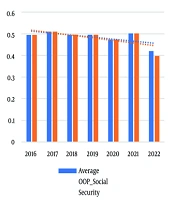
Soleymani F, Abdi A, Mirzaei A, Raeis Zadeh MM, Zeinalkhani A, et al. Affordability Analysis of Selected Medicines in Iran: A National Cross-sectional Survey Using World Health Organization Out-of-Pocket Methodology. Iran J Pharm Res. 2026;25(1):e163774. doi: https://doi.org/10.5812/ijpr-163774
Homaie Rad E. Demand Models and Expenditure Models: A Letter to Editor. Health Scope. 2015;4(2):e25163. doi: https://doi.org/10.17795/jhealthscope-25163

Payandeh A, Mehrabi Y, Zayeri F, Rezaei Ghahroodi Z. Health Expenditure Modelling in Southeast of Iran: A Population-Based Setting Using Quantile Regression Perspective. Health Scope. 2017;6(4):e64185. doi: https://doi.org/10.5812/jhealthscope.64185
More by these authors
Last Update: 1 week ago
Last Update: 1 week ago
Last Update: 1 week ago
Last Update: 7 hours ago
Last Update: 2 days ago
Last Update: 5 days ago
