Analysis of Hepatitis E virus-Like Sequence in Chimpanzee

Author(s):
Chenglin ZhouChenglin Zhou1, Wang LiWang Li1, Shixing YangShixing Yang1,*
1Department of Microbiology, School of Medical Science and Laboratory Medicine, Jiangsu University, Zhenjiang, China

Hepatitis Monthly:Vol. 14, issue 9; e19473
Published online:Sep 01, 2014
Article type:Letter
Received:Apr 14, 2014
Accepted:Aug 07, 2014
How to Cite:Zhou C, Li W, Yang S. Analysis of Hepatitis E virus-Like Sequence in Chimpanzee. Hepat Mon. 2014;14(9):e19473. doi: https://doi.org/10.5812/hepatmon.19473

Dear Editor,
Hepatitis E virus (HEV), a member of the genus Hepevirus, is a non-enveloped virus with a positive stranded RNA genome that is approximately 7.2 kb in length (1). It has been hypothesized that zoonosis is involved in the transmission of HEV (2, 3). Hepatitis E virus antibodies or genes have been reported to exist in many species of mammals, including monkeys (4, 5). Recently, divergent HEV strains has been discovered in different animals, including rats (6), mouses (7), and rabbits (8), which suggests that more animal species could be the reservoir of HEV. In the present study, we analyzed a HEV-like sequence, which was found by chance during the discovery of RNA virus in fecal samples of Chimpanzee from a zoo in China. Briefly, we extracted total RNA from the fecal suspension and performed reverse transcription using a primer containing a fixed sequence followed by a randomized octomer at the 3′ end. A single round of DNA synthesis was then performed using Klenow fragment polymerase. Twenty cycles of PCR amplification of nucleic acids was then performed using primers consisting of fixed portions of the random primers. Then the PCR products were purified, cloned into T-vector and sequenced. The resulting sequences were searched in GenBank using BLASTx. Searching results showed that one 685 bp sequence had the highest sequence homology with HEV, sharing 45-58% sequence identities. Sequence analysis revealed that the putative amino acid sequence of this fragment included the whole RdRp domain, which contained 157 amino acids. Due to the high divergence of the sequence, multiple attempts to acquire longer sequences of this virus failed. In order to investigate whether this sequence is prevalent in the Chimpanzee population, a set of primers were designed according to the 685 bp sequence in the present study to perform PCR screening in 24 fecal samples collected from Chimpanzees at the same zoo and 13 fecal samples from another zoo in China. The primers were Chev1 [5’-TGTCCTCATGTCTGTCAGG-3’] and Chev2 [5’-AATCACATCTACCAACAGC-3’] for the first round of PCR, and Chev3 [5’-TGCCACGGTCCACCGATCG-3’] and Chev4 [5’-ATAGAACCACCGGCGTTG-3’] for the second round. This set of nested primers was designed to amplify a 154-nt segment. Our PCR screening results indicated that seven (29.2%) of the 24 fecal samples from the same zoo were positive for this HEV-like sequence, while none of the 13 samples from the other zoo were positive, which suggests that this virus strain was highly prevalent in the Chimpanzee population at the studied zoo. The seven positive samples were cloned and sequenced; results indicated that they shared > 99% identity over nucleotide level, suggesting they belonged to the same virus strains. In order to further identify the genetic relationship between the sequences of this study and other known HEV strains, we performed a phylogenetic analysis based on the predicted amino acid sequences in the current study and those related sequences retrieved from GenBank. The HEV sequences included those from well-known HEV genotypes 1-4 (from human or pig), rat HEV, mouse HEV, rabbit HEV, and avian HEV. The other four related virus sequences were also added as outgroups, including hepatitis A virus, sapovirus, rabbit vesivirus and rabbit hemorrhagic disease virus. Briefly, amino acid sequences were aligned using Clusta lW v2.0. Phylogenetic analysis was constructed using the Mega 5 software (http://www.megasoftware.net/). GenBank accession numbers of the sequences used as references in this analysis are shown in Figure 1. The sequences determined in the current study were deposited in GenBank; strain name being Nhev-Cb1 and the accession number E212350. Our phylogenetic analysis indicated that Nhev-Cb1 clustered with the other HEV sequences, lying in a deep branch with high bootstrap value of 100 (Figure 1). Over the amino acid sequence level, Nhev-Cb1 shared 35-39% sequence identity with the other HEV species, and 29-32% sequence identities with the four reference sequences. Our phylogenetic results suggested that the virus in the present study was a novel type of HEV. Although the antibodies to HEV and human origin HEV genes were discovered in non-human primates (4, 5, 9), these animals are not considered as the natural reservoirs for HEV. In the present study, HEV-like sequences were detected in seven (29.2%) of 24 Chimpanzees at the studied zoo, suggesting that if the sequences are from real viral particles, the virus may be a new type of HEV using non-human primate as its natural host.
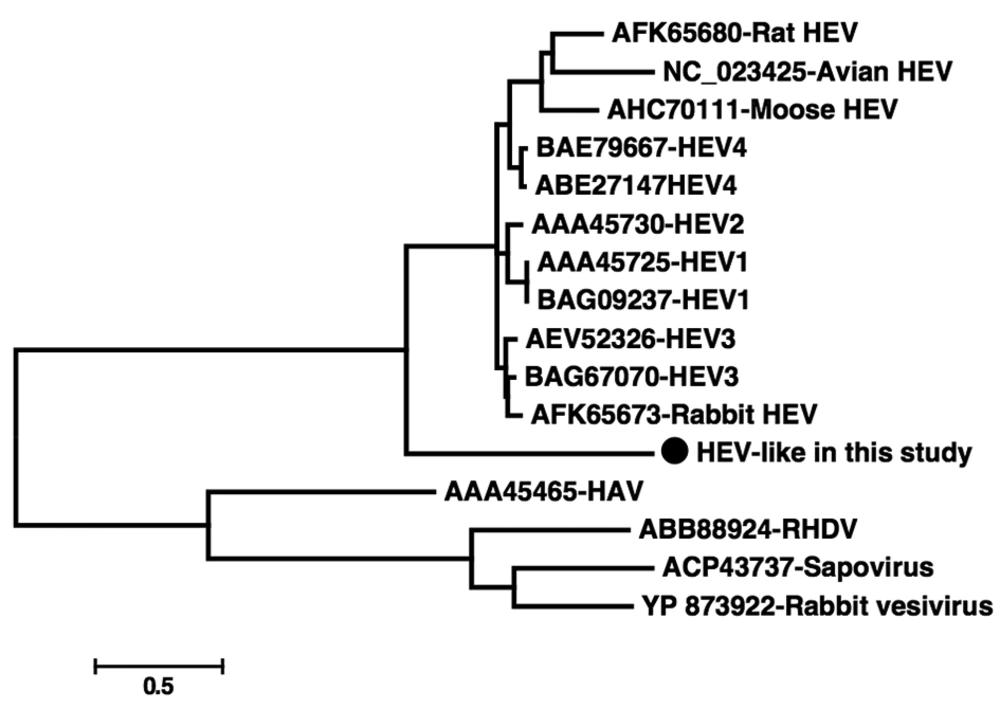
The phylogenetic tree was produced with the amino acid sequence alignments of the sequence in the present study and another 15 reference sequences, using the maximum-likelihood method with Mega 5 software. The sequence identified in the current study is marked with a black circle.

Figure 1.

The phylogenetic tree was produced with the amino acid sequence alignments of the sequence in the present study and another 15 reference sequences, using the maximum-likelihood method with Mega 5 software. The sequence identified in the current study is marked with a black circle.


Acknowledgments

Footnotes

References

  • 1.
    Reyes GR, Purdy MA, Kim JP, Luk KC, Young LM, Fry KE, et al. Isolation of a cDNA from the virus responsible for enterically transmitted non-A, non-B hepatitis. Science. 1990;247(4948):1335-9. [PubMed ID: 2107574].
  • 2.
    Meng XJ, Purcell RH, Halbur PG, Lehman JR, Webb DM, Tsareva TS, et al. A novel virus in swine is closely related to the human hepatitis E virus. Proc Natl Acad Sci U S A. 1997;94(18):9860-5. [PubMed ID: 9275216].
  • 3.
    Zhang W, He Y, Wang H, Shen Q, Cui L, Wang X, et al. Hepatitis E virus genotype diversity in eastern China. Emerg Infect Dis. 2010;16(10):1630-2. [PubMed ID: 20875298]. https://doi.org/10.3201/eid1610.100873.
  • 4.
    Huang F, Yu W, Hua X, Jing S, Zeng W, He Z. Seroepidemiology and molecular characterization of hepatitis E Virus in Macaca mulatta from a village in Yunnan, China, where infection with this virus is endemic. Hepat Mon. 2011;11(9):745-9. [PubMed ID: 22235219]. https://doi.org/10.5812/kowsar.1735143X.730.
  • 5.
    Yamamoto H, Suzuki J, Matsuda A, Ishida T, Ami Y, Suzaki Y, et al. Hepatitis E virus outbreak in monkey facility, Japan. Emerg Infect Dis. 2012;18(12):2032-4. [PubMed ID: 23171579]. https://doi.org/10.3201/eid1812.120884.
  • 6.
    Johne R, Heckel G, Plenge-Bonig A, Kindler E, Maresch C, Reetz J, et al. Novel hepatitis E virus genotype in Norway rats, Germany. Emerg Infect Dis. 2010;16(9):1452-5. [PubMed ID: 20735931]. https://doi.org/10.3201/eid1609.100444.
  • 7.
    Lin J, Norder H, Uhlhorn H, Belak S, Widen F. Novel hepatitis E like virus found in Swedish moose. J Gen Virol. 2014;95(Pt 3):557-70. [PubMed ID: 24296469]. https://doi.org/10.1099/vir.0.059238-0.
  • 8.
    Zhao C, Ma Z, Harrison TJ, Feng R, Zhang C, Qiao Z, et al. A novel genotype of hepatitis E virus prevalent among farmed rabbits in China. J Med Virol. 2009;81(8):1371-9. [PubMed ID: 19551838]. https://doi.org/10.1002/jmv.21536.
  • 9.
    Dastgerdi ES, Amini-Bavil-Olyaee S. Hepatitis E virus infection in macaca mulatta. Hepat Mon. 2011;11(10):852-3. [PubMed ID: 22224088]. https://doi.org/10.5812/kowsar.1735143x.783.

Similar Articles

12
Mar
2016

Hepatitis E Virus Circulation in Italy: Phylogenetic and Evolutionary Analysis

Carla Montesano,
Marta Giovanetti,
Marco Ciotti,
Eleonora Cella,
Alessandra Lo Presti,
Alba Grifoni
,et al.

Montesano C, Giovanetti M, Ciotti M, Cella E, Lo Presti A, et al. Hepatitis E Virus Circulation in Italy: Phylogenetic and Evolutionary Analysis. Hepat Mon. 2016;16(3):e58760. doi: https://doi.org/10.5812/hepatmon.31951

23
Jun
2015

Genotype 4 Hepatitis E Virus Prevalent in Eastern China Shows Diverse Subtypes

Hua Tian,
Xingli Fu,
Wang Li,
Yuan Huang,
Jiayao Sun,
Gai Zhou
,et al.

Tian H, Fu X, Li W, Huang Y, Sun J, et al. Genotype 4 Hepatitis E Virus Prevalent in Eastern China Shows Diverse Subtypes. Hepat Mon. 2015;15(6):e25367. doi: https://doi.org/10.5812/hepatmon.25367v2

17
Mar
2016

Hepatitis E Virus Infection Among Chronic Hemodialysis

Shokouh Shayanpour,
Fatemeh Hayati

Shayanpour S, Hayati F. Hepatitis E Virus Infection Among Chronic Hemodialysis. Jundishapur J Microbiol. 2016;9(3):e26645. doi: https://doi.org/10.5812/jjm.26645

3
Nov
2019
Hepatitis Monthly

Where Hepatitis B and Hepatitis E Meet: Epidemiological and Clinical Aspects

Semvua B Kilonzo,
Daniel Gunda,
Qing Ning,
Meifang Han

Kilonzo SB, Gunda D, Ning Q, Han M. Where Hepatitis B and Hepatitis E Meet: Epidemiological and Clinical Aspects. Hepat Mon. 2019;19(10):e93840. doi: https://doi.org/10.5812/hepatmon.93840

16
Aug
2013

Prevalence of Hepatitis Delta Virus (HDV) Infection in Chronic Hepatitis B Patients with Unusual Clinical Pictures

Shiva Ghamari,
Seyed Moayed Alavian,
Mario Rizzetto,
Antonella Olivero,
Antonina Smedile,
Abulfazl Khedive
,et al.

Ghamari S, Alavian SM, Rizzetto M, Olivero A, Smedile A, et al. Prevalence of Hepatitis Delta Virus (HDV) Infection in Chronic Hepatitis B Patients with Unusual Clinical Pictures. Hepat Mon. 2013;13(8):e6731. doi: https://doi.org/10.5812/hepatmon.6731


Crossmark
Crossmark
Checking
Share on
Cited by
Metrics

Ordering Reprints

Articles are published under the Creative Commons license stated on each article. No permission or royalty fee is required for uses permitted by that license. CCC handles optional bulk and customized reprint orders. Any quotation covers production and delivery services only, not copyright permission. > Request Reprints from CCC