Fulltext
Full-text is available in the PDF file.
Authors
Introduction: Prosthetic heart valve thrombosis (PHVT) is a major complication in patients with mechanical prosthetic heart valve which occurs primarily due to ineffective anticoagulation. This study aimed to evaluate the clinical profile of the patients presenting with PHVT undergoing fibrinolytic therapy and analyzing patients with respect to New York Heart Association (NYHA) functional class on presentation and its association with outcome of fibrinolytic therapy.
Methods: This was prospective, observational study conducted from June, 2016 to April, 2018. Total 133 patients with prosthetic heart valve thrombosis were included. Routine blood investigations included complete hemogram, liver and renal function tests. Prothrombin time with INR was done on admission. The diagnosis of PHVT was assessed by cine-fluoroscopy (CF) and/or echocardiography (transthoracic/transesophageal). Follow-up at 6 months was scheduled for all patients.
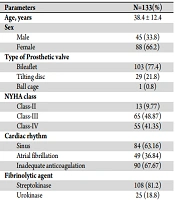
Results: All patients received fibrinolytic therapy in which 108 (81.2%) were treated with streptokinase and 25 (18.8%) were treated with urokinase. On presentation, 48.9% patients were in NYHA class III, 41.4% in NYHA class IV and 9.77% in NYHA class II. Fibrinolytic therapy was successful in 105 patients (78.9%) and it failed in 28 patients (21.1%). Mortality in NYHA class II was 0%, NYHA class III was 4.6% and in NYHA class IV was 23.6%. During 6 months follow up prosthetic heart valve thrombosis recurred in 12 (11.43%) patients.
Conclusion: From our single center experience, fibrinolytic therapy is effective first line therapy for prosthetic heart valve thrombosis and NYHA functional class on presentation can predict the outcome of fibrinolytic therapy.
© 2020, International Journal of Cardiovascular Practice. This open-access article is available under the Creative Commons Attribution 4.0 (CC BY 4.0) International License (https://creativecommons.org/licenses/by/4.0/), which allows for the copying and redistribution of the material only for noncommercial purposes, provided that the original work is properly cited.
Jafari Fesharaki M, Mahjoob MP, Kachoeian N, Eslami V. Clinical profile of patients with prosthetic heart valve thrombosis undergoing fibrinolytic therapy and NYHA class as a predictor of outcome. Int J Cardiovasc Pract. 2020;5(2):e131480. doi:
Singhal G. Clinical profile of patients with prosthetic heart valve thrombosis undergoing fibrinolytic therapy and NYHA class as a predictor of outcome. Int J Cardiovasc Pract. 2020;5(2):e131482. doi:
Asadi Qomi M, Gohari S, Ahangar H, Jalilvand A, Moosavi SJ, et al. Clinical profile of patients with prosthetic heart valve thrombosis undergoing fibrinolytic therapy and NYHA class as a predictor of outcome. Int J Cardiovasc Pract. 2020;5(2):e131483. doi:
Bhatia S, Jain S, Sharma V, Mansuri Z, Patel K, et al. Clinical profile of patients with prosthetic heart valve thrombosis undergoing fibrinolytic therapy and NYHA class as a predictor of outcome. Int J Cardiovasc Pract. 2021;6(1):e131484. doi:
Rajan R, Vasantha Krishnakumar VN, Bahuleyan CG, Nair PB. Mitral Prosthetic Valve Obstruction and Its Complications. Int Cardiovasc Res J. 2017;9(4):e10968. doi: https://doi.org/10.17795/icrj-9(4)247
Last Update: 1 month ago
Last Update: 1 month ago
Last Update: 1 month ago
Last Update: 6 days ago
Last Update: 7 hours ago
Last Update: 4 days ago