
1. Introduction
Germ cell tumors represent 15-20% of ovarian cancers and most of them are mature cystic teratomas (1). Struma ovarii is a highly specialized ovarian teratoma, chiefly represented by thyroid tissue (2). In fact, while 5-15% of teratomas contains small foci of thyroid tissue, this latter should represent more than 50% in a struma ovarii (1). Approximately, 5% of struma ovarii has been proven to be malignant and metastases are uncommon (2). Fairly good prognosis characterizes these patients: survival rate of patients in follow-up at 5, 10 and 25 years is 92%, 85% and 79%, respectively (3). Long-term follow-up is recommended in all cases (4). As in the thyroid, papillary carcinoma is the most common malignant histotype (70%, 1/3 represented by its follicular variant) arising in struma ovarii; while follicular carcinoma is observed in the remaining 30% (3-5). Malignant struma ovarii generally occurs in patients in the fifth and sixth decades of life (5), it is unilateral (94%) and more frequently involves the left ovary (3, 5). Functional thyroid alterations are unusual and overt hyperthyroidism is reported in 5-8% of cases (5). The most common clinical presentation of struma ovarii is a pelvic mass (3); lower abdominal pain, abnormal vaginal bleeding or menstrual irregularities and ascites may be associated (5). However, the tumor is often unexpectedly diagnosed during abdominal/pelvic ultrasound or surgery (3, 5). Abdominal hysterectomy and bilateral salpingo-oophorectomy with omentectomy is the surgical treatment for malignant struma ovarii. Unilateral salpingo-oophorectomy is the preferred treatment for women who require preservation of fertility. Being this tumor fairly uncommon, there is a lack of diagnostic and treatment guidelines (4, 6-8). After initial surgery, some authors suggest that the management of malignant struma ovarii may be similar to that of other germ cell tumors (1); other authors suggest, as in differentiated cancer of thyroid gland management, to perform a thyroidectomy followed by radiotherapy with 131 isotope of Iodine (RAI) (9) and levothyroxine suppressive therapy (3, 4, 7, 8), although restricted to patients with recurrence or residual disease (2, 4, 5). No consensus has been reached in performing prophylactic total thyroidectomy and the treatment strategy for nonmetastatic malignant disease remains controversial. We present a case of 30-year-old female with follicular variant of papillary thyroid carcinoma arising in struma ovarii and concomitant differentiated cancer of thyroid gland.
2. Case Presentation
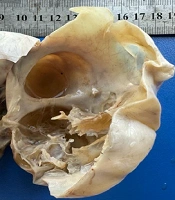
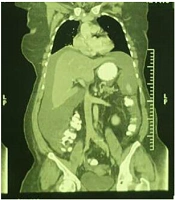
A 30-year-old woman was admitted to the emergency room because of persistent abdominal pain in the right side, appeared some day before, during a shift work as agricultural laborer. An accurate medical history ascertained that she had an increased steady weight (109 kg; BMI = 40 Kg/m2), but she was in apparently good health also showing customary appetite and regular menses, before the appearance of pain. Physical examination revealed the presence of a large mass, palpable in hypogastric region and in right lower abdominal quadrant. Ultrasonography confirmed an abdominal mass adjacent to the right ovary. To better define the diagnosis, the physician required blood sampling for routine tests, gynecological counseling and an abdominal computer tomography (CT). The abdominal CT confirmed the presence of a mass measuring 10 x 6 cm, in the right ovary. The patient underwent right unilateral salpingo-oophorectomy. In particular, an ovariian cyst (7, 3 x 3 cm) along with a portion of the fallopian tubes of 4 cm and the vermiform appendix were removed. Peritoneal washing and multiple peritoneal biopsies in nearby areas (Douglas, bladder, bilateral paracolic gutter, and diaphragm) were also performed. Histological examination revealed the presence of a follicular variant of papillary thyroid carcinoma (0.9 cm) harbored in a mature teratoma. The cancer was localized and the right ovary capsule was not infiltrated by the tumor. Based on Union for International Cancer Control (UICC) 2002, classification tumor received a pT1a grading. Appendix showed the features of chronic follicular inflammation and the remaining tissues were disease-free. After surgery, functional examination of thyroid gland revealed serum iodothyronines levels in the normal range, thyroid ultrasonography showed a normal glandular volume with patchy echo-structure and, in the left thyroid lobe, the presence of a 23, 4 x 14 x 9 mm hypoechogenic nodular lesion. An ultrasound assisted fine needle aspiration of this thyroid lesion was performed and cytological examination showed the presence of dense colloid in particles and small groups of thyrocytes with notes of oxyphilic metaplasia and anisonucleosis; this sample was classified as follicular lesion with oxyphilic cells of undetermined significance (category III according to the Bethesda system, 2009) (10). So far, in presence of follicular lesion and for an appropriate follow-up of papillary carcinoma arising in struma ovarii, the patient underwent total thyroidectomy (11, 12). Histological examination revealed that the nodule examined in the left lobe was benign, but showed a papillary micro-carcinoma in the right lobe (diameter = 0.2 cm; pT1a) within a hyperplastic thyroid characterized by abundant oxyphil cells. The ablation of residual thyroid tissue was performed by a dose of 30 mCi of 131I according to Meas et al. (13). Whole body scan after therapeutic dose showed two focal areas of strong uptake in the anterior region of the neck, in right superior paramedian and left inferior paramedian areas, due to minimal glandular remnants; no area of uptake in the pelvis or elsewhere was notice. The thyroid-stimulating hormone (TSH) value before radioiodine therapy was 64.8 mU/L and serum thyroglobulin (Tg) was 1.24 mg/dL, in the absence of anti-thyroglobulin antibodies (anti-TgAb). Levothyroxine treatment was started (1.6 μg/Kg/day) and thyroid hormones and TSH were evaluated after four months. Levothyroxine dose had been increased until an appropriate TSH value (0.24 mU/L) had reached at 1.92 μg/Kg/day. Six months after total thyroidectomy, patient underwent neck ultrasonography and Tg evaluation, which showed no evidence of recurrences. Patient is up to now in follow-up for both struma ovarii and differentiated thyroid cancer according to European Thyroid Association guidelines (12).
3. Discussion
First described at the end of 21th century, struma ovarii is a rare tumor representing less than 1% of all ovarian tumors (6, 14) and 2.7% of all dermoid tumors (6). A diagnostic and therapeutic characterization of struma ovarii is needed as it may harbor a differentiated thyroid cancer (1). Even the generic term “malignant struma ovarii” has been, in fact, replaced with the more appropriate “thyroid carcinoma arising in struma ovarii” (TCASO), namely when histological features support the existence of a well-differentiated thyroid carcinoma (3, 14, 15). Molecular evidence that malignant struma ovarii and differentiated thyroid cancer may share similar pathogenic events (3, 16) has been presented. Approximately 70% of follicular cell-derived thyroid carcinomas are associated with activating mutations of BRAF, RAS, RET and NTRK1 (3, 4, 16). BRAF mutations have been described in 29-69% of primitive papillary thyroid cancer and in particular V600E missense mutation type is the most common alteration in sporadic papillary carcinoma (3, 17). Also in four out of six malignant struma ovarii and in none of nine benign struma ovarii, BRAF mutations were observed in the Schmidt’s study (3, 4). The concurrent presence of the same genetic alteration (i.e. BRAF mutations), in thyroid neoplasia and in struma ovarii would be intriguing in that it may support the hypothesis of a multifocal thyroid neoplasia in two distant sites (13, 16). Autonomous histopathological criteria have not been established for thyroid carcinoma arising in struma ovarii and, so far, the diagnosis of malignant struma ovarii follows the guidelines for the diagnosis of primary thyroid carcinoma (3). Evidence also indicates that patients with malignant struma ovarii should be treated as those having differentiated cancer in the thyroid gland (3, 10).
In patients with thyroid cancer confined to the ovary, pelvic surgery has been considered sufficient and prophylactic thyroidectomy not recommended (1, 2, 14); in these patients follow-up ensues as in non-aggressive DTC (1, 14). Fine needle aspiration cytology has been considered appropriate when thyroid nodular lesions would have been detected at ultrasound (1, 4, 14). Noticeably, however, a thyroid carcinoma concurrent with malignant struma ovarii is increasingly detected (14, 18) and the treatment of this association is, as yet, not properly defined. In fact, a more extensive treatment, e.g. total thyroidectomy and RAI, after pelvic surgery, is only recommended for malignant struma ovarii with extra-ovarian spread or distant metastasis (1-3). In patients with extra-ovarian or metastatic disease, evidence suggests that radioiodine ablation and thyrotropin suppression are associated with increased disease-free survival (3, 7). According to another study, patients who underwent total thyroidectomy and radio ablation after pelvic surgery were free of recurrence even after 36 years (7, 8). On the contrary, a recurrence rate of 50% was associated with the conservative treatment of patients (8). Moreover, a delayed appearance of distant metastasis has been described three years after the treatment in patients with struma ovarii who underwent pelvic surgery alone (18). A not negligible fraction (6%) of patients with longer follow up, developed distant metastases after one, three and seven years (15). Two-thirds of metastasis occurred at the time of disease recurrence, rather than at first presentation (7); in fact, a number of cases were diagnosed as malignant only following the detection of metastatic recurrences (7). In this clinical case, an occult papillary microcarcinoma concomitant to malignant struma ovarii has been described. High prevalence of occult thyroid papillary microcarcinoma has been described in autoptic studies (36%) and/or following surgery for benign conditions (2-24%) (19). However, some of these microcarcinomas may represent more aggressive varieties of disseminated tumor cells (DTCs) (17). Indeed, papillary microcarcinoma, although infrequently, may show significant differences in clinical behavior, sometimes being very aggressive, despite small primary tumor size (17). According to Meas et al. (13), the contemporary presence of two possibly related thyroid cell-derived tumors, although with low risk stratification, may be considered as a multifocal expression of the same pathogenic alteration. They suggested that a threshold of more than one centimeter as sum of all foci may require a more cautious seeking of thyroid tissue lesions (13). In this view, American Thyroid Association guidelines (20) concerning DTC follow-up should be reinterpreted as being the struma ovarii and papillary carcinoma (any size) a multifocal expression of the same tumor. In conclusion, a treatment including thyroidectomy followed by radioablation should not be denied a priori, but in selected cases may be advisable to decrease the risk of recurrence and to allow an accurate follow-up (7).