Full Text
Full text is available in PDF
International Journal of Endocrinology and Metabolism
Research Institute for Endocrine Sciences
Authors
Background: Previous studies have suggested reduced fat metabolism in older subjects. However, corrections for their reduced maximal oxygen consumption and the effects of training and substrate availability have not been fully examined.
Objectives: Fat metabolism (FM) in older subjects (n = 14, 75 ± 7 yrs), and the effects of exercise training were compared with FM in younger subjects (n = 16, 22 ± 3 yrs).
Materials and Methods: All subjects completed a maximal exercise test and a sustained submaximal run at 70% of their maximal capacity. The respiratory exchange ratio (RER) and blood substrate levels were determined. Older subjects were re-tested after training.
Results: Young subjects had higher oxygen consumption (VO2) peak (36.3 ± 6.7 vs. 23.7 ± 6.2 ml/kg/min) and lower slope of RER vs. VO2 than older subjects. However, the slope of the RER vs. VO2 relationship was not different between younger and older subjects, after correction for their VO2 peaks. Younger subjects had longer sustained exercise times (45.5 ± 17.6 min) than the elderly (30.2 ± 14.0 min), pre-training. Post-training, there was a significant increase in VO2 peak (25%) in older subjects (P = 0.001) and submaximal exercise time (30.2 ± 14.0 vs. 58.3 ± 27.3min, P = 0.020). Respiratory exchange ratio was reduced during both exercises after training (0.90 ± 0.03 vs. 1.00 ± 0.03, P = 0.04).
Conclusions: The RER of older subjects was not different from that of younger subjects, after correction for the VO2 peak. The VO2 peak, sustained exercise time, and RER decreased after training in older subjects, indicating increased fat metabolism.
© 2011 Kowsar M.P.Co. All rights reserved.
© 2011, Author(s). This open-access article is available under the Creative Commons Attribution 4.0 (CC BY 4.0) International License (https://creativecommons.org/licenses/by/4.0/), which allows for unrestricted use, distribution, and reproduction in any medium, provided that the original work is properly cited.
Gholamali M, Nourshahi M, Ranjbar K. Relationship between Anthropometric Factors, Respiratory Exchange Ratio and Energy Expenditure with Maximal Oxygen Uptake among Sedentary Men. Zahedan J Res Med Sci. 2014;16(6):. doi:
Rezaei Nasab H, Ranjbar R, Habibi A, Shakerian S. Comparison of Substrate Oxidation and Energy Expenditure During Acute Aerobic Exercise With Moderate and High Intensity in Patients With Type 2 Diabetes. Jentashapir J Cell Mol Biol. 2015;6(5):e24160. doi: https://doi.org/10.17795/jjhr-24160
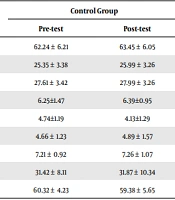
Cheragh Birjandi K, Ghasemi E, Karimi E, Ghoncheh S. Combined Training Reduces Redox and Inflammatory Biomarkers and Improves General-Social Health in Elderly Men. Asian J Sports Med. 2023;14(1):e132103. doi: https://doi.org/10.5812/asjsm-132103
Banitalebi E, Bovirhasani Baghanari H. Effect of Sequence Order of Combined Training (Resistance and Endurance) on Strength, Aerobic Capacity, and Body Composition in Older Women. Middle East J Rehabil Health Stud. 2015;2(2):e28514. doi: https://doi.org/10.17795/mejrh-28514
Last Update: 3 weeks ago
Last Update: 3 weeks ago
Last Update: 3 weeks ago
Last Update: 3 hours ago
Last Update: 9 hours ago
Last Update: 4 days ago
