Full Text
Full text is available in PDF
International Journal of Endocrinology and Metabolism
Research Institute for Endocrine Sciences
Authors
We aim to evaluate a non-mydriatic retinal camera as a safe and efficacious screening tool, for diabetic retinopathy, in diabetes centers.
Materials and Methods: 221 consecutive patients attending a Diabetes Center submitted to retinal photographs using a non-mydriatic camera. Patients were included if they had not had previous laser therapy and if they had a formal ophthalmologic consultation within 6 months of the photography Four endocrinologists reviewed the retinal photographs and recommended an interval (urgent referral, early referral, non-referral) for ophthalmologic assessment. Endocrinologists' grades were compared against the gold standard of ophthalmological findings. The endocrinologists were privy only to the patient's age, type and duration of diabetes mellitus.
Results: Twenty-seven cases were deemed as requiring early referral by the ophthalmologists.The endocrinologists agreed with ophthalmologist referral times in 27, 26, 23 and 27 cases respectively.Two cases requiring urgent referral according to the ophthalmologists were also judged as requiring urgent referral by all endocrinologists.A mean sensitivity of 95.4% (95% CI 88.5%-100%) was attained.
Conclusions: The use of a non-mydriatic camera to determine need for ophthalmologic referral was found to be safe and efficacious, with no serious delays in referral noted. On average this tool can safely defer 53.5% of routine ophthalmologic referrals without any risk to the patient's eyesight.
© 2005, Author(s). This open-access article is available under the Creative Commons Attribution 4.0 (CC BY 4.0) International License (https://creativecommons.org/licenses/by/4.0/), which allows for unrestricted use, distribution, and reproduction in any medium, provided that the original work is properly cited.
Mazarei M. Risk factors of diabetic retinopathy in patients referred to Bouali eye center. J Inflamm Dis. 2024;9(3):e155141. doi:
Ghasemi M, Khalaj M, Mohmmadizeidi E. Assessment of the eye problems in diabetic patients in Qazvin. J Inflamm Dis. 2024;12(2):e155399. doi:
Khastavaneh H, Ebrahimpour-Komleh H. Segmentation of Diabetic Retinopathy Lesions in Retinal Fundus Images Using Multi-View Convolutional Neural Networks. I J Radiol. 2019;16(Special Issue):e99148. doi: https://doi.org/10.5812/iranjradiol.99148
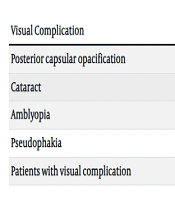
Validad MH, Nakhaee Moghadam M, Mirzaei I, Parsi-Moud A, Kankashian M, et al. Early Detection of Anterior Segment Visual Complications in Pediatrics with Type 1 Diabetes Mellitus. Inn J Pediatr. 2024;34(4):e143040. doi: https://doi.org/10.5812/ijp-143040
Rasoulinejad SA. Evaluating the Risk Factors of Development and Progression of Diabetic Retinopathy: A Review Study. Shiraz E-Med J. 2022;23(5):e117171. doi: https://doi.org/10.5812/semj.117171
Last Update: 3 weeks ago
Last Update: 3 weeks ago
Last Update: 3 weeks ago
Last Update: 9 hours ago
Last Update: 11 hours ago
Last Update: 4 days ago
