Full Text
Full text is available in PDF
International Journal of Endocrinology and Metabolism
Research Institute for Endocrine Sciences
Authors
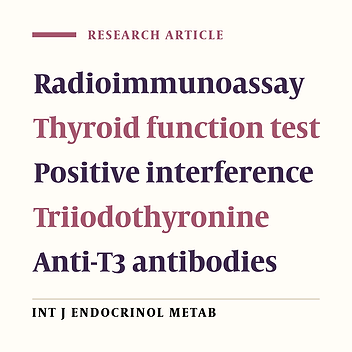
Determination of thyrotropin (TSH), total and free thyroxine (T4) and triiodothyronine (T3) are widely used for thyroid function evaluation. There have been numerous reports of interfer-ence in thyroid hormone immunoassays. Herein, the possible occurrence of interference is inves-tigated for a radioimmunoassay kit of total T3. Materials and Methods: A total of 3471 patients were examined through the serum level meas-urement of TSH, total T4 and T3. T3 analysis was made through a competitive solid-phase radio labeled (125I) immunoassay by T3 Izotop kit (Izotop Co. Budapest, Hungary). The presence of T3 assay interference was considered probable if the endocrine profile was inconsistent with the clinical picture and/or the obtained value for T3 showed extreme deviaton from normal levels, i.e. above 780 ng/dL. For such patients, the exis-tence of interference was verified by re-measuring T3 level by another RIA kit (Immu-notech kit, Marseille, France). Results: Among 3471 patients studied, 40 cases (1.2 %) had spuriously high T3 serum levels with T3-Izotop kit while normal T3 levels (132.1±31.0 ng/dL) were observed with T3-Immunotech kit; the positive interference was more prevalent among women (1.4% vs. 0.5% in men), especially post-menopausal women. Mean serum levels of total T4 and TSH in the positive interference group were 9.0±2.0 μg/dL and 1.79±1.47 μU/mL, respectively. Conclusion: In accordance with numerous re-ports of interferences in thyroid hormone im-munoassays, the results of our study indicates that both laboratory professionals and clinicians must be vigilant to the possibility of antibody interference in thyroid function assays.
© 2007, Author(s). This open-access article is available under the Creative Commons Attribution 4.0 (CC BY 4.0) International License (https://creativecommons.org/licenses/by/4.0/), which allows for unrestricted use, distribution, and reproduction in any medium, provided that the original work is properly cited.
Beato-Víbora PI, Alejo-González S. Avoiding Misdiagnosis Due to Antibody Interference with Serum Free Thyroxin. Int J Endocrinol Metab. 2017;15(1):e13257. doi: https://doi.org/10.5812/ijem.37792
Dawood MH, Dawood MH, Al-Nussairawi M, Gharbavi M. Biomarker Test Characteristics and Their Relationship to Healthcare Practices in Iraqi Patients Receiving Hyperthyroidism Treatment. Jundishapur J Chronic Dis Care. 2025;14(3):e162333. doi: https://doi.org/10.5812/jjcdc-162333
Soltani A, Rahimian N, Rahbar Z, Moosapour H. Before Moving Towards Recombinant Thyrotropin, Can We Benefit From Anti-Thyroid Drugs? A Case Study. Int J Endocrinol Metab. 2008;6(3):. doi:
Kalantari S. Subclinical Hypothyroidism. Int J Endocrinol Metab. 2007;5(1):. doi:
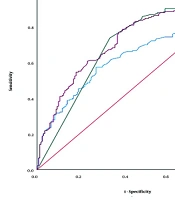
Binti Rahmat N, Tuan Ismail TS, bin Md Muslim MZ, bin Wan Zain WMS, bin Zakaria AZ, et al. The Free Thyroxine-to-Thyroid Stimulating Hormone Ratio: A Potential Diagnostic Marker for Graves’ Disease. Int J Endocrinol Metab. 2025;23(1):e158565. doi: https://doi.org/10.5812/ijem-158565
Last Update: 3 weeks ago
Last Update: 3 weeks ago
Last Update: 3 weeks ago
Last Update: 5 hours ago
Last Update: 1 day ago
Last Update: 4 days ago
