
1. Background
The Internet stands as one of the most significant human achievements in recent years (1). In 2015, the number of worldwide Internet users reached approximately 3.3 billion, encompassing 45% of the global population (2). In light of advancements in education, communication, and entertainment, the Internet has become an indispensable tool for disseminating knowledge and scientific news across a wide spectrum of activities and purposes (3). Furthermore, due to the coronavirus disease 2019 (COVID-19) outbreak, Internet usage has become pervasive in medical education, with a rising number of internet-based training courses for physicians and medical students (4).
However, excessive use of this multimedia tool can lead to addiction, causing users to lose control over their Internet usage and resulting in physical, psychological, and social problems (5). The American Psychiatric Association (APA) defines Internet addiction as a pattern of Internet use that disrupts normal functioning and is accompanied by negative emotional states over a two-month period. The APA has established seven diagnostic criteria for this disorder, including: (1) Tolerance; (2) withdrawal symptoms; (3) increased Internet usage duration beyond the originally intended time; (4) persistent desire to control Internet behavior; (5) spending a significant amount of time on Internet-related activities; (6) reduction in social, professional, and recreational activities; and (7) continued use despite negative consequences (6).
Research indicates that Internet users are predominantly aged between 16 and 25 years, putting students at a high risk for Internet addiction and its associated direct and indirect adverse effects (7). Exposure to the light emitted by computer monitors during Internet use can inhibit the secretion of melatonin and delay the onset of sleep (8). Sleep quality is defined as an individual’s satisfaction with their overall sleep experience, encompassing aspects such as sleep initiation, sleep maintenance, sleep duration, and daytime wakefulness (9). It is a crucial factor in assessing an individual’s general health and quality of life (10), and it significantly impacts cognitive function and concentration levels required for daily tasks (11).
Medical students, due to their involvement in demanding and lengthy academic programs, often face poor sleep quality and high levels of academic stress (12). Therefore, investigating their sleep problems is of paramount importance. Despite numerous studies exploring the relationship between Internet use and sleep quality and cognitive function in various populations, there is a dearth of reliable research examining the prevalence of Internet addiction and its implications among medical students in Iran.
2. Objectives
This study aimed to investigate the association between Internet usage, sleep quality, and cognitive function in this specific group.
3. Methods
3.1. Study Design
This analytical cross-sectional study was conducted in Mashhad, Iran, within 2019 and 2021. The study protocol received approval from the Ethics Committee of Mashhad University of Medical Sciences, Mashhad, Iran (IR.MUMS.MEDICAL.REC.1398.342). The participants provided signed consent forms, and the researchers pledged to maintain the confidentiality of their information.
The study included a total of 525 pre-internship medical students, comprising 304 first-year and second-year students, 113 third-year students, and 108 externs. The participants were selected using a stratified sampling method. The inclusion criteria were an age range of 18 - 30 years, current enrollment as university students, and willingness to participate in the study. The exclusion criteria encompassed incomplete questionnaires and conditions associated with an elevated risk of sleep disorders, such as a history of sleep medication usage, pregnancy or lactation, medical interns, and individuals currently infected with COVID-19 or in the COVID-19 recovery period.
3.2. Data Collection Tools
Demographic information, including age, gender, level of education, marital status, and place of residence (dormitory or personal habitation), was collected using a checklist. The data were gathered through three valid questionnaires: the Cognitive Ability Questionnaire (CAQ), the Pittsburgh Sleep Quality Index (PSQI), and the Internet Addiction Questionnaire (IAQ).
The Internet Addiction Questionnaire comprises 20 items scored on a 5-point Likert scale. Responders are categorized as average online users (scores between 20 and 49), users with occasional or frequent problems (scores between 50 and 79), and users with significant problems (scores between 80 and 100) (13). A previous study conducted a psychometric evaluation of the Persian-translated questionnaire, demonstrating acceptable content and convergent validity, in addition to satisfactory test-retest reliability (r = 0.82) and internal consistency (Cronbach’s alpha = 0.88) in a sample of 233 university students (14).
The Pittsburgh Sleep Quality Index consists of 18 items rated on a 4-point Likert scale (ranging from 0 to 3). The index encompasses 7 subscales, with each subscale receiving a score from 0 to 3 (0: None, 1: Weak, 2: Moderate, and 3: Severe). The total PSQI score ranges from 0 to 21, enabling differentiation between appropriate and poor sleep quality (15). The 7 PSQI subscales cover various aspects: (1) Sleep duration, (2) sleep disturbance, (3) sleep latency, (4) daytime dysfunction due to sleepiness, (5) sleep efficiency, (6) overall sleep quality, and (7) sleep medication (16). The Persian-translated questionnaire’s psychometric validity was previously confirmed in a study involving 258 adults, including 125 psychiatric patients and 133 controls. The Cronbach’s alpha for the questionnaire in the total population, psychiatric patients, and healthy adults were 0.77, 0.52, and 0.78, respectively (17).
The Cognitive Ability Questionnaire comprises 30 items and assesses 7 components: Memory, inhibitory control and selective attention, decision-making, planning, sustainable attention, social cognition, and cognitive flexibility (18). This questionnaire, designed to evaluate cognitive ability and its various components in the Iranian population, measures cognitive ability based on a five-point Likert scale (ranging from 1 indicating almost never to 5 indicating almost always) (18). The Persian-translated questionnaire’s validity was previously established in a study involving 181 elderly and 224 young adults, with a Cronbach’s alpha of 0.834 and a test-retest reliability Pearson correlation coefficient of 0.865 (18).
3.3. Statistical Analysis
The data were entered into the Statistical Package for Social Sciences (SPSS) software (version 22, SPSS Inc., Chicago, IL, USA). Missing data were not imputed, and the analyses were performed using raw values. Mean and standard deviation were utilized to describe quantitative data with a normal distribution. The comparison of mean questionnaire scores between groups was conducted using an independent t-test. The chi-square test was employed to compare the distribution patterns of internet addiction categories among the domains of the Pittsburgh questionnaire. The correlation between the total IAQ and the total scores of the cognition and Pittsburgh questionnaires was assessed using the Spearman correlation test. The level of statistical significance was set at 0.05.
4. Results
A total of 525 pre-internship medical students, with a mean age of 21.12 ± 2.91 years (range: 18 - 30 years), were included in this study. Among the participants, 304 (57.9%), 113 (21.5%), and 108 (20.6%) subjects were basic science students, physiopathology students, and medical externs, respectively. Of the 525 participants, 287 (54.7%) and 238 (45.3%) students were female and male, respectively, while 489 (93.1%) were single, and the remainder were married. Additionally, 381 participants (72.6%) lived with their families, 89 (17%) had their own place, and 55 (10.5%) resided in dormitories. Moreover, 10 participants (1.9%) reported drug abuse. The frequency of Internet usage among the participants is shown in Figure 1.
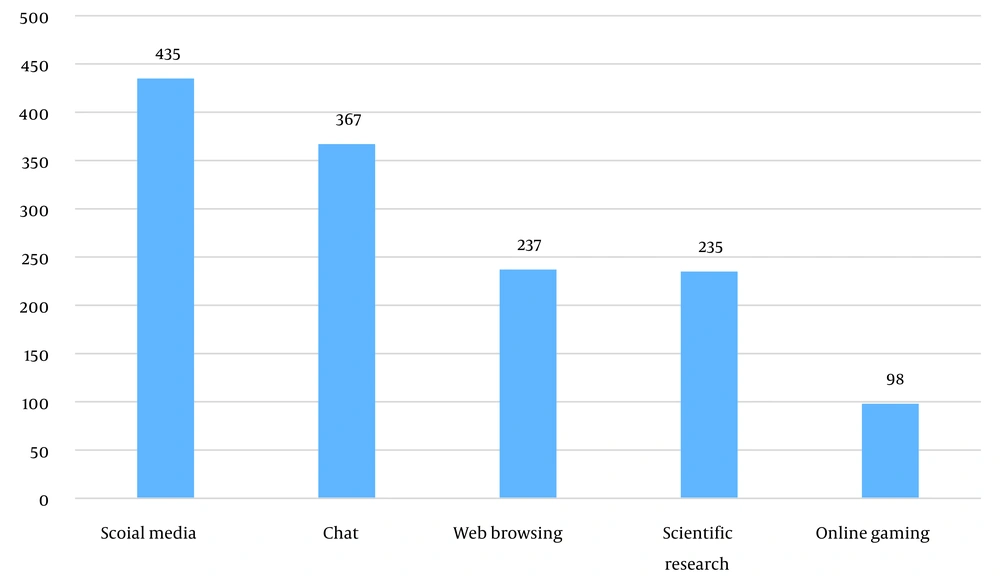
Figure 1.
Frequency of type of Internet usage and their percentage
The mean score of IAQ was 38.6 ± 13.3, ranging from 1 to 87. Average Internet use was observed in 430 (81.9%) participants; nevertheless, 94 participants (17.9%) experienced occasional or frequent problems, and only one participant had significant problems. The mean PSQI score was 6.33 ± 2.99, ranging from 1 to 17, and the mean CAQ score was 68.49 ± 14.82, ranging from 34 to 135. It should be noted that since only one subject had significant Internet problems, the groups with occasional or frequent problems (scores between 50 and 79) and significant problems (scores between 80 and 100) were combined for data analysis.
The mean total scores of the Pittsburgh questionnaire among participants categorized as average Internet users and those with occasional or frequent problems/significant problems were 6.03 ± 2.87 and 7.68 ± 3.16, respectively. The mean scores of the CAQ among average Internet users and those with occasional or frequent problems/significant problems were 66.42 ± 13.95 and 77.88 ± 15.10, respectively. The mean score of the CAQ was significantly higher in participants with occasional or frequent problems/significant problems than in average Internet users.
A significant direct correlation was observed between the total score of IAQ and the total CAQ score (r = 0.439, P < 0.001). Additionally, a significant but slight correlation was observed between the total internet addiction score and the total PSQI score (r = 0.264, P < 0.001) (Figure 2).
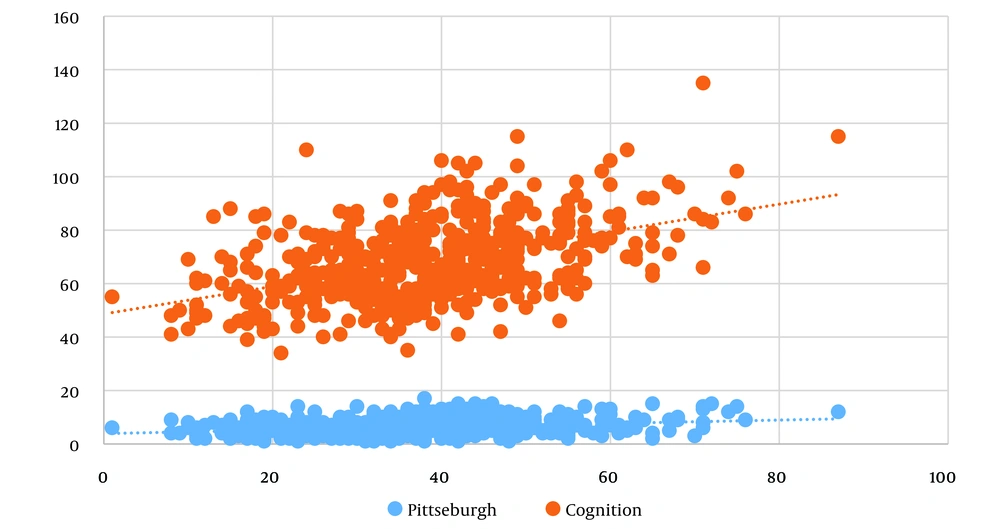
Figure 2.
Correlation between Internet addiction score (horizontal axis) and total cognition and Pittsburgh scores
Table 1 shows the different subscales of the Pittsburgh questionnaire between the “average Internet users” and those with “occasional or frequent problems/significant problems” participants. A significant association was observed between categories of IAQ and sleep latency (P = 0.032), daytime dysfunction due to sleepiness (P < 0.001), sleep efficiency (P = 0.001), and overall sleep quality (P < 0.001) indicating worse conditions in participants with occasional or frequent problems/significant problems than in those with average Internet use.
Table 1.
Different Subscales of the Pittsburgh Questionnaire Between the 2 Categories of Average Online Users and Participants with Occasional or Frequent Problems/Significant Problems
| Variables and Scores | Total a; No. (%) | Average Online Users (Scores 20 - 49); No. (%) | Occasional or Frequent Problems/Significant Problems (Scores 50 - 100); No. (%) | P-Value |
|---|---|---|---|---|
| Sleep duration (h) | 0.302 | |||
| 0 (more than 7) | 225 (42.9 ) | 191 (84.9) | 34 (15.1) | |
| 1 (6 - 7) | 156 (29.7) | 122 (78.2) | 34 (21.8) | |
| 2 (5 - 6) | 126 (24) | 101 (80.2) | 25 (19.8) | |
| 3 (less than 5) | 18 (3.4) | 16 (88.9) | 2 (11.1) | |
| Sleep disturbance | 0.065 | |||
| 0 (0) | 55 (10.5) | 48 (87.3) | 7 (12.7) | |
| 1 (1 - 9) | 410 (78.1) | 339 (82.7) | 71 (17.3) | |
| 2 (10 - 18) | 60 (11.4) | 43 (71.7) | 17 (28.3) | |
| Sleep latency | 0.032 | |||
| 0 | 98 (18.7) | 84 (85.7) | 14 (14.3) | |
| 1 - 2 | 200 (38.1) | 173 (86.5) | 27 (13.5) | |
| 3 - 4 | 143 (27.2) | 109 (76.2) | 34 (23.8) | |
| 5 - 6 | 84 (16) | 64 (76.2) | 20 (23.8) | |
| Daytime dysfunction due to sleepiness | < 0.001 | |||
| 0 (none) | 122 (23.2) | 108 (88.5) | 14 (11.5) | |
| 1 (weak) | 195 (37.1) | 175 (89.7) | 20 (10.3) | |
| 2 (moderate) | 153 (29.1) | 110 (71.9) | 43 (28.1) | |
| 3 (severe) | 55 (10.5) | 37 (67.3) | 18 (32.7) | |
| Sleep efficiency | 0.001 | |||
| 0 (more than 85%) | 391 (74.5) | 333 (85.2) | 58 (14.8) | |
| 1 (75 - 84%) | 85 (16.2) | 60 (70.6) | 25 (29.4) | |
| 2 (65 - 74%) | 26 (5) | 20 (76.9) | 6 (23.1) | |
| 3 (less than 65%) | 23 (4.4) | 17 (73.9) | 6 (26.1) | |
| Overall sleep quality | < 0.001 | |||
| Very well | 82 (15.6) | 74 (90.2) | 8 (9.8) | |
| Well | 288 (54.9) | 248 (86.1) | 40 (13.9) | |
| Bad | 126 (24) | 90 (71.4) | 36 (28.6) | |
| Very bad | 29 (5.5) | 18 (62.1) | 11 (37.9) | |
| Sleep medication | 0.816 | |||
| 0 (never) | 469 (89.3) | 386 (82.3) | 83 (17.7) | |
| 1 (less than once a week) | 27 (5.1) | 21 (77.8) | 6 (22.2) | |
| 2 (less than twice a week) | 16 (3) | 12 (75) | 4 (25) | |
| 3 (3 times or more per week) | 13 (2.5) | 11 (84.6) | 2 (15.4) |
a The sum of the percentages in the total column is 100% vertically.
5. Discussion
Despite the many useful aspects of the Internet, its excessive usage can lead to addiction and negatively impact the quality of life of its users. This cross-sectional study revealed a significant association between Internet addiction and sleep quality. Moreover, significant differences were observed in some PSQI subscales, including sleep latency, daytime dysfunction due to sleepiness, sleep efficiency, and overall sleep quality, between participants categorized as having occasional or frequent problems/significant problems compared to average Internet users.
The prevalence of Internet addiction has been previously studied among Iranian medical students. Recent studies show that the prevalence of Internet addiction disorder or pathological Internet use among Iranian medical students varies between 5.22% and 16.1% (19). The results of the present study also demonstrated that 95 participants (18.1%) were classified as having occasional or frequent problems/significant problems.
Users depend on the Internet for a variety of activities. The present study demonstrated that social media and chat were the most popular Internet pastimes; however, online gaming was the least favored among the users. A study on Turkish students indicated that their most common reason for using the Internet was to visit social media platforms, including WhatsApp (92%), Instagram (79%), and YouTube (78%) (3).
Ismail et al. evaluated the relationship between Internet addiction and anxiety using an online questionnaire among 237 medical students, who were selected based on stratified random sampling. They reported that the frequency of Internet addiction was 83.5%. They also observed that pre-clinical students had a higher risk of anxiety than those in clinical years. Nevertheless, they reported that high scores of Internet addiction had a protective role against anxiety (19). However, the controversy in their results might be due to the small sample size in the study, and further research is required.
In a systematic review and meta-analysis study conducted in 2019, 13 studies involving 18 740 participants were reviewed to examine the effect of gender, year, and field of study on sleep quality in Chinese medical students. It was reported that the prevalence of poor sleep quality was 25% (20). On the other hand, in the current study, 126 (24%) of the participants described their sleep quality as bad, and 29 (5.5%) participants reported their sleep quality as very bad. The differences in the results might be attributed to variations in sample size.
A meta-analysis conducted in 2018 assessed the Internet addiction status of 3 651 medical students and showed that the pooled prevalence of Internet addiction among medical students was five times higher compared to the general population. It was also suggested that students’ age and gender were not significantly associated with the severity of Internet addiction (21). However, Khan et al. observed that the prevalence of addiction was significantly higher in students lacking physical activity. Nonetheless, they also observed no relationship between students’ gender and Internet addiction (22).
The current study revealed a significant but weak correlation between Internet addiction and sleep quality and a significant correlation between Internet addiction and cognitive function. Similar outcomes were reported in a study conducted in 2016, which showed that increased dependence on social networking sites was significantly correlated with decreased sleep quality and increased daily cognitive impairments among 324 Internet users aged 18 to 58 years (23). Moreover, a study conducted on medical students in Saudi Arabia suggested that decreased nighttime sleep duration, delayed sleep phase, and increased daytime sleepiness negatively impacted the academic performance of the students (24).
The results of the current study can be used to help manage Internet usage and the time spent on the Internet more effectively. These findings can also help reduce the negative effects of Internet use on sleep quality and cognitive function among medical students. The large sample size was one of the strengths of the current study. However, further studies are required to examine other factors affecting sleep quality among Internet users, including environmental and geographical factors.
5.1. Conclusions
This study underscores the significant association between Internet addiction and sleep quality in medical students. Since sleep deprivation can affect the academic status and cognitive performance of students, Internet addiction should be a major concern among medical students aspiring to become health professionals, as the consequences of this addiction can negatively impact their careers and goals.