
Dear Editor,
Impulsivity is a multidimensional concept defined as increased tendencies to respond to some internal or external stimuli in an abrupt, unplanned manner without carefully considering them. It is associated with multiple psychiatric disorders, including opioid dependence. Impulsivity is also closely linked to craving and is considered an important factor leading to relapse; thus, it becomes a crucial factor to be addressed during relapse prevention therapy. It also affects the course of illness as it is associated with self-harm and suicidal behaviors (1). Aggression can be defined as a behavior that is often unprovoked and intended to cause physical or psychological harm to self or others. Aggressive traits in early life are seen as an important predictor of future substance use. Aggressive traits or behaviors are also associated with poor treatment outcomes, such as difficulty maintaining abstinence, frequent relapses, and poor psycho-social outcomes. We present our findings of impulsiveness and aggression in patients with opioid dependence in comparison with controls.
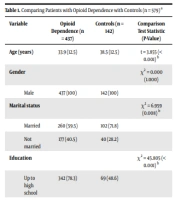
The study was conducted at a tertiary care addiction treatment facility and was part of a project (2) duly approved by the Institutional Ethics Committee (IEC-468/07.10.2016, RP-17/2016). Male patients with opioid dependence (n = 437) and healthy controls selected from the patients’ relatives (n = 142) were recruited after obtaining written informed consent. The two groups were compared on sociodemographic profile, as well as on impulsivity and aggression, using the Barratt Impulsiveness Scale-11 (BIS-11) and the Buss Perry Aggression Questionnaire (BPAQ), respectively. The BIS-11 is a self-report measure to assess behavioral patterns relating to impulsivity across three domains, namely motor (behavioral), attentional (cognitive), and non-planning impulsiveness. The BPAQ measures aggressive traits across four subdomains, namely verbal aggression, physical aggression, anger, and hostility (Table 1).
Table 1.
Comparing Patients with Opioid Dependence with Controls (n = 579) a
| Variable | Opioid Dependence (n = 437) | Controls (n = 142) | Comparison Test Statistic (P-Value) |
|---|---|---|---|
| Age (years) | 33.9 (12.5) | 38.5 (12.5) | t = 3.855 (< 0.001) b |
| Gender | χ2 = 0.000 (1.000) | ||
| Male | 437 (100) | 142 (100) | |
| Marital status | χ2 = 6.959 (0.008) b | ||
| Married | 260 (59.5) | 102 (71.8) | |
| Not married | 177 (40.5) | 40 (28.2) | |
| Education | χ2 = 45.805 (< 0.001) b | ||
| Up to high school | 342 (78.3) | 69 (48.6) | |
| Above high school | 95 (21.7) | 73 (51.4) | |
| Employment | χ2 = 3.710 (0.058) | ||
| Currently employed | 365 (83.5) | 128 (90.1) | |
| Currently not employed | 72 (16.5) | 14 (9.9) | |
| Residence | χ2 = 50.879 (< 0.001) b | ||
| Urban | 243 (55.6) | 126 (88.7) | |
| Rural | 194 (44.4) | 16 (11.3) | |
| Tobacco use | 355 (81.2) | 55 (38.7) | χ2 = 93.675 (< 0.001) b |
| Alcohol use | 116 (26.5) | 26 (18.3) | χ2 = 3.926 (0.058) |
| Cannabis use | 117 (26.8) | 0 (0) | χ2 = 47.646 (< 0.001) b |
| Sedative use | 48 (11.0) | 2 (1.4) | χ2 = 12.455 (< 0.001) b |
| Heroin use | 275 (62.9) | NA | NA |
| Natural opioid use | 163 (37.3) | NA | NA |
| Pharmaceutical opioid use | 67 (15.3) | NA | NA |
| History of IDU | 31 (7.1) | NA | NA |
| Barratt Impulsiveness Scale-11 | |||
| Attentional | 16.05 (2.33) | 14.31 (2.21) | t = 7.847 (< 0.001) b |
| Motor | 20.66 (2.83) | 20.49 (2.42) | t = 0.63 (0.529) |
| Non-planning | 27.11 (3.61) | 23.95 (2.86) | t = 9.492 (< 0.001) b |
| Buss Perry Aggression Questionnaire | |||
| Physical | 23.05 (6.13) | 19.84 (4.67) | t = 5.716 (< 0.001) b |
| Verbal | 11.87 (4.40) | 8.73 (3.26) | t = 7.853 (< 0.001) b |
| Anger | 18.53 (4.58) | 14.77 (3.90) | t = 8.806 (< 0.001) b |
| Hostility | 16.20 (5.19) | 12.15 (3.75) | t = 8.585 (< 0.001) b |
Abbreviations: IDU, injecting drug use; NA, not applicable
a Shown as mean (standard deviation) or frequency (percentage)
b Significant at P < 0.05
It was seen that substance use (other than opioids), including tobacco, alcohol, sedative, and cannabis use, was significantly higher in individuals with opioid dependence. The majority of opioid users were heroin users (63%), followed by natural opioid users (37%), and some also had a history of pharmaceutical opioid use (15%). Around 7% of opioid-dependent individuals had a history of injecting drug use (IDU). Impulsivity scores were significantly higher among opioid-dependent individuals for the attentional and non-planning domains but not for motor impulsiveness. These findings are based on previous studies showing that opioid users have higher impulsivity scores than non-users (3). The significantly higher scores in the attentional and non-planning domains of the BIS-11 indicate a higher degree of inattention, cognitive instability, lack of self-control, and intolerance to cognitive complexity. Literature is divergent on the domains of impulsiveness demonstrating higher scores, with all three domains showing higher scores in one study (4) and higher motor and non-planning impulsiveness (but not attentional impulsiveness) in another. The effect of substances on behavioral measures and control sample selection may explain the differences observed. The BPAQ scores were significantly higher in all subdomains, including physical aggression, verbal aggression, anger, and hostility, in individuals with opioid dependence. While one previous study had similar findings (5), another did not find higher verbal aggression in heroin users, though other aggression measures were higher (6).
Some limitations of the present study deserve attention, including single cross-sectional assessment, lack of matching on some parameters like age and educational status, single-centered sample recruitment, the ratio of cases to controls being 3: 1, and potential response biases. Despite the limitations, the present findings report impulsiveness and aggression in one of the largest samples of opioid-dependent individuals. Based on the findings, it is important to address impulsiveness and aggression in the clinical care of patients. Impulsiveness may lead to difficulty in controlling oneself, leading to interpersonal difficulties and hence a potentially greater number of relapses. Similarly, aggression may precipitate interpersonal difficulties leading to relapses and also difficulties in engagement and continuation with treatment. Thus, this consideration should go preemptively in the psychotherapy and therapeutic interaction of patients with opioid dependence. In the future, long-term follow-up studies will help to better understand the causal relationship between the occurrence of opioid dependence and impulsivity and aggression and the influence of impulsiveness on outcomes of substance use disorder treatment and ancillary outcomes, such as self-harm, incarceration, occupational rehabilitation, and recovery.