Cover image of the article: A Rare Presentation of Fulminant Necrotizing Soft Tissue Infection in Post Partum Period: Report of Two Cases

Image Credit:International Journal of Infection

A Rare Presentation of Fulminant Necrotizing Soft Tissue Infection in Post Partum Period: Report of Two Cases

Authors

Anju KumariAnju Kumari ORCID1, Meghraj KundanMeghraj Kundan ORCID2,*
1Department of Obstetric and Gynaecology, VMMC and Safdarjung Hospital, New Delhi, India
2Department of General Surgery, VMMC and Safdarjung Hospital, New Delhi, India
*Corresponding Author: Department of General Surgery, VMMC and Safdarjung Hospital, New Delhi, India. Email: drmeghrajkundan@gmail.com

International Journal of Infection:Vol. 7, issue 1; e101258
Published online:Apr 05, 2020
Article type:Case Report
Received:Jan 21, 2020
Accepted:Mar 26, 2020
How to Cite:Kumari A, Kundan M. A Rare Presentation of Fulminant Necrotizing Soft Tissue Infection in Post Partum Period: Report of Two Cases. Int J Infect. 2020;7(1):e101258. doi: https://doi.org/10.5812/iji.101258

Abstract

Necrotizing fasciitis is a severe infection involving skin, subcutaneous tissue and superficial fascia, which has lethal outcome. Risk factors associated with this condition include diabetes mellitus, anemia, and immunosuppressive states such as AIDS, or prolonged steroid use. Surgery is an independent risk factor. Serial surgical debridement with appropriate broad spectrum antibiotics is the mainstay of treatment. We are reporting two cases. First is necrotizing soft tissue infection of the anterior abdominal wall in post cesarean patient, which was very fulminant and fatal. The second is Fournier’s gangrene in a patient with episiotomy during normal vaginal delivery. Postpartum necrotizing soft tissue infection is very challenging and fatal. Nowadays these are very rare cases due to antibiotics.

Highlights

1. Introduction

Necrotizing fasciitis is a severe infection involving skin, subcutaneous tissue and superficial fascia, which has lethal outcome (1). It is a rare infection having incidence of 0.4 per 100000 and 34% mortality (2). Risk factors associated with this condition include diabetes mellitus, anemia, immunosuppressive states such as AIDS, prolonged steroid use. Surgery is an independent risk factor. Post-operative NSAID has been reported as a risk factor in some study (3, 4). Necrotizing fasciitis is usually polymicrobial, but methicillin resistant Staphylococcus aureus (MRSA) has been associated with up to one third of patients (5). Necrotizing fasciitis had been described by Hippocrates in the 5th century and its association with cesarean section was first reported by Gretz et al. in 1962 (6, 7). Goepfert et al. had given an incidence rate of 1.8 per thousand cesarean deliveries (8). Schorge et al. (9) reported five cases over a 15 year period.

2. Case Presentation

2.1. Case 1

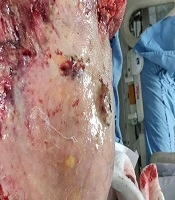
A 31 year female presented with anterior abdominal wall necrotizing soft tissue infection with fever from the last three days (Figure 1). She had undergone cesarean section six days before. The patient had developed pus discharge from the surgical site on the third post-operative day, which had spread to the anterior abdominal wall in a short period. The patient had low grade fever continuously for two days. She had no comorbidity such as diabetes, hypertension, COPD etc. On local examination, the wound was filled with pus and sloughed materials. Necrotic patches were present on the wound, with ill-defined margins. Her blood investigation showed low hemoglobin (Hb = 9) and leukocytosis (WBC = 18000), serum creatinine, urea, bilirubin were normal. The patient was started on broad spectrum antibiotics like amoxicillin-clavulanic acid and clindamycin through intravenous route. After proper resuscitation, the patient was operated and surgical debridement was done (Figures 2 and 3). Culture and sensitivity of debrided deep tissue with pus was sent. On culture and sensitivity, MRSA (methicillin resistant Staphylococcus aureus) was the causative organism, which was sensitive to imipenem, colistin. According to sensitivity the antibiotic was re-administered. The patient had been observed continuously. Serial debridement and regular dressing was done. Patient infection could not be controlled. Patient condition deteriorated and ultimately the patient could not be saved and died due to septic shock.
At the time of presentation
Figure 1.
At the time of presentation
Post-surgical debridement
Figure 2.
Post-surgical debridement
Figure 3.
Post-surgical debridement

2.2. Case 2

A 26 year old female had undergone normal vaginal delivery with episiotomy. She had developed episiotomy site infection on the fourth post-operative day. Initially, there was pus discharge from site then infection spreaded to vulvar area. It involved skin, subcutaneous tissue and superficial fascia. Gradually it spreaded to the whole perineum including the perianal area. Clinically it was necrotizing soft tissue infection of perineum also known as Fournier’s gangrene. The wound was filled with pus, sloughed tissue, and necrotic materials. The patient was surgically debrided in operation theater after pre-operative preparation. Culture and sensitivity of pus was sent. There was both aerobic and anaerobic infection like Streptococcus pyogens, bacteriodes, which was sensitive to clindamycin, linezolid, amikacin etc. Antibiotics such as linozolid and amikacin were started at optimum dose. Serial surgical debridement with regular dressing was done. Patient improved gradually and wound healed. Patient was discharged and followed-up.

3. Discussion

Necrotizing fasciitis (NF), also known as flesh eating disease, is a rapidly progressing infection causing extensive soft tissue necrosis mostly involving the perineum, anterior abdominal wall and limbs. Approximately 20% of cases occur post operatively. Mostly NF was reported before the era of prophylactic antibiotics (10). DeMuro et al. (3) reported NF in obstetrics and gynecology patients. Serial surgical debridement with appropriate broad spectrum antibiotics is the mainstay of treatment. Antibiotic therapy without debridement has higher mortality rate (2). Post-surgical debridement, culture sensitivity of tissue should be sent for appropriate antibiotic. Almarzouqi et al. (11) reported fatal necrotizing fasciitis following episiotomy.
Necrotizing fasciitis in post-partum patients is a very big challenge for both diagnosis and management as very few had clinical experience of this. High clinical suspicion and aggressive management are associated with good prognosis.
Footnotes

  • Authors' Contribution: Anju Kumari did data collection and design. Meghraj Kundan did editing, concept, and Manuscript writing.

  • Conflict of Interests: There is no conflict of interest.

  • Funding/Support: There is no funding received.

  • Informed Consent: Informed consent was signed by the patient.

References

  • 1.
    Wong CH, Chang HC, Pasupathy S, Khin LW, Tan JL, Low CO. Necrotizing fasciitis: Clinical presentation, microbiology, and determinants of mortality. J Bone Joint Surg Am. 2003;85(8):1454-60. [PubMed ID: 12925624].
  • 2.
    Hakkarainen TW, Kopari NM, Pham TN, Evans HL. Necrotizing soft tissue infections: Review and current concepts in treatment, systems of care, and outcomes. Curr Probl Surg. 2014;51(8):344-62. [PubMed ID: 25069713]. [PubMed Central ID: PMC4199388]. https://doi.org/10.1067/j.cpsurg.2014.06.001.
  • 3.
    DeMuro J, Hanna A, Chalas E, Cunha B. Polymicrobial abdominal wall necrotizing fasciitis after cesarean section. J Surg Case Rep. 2012;2012(9):10. [PubMed ID: 24960796]. [PubMed Central ID: PMC3649624]. https://doi.org/10.1093/jscr/2012.9.10.
  • 4.
    Aronoff DM, Bloch KC. Assessing the relationship between the use of nonsteroidal antiinflammatory drugs and necrotizing fasciitis caused by group A streptococcus. Medicine (Baltimore). 2003;82(4):225-35. [PubMed ID: 12861100]. https://doi.org/10.1097/01.md.0000085060.63483.bb.
  • 5.
    Paz Maya S, Dualde Beltran D, Lemercier P, Leiva-Salinas C. Necrotizing fasciitis: An urgent diagnosis. Skeletal Radiol. 2014;43(5):577-89. [PubMed ID: 24469151]. https://doi.org/10.1007/s00256-013-1813-2.
  • 6.
    Descamps V, Aitken J, Lee MG. Hippocrates on necrotising fasciitis. Lancet. 1994;344(8921):556. [PubMed ID: 7914656]. https://doi.org/10.1016/s0140-6736(94)91956-9.
  • 7.
    Gretz HJ, Marchbanks VJ, Houle DB. Progressive bacterial synergistic symbiotic gangrene. A complication of cesarean section. Am J Obstet Gynecol. 1962;83:54-6. [PubMed ID: 13901752]. https://doi.org/10.1016/0002-9378(62)90287-9.
  • 8.
    Goepfert AR, Guinn DA, Andrews WW, Hauth JC. Necrotizing fasciitis after cesarean delivery. Obstet Gynecol. 1997;89(3):409-12. [PubMed ID: 9052595]. https://doi.org/10.1016/S0029-7844(96)00511-X.
  • 9.
    Schorge JO, Granter SR, Lerner LH, Feldman S. Postpartum and vulvar necrotizing fasciitis. Early clinical diagnosis and histopathologic correlation. J Reprod Med. 1998;43(7):586-90. [PubMed ID: 9693409].
  • 10.
    Gallup DG, Freedman MA, Meguiar RV, Freedman SN, Nolan TE. Necrotizing fasciitis in gynecologic and obstetric patients: A surgical emergency. Am J Obstet Gynecol. 2002;187(2):305-10. idscussion 310-1. [PubMed ID: 12193917].
  • 11.
    Almarzouqi F, Grieb G, Klink C, Bauerschlag D, Fuchs PC, Alharbi Z, et al. Fatal necrotizing fasciitis following episiotomy. Case Rep Surg. 2015;2015:562810. [PubMed ID: 26064762]. [PubMed Central ID: PMC4439488]. https://doi.org/10.1155/2015/562810.

Copyright

Copyright © 2020, International Journal of Infection. This is an open-access article distributed under the terms of the Creative Commons Attribution-NonCommercial 4.0 International License (http://creativecommons.org/licenses/by-nc/4.0/) which permits copy and redistribute the material just in noncommercial usages, provided the original work is properly cited.

Similar Articles

3
Sep
2022
Fournier’s Gangrene: A Novel Approach and Pushing the Envelope to a Case of Abdominoperineal Necrotizing Soft Tissue Infection in Peripheral Hospital Setup and Review of Literature

Fournier’s Gangrene: A Novel Approach and Pushing the Envelope to a Case of Abdominoperineal Necrotizing Soft Tissue Infection in Peripheral Hospital Setup and Review of Literature

Thokchom-Bishwajit Singh,
Ranjan Kumar,
Mahesh Behera,
Sanasam Ushakiran Singh

Singh T, Kumar R, Behera M, Ushakiran Singh S. Fournier’s Gangrene: A Novel Approach and Pushing the Envelope to a Case of Abdominoperineal Necrotizing Soft Tissue Infection in Peripheral Hospital Setup and Review of Literature. J Arch Mil Med. 2022;10(3):e123009. doi: https://doi.org/10.5812/jamm-123009

20
Jul
2014
Fournier's Gangrene in Children: Report on 7 Cases and Review of Literature

Fournier's Gangrene in Children: Report on 7 Cases and Review of Literature

Mohsen Rouzrokh,
Atossa Tavassoli,
Alireza Mirshemirani

Rouzrokh M, Tavassoli A, Mirshemirani A. Fournier's Gangrene in Children: Report on 7 Cases and Review of Literature. Inn J Pediatr. 2014;24(5):. doi:

1
Apr
2008
Necrotizing Fasciitis -the Flesh Eating Bacterial Disease- of the Neck

Necrotizing Fasciitis -the Flesh Eating Bacterial Disease- of the Neck

Masoud Shariat,
Z Mohammad,
AH Hamzaini,
Ch Ping Kiat

Shariat M, Mohammad Z, Hamzaini A, Ping Kiat C. Necrotizing Fasciitis -the Flesh Eating Bacterial Disease- of the Neck. Shiraz E-Med J. 2008;9(2):e78553. doi:

30
Jul
2013
Severe Multiple Necrotizing Fasciitis Complicated by Abdominal Compartment Syndrome in an Infant

Severe Multiple Necrotizing Fasciitis Complicated by Abdominal Compartment Syndrome in an Infant

Kai Shi,
Zhao Jing-Chun,
Xian Chun-Jing,
Yu Jia-Ao

Shi K, Jing-Chun Z, Chun-Jing X, Jia-Ao Y. Severe Multiple Necrotizing Fasciitis Complicated by Abdominal Compartment Syndrome in an Infant. Inn J Pediatr. 2013;23(5):. doi:

23
May
2016
Fournier’s Gangrene in a Neonate With Acute Myeloid Leukemia: A Case Report

Fournier’s Gangrene in a Neonate With Acute Myeloid Leukemia: A Case Report

Ziba Mosayebi,
Ali Omidian,
Amir Hossein Movahedian,
Farzad Kompani,
Seyyed Saeed Hosseininodeh

Mosayebi Z, Omidian A, Movahedian AH, Kompani F, Hosseininodeh SS. Fournier’s Gangrene in a Neonate With Acute Myeloid Leukemia: A Case Report. Inn J Pediatr. 2016;26(3):e4537. doi: https://doi.org/10.5812/ijp.4537

More by these authors

Anju KumariPubMedScholar
Meghraj KundanPubMedScholar
Share
Cited by
Metrics