1. Context
Coronavirus disease 2019 (COVID-19) began in China on Dec 1, 2019, and spread to most of the world four months later by March 2020. By April 5, 2020, only 26 countries, representing only 1% of the total world population, reported no case of COVID-19. Although the disease has spread worldwide, its severity differs remarkably. While some countries have been battered by the virus and recorded as many as 1,300 deaths per day, it has not been the case for others. This paper compares the severity of COVID-19 between tropical and non-tropical countries.
Tropical countries are countries that are located in the tropics or around the Earth’s equator. More specifically, they are countries that are located between the Tropic of Cancer and the Tropic of Capricorn. Tropical countries typically have a tropical climate, which means that it is warm all year long with two seasons of dry and wet. The tropical regions makeup about 40% of the surface area of the planet and are home to approximately 40% of the world’s population1. However, not all nations located in the tropics have a tropical climate. Regions, including the Sahara Desert and Australian Outback, both of which located within the tropics, are not tropical. Therefore, some countries like Ghana, Zimbabwe, Namibia, etc. are not tropical.
Non-tropical countries are temperate countries. These are the countries outside the tropics and hence experience winter and summer or very cold and very hot weather. They are located far from the equator and the further away from it, the more intense the hot and cold temperatures they experience. Temperate countries account for 60% of the world’s population.
This research highlights how COVID-19 has affected tropical and temperate countries, in terms of the number of affected cases and deaths from the disease. It is important to know how severe the disease is likely to affect a country so that this informs the mitigation measures to implement in the country to balance the tradeoff between the economy and health eco-system.
1.1. Background
COVID-19 was first detected in China and quickly spread to the US, Russia, UK, France, Germany, Nepal, Australia, Malaysia, Singapore, South Korea, Vietnam, and Taiwan and eventually worldwide. COVID-19 was declared as a global pandemic on March 12, 2020, by the World Health Organization (WHO) (1). It was quickly realized that COVID-19 is spread by contact with droplets from the mouth or nose of an infected person. Therefore, countries put up some measures to reduce/stop the spread of the virus. These included:
Building COVID-19 hospitals: Health centers specifically set up to care for COVID-19 patients and separate them from other patients.
Social distancing: Maintaining a distance of at least one meter between people.
Staying at home: Working from home to avoid infection and leaving only to get essential services (healthcare, food).
Closure of non-essential services: These included schools, shops, hotels, salons, etc.
Closure of borders: No permission of entry into the country either by air, water, train, or on foot.
Lockdown: No movements, curfews, etc.
Public health: Washing hands with sanitizers or soap and water, wearing masks, etc.
Quarantine: Isolating people who have been in contact with infected people for 14 days.
Government handouts: Free delivery of essentials, stimulus packages, government cheques, loan relief, etc.
Online services: Shift to e-services and m-services e.g. e-learning for schools, online shopping, mobile banking, etc.
Such measures have been credited to reduce the spread of the diseases in the countries where it first hit. However, these measures were simply copied and enforced in other countries without any risk calculation/analysis. There was no consideration of Individual country factors like environment, the location from the equator, wealth, healthcare status, genetics, etc. Therefore, the economies of some countries have been heavily impeded and may crash in a few weeks. This is because governments are collecting very little tax revenue, some cannot afford to provide any stimulus packages and essentials to the affected populations, and others have had to borrow at exorbitant rates to contain the situation.
This research compares the prevalence of COVID-19 among the tropical and non-tropical countries and makes recommendations on what measures the tropical countries can take in fighting COVID-19. This is to avoid a “one-size fits all” kind of approach that may lead to unnecessarily hard measures and bad consequences for the population of poor economies.
1.2. Objectives
The goal of this work is to analyze the severity of COVID-19 in tropical and non-tropical countries. The specific objectives are to:
1) Gather data on confirmed incidents and deaths due to COVID-19.
2) Define and calculate the severity of COVID-19 in the intended countries.
3) Compare the severity in tropical and temperate countries.
4) Make recommendations on the management of COVID-19 depending on if a country is a tropical country or not.
2. Evidence Acquisition
A literature review was conducted and data were collected on April 5, 2020, four months after the start of the outbreak. The data were collected from worldometers.info (2), the RT Magazine (3), and the UN websites (4).
The data were analyzed using MS Excel. This included data segregation, summarization (addition, histogram binning), visualization (tables, graphs), and presentation (data analysis and paper writing).
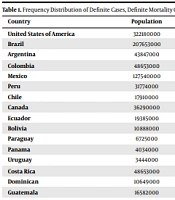
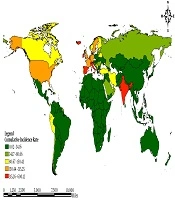
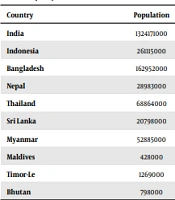
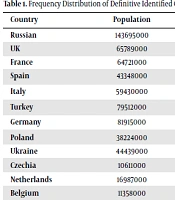
This research analyzed the data from 205 countries, categorized as temperate or tropical, as provided by the World Population Review (5). Ninety-three tropical countries were analyzed, corresponding to 46% of the world’s population, and 112 temperate counties, corresponding to 53% of the world’s population. This means that 99% of the world’s population was ably represented in this research. The sample used here was sufficient to be considered as a confident representation of the situation. The detailed list of the considered temperate countries is provided in Appendixes 1 and 2 in Supplementary File.
3. Results
3.1. Countries Which Have Not Featured any Cases
By April 5, 2020, only 26 countries had not recorded any COVID-19 cases and hence were not analyzed in this research. The details are provided in Appendix 3 in Supplementary File, which shows these countries categorized as temperate or tropical.
3.2. Cases and Deaths
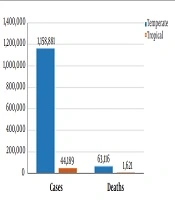
There were 1,203,058 confirmed cases of COVID-19 and 64,743 deaths. A summary is presented in Figure 1, which shows the number of cases and deaths as compared between temperate and tropical countries. It was observed that 96% of the cases occurred in the temperate regions and only 4% featured in the tropics. Besides, as many as 97.5% of the total deaths occurred in the temperate countries and only 2.5% in the tropics. Figure 1 shows that much as the cases were increasing exponentially among the temperate countries, it was not the case in the tropics.

Figure 1.
COVID-19 cases and deaths
3.3. Duration with the Disease
It is noticed that the temperate countries have spent more time with the virus in circulation than the tropical ones. On average, the tropical countries have spent 25 days with the disease, while temperate countries have spent 37 days.
The tropical countries with the highest number of days with the disease include Thailand (83 days, 2,169 infections, and 23 deaths), Singapore (79 days, 1189 infections, and six deaths), and Malaysia (79 days, 3,483 infections, and 57 deaths). The temperate countries with the highest number of days with the disease are China (126 days, 81,669 infections, and 3,329 deaths) and Japan (80 days, 3,851 infections, and 88 deaths), and South Korea (76 days, 10,237 infections, and 183 deaths).
These figures show that COVID-19 was introduced to tropical countries much later and it presented far fewer rates of infection and death.
3.4. Rate of Infection
The 10 most infected (and affected) countries of both tropical and temperate climates are analyzed here. The 10 most affected temperate countries, measured by the number of infections in order of infection included the USA, Spain, Italy, Germany, France, China, Iran, UK, Turkey, and Switzerland. The 10 most affected tropical countries in order of infection included Brazil, India, Malaysia, Ecuador, the Philippines, Thailand, Indonesia, Mexico, Panama, and Peru.
The incidences in both categories are compared in Figure 2. It is seen that the worst affected tropical countries have an almost constant low infection rate, while the temperate ones have an exponential rate of infection.

Figure 2.
The trend of infection among 10 most affected countries
3.5. Peak Seasons
Our findings revealed that for both categories of countries, the COVID-19 incidence presented two peak seasons. Figure 3 illustrates how the first peak season of infection happened 31 - 40 days after the first incidence, while the next peak season occurred between 61 and 70 days. The second peak season was slightly less aggressive than the first one.

Figure 3.
Number of cases during 100 days
3.6. Behavior Over Time
Figure 4 shows the prevalence of the disease when compared against the duration it spent within a country. The x-axis represents the number of COVID-19 cases registered in a country binned per 10 days. Figure 4 shows clearly that whereas the temperate countries experienced huge spikes in cases between 31 and 70 days, the case is not the same for the tropical countries that presented a nearly flat curve with a slightly non-dramatic increase.

Figure 4.
Cases versus numbers of days a country had the disease
3.7. Comparison of Countries with the Disease for Over 60 Days
Only 24 countries have had the disease for more than 60 days. The tropical countries with the longest period with COVID-19 are India, the Philippines, Vietnam, Malaysia, Singapore, and Thailand. The temperate countries with the longest period with COVID-19 are Belgium, Spain, UK, Sweden, Russia, Italy, Finland, UAE, Germany, Sri Lanka, Canada, Australia, Nepal, Macao, Taiwan, South Korea, Japan, and China. The number of deaths registered during this period for tropical countries adds up to 329 while it is 38,677 for deaths in temperate countries. The deaths in tropical countries accounted for less than one percent (0.85% to be precise) that of the temperate zones.
3.8. Severity of the Disease
We define the severity of COVID-19 (S) as the total number of cases per one million people. The reasoning behind using this definition of the severity is because it is a more accurate description of how widely the disease has spread among people in a country. This is more accurate than a simple count of confirmed cases because, for example, 10 affected people in a country of 1,000,000 is not as severe as 10 affected people in a country of 100. Therefore,
S, severity; N, total number of cases; P, population.
The computation of the severity for all countries was analyzed, which revealed that the average severity of COVID-19 was 608.3 in temperate countries and 101.7 in tropical countries. The results showed that the severity (how severe the disease is) was six times more for temperate countries than for tropical ones. Appendixes 1 and 2 in Supplementary File provide details on the severity in all the other countries considered.
The worst affected countries that needed dare interventions included San Marino, Andorra, and Luxembourg. Note that although San Marino has few cases, they are too many relative to the total number of its inhabitants. That is why it has emerged as the most severely hit country in the whole world. Table 1 provides details on the 10 most severely hit countries in both categories.
Table 1.
The Top 10 Countries in Terms of Severity
| Country | Cases | Population | Severity |
|---|---|---|---|
| Temperate | |||
| San Marino | 259 | 33,931 | 7633.1 |
| Andorra | 466 | 77,265 | 6031.2 |
| Luxembourg | 2,729 | 625,978 | 4359.6 |
| Iceland | 1,417 | 341,243 | 4152.5 |
| Faeroe Islands | 181 | 48,863 | 3704.2 |
| Gibraltar | 98 | 33,691 | 2908.8 |
| Spain | 126,168 | 46,754,778 | 2698.5 |
| Tropical | |||
| Montserrat | 6 | 4,992 | 1201.9 |
| Saint Martin | 29 | 38,666 | 750.0 |
| Saint Barthelemy | 6 | 9,877 | 607.5 |
| Aruba | 64 | 106,766 | 599.4 |
| Cayman Islands | 35 | 65,722 | 532.5 |
| Mayotte | 134 | 272,815 | 491.2 |
| Panama | 1801 | 4,314,767 | 417.4 |
| Martinique | 145 | 375,265 | 386.4 |
| Reunion | 334 | 895,312 | 373.1 |
| Guadeloupe | 134 | 400,124 | 334.9 |
4. Discussion
This research showed that the countries nearer to the equator were affected quite differently from those far from it. The incidences in the tropics were far much fewer, and the deaths were less than 3% of the total deaths occurring from COVID-19. This is consistent with the practice of flu-related diseases that kill far fewer people in the tropics, which is not the case in the non-tropics. More research is needed to identify the actual ingredient within the tropics that does not favor the COVID-19 virus.
Also, the spread of the disease in temperate regions grew exponentially while it was almost constantly low in the tropics. Therefore, measures to be adopted between the two regions do not need to be the same. Countries in the tropics do not need to completely shut down their economies with harsh measures, and yet harsh measures are needed in the temperate countries.
This research, therefore, proposes a modification of the recommended measures of tackling COVID19, which put into consideration the risks/opportunities presented based on a country’s distance from the equator.
A) Borders: Close the borders of temperate countries until the situation improves. The ones for tropical countries can remain open for visitors from temperate regions and quarantine from tropical countries.
B) Quarantine: Isolate everyone in temperate countries from the public for 14 days or until a vaccine/cure is found. In tropical countries, isolate only infected people from the public for 14 days.
C) Economic activities: Close non-essential businesses and economic or social activities in temperate countries but do not shut down economies for the tropical countries. Instead, let people continue working and schools remain open. Set special rules for high-risk areas like airports and quarantine centers.
D) Lockdown: In tropical countries, minimize movement of people on the streets, between towns, or public gatherings. Movements in tropical countries should be allowed within the country, with heightened measures set by health professionals, etc.
E) Personal hygiene: For both countries, maintain personal hygiene and diet. Eat more vitamins and a balanced diet, wash hands with soap/sanitizers, etc.
F) Sunshine therapy: Encourage people to spend enough time in the sun or outdoors.
G) COVID-19 hospitals: Build special hospitals or isolation centers for sufferers of the disease in temperate countries. No need to build special COVID-19 hospitals in tropical countries. The regular health centers can be used, with special sections cordoned off for COVID-19 patients and suspects.
H) Social distancing: Maintain a distance of at least one meter between people.
I) Research funding: Fast track research funding for publications on COVID-19 until a vaccine or cure is found.
J) Online services: Shift to e-services and m-services, e.g. e-learning for schools, online shopping, mobile banking, etc.
4.1. Conclusions
This paper quantified the severity of COVID-19 in tropical and temperate countries. The severity of the disease in terms of infection or death was six times more for countries located in the temperate region. Infections in tropical countries accounted for only 4% of global infections with even fewer deaths (2.5%). Moreover, the behavior of the disease varied over time, depending on whether a country lied in the tropical or temperate region. The disease presented multiple peak seasons of infection; thus, countries should not relax when they notice the first slowness in infections.
The research proposes amendments to the strategies used to combat the disease, depending on the risks associated with distance from the equator. This is for some countries to avoid unnecessarily undertaking extreme or light measures to fight the disease.