
1. Background
Globally, blood transfusion is a critical therapeutic tool in modern medicine, saving millions of patients from death and morbidity annually. However, it can be a potential source for transmission of many life-threatening infectious agents (1). Safety of blood and blood products is considered a measure of community health. Variations in the spread of infections among blood donors could reflect changes in common risk factors in the general population (2). The most common viruses transmitted through the contaminated blood and blood components include hepatitis B virus (HBV), hepatitis C virus (HCV), human immunodeficiency virus (HIV), and human T-cell leukemia virus type 1 (HTLV-1) (3, 4).
The prevalence of the mentioned viral infections among blood donors varies geographically and demographically and depends on the prevalence of the viruses in the community, as well (5). Globally, approximately 560 million people are chronically infected with HCV, HBV, or HIV infections (6). Based on the World Health Organization (WHO) reports, the prevalence of HBV, HCV, and HIV infections among blood donors from different parts of the world ranges 0.008% to 6.08%, 0.004% to 1.96%, and 0.0004% to 2%, respectively (7). The overall prevalence of these three viral infections was reported to be 0.7%, 0.5%, and 0.004%, respectively, among Iranian blood donors (8-10). In many countries, a significant decrease in the transmission of these viruses occurred when some measures were taken including the meticulous pre-transfusion serological screening of donated blood and the exclusion of high-risk groups from blood donation (1, 11). To minimize the risk of transfusion-transmitted infections (TTIs), several blood safety strategies are applied at Iranian blood transfusion centers. These include donor selection by uniform regulations and standards, removal of replacement donation, self-deferral procedure, confidential unit exclusion, the use of high-sensitive screening and precise confirmatory lab tests, implementation of efficient callback and look-back systems, and regular inspections by internal and external supervisors (12, 13).
Mashhad city, the capital of Razavi Khorasan province in the northeast of Iran, annually attracts more than 20 million tourists and pilgrims (14). Some pilgrims donate their blood voluntarily during their pilgrimage, which may affect the prevalence of TTIs among the blood donors in the city. Furthermore, the prevalence of HTLV-1 infection has been reported to be high in this city (15). To the best of our knowledge, there is no report on the prevalence of blood-borne viruses among pilgrims from Mashhad.
2. Objectives
This study was designed to compare the prevalence of HBV, HCV, HIV, and HTLV-1 infections between donors from Mashhad and those from other cities of Iran referring to blood transfusion centers of the city. The findings of this survey could help make more effort for lowering the risk of blood-borne infections in transfusion settings.
3. Methods
In this cross-sectional study, we reviewed the records of 58049 individuals referring to one of the fixed and mobile blood centers in Mashhad in 2011. The participants were classified into two groups. Group 1 included residents defined as people who were living in Mashhad at the time of blood donation and group 2 comprised pilgrims defined as people who lived in cities other than Mashhad at that time. A first-time donor was defined as a person who successfully donated blood for the first time and had no history of a previous donation. A regular donor was defined as a person who donated blood at least twice during the past year. A repeated donor was someone whose previous donation was more than one year ago.
The donors’ demographic characteristics such as age, sex, residency, education level, date, and frequency of blood donations were entered in the information sheets. Furthermore, the results of initial and confirmatory tests for HBV, HCV, HIV, and HTLV-1 were extracted from an electronic database in the Regional Blood Transfusion Office of Razavi Khorasan in Mashhad, Iran. The screening test for HBV was initially performed with the ELISA kit to detect hepatitis B surface antigen (HBsAg) (Siemens, Germany) and then confirmed by the neutralization test (Siemens, Germany). The positive results of ELISA tests for antibodies against HCV (Hepanostika, China), HIV-1/2 (Biomerieux, France), and HTLV-1/2 (Adaltis, Italy) verified by western blot (WB) tests (MP Diagnostics, Singapore). To detect all the four viruses, ELISA tests were conducted in duplicate based on the manufacturers’ recommendations.
This study was approved by the research and technology deputy of Academic Center for Education, Culture and Research (ACECR), Razavi Khorasan Branch, Mashhad, Iran, regarding methodological and ethical issues (No. 91.48.2585). Data were described using the Microsoft Excel 2010 software and Epi-Info version 6 software. Since the data of all blood donors were included, there was no need to use any statistical test to determine the difference between the two study groups.
4. Results
The mean age of 58049 blood donors was 34.5 ± 9.9 years (range: 16 - 69). One person from overseas and eight from Iran with unknown residence were excluded from further analysis. Finally, 58040 donors were included in the study, comprising 42821 inhabitants of Mashhad city (73.8%) and 15219 people living in other cities of the country (26.2%). There was no difference between the mean age of residents and pilgrims (34.6 ± 9.9 and 34.2 ± 10 years, respectively). The male to female ratio was 13.1 and 6.6 in the two groups, respectively. Table 1 shows the distribution of demographic and blood donation data in the two groups.
Table 1.
Comparison of the Demographic Variables and Blood Donation Data in Residents and Pilgrims of Mashhada
| Variables | Residents | Pilgrims |
|---|---|---|
| Sex | ||
| Male | 39776 (92.2) | 13207 (68.8) |
| Female | 3045 (7.1) | 2012 (13.2) |
| Age, y | ||
| < 20 | 1034 (2.4) | 482 (3.2) |
| 20 - 29 | 14476 (33.8) | 5340 (35.1) |
| 30 - 39 | 14212 (33.2) | 4705 (30.9) |
| 40 - 49 | 9154 (21.4) | 3316 (21.8) |
| 50 - 59 | 3701 (8.6) | 1321 (8.7) |
| ≥ 60 | 244 (0.6) | 55 (0.4) |
| Education level | ||
| Elementary to high school | 12421 (29.0) | 5917 (38.9) |
| Diploma | 13776 (32.2) | 6867 (45.1) |
| Academic | 16624 (38.8) | 2435 (16.0) |
| Type of denotation | ||
| First-time | 14358 (33.5) | 9143 (60.1) |
| Repeated | 11667 (27.3) | 3008 (19.8) |
| Regular | 16796 (39.2) | 3068 (20.2) |
aValues are expressed as No. (%).
4.1. Prevalence of Viral TTIs Among Residents and Pilgrims
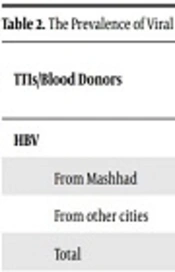
Table 2 shows the prevalence of viral TTIs among blood donors according to their residency. The most common infections among all donors were HBV and HTLV-1 (427 and 350 per 100000 population, respectively). Furthermore, the prevalence of HCV infection was as low as 59 per 100000 population. Only was one HIV-positive patient identified among all blood donors whose residence was in Mashhad. As Table 2 shows, the prevalence of HBV and HCV infections in residents (329 and 54 per 100,000 population, respectively) was lower than that in pilgrims (565 and 72 per 100,000 population, respectively). Conversely, the frequency of HTLV-1 infection in the first group (390 per 100,000 population) was higher than that in the second group (237 per 100,000 population). The prevalence of HTLV-1 and HBV infections was considerably higher among 5177 pilgrims from Razavi Khorasan province (560 and 850 per 100,000 population, respectively) than among 10042 pilgrims from other provinces of Iran (70 and 418 per 100,000 population, respectively). However, the frequency of HCV infection was lower among blood donors from Razavi Khorasan (39 per 100,000 population) than among donors from other provinces (90 per 100,000 population). As expected, most cases with TTIs were observed among first-time blood donors in both residents and pilgrims. Only were 10 seropositive cases from Mashhad, including five HBV, two HCV, and three HTLV-1 positive persons, found to be repeated or regular donors. Moreover, six pilgrims, including four HBV, one HCV, and one HTLV-1 positive individuals, were repeated or regular donors.
Table 2.
The Prevalence of Viral Transfusion-Transmitted Infections Among 58040 Iranian Blood Donors (42821 from Mashhad and 15219 from Other Cities)
| TTIs/Blood Donors | Positive Double ELISA Test | Confirmatory Test | Prevalence (per 100000 Population) | ||
|---|---|---|---|---|---|
| Negative | Indeterminate | Positive | |||
| HBV | |||||
| From Mashhad | 174 | 30 | 3 | 141 | 329 |
| From other cities | 100 | 12 | 2 | 86 | 565 |
| Total | 274 | 42 | 5 | 227 | 427 |
| HCV | |||||
| From Mashhad | 120 | 63 | 34 | 23 | 54 |
| From other cities | 57 | 35 | 11 | 11 | 72 |
| Total | 177 | 98 | 45 | 34 | 59 |
| HIV | |||||
| From Mashhad | 54 | 39 | 14 | 1 | 2 |
| From other cities | 23 | 21 | 2 | 0 | 0 |
| Total | 77 | 60 | 16 | 1 | 2 |
| HTLV-1 | |||||
| From Mashhad | 316 | 116 | 33 | 167 | 390 |
| From other cities | 83 | 37 | 10 | 36 | 237 |
| Total | 399 | 154 | 43 | 203 | 350 |
Abbreviations: HBV, hepatitis B virus; HCV, hepatitis C virus; HIV, human immunodeficiency virus; HTLV-1, human T-cell leukemia virus type 1; TTIs, transfusion-transmitted infections.
5. Discussion
This survey provides the first report on the seroprevalence of viral blood-borne infections among donors from Mashhad and those from other cities of Iran referring to the blood centers of Mashhad in 2011. The current study revealed that the frequency of HTLV-1 infection was much higher among the donor population in Mashhad than that of other cities. This finding is in agreement with the previous reports on the HTLV endemicity in the region (16, 17). Our previous study (2009) demonstrated that the prevalence of HTLV infection was 2.2% in the general population of Mashhad (15). However, a recent survey exhibited a declining trend in the prevalence of HTLV-1 infection among blood donors in Mashhad (18).
Our study revealed a relatively lower prevalence of HBV and HCV infections among Mashhad residents than among pilgrims. These differences can be mainly explained by the higher proportion of repeated and regular donors in the first group (66.5% vs. 40%). Indeed, these groups are more likely to be aware of viral TTIs and their transmission routes and have lower risk factors due to several screening tests in the process of blood donation (19). A retrospective study in Bushehr, the Southwest of Iran, indicated that the prevalence of HBV, HCV, and HIV infections was significantly higher in first-time blood donor volunteers than in regular donors (19).
The slightly lower frequency of hepatitis B and C viruses in donors from Mashhad could also be owing to the lower rate of these infections in the general population of Mashhad. Our previous studies demonstrated that the prevalence of HBV and HCV infections in Mashhad was somewhat lower than that in some other cities of the country (20, 21). Some epidemiologic surveys in other provinces reported similar prevalence rates for HCV infection (3, 19). In addition, a considerably higher rate of HBV infection was found among donors from provinces such as Golestan and Sistan and Baluchistan (1.61% and 1.53%, respectively). Consistently, a recent systematic review estimated the highest rate of HBV infection in the general population of these two provinces (6.1% and 3.4%, respectively) (22)
Regarding the HIV infection, the present study only found one seropositive case among donors from Mashhad. In a very recent study, Musavi et al. systematically reviewed 49 studies comprising 5403,170 donors, estimating the prevalence of HIV infection as low as 7.9 per 100,000 population among Iranian blood donors, with the lowest prevalence in Razavi Khorasan province (0.9 per 100,000 population) (23). Similarly, in the first population-based investigation on the general population of Mashhad, no positive case of HIV infection was identified (24).
The prevalence of viral blood-borne infections was much lower in Iran than in some countries such as India, Pakistan, Ethiopia, and Nigeria. This could be owing to the different incidence rates of risky behaviors among populations and different preventive measures including awareness programs, quality of donor recruitment, and screening strategies administered at blood transfusion centers (5, 19, 25-27).
5.1. Conclusions
Our study indicated a very low prevalence of TTIs, particularly HCV and HIV infections, among blood donors from all parts of Iran. A higher prevalence of HTLV-1 infection in Mashhad residents than in pilgrims and tourists from other parts of the country displays the endemicity of the virus in this area. Moreover, the fairly high prevalence of HBV and HCV among pilgrims than among residents could be partly explained by the higher percentage of first-time donors in the former group.