
1. Background
Since talented school students are expected to perform better than their peers, they are identified and selected based on specific criteria to benefit from special educational programs in schools for talented students (1). In Iran, talented students are also selected through an entrance exam to enter these types of schools. In these schools, which are called “the National Organization for Development of Exceptional Talents (SAMPAD)” in Iran, efforts are made to select and employ educational and administrative staff from individuals with higher abilities. The level of SAMPAD schools is higher than regular schools in terms of the environment, facilities, homework, educational programs, and extracurricular activities (2-4). This difference can sometimes impose stress on students in these schools. In addition, the psychological pressures related to the entrance and periodic exams of these schools should also be mentioned (5-9).
Undoubtedly, the specificity of talented students in such schools and presence in a particular school environment, despite all its advantages, is not without challenges and accompanies some considerations that should not be neglected (1). Maintaining and promoting the mental health of these students is one of the most important considerations. According to the definition by the World Health Organization, mental health includes “the feeling of well-being” that enables individuals to identify their abilities and adapt to the usual stresses of life and work to build their community (10).
A considerable percentage of school-age children and adolescents have signs and symptoms of mental health problems; therefore, the prevalence of serious problems among them has been estimated to be 3 - 18% (11, 12). Unfortunately, in some cases, the parents and educators of students at home and school cannot make accurate judgments about the possible presence of these problems in adolescents; therefore, a large number of these students do not receive adequate help to solve such problems (5, 7, 13-16). These problems can be classified and identified in the form of emotional symptoms, conduct problems, hyperactivity/inattention, peer relationship problems, and prosocial behaviors (17, 18).
Emotional disorders are described as the exacerbated and abnormal manifestations of the adolescent’s feelings and emotions toward his/her age of development, such as fear, anxiety, and sadness. Conduct problems are recurring and persistent patterns of behavior in which the fundamental rights of others or basic social norms and regulations relative to his/her age are violated. Hyperactivity/inattention is the same as restlessness and lack of concentration. Prosocial behaviors are related to the adolescent’s interaction or relationship with others in the family and his/her relationship outside the home, especially with peers and classmates (17, 18).
In order to correctly analyze and interpret the epidemiological data of any disease or community health-related condition, attention to gender differences is considered inevitable (19). Gender differences can also be important in mental health status (20). Mental health problems in talented school students can also be affected by gender. There is not much information about the mental health status of SAMPAD school students, with an emphasis on the difference between male and female students in Iran.
2. Objectives
This study was conducted to determine the prevalence of mental health problems in Iranian students studying in junior high schools in one of the country’s provinces, aiming to identify the most vulnerable groups of Iranian adolescents in terms of mental health problems with an emphasis on the difference between boys and girls. Paying attention to gender differences in planning to promote the mental health of this group of adolescents can help make interventions more targeted and further improve their results.
3. Methods
The study population of this cross-sectional (descriptive-analytical) study consisted of male and female students aged 12 - 15 years, in the seventh, eighth, and ninth grades studying in SAMPAD schools of Semnan province, Iran, within the academic year of 2019 - 2020. Sampling was performed by the stratified-cluster random method among all students of these schools. Gender and educational grade were considered the categories; each classroom was considered a cluster, and six classrooms were randomly selected, taking into account the defined categories (three classes from female schools and three classes from male schools; two classes from each grade). Moreover, all students present in the class were included in the study if they and their parents agreed. Given the prevalence of mental health problems in adolescents equal to 20% with 10% accuracy, the minimum sample size was estimated to be 125 individuals, assuming a 95% confidence interval (CI), 80% power, and the number 2 as the design effect.
The tool used to assess students’ mental health was the standardized Persian version of the Strengths and Difficulties Questionnaire (SDQ) related to adolescence, which is used to screen mental health problems in 11-17-year-old adolescents. This questionnaire consists of 25 items, with five areas of emotional problems, conduct problems, hyperactivity/inattention disorder, peer relationship problems, and prosocial behaviors. The SDQ contains the student, parent, and teacher versions. For each item, the individual can choose the option “Not true”, “definitely true”, or “slightly true.” The student (in the classroom) and parents (at home) versions were used in the present study. Each item is given a score of 0, 1, or 2. The total score is the sum of the scores of the first four subgroups (except prosocial behaviors); accordingly, the score of the problems ranges from 0 to 40, and the score of prosocial behaviors is determined separately from 0 to 10. The sensitivity and specificity of this scale are very high, so that, according to studies, the prevalence of mental health problems determined based on this questionnaire is shown to be only 1 - 2% different from their actual prevalence (17). The validity and reliability of the questionnaire for the Iranian population have been confirmed (18, 21-23). This questionnaire has also been used in several studies in Iran (24, 25).
The SDQ was completed by students and their parents, and demographic information, including place of residence (city/village), parents’ education and occupation, and adequacy of family income, was completed by the parents themselves. Data analysis was performed using SPSS software (version 24). In addition to reporting the students’ frequency distribution in terms of baseline and demographic characteristics, the relative frequency of mental health problems was reported by number and percentage after converting the scores into diagnostic codes in the studied subgroups. Wald’s method was used to calculate the CI. Analysis was performed using the Spearman correlation coefficient, chi-square test, Fisher’s exact test, and Mann-Whitney U test at a 95% confidence level.
This study had the approval and ethics code of Semnan University of Medical Sciences. The presence of researchers in the school environment occurred after obtaining the necessary permits and coordination with the General Department of Education and the offices of Semnan province, and the school principal. All collected information was confidential, and participation in the project was completely free. The students and their parents participated in the study only if they had conscious willingness and consent.
4. Results
Out of 125 eligible students, 112 subjects studying in junior high schools in schools for talented students of Semnan province completed the questionnaires (response rate: 89.6%). Among them, 52 (46.4%) and 60 (53.6%) subjects were boys and girls, respectively (mean age: 14.0 ± 0.8 years). The numbers of students participating in the seventh, eighth, and ninth grades were 37, 37, and 38, respectively. Of the total participants, 44 students (39.3%) were studying in schools in the city of Semnan (i.e., the capital of the province). Furthermore, 109 students lived in the city, and only 3 students (2.7%) lived in the rural areas of the province. Table 1 shows the frequency distribution of the students participating in the study regarding the baseline and demographic characteristics.
Table 1.
Frequency Distribution of Students Participating in the Study in Terms of Baseline and Demographic Characteristics
| Characteristics | No. (%) | Characteristics | No. (%) |
|---|---|---|---|
| City | Father’s job | ||
| Semnan (province center) | 44 (39.3) | Office employee | 58 (51.8) |
| Shahroud | 35 (31.2) | Manual worker | 7 (6.3) |
| Damghan | 14 (12.5) | Farmer/rancher | 3 (2.7) |
| Garmsar | 19 (17.0) | Shopkeeper | 17 (15.1) |
| Grade | Retired | 10 (8.9) | |
| 7 | 37 (33.0) | Unemployed | 2 (1.8) |
| 8 | 37 (33.0) | Other occupations | 15 (13.4) |
| 9 | 38 (34.0) | Mother’s education | |
| Age, y | High school | 13 (11.6) | |
| 12 | 8 (7.1) | Diploma | 24 (21.4) |
| 13 | 15 (13.4) | Associate degree | 7 (6.3) |
| 14 | 54 (48.2) | Bachelor’s degree | 54 (48.2) |
| 15 | 35 (31.3) | Master’s degree | 11 (9.8) |
| Gender | Doctorate | 3 (2.7) | |
| Male | 52 (46.4) | Mother’s job | |
| Female | 60 (53.6) | Housewife | 72 (64.3) |
| Habitation | Employed | 40 (35.7) | |
| Urban | 109 (97.3) | Adequacy of income | |
| Rural | 3 (2.7) | More than needed | 17 (15.2) |
| Father’s education | As much as necessary | 62 (55.3) | |
| High school | 8 (7.1) | Enough with thrift | 30 (26.8) |
| Diploma | 22 (19.6) | Insufficient | 3 (2.7) |
| Associate degree | 7 (6.3) | Birth rank | |
| Bachelor’s degree | 35 (31.3) | 1 | 69 (61.6) |
| Master’s degree | 34 (30.4) | > 1 | 43 (38.4) |
| Doctorate | 6 (5.3) |
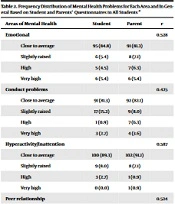
Table 2 shows the frequency distribution of mental health problems for each area and, generally, based on student and parents’ questionnaires in all students (without gender segregation). A positive and significant correlation was observed between mental health status in general (r = 0.627) and all areas (r within 0.313 - 0.587) between the student and parents’ questionnaires (P < 0.001). As shown in Table 3, the near-normal status based on student and parents’ questionnaires is 80.4% and 85.7%, respectively, explaining the prevalence of degrees of mental health problems equal to 19.6% (95% CI: 12.3 - 27.0%) and 14.3% (95% CI: 7.8 - 20.8%) in them, respectively.
Table 2.
Frequency Distribution of Mental Health Problems for Each Area and In General Based on Student and Parents’ Questionnaires in All Students a
| Areas of Mental Health | Student | Parent | r |
|---|---|---|---|
| Emotional | 0.528 | ||
| Close to average | 95 (84.8) | 91 (81.3) | |
| Slightly raised | 6 (5.4) | 8 (7.1) | |
| High | 5 (4.5) | 7 (6.3) | |
| Very high | 6 (5.3) | 6 (5.3) | |
| Conduct problems | 0.425 | ||
| Close to average | 91 (81.3) | 92 (82.1) | |
| Slightly raised | 17 (15.2) | 9 (8.0) | |
| High | 1 (0.9) | 7 (6.3) | |
| Very high | 3 (2.6) | 4 (3.6) | |
| Hyperactivity/inattention | 0.587 | ||
| Close to average | 100 (89.3) | 102 (91.1) | |
| Slightly raised | 9 (8.0) | 8 (7.1) | |
| High | 3 (2.7) | 1 (0.9) | |
| Very high | 0 (0.0) | 1 (0.9) | |
| Peer relationship | 0.524 | ||
| Close to average | 62 (55.4) | 77 (68.8) | |
| Slightly raised | 22 (19.6) | 17 (15.2) | |
| High | 14 (12.5) | 9 (8.0) | |
| Very high | 14 (12.5) | 9 (8.0) | |
| Prosocial behavior | 0.313 | ||
| Close to average | 93 (83.0) | 89 (79.5) | |
| Slightly lowered | 10 (8.9) | 6 (5.4) | |
| Low | 7 (6.3) | 9 (8.0) | |
| Very low | 2 (1.8) | 8 (7.1) | |
| Overall mental health | 0.627 | ||
| Close to average | 90 (80.3) | 96 (85.7) | |
| Slightly raised | 13 (11.6) | 9 (8.0) | |
| High | 5 (4.5) | 4 (3.6) | |
| Very high | 4 (3.6) | 3 (2.7) |
a Values are expressed as No. (%). r: Spearman correlation coefficient (P < 0.001 for all)
Table 3 shows the comparison of students’ personal characteristics between the two genders. As shown in Table 3, there is no significant difference between girls and boys in terms of baseline and demographic characteristics.
Table 3.
Comparison of Students’ Baseline and Demographic Characteristics between the Two Genders
| Characteristics | Gender | P-Value | |
|---|---|---|---|
| Male (n = 52), No. (%) | Female (n = 60), No. (%) | ||
| City | 0.868 a | ||
| Semnan (province center) | 20 (38.5) | 24 (40.0) | |
| Other cities | 32 (61.5) | 36 (60.0) | |
| Grade | 0.136 | ||
| 7 | 20 (38.5) | 17 (28.3) | |
| 8 | 18 (34.6) | 19 (31.7) | |
| 9 | 14 (26.9) | 24 (40.0) | |
| Age, y | 0.963 | ||
| 12 | 4 (7.7) | 4 (6.7) | |
| 13 | 7 (13.5) | 8 (13.3) | |
| 14 | 26 (50.0) | 28 (46.7) | |
| 15 | 15 (28.8) | 20 (33.3) | |
| Habitation | > 0.999 b | ||
| Urban | 51 (98.1) | 58 (96.7) | |
| Rural | 1 (1.9) | 2 (3.3) | |
| Father’s education | 0.731 a | ||
| High school | 15 (28.3) | 15 (25.4) | |
| University | 38 (71.7) | 44 (74.6) | |
| Father’s job | 0.190 a | ||
| Employed | 48 (94.1) | 52 (86.7) | |
| Unemployed/retired | 3 (5.9) | 8 (13.3) | |
| Mother’s education | 0.838 a | ||
| High school | 17 (32.1) | 20 (33.9) | |
| University | 36 (67.9) | 39 (66.1) | |
| Mother’s job | 0.339 a | ||
| Housewife | 31 (59.6) | 41 (68.3) | |
| Employed | 21 (40.4) | 19 (31.7) | |
| Adequacy of income | 0.629 c | ||
| More than needed | 5 (9.6) | 12 (20.0) | |
| As much as necessary | 36 (69.2) | 26 (43.3) | |
| Enough with thrift | 9 (17.3) | 21 (35.0) | |
| Insufficient | 2 (3.9) | 1 (1.7) | |
| Birth rank | 0.783 a | ||
| 1 | 31 (60.8) | 38 (63.3) | |
| > 1 | 20 (39.2) | 22 (36.7) | |
a Chi-square test
b Fisher’s exact test
c Mann-Whitney U test
Table 4 shows the frequency distribution of mental health problems in general and for each area, based on the student questionnaire by gender. As shown in Table 4, based on the questionnaire completed by the students themselves, the percentage of problems related to the lack of prosocial behaviors in female students is significantly higher than in male students (25% compared to 7.7%). The comparison between the two genders did not show any differences between other areas and the general status.
Table 4.
Frequency Distribution of Mental Health Status Based on the Student Questionnaire by Gender a
| Areas of Mental Health (Student Questionnaire) | Gender | P-Value | |
|---|---|---|---|
| Male | Female | ||
| Emotional | 0.143 | ||
| Close to average | 47 (90.4) | 48 (80.0) | |
| Slightly raised | 2 (3.8) | 4 (6.7) | |
| High | 0 (0.0) | 5 (8.3) | |
| Very high | 3 (5.8) | 3 (5.0) | |
| Conduct problems | 0.216 | ||
| Close to average | 40 (76.9) | 51 (85.0) | |
| Slightly raised | 8 (15.4) | 9 (15.0) | |
| High | 1 (1.9) | 0 (0.0) | |
| Very high | 3 (5.8) | 0 (0.0) | |
| Hyperactivity/inattention | 0.338 | ||
| Close to average | 48 (92.3) | 52 (86.7) | |
| Slightly raised | 3 (5.8) | 6 (10.0) | |
| High | 1 (1.9) | 2 (3.3) | |
| Very high | 0 (0.0) | 0 (0.0) | |
| Peer relationship | 0.486 | ||
| Close to average | 28 (53.8) | 34 (56.7) | |
| Slightly raised | 8 (15.4) | 14 (23.3) | |
| High | 8 (15.4) | 6 (10.0) | |
| Very high | 8 (15.4) | 6 (10.0) | |
| Prosocial behaviors | 0.017 | ||
| Close to average | 48 (92.3) | 45 (75.0) | |
| Slightly lowered | 2 (3.9) | 8 (13.3) | |
| Low | 1 (1.9) | 6 (10.0) | |
| Very low | 1 (1.9) | 1 (1.7) | |
| Overall mental health | 0.655 | ||
| Close to average | 41 (78.8) | 49 (81.7) | |
| Slightly raised | 6 (11.5) | 7 (11.7) | |
| High | 2 (3.8) | 3 (5.0) | |
| Very high | 3 (5.8) | 1 (1.7) | |
a Values are expressed as No. (%). P-value: Mann-Whitney U test
Table 5 shows the frequency distribution of mental health problems in general and for each area, based on parents’ questionnaire by gender. As shown in Table 5, based on the questionnaire completed by the parents, the percentage of problems related to the lack of prosocial behaviors in female students is still significantly higher than in male students (31.7% compared to 7.7%). In addition, according to the parents’ questionnaire, the frequency of conduct problems was higher in boys than in girls (26.9% compared to 10%). Again, the comparison of the two genders showed no difference between other areas and the general status.
Table 5.
Frequency Distribution of Mental Health Status Based on Parents’ Questionnaire by Gender a
| Areas of Mental Health (Parents’ Questionnaire) | Gender | P-Value | |
|---|---|---|---|
| Male | Female | ||
| Emotional | 0.622 | ||
| Close to average | 43 (82.7) | 48 (80.0) | |
| Slightly raised | 5 (9.6) | 3 (5.0) | |
| High | 2 (3.8) | 5 (8.3) | |
| Very high | 2 (3.8) | 4 (6.7) | |
| Conduct problems | 0.026 | ||
| Close to average | 38 (73.1) | 54 (90.0) | |
| Slightly raised | 7 (13.5) | 2 (3.3) | |
| High | 5 (9.6) | 2 (3.3) | |
| Very high | 2 (3.8) | 2 (3.3) | |
| Hyperactivity/inattention | 0.285 | ||
| Close to average | 49 (94.2) | 53 (88.3) | |
| Slightly raised | 2 (3.8) | 6 (10.0) | |
| High | 1 (1.9) | 0 (0.0) | |
| Very high | 0 (0.0) | 1 (1.7) | |
| Peer relationship | 0.521 | ||
| Close to average | 38 (73.1) | 39 (65.0) | |
| Slightly raised | 5 (9.6) | 12 (20.0) | |
| High | 4 (7.7) | 5 (8.3) | |
| Very high | 5 (9.6) | 4 (6.7) | |
| Prosocial behaviors | 0.001 | ||
| Close to average | 48 (92.3) | 41 (68.3) | |
| Slightly lowered | 2 (3.8) | 4 (6.7) | |
| Low | 2 (3.8) | 7 (11.7) | |
| Very low | 0 (0.0) | 8 (13.3) | |
| Overall mental health | 0.390 | ||
| Close to average | 43 (82.7) | 53 (88.3) | |
| Slightly raised | 5 (9.6) | 4 (6.7) | |
| High | 2 (3.8) | 2 (3.3) | |
| Very high | 2 (3.8) | 1 (1.7) | |
a Values are expressed as No. (%). P-value: Mann-Whitney U test
5. Discussion
Mental health problems, especially emotional and behavioral problems, in adolescents are one of the main concerns of experts, parents, and educators. Although these problems are not as severe as mental disorders, they interfere with adolescents’ mental performance and how they show reactions to their environment (26).
The results of previous studies confirm the presence of gender differences in terms of different age groups regarding mental health (27). This difference exists not only in the prevalence and occurrence of these problems but also in individuals’ willingness to raise the issue and their access to therapeutic or preventive interventions (28). Adolescence is a preliminary stage in increasing vulnerability to emotional and behavioral factors because the individual is building his/her identity. Emotional and behavioral problems are recognized as factors affecting the personal, educational, family, and social life of adolescents; accordingly, individuals who show emotional or behavioral symptoms during adolescence are more likely to subsequent developmental disorders in adulthood (29).
According to the results of the present study, the prevalence of mental health problems in junior high school students of SAMPAD schools was estimated at 19.6% and 14.3%, according to the student questionnaire and the parents’ questionnaire, respectively. Based on previous studies by the authors of this article, the prevalence of mental health problems in the students of public schools in Semnan province in the same age group was estimated at 28.8%, explaining a much lower prevalence of these problems in SAMPAD students (25). According to epidemiological studies conducted in Spain, 11.6 - 34.6% of Spanish adolescents showed emotional symptoms; nevertheless, 4.9 - 25.7% had behavioral problems (30). In BELLA’s study in Germany, the prevalence of psychological problems among 7-17-year-old adolescents was estimated at 14.5% (16). Another study in Germany estimated the overall prevalence of psychological disorders in the 3-16-year-old age group to be 18.5% (31). A similar study in the United Arab Emirates on 6-15-year-old students reported the prevalence of mental health-related problems to be 23.9% (32).
In the present study, there was a difference between girls and boys in prosocial behaviors according to both the student and the parents’ questionnaires. According to both scales, the lack of prosocial behaviors was higher in female students than in male students. Voluntarily benefiting others is the main purpose of prosocial behavior. For example, these behaviors manifest through generous sharing, cooperation with minorities, and help and consolation from peers (33). Adolescents who have more abilities in prosocial behaviors are less aggressive and get along better with their peers; therefore, they have better social and emotional well-being (34). Therefore, talented school girls need attention and reinforcement of prosocial behaviors.
In the present study, male students showed a higher prevalence of conduct problems than their female counterparts. Behaviors that manifest in this area include harm to humans, animals, and personal and public property and sometimes are even criminal. This gender difference has also been confirmed in previous studies. Previous studies have shown that conduct problems or disorders in adolescents and young adults peak within the age of 14 - 17 years and then decrease (35). In addition, studies have shown that conduct problems might accompany some psychiatric disorders or illnesses, such as depression (36). Since research has shown that male adolescents, compared to their female counterparts, are less likely to share their emotional or psychological problems with others, less likely to seek help from their parents or educators, or less likely to refer to counselors due to stigma (28), further attention should be paid to the implementation of screening programs and preventive interventions for this problem in boys studying in schools for talented students. Given that conduct disorders sometimes tend to become stable in the individual at older ages, these interventions become more important.
In the present study, the target population was privileged and talented adolescents. Research on talented school students is considered the most important strength of this study in terms of innovation. However, the limitation of the sample size should be considered the most critical shortcoming of this study. Semnan province is one of the least populated provinces in the country. Considering the small number of SAMPAD schools in the province and the relatively small number of students in these schools, the results should be generalized cautiously. Additionally, in this study, the teacher questionnaire was not used due to the large number of teachers and the impossibility of its distribution among all teachers in each class, which can be mentioned as another limitation.
5.1. Conclusions
In talented school students in Iran, girls regarding strengthening prosocial behaviors and boys regarding conduct problems require attention and effective action. Screening programs and holding periodic consultations to timely diagnose the problems mentioned above are recommended to SAMPAD school officials and parents of students in these schools.