Innovative Journal of Pediatrics
The Scientific Journal of Growth & Development Research Center
e-ISSN 3117-5341
Image Credit:Inn J Pediatr
Outline
Apparent Life-Threatening Events in Neonatal Period: Clinical Manifestations and Diagnostic Challenges in a Pediatric Referral Center
Authors
Leila Shahbaznejad1,*, Maliheh Kadivar2, Bahareh Yaghmaie3, Bahar Allahverdi4, Nosrat Razi5, Ziba Mosayebi6
Published online:Mar 21, 2013
Article type:Research Article
Received:Aug 12, 2012
Accepted:Mar 13, 2013
How to Cite:Shahbaznejad L, Kadivar M, Yaghmaie B, Allahverdi B, Razi N, et al. Apparent Life-Threatening Events in Neonatal Period: Clinical Manifestations and Diagnostic Challenges in a Pediatric Referral Center. Inn J Pediatr. 2013;23(4):. doi:
Abstract
Objective: Apparent Life-Threatening Events (ALTEs) is an episode that is frightening to the observer and is characterized by some combination of apnea, color change, altered muscle tone, choking, and gagging. This study was designed to evaluate and follow up neonates who presented with clinical manifestation of an ALTE in a year. Methods: In this prospective observational study, all of the neonates with episode of ALTE who were admitted to the Children’s Medical Center (CMC) in Tehran, from June 15th 2010 to May 14th 2011 were enrolled in the study. Data from patients consisting of history, physical examinations, and paraclinical findings were recorded in a checklist and all followed up 3 to 6 months after discharge. Findings: During the study period 18 neonates were admitted due to ALTE episode(s) with mean age of 15±13 days. Nine (50%) neonates had previous attacks of ALTE. The most frequent complaint was cyanosis in 12 (67%) and apnea in 8 (44%) patients. In 10 (56%) the event lasted less than one minute, 13 (72%) were awake, 17 (95%) in supine position and 13 (72%) on their parent’s lap. Primary antagonistic impression on admission was sepsis in 11 (61%) and concomitant seizure in 5 (28%). The most common final diagnosis according to repeated physical examinations, result of paraclinical investigations and follow up was sepsis 4 (22%) and aspiration 9 (50%). ALTE recurred in none of the neonates during follow up. Conclusion The rate of ALTE seems to be higher than in this study owing to high incidence of recurrent ALTE. Although most of these attacks regress spontaneously, more attention should be paid for the underlying diseases.
Highlights
References
- 1.References are available on the PDF.
Copyright
© 2013, Author(s). This open-access article is available under the Creative Commons Attribution 4.0 (CC BY 4.0) International License (https://creativecommons.org/licenses/by/4.0/), which allows for unrestricted use, distribution, and reproduction in any medium, provided that the original work is properly cited.
Similar Articles
18
Oct
2016
Assessing the Role of Clinical Manifestations and Laboratory Findings in Neonatal Sepsis
Masoumeh Hematyar,
Reza Najibpour,
Seyedehsara Bayesh,
Asal Hojjat,
Ali Farshad
Hematyar M, Najibpour R, Bayesh S, Hojjat A, Farshad A. Assessing the Role of Clinical Manifestations and Laboratory Findings in Neonatal Sepsis. Arch Pediatr Infect Dis. 2017;5(1):e29985. doi: https://doi.org/10.5812/pedinfect.29985
20
Jun
2021
Prediction of the Course of Transient Tachypnea of the Newborn by Blood Laboratory Parameters at the Time of Admission
Sadrettin Ekmen,
Erkan Doğan
Ekmen S, Doğan E. Prediction of the Course of Transient Tachypnea of the Newborn by Blood Laboratory Parameters at the Time of Admission. Inn J Pediatr. 2021;31(3):e112224. doi: https://doi.org/10.5812/ijp.112224
6
Mar
2016
Etiology and Clinical Outcomes of Neonatal and Pediatric Sepsis
Atmaram Pawar,
Asawari Raut,
Vijay Kalrao,
John Jacob,
Isha Godha,
Ritty Thomas
Pawar A, Raut A, Kalrao V, Jacob J, Godha I, et al. Etiology and Clinical Outcomes of Neonatal and Pediatric Sepsis. Arch Pediatr Infect Dis. 2016;4(2):e33602. doi: https://doi.org/10.5812/pedinfect.33602
6
Feb
2021
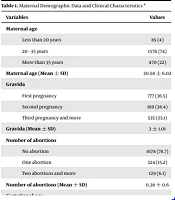
The Prevalence of Neonate Resuscitation and Some Related Factors in an Academic Center in the North of Iran
Mandana Mansour Ghanaie,
Zahra Rafiei Sorouri,
Farnoush Farzi,
Gelareh Biazar,
Reyhaneh Shahrokhi Rad,
Mohadese Ahmadi
,et al.Mansour Ghanaie M, Rafiei Sorouri Z, Farzi F, Biazar G, Shahrokhi Rad R, et al. The Prevalence of Neonate Resuscitation and Some Related Factors in an Academic Center in the North of Iran. J Compr Ped. 2021;12(1):e109316. doi: https://doi.org/10.5812/compreped.109316
31
Dec
2011
Assessment of Febrile Neonates According to Low Risk Criteria for Serious Bacterial Infection
Tahereh Rostami,
Mohammad Momtazbakhsh,
Houman Hashemian,
Marjaneh Zarkesh
Rostami T, Momtazbakhsh M, Hashemian H, Zarkesh M. Assessment of Febrile Neonates According to Low Risk Criteria for Serious Bacterial Infection. Inn J Pediatr. 2011;21(4):. doi:
Cited by
- Scopus by DOI: 0
Last Update: 1 week ago
- Scopus by Title: 1
Last Update: 1 week ago
- Scopus by Title (Ref): 1
Last Update: 1 week ago
- CrossRef: 0
Last Update: 4 hours ago
- OpenAlex: 0
Last Update: 7 hours ago
- OpenCitations: 0
Last Update: 5 days ago
Comments
Number of Comments:0