Innovative Journal of Pediatrics
The Scientific Journal of Growth & Development Research Center
e-ISSN 3117-5341
Image Credit:Inn J Pediatr
Outline
Paragonimiasis in Chinese Children: 58 Cases Analysis
Authors
Published online:Apr 25, 2012
Article type:Research Article
Received:Jun 07, 2011
Accepted:Apr 18, 2012
How to Cite:Fang Tang L, Zhen Xu H, Ping Zheng X, Min Chen Z. Paragonimiasis in Chinese Children: 58 Cases Analysis. Inn J Pediatr. 2012;22(4):. doi:
Abstract
Objective: To analyze the clinical and radiological features of paragonimiasis in children and raise the awareness of this disease.
Methods: A total of 58 paragonimiasis patients were reviewed. They were 42 boys and 16 girls aged 2.0 to 15.3 years.
Findings: Among these patients, 20 were diagnosed in the recent 5 years, 46 with a history of raw water or food ingestion. Except 2 patients without any complaint, the most common features involved the systemic (41, 70.7%) and respiratory systems (43, 74.1%), followed by abdominal, cardiac and nervous systems, with rash and mass. Eosinophilia was noted in 46 (79.3%) patients, granulocytosis in 45 (77.6%), anemia in 14 (24.1%), and thrombocytopenia in 3. Imageology showed pneumonia in 26 (44.8%) patients, pleurisy in 28 (48.3%), hydropericardium in 17 (29.3%), ascites in 16 (27.6%), and celiac lymphadenitis in 13 (22.4%). Besides hepatomegaly and splenomegaly, calcification and multiple lamellar low echogenic areas in the liver were noted, each in one patient. Abnormal brain imaging was noted in 4 of 10 patients. Karyocyte hyperplasia with eosinophilia was noted in all the 19 patients who received bone marrow puncture.
Conclusion: Paragonimiasis should be considered in the differential diagnosis of patients with multiple organs or system lesions, especially those with eosinophilia, serous cavity effusion, respiratory, cardiac, digestive system, nervous system abnormality, and/or mass. Healthy eating habit is helpful for paragonimiasis prevention.
Highlights
References
- 1.References are available on the PDF.
Copyright
© 2012, Author(s). This open-access article is available under the Creative Commons Attribution 4.0 (CC BY 4.0) International License (https://creativecommons.org/licenses/by/4.0/), which allows for unrestricted use, distribution, and reproduction in any medium, provided that the original work is properly cited.
Similar Articles
25
Jul
2015
Overview of Hydatid Disease in Iranian Children
Alireza Fahimzad,
Abdollah Karimi,
Sedigheh Rafiei Tabatabaei,
Shahnaz Armin,
Roxana Mansour Ghanaei,
Fatemeh Fallah
,et al.Fahimzad A, Karimi A, Rafiei Tabatabaei S, Armin S, Mansour Ghanaei R, et al. Overview of Hydatid Disease in Iranian Children. Arch Pediatr Infect Dis. 2015;3(3):e30084. doi: https://doi.org/10.5812/pedinfect.30084v2
16
Oct
2023
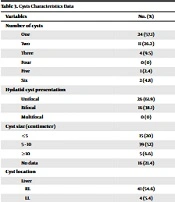
Cystic Hydatid Disease in Children in Gorgan, North of Iran from 2014 to 2021
Leila Barati,
Lobat Shahkar,
Amirmohammad Raeiji,
Gholamreza Veghari
Barati L, Shahkar L, Raeiji A, Veghari G. Cystic Hydatid Disease in Children in Gorgan, North of Iran from 2014 to 2021. Inn J Pediatr. 2023;33(5):e136687. doi: https://doi.org/10.5812/ijp-136687
31
Dec
2010
Evaluation of Clinical Findings and Treatment of Childhood Brucellosis in Zahedan
Gholamreza Soleimani
Soleimani G. Evaluation of Clinical Findings and Treatment of Childhood Brucellosis in Zahedan. J Compr Ped. 2010;2(2):. doi:
16
Apr
2016

Assessment of Cavitary Pulmonary Tuberculosis in Children
Ferial Lotfian,
Payam Mehrian
Lotfian F, Mehrian P. Assessment of Cavitary Pulmonary Tuberculosis in Children. Arch Pediatr Infect Dis. 2016;4(2):e35919. doi: https://doi.org/10.5812/pedinfect.35919
14
Dec
2022
Seroprevalence of Toxocariasis Among Hypereosinophilic Children: A Single Center Study, Tehran, Iran
Meysam Sharifdini,
Mehdi Zarean,
Mehrzad Sadredinamin,
Mitra Zare- Bavani,
Sarah Sharifi-yazdi,
Bahram Nikmanesh
Sharifdini M, Zarean M, Sadredinamin M, Zare- Bavani M, Sharifi-yazdi S, et al. Seroprevalence of Toxocariasis Among Hypereosinophilic Children: A Single Center Study, Tehran, Iran. Arch Pediatr Infect Dis. 2022;11(1):e123107. doi: https://doi.org/10.5812/pedinfect-123107
Cited by
- Scopus by DOI: 0
Last Update: 2 weeks ago
- Scopus by Title: 12
Last Update: 2 weeks ago
- Scopus by Title (Ref): 12
Last Update: 2 weeks ago
- CrossRef: 0
Last Update: 3 hours ago
- OpenAlex: 0
Last Update: 6 hours ago
- OpenCitations: 0
Last Update: 5 days ago
Comments
Number of Comments:0