Cover image of the article: Amniotic Deformity, Adhesions, Mutilations (ADAM) Complex: A Frightful Condition

Image Credit:Inn J Pediatr

Amniotic Deformity, Adhesions, Mutilations (ADAM) Complex: A Frightful Condition

Authors

Srinivas Murki1,*, Deepak Sharma1, Oleti Tejo Pratap1
1Department of Neonatology, Fernandez Hospital, Hyderabad, India
*Corresponding Author: Corresponding author: Srinivas Murki, Department of Neonatology, Fernandez Hospital, Hyderabad, India, E-mail: Email: srinivasmurki2001@gmail.com

Innovative Journal of Pediatrics:Vol. 25, issue 1
Published online:Feb 15, 2015
Article type:Letter
Received:Jun 08, 2014
Accepted:Oct 24, 2014
How to Cite:Murki S, Sharma D, Tejo Pratap O. Amniotic Deformity, Adhesions, Mutilations (ADAM) Complex: A Frightful Condition. Inn J Pediatr. 2015;25(1):-. doi: https://doi.org/10.5812/ijp.250

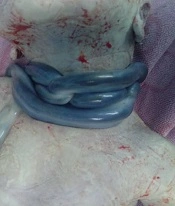
A term male infant with a birth weight of 2.5 kg was born to primigravida mother through normal vaginal delivery. Baby cried after birth with an Apgar score of 8/9/9 and did not require any resuscitation. Maternal history was not significant for any drug intake or medical illness. On physical examination baby was diagnosed to have smaller sized medial four toes of both lower limbs, constriction bands around the fingers, distal atrophy of fingers with absence of nails in all toes (Figures 1 and 2).
Little toe was larger in size than the other toes of lower limbs. Baby was evaluated for other malformations which showed normal echocardio-graphy, cranial ultrasound, and ultrasound of abdomen and renal region. Baby was discharged after plastic surgeon's opinion. The infant was in regular follow up for four months, after which parents gave the spot, hence was lost in follow up. In follow up no new malformations were observed.
Amniotic deformity, adhesions, mutilations (ADAM) complex is recognized by varying names which includes ABS, Amnion rupture sequence, Amniotic bands, Amniotic band sequence, Congenital constriction rings, Constriction band syndrome, Limb body wall complex, Streeter anomaly, Streeter bands, TEARS (The Early Amnion Rupture Spectrum), Streeter dysplasia or Pseudoainhum. The cause of ADAM syndrome is believed to be entrapment of the fetal parts like hands or feet in amniotic bands intrauterine which leads to fall in blood supply to affected organ leading to its malformation (1). In that respect is no definitive theory for the cause of ADAM syndrome, but amniotic band theory and vascular band theory are postulated for ADAM syndrome. On that point are no genetic associations (2, 3). The effect of band entrapment can be many, ranging from congenital lymphedema, amputation or constriction rings around the extremities. ADAM syndrome is linked with other malformations which includes club hands, clubfoot, cleft lip and palate (4, 5). Treatment calls for supportive care and plastic or reconstructive surgical procedure (6).
Learning Points/Take Home Message
  1. ADAM syndrome is induced by the amniotic bands and it contributes to a varied spectrum of deformities to the fetus from distal ring constrictions to complete limb amputations.
  2. Appropriate surgical intervention and regular follow up of these neonates can eliminate potential limb threatening constrictions and provide a respectable caliber of liveliness.
Associated malformations must be explored in these newborn infants and parents must be counseled regarding this problem.
showing small sized medial four toes of both lower limbs, constriction bands around the fingers, distal atrophy of fingers with absence of nails in all toes. Also note little toe is large in size than other toes of lower limbs.
Figure 1.
showing small sized medial four toes of both lower limbs, constriction bands around the fingers, distal atrophy of fingers with absence of nails in all toes. Also note little toe is large in size than other toes of lower limbs.
showing small sized medial four toes of both lower limbs, constriction bands around the fingers, distal atrophy of fingers with absence of nails in all toes. Also note little toe is large in size than other toes of lower limbs

Figure 2.
showing small sized medial four toes of both lower limbs, constriction bands around the fingers, distal atrophy of fingers with absence of nails in all toes. Also note little toe is large in size than other toes of lower limbs

References

  • 1.
    Streeter GL. Focal deficiencies in fetal tissues and their relation to intra-uterine amputation. Contrib Embryol Carnegie Inst. 1930;22:1-44.
  • 2.
    Higginbottom MC, Jones KL, Hall BD, Smith DW. The amniotic band disruption complex: timing of amniotic rupture and variable spectra of consequent defects. J Pediatr. 1979;95(4):544-9. [PubMed ID: 480028].
  • 3.
    Sentilhes L, Verspyck E, Patrier S. Marpeau flanges amniotic disease: pathogenesis, prenatal diagnosis and neonatal care. J Gynecol Obstet Biol Reprod. 2003;32(8 Pt 1):693-704.
  • 4.
    Jabor MA, Cronin ED. Bilateral cleft lip and palate and limb deformities: a presentation of amniotic band sequence? J Craniofac Surg. 2000;11(4):388-93. [PubMed ID: 11314389].
  • 5.
    Shetty P, Menezes LT, Tauro LF, Diddigi KA. Amniotic band syndrome. Indian J Surg. 2013;75(5):401-2. [PubMed ID: 24426485]. https://doi.org/10.1007/s12262-012-0468-x.
  • 6.
    Gabos PG. Modified technique for the surgical treatment of congenital constriction bands of the arms and legs of infants and children. Orthopedics. 2006;29(5):401-4. [PubMed ID: 16729738].

Copyright

Copyright © 2015, Growth & Development Research Center.This is an open-access article distributed under the terms of the Creative Commons Attribution-NonCommercial 4.0 International License (http://creativecommons.org/licenses/by-nc/4.0/) which permits copy and redistribute the material just in noncommercial usages, provided the original work is properly cited.

Similar Articles

23
Dec
2015
Amelia: A Case Report and Literature Review

Amelia: A Case Report and Literature Review

Fatemeh Eghbalian,
Amine Sharif,
Amir Reza Monsef

Eghbalian F, Sharif A, Monsef AR. Amelia: A Case Report and Literature Review. Inn J Pediatr. 2015;25(6):e4114. doi: https://doi.org/10.5812/ijp.4114

30
Dec
2004
Three Unique Cases of Uterine Anomaly: Atypical Müllerian Ducts Development

Three Unique Cases of Uterine Anomaly: Atypical Müllerian Ducts Development  

M. T. Meamarzadeh,
G. H. Shahrzad

Meamarzadeh MT, Shahrzad GH. Three Unique Cases of Uterine Anomaly: Atypical Müllerian Ducts Development  . I J Radiol. 2004;2(1&2):e79252. doi:

30
Aug
2007
Developmental Defects of Uterine Cavity: Presentation of Seven Patients

Developmental Defects of Uterine Cavity: Presentation of Seven Patients  

Gh. Shahrzad,
Ahmad Vosough

Shahrzad G, Vosough A. Developmental Defects of Uterine Cavity: Presentation of Seven Patients  . I J Radiol. 2007;4(3):e79125. doi:

19
Dec
2011

Urogenital and Other Associated Anomalies in Patients With Anorectal Malformations

Mohammad Sabzehei,
Hassan Bazmamoun,
Seyed Mousavi-Bahar

Sabzehei M, Bazmamoun H, Mousavi-Bahar S. Urogenital and Other Associated Anomalies in Patients With Anorectal Malformations. Nephro-Urol Mon. 2011;4(1):388-390. doi: https://doi.org/10.5812/kowsar.22517006.1678

26
Nov
2022
Could the Increase in Fetal Movement Be a Sign of the Imminent Fetal Demise? A Case Report

Could the Increase in Fetal Movement Be a Sign of the Imminent Fetal Demise? A Case Report

Sedigheh Hantoushzadeh,
Fatemeh Rashidi,
Golnar Hassanzadeh,
Zahra Khalaj Sereshki,
Nasim Eshraghi,
Marzieh Jamali
,et al.

Hantoushzadeh S, Rashidi F, Hassanzadeh G, Khalaj Sereshki Z, Eshraghi N, et al. Could the Increase in Fetal Movement Be a Sign of the Imminent Fetal Demise? A Case Report. Fertil Gynecol Androl. 2022;2(1):e132085. doi: https://doi.org/10.5812/fga-132085

More by these authors

Srinivas MurkiPubMedScholar
Deepak SharmaPubMedScholar
Oleti Tejo PratapPubMedScholar
Share
Cited by
Metrics